Showing posts with label inin games. Show all posts

Tuesday, May 26, 2026

R-Type Dimensions III (Multi) Review

All month long we've been looking back and celebrating Capcom's Blue Bomber with MEGA MAY. Let's interrupt this themed month for a little longer to look back at another classic franchise, albeit a shoot-em-up series: R-Type! This review of the recently released R-Type Dimensions III is based off the Nintendo Switch 2 version of the game, and here is the SPC verdict.

Lightning strikes thrice


The original R-Type III was a game that was quite frankly, super punishing in its difficulty, but offered rewards for the players who overcame its challenges and learned to persevere over the game. Now, over three decades since its original release, R-Type III is back with new bells, whistles, and improvements but also some unfortunate major downgrades as well with R-Type Dimensions III.

Let's start with a quick (and I do mean, quick) history lesson. R-Type III: The Third Lightning originally released in 1993 on the Super Nintendo being the first R-Type series installment to not release in arcades. It boasted Mode 7 effects such as the ability to grow and shrink its individual sprites to impressive effect, for one. Unlike past entries which were made by Irem, it was developed by Tamtex.

My "pew pews" with my lasers go "pow pow" on the targets they hit.

R-Type Dimensions III takes the original R-Type III: The Third Lightning game and applies myriad configurable options and amenities to it, such as the ability to customize the controls to your liking (for the most part), as well as freely switch between the original 2D visuals and the all-new 3D mode with a touch of a button. Both graphical modes allow the optional application of scanlines as well. 

Seamlessly (well, with a little slowdown here and there) switch between 2D and 3D graphical modes with a button press.

The visuals of 3D mode are really cool to look at. You have specific segments where the camera can move dynamically to tilt the perspective in an awesome way. Other than that, everything is impressively detailed, from the enemies, whether they be piloted crafts or organic alien nightmares, to the background and foreground geometry. The music has received polish too in 3D mode, offering real instruments as opposed to soundfonts, and it really brings new life to the original's already impeccable, impressive soundtrack.

Another added inclusion is that of a local two-player co-op mode. The original R-Type III had two players able to play, but upon one player's death, it simply switched to the progress of the other player's run. The time around, actual co-op is present, affording two players to pilot their respective ships on the same screen at once. This is a really nifty addition!

Overwhelming odds? Well, two can literally play this game!

Starting off a run in R-Type Dimensions III, you get a choice between three Forces. These bestow your ship with a miniature ship of sorts that grants unique abilities and weaponry. This additional arsenal of firepower can be independently deployed or attached to your ship, which brings some added strategy to the game--of what to pick up and where to place it. There are sections of stages more suitable for deploying while others are better for having your Force attached to your ship. Depending on your particular play style or how you want to initiate and take on a given run, the choice of your starting Force is important to factor in. Each selectable starting Force has its own advantages/disadvantages, pros/cons, benefits/weaknesses to the battles at hand, which is a cool, albeit expected touch.

The original R-Type III wasn't a game you just played through casually and expected to reach its end without any friction. No, this is "Friction: The Game" in top tier form. It's a game that demands your dedication to it, but one of the greatest rewards for an R-Type player is mastering a given stage--perhaps even going for that coveted no-death run.  

Deaths aren't optional for beginners, and heck, even advanced players used to the R-Type series. It's expected. It's mandatory. It's a constant influx of ship explosions, whether from stray bullets, to walls closing in and crushing your ship on the fly. Memorization is key, and even then, you have to properly execute what is expected of you to survive. This is indeed an incredibly challenging, difficult game.

The stages themselves are designed in a masochistic way that losing lots of lives is quite easy to do, unlike everything else in R-Type. Even from the first stage, you pilot your way through the starting openness of space with modest amounts of space debris flying at you, but soon find yourself entering a claustrophobic series of walls that close in, shift about, and even at one point spin while requiring you to move out of harm's way in the process. 

From open space shenanigans to inner alien action, R-Type Dimensions III takes you all over.

Fortunately, the added Infinite Mode alleviates some (but nowhere near all) of the aggravation. Instead of Classic Mode's limited assortment of lives and spawning you back at the last checkpoint, Infinite Mode--as true to its name--grants infinite lives and also respawns you directly back into the action from your current location. Sure, this also means that you can respawn immediately back into harm's way, losing yet another ship in the process, but it's a minor inconvenience for the power of unlimited lives.

That said, it would have been a nice touch to include some kind of rewind capability for at least Infinite Mode. As deaths result in your ship leveling down to its original under-powered, woefully weak state, it makes for an agonizing playthrough, especially when you're perishing every 5-10 seconds like this R-Type "pro" did (read: I absolutely, positively sucked at this game).  

As a shoot-em-up, R-Type Dimensions III is as nice as they get, at least control-wise. Threading the needle through enemy ships, bullets, and hazards feels pleasant and precise. You're not going to die because the controls weren't responsive, that much is for certain. 

Infinite Mode presents players with an unlimited amount of lives to spend.

However, and quite unfortunately, this remake presents new issues not found in the 1993 original rear their ugly head in. For one, hitboxes feel considerably "off" and inaccurate. This means that deaths happen a lot more than they otherwise would due to your hitbox being larger than it's specifically supposed to be. Shots that don't even graze my ship could end in an explosive result, for example, and frustratingly so.

Furthermore, many enemies don't properly register with a helpful visual clue you're hitting them, either with a flashing animation as bullets pelt them or anything else visually. Was I actually dealing damage to a baddie? It was difficult to tell, such as with the second stage's boss, and with a game that's already punishing in its level of challenge, these oversights and added aggravations do not make for a good impression--especially since they appeared to creep and leak over into the 2D portion of R-Type Dimensions III as well!

No doubt the original developers enjoyed Ridley Scott's Alien series.

It's hard to recommend playing R-Type Dimensions III over the original, especially if you're a purist or diehard fan of the 1993 SNES classic because of these oversights. They make the game much more challenging and pretty much to an oftentimes unfair degree. Those new to the series or game might not mind these issues as much, but the game will essentially curb stomp these players unbeknownst to its dastardly, dire difficulty. The added bells and whistles like switching between 2D and 3D mode, Infinite Mode, and the two-player co-op mode--to name a few--are great additions, but are they worth suffering through a flawed, botched R-Type III remake over the original? Unfortunately, the answer is an emphatic "no".

ININ Games has already put out a statement regarding these issues--in fact, said statement released a day after the game's launch. So, the grievances to the gameplay that players have will hopefully soon be patched, but the fact that this is how the game was launched to begin with doesn't instill much confidence. For the time being, it's best to wait out a patch/update to R-Type Dimensions III and just play the original R-Type III in the meantime. It's a much better experience, even without the aforementioned modern bells and whistles.

[SPC Says: C-] 

A Nintendo Switch 2 game code was provided by the publisher for the purpose of this review.

Thursday, August 29, 2024

Shadow of the Ninja: Reborn (Multi) Review

Shadow of the Ninja: Reborn officially released today on the Nintendo Switch, PlayStation 5, Steam, and the Xbox Series of consoles, the latter of which this review is based off of. Here is the SuperPhillip Central verdict.

Without a shadow of a doubt, you will get schooled.

The original Shadow of the Ninja is an NES cult classic, known for its compelling combination of awesome action platforming and punishing but fair difficulty. It's currently available as a game to play as one of Nintendo Switch Online's offerings, specifically in the NES catalog. Now, decades later, the title is remade and reborn, getting a new lease on life with added features, a new level, and lots of polish with Shadow of the Ninja: Reborn. Keeping that aforementioned combination of action platforming and punishing but fair (for the most part) difficulty, Reborn is hardly a game for the timid, and that isn't always the player's fault, either.

Being a relic of the NES era, there isn't a massively deep narrative or plot to Shadow of the Ninja's remade incarnation. What you get is two ninjas--Hayate and Kaede--who are on a mission to take down a dictator who leads a dystopian country. That's pretty much it plot-wise, but it serves a serviceable enough purpose to get to slaying enemies and evading death traps of all shapes and sizes in the six level campaign. 

Which ever ninja you choose to start out with is less of a choice of skill set--they both seem to play similarly for the most part (save for slightly different but discernible physics)--and more on aesthetics. Each start out with a ninja blade and a kusarigama--a spear that extends from a chain. The former is perfect for melee and honing in on close-by foes, while the latter is excellent for not only keeping space between enemies but also taking them out from afar before making a perilous jump, for example. The kusarigama can be fired in all compass directions when possible (i.e. there aren't walls or floors in the way), and both the blade and chain can be temporarily upgraded once for better utility. 

Ninja gear discovered in levels in all sorts of locations makes for the bow that wraps your ninja's offensive package together. These come in the form of myriad weapons, abilities, and health-bestowing items to utilize in a pinch. From traditional shuriken and kunai to less typical ninja fare like shotguns and miniguns, your ninja can acquire quite the arsenal--though only a handful of ninja gear can be equipped at once before they're tossed away upon collecting a new one.

The ninja gear that you keep in your possession by the end of a level is put into the shop for permanent access, where at the beginning of a given playthrough you use the money you've earned from slaying enemies to purchase an assortment of ninja gear to start your next playthrough. The highest amount of money you've earned is the benchmark for future playthroughs, so there's never any worry about messing yourself over with a low budget to buy gear on a playthrough.

The six levels themselves are sometimes overwhelming affairs. Practically every few steps in a level sees your ninja encountering some kind of enemy, trap, or pit to deal with. Yes, in these levels death is less of a possibility--it's more of a certainty. Fortunately, levels are also split up between multiple sub-areas, which serve as checkpoints. Now, that doesn't mean that these sub-areas aren't lengthy endeavors onto themselves, meaning that I never died deep into a sub-area and had to redo tons of progress. Oh, I definitely and frustratingly did. But at the very least there's the option to continue that is available after the somewhat patronizing and overlong "Game Over" screen plasters itself on your screen--a screen that I got a little TOO used to.

With six levels, Shadow of the Ninja: Reborn might not seem like a lengthy endeavor of a game. Truth be told, if you have the skills to rush through every level like a master ninja, then Reborn won't give you too much longevity. Fortunately, most of us aren't equipped with that advanced skill set. Instead, you'll find yourself replaying levels, making slow but steady progress, earning new ninja gear to assist you on future playthroughs, and finally, FINALLY, making enough headway to take down the final boss and successfully beating the game. 

There are two difficulty modes in Shadow of the Ninja: Reborn--normal and hard. The first is the base difficulty, suggested to beginners and standard players alike. The latter presents more enemies, advanced attack patterns for said enemies, and just a more arduous journey--which the base difficulty of normal is no cakewalk to begin with! Co-op play is also offered for two players locally, which serves as a nice way to lessen the difficulty burden, but unless you can find a co-op partner who can put up with the level of challenge on display, then you'll probably be going it alone.

That said, here comes the troublesome part of Shadow of the Ninja: Reborn--and it's a bit of a doozy: the controls. While hacking and slashing feel wonderful and are done well, it's other mechanics that don't hold up so well. This includes climbing, which makes it so simple tasks like clinging to pipes were efforts in frustration as my ninja would either climb to the other side of the pipe to take damage or drop out completely from the pipe, also taking damage from the fall into the abyss. Then, there's wall climbing, which is all too aggravating and requires double tapping the A button when on a wall to scale it. It's quite clunky and finnicky, offering nowhere near the precision and grace required for some of the later stages' platforming challenges.

Last but not least, the ninja gear you stumble upon that I touched on earlier is a bit cumbersome to switch between. Rather than being able to cycle through all your options with the unused rear triggers, instead you are forced to hold the ninja gear button and press left and right on the D-Pad to cycle through your options. It's rather challenging in the heat of battle to madly switch to the proper ninja gear you want. It made for situations where I'd die and get a game over, right before being able to select a healing ninja gear, for example. 

Shadow of the Ninja: Reborn looks divine with its upgraded visuals. The spritework is tremendous, offering immensely and painstakingly detailed characters, and the biggest charmer here is that of enemies, especially those large ones like the yellow robotic bully that loves to fire flames from its flamethrower. The backgrounds and environments are no slouch either--and that's an understatement. Everything oozes atmosphere and the aesthetics are stellar. The soundtrack has gotten a boost and improvement too, and the tunes feature the guidance of the original composer, Iku Mizutani, delivering a lovely 80s/90s hard rock sound to it.

Depending on your level of patience and perseverance, Shadow of the Ninja: Reborn may be a tough ask to consider playing. This is a massively difficult game, which sometimes isn't helped by the clunky climbing controls or the on-the-fly ninja gear switching. It's also a short game to experience all of the content available, but most players will not exactly be able to breeze through it to see it all in a fast fashion. If you're willing to put in the effort and contend with the level of challenge offered, Shadow of the Ninja: Reborn is a remarkable 2D action platformer that properly transitions the NES original to a new era.

[SPC Says: B-]

A copy of Shadow of the Ninja: Reborn was provided by the publisher for the purpose of this review.

Thursday, December 16, 2021

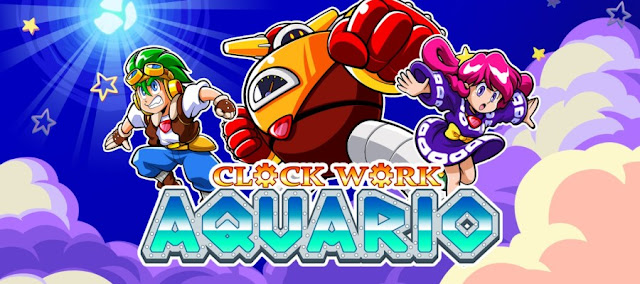
Clockwork Aquario (NSW, PS4) Review

Releasing in early December in parts outside of North America, and in North America proper this past Tuesday, Clockwork Aquario has an incredibly interesting story behind its release. What's better is that this long-lost game was well worth the 28-year wait! Read more with the SPC review.

Unlike clockwork, this game's arrival is hardly an everyday occurrence; it's a miracle.

Some things in this hobby and industry of ours never cease to amaze. 28 years ago, Westone--the developer behind the Wonder Boy series--was planning a release of a colorful, charming-looking title known as Clockwork Aquario. It was set to launch in arcades courtesy of the Sega System 18. However, the game was cancelled before it saw the light of day and the light of launch, for that matter. 

Now, 28 years later in one heck of a delightful and welcomed miracle, Clockwork Aquario has had its code cleaned up, its missing pieces put together, and its issues amended to see its momentous release on Nintendo Switch and PlayStation 4. The end result is nothing more than indeed a miracle, and it was a pleasure to play through this game, how ever short lived it was.

To start off, Clockwork Aquario was meant to gobble up quarters and tokens in arcades. The game uses a two-hit system, so it's rather challenging, as after your first hit, if you get hit again, you lose a life. This home console release sees multiple difficulties which determine how many continues you have to work with. Even the easiest difficulty means you can't just rush into enemies all willy-nilly, as you'll most likely burn through lives and continues rather quickly.

And I oop!

That said, Clockwork Aquario is hardly a lengthy affair. Its runtime is just around 20 minutes to complete a playthrough, and that's understandable given it was originally meant to be an arcade game. That said, what it lacks in length, the game makes for in longevity due to how joyously fun it is to replay. Those 20 minutes fly by when you're moving through its five levels and six bosses. 

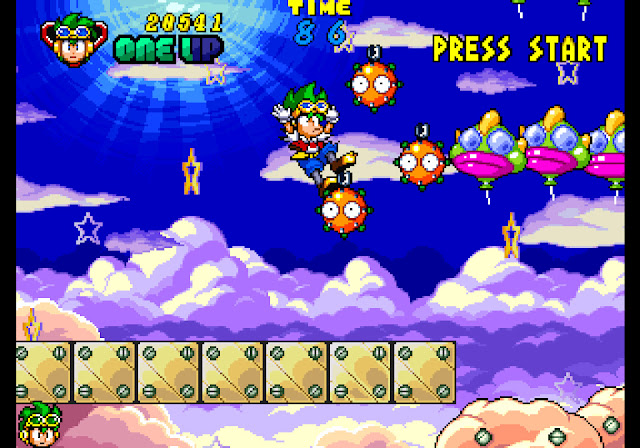
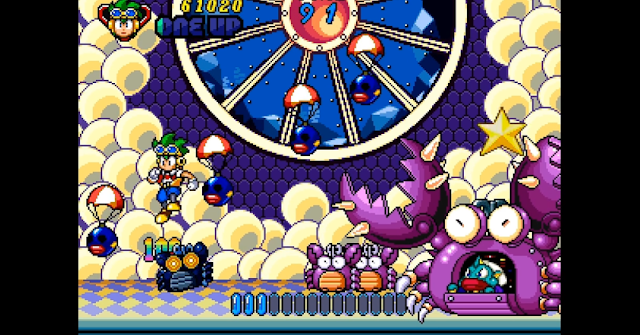
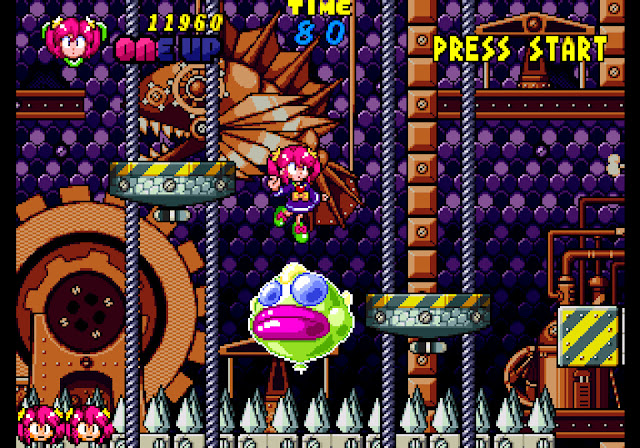
Clockwork Aquario plays like a precursor to the Klonoa series. You can punch, pick up, and throw enemies into one another and other objects to score points, as well as jump on baddies to eliminate them that way. As the length of the game would lead you to believe, stages in Clockwork Aquario aren't too long, and they never outwear their welcome. They feature one extended level of platforming and combat, usually ending with a mini-boss of some sort. Then, the second portion of the level changes scenes and pits you against the level's main boss, always the big bad of the game (a cute, but evil genius penguin) in a machine similar to Dr. Robotnik in the Sonic the Hedgehog games.

We got 'em right where we want, so it's time to turn this particular boss into crabmeat!

Co-op is possible as well in Clockwork Aquario, and this allows a duo of friends or family members to join together, bashing baddies, and even throwing each other around levels in a funny, frantic kind of way.

If there's one complaint to be found with regard to Clockwork Aquario other than some folks' possible distaste for the game's length, it's that so many of the modes are just variations of the same 20-minute or so adventure. You have different difficulties, which simply add or subtract the number of continues you have to work with, the Arcade Mode (which allows unlimited continues and ways to tinker with the game), and a mini-game only playable for two players locally. Other than that, there are filters to apply, remixed music to listen to, and a gallery that shows a series of art and photos from the game's development. The latter here is great for archival purposes and just a pleasure to look at.

Speaking of pleasures to look at, can we talk about the visuals of Clockwork Aquario? If you don't want to, feel free to skip this paragraph, but you'll be missing out. The colors of this game just POP much like the balloons that your three playable heroes can bash open. The awesome amount of detail in the sprites and environments is just jaw-dropping, and it makes this game deliver nirvana for the eyes. So, too, does the game do it for the ears, offering a bouncy and happy soundtrack full of bops and delightful melodies. 


Everything about Clockwork Aquario is a delight for the eyes and the ears.

Clockwork Aquario may not be a lengthy game, and it may just take the same 20-minute game and change something here and there to call it a new "mode", but it's one wonderful game. I find it almost insulting to have to give this great piece of gaming history a grade, as I feel it cheapens or somehow diminishes the impact of having this game come back after a nearly three-decade hiatus. Nevertheless, if you're digging a piece of gaming history that is most importantly an entertaining one, then look no further than Clockwork Aquario.

[SPC Says: B]

A code was provided by the publisher for the purpose of this review.

Wednesday, September 1, 2021

DariusBurst: Another Chronicle EX+ (NSW) Rapid Review

Let's not waste any time starting the rollout of reviews for this month. SuperPhillip Central dives right in with a review of DariusBurst: Another Chronicle EX+. It's a mouthful of a game name, for sure, but one seriously fun shoot-em-up. Here is the rapid review of the game.

Bursting from the seams with side-scrolling shooting action

Shoot-em-ups (or shmups, if you'd prefer) are no stranger to the Nintendo Switch. In fact, there have been plenty of popular genres from yesteryear that are receiving a second (or third) lease on life on the Switch. Taito's DariusBurst: Another Chronicle EX+ is another of these side-scrolling shooters, offering intense space combat, requiring deft dodging, precision-based movement, and apt shooting to survive waves upon waves of enemy forces.

DariusBurst's main campaign features a total of 24 stages (12 in the regular mode and 12 in the original mode) of side-scrolling shooting action for perspective pilots to encounter. However, only three of these are played in a given playthrough. You start out by choosing one of three stages, and after completion of that stage, you get to decide between a choice of two stages to play next. The stage selection is basically a branch where the lower you go on the tree of stages, the harder and more difficult the stage will be for your ship to endure. 

You get a selection of a multitude of ships to choose from as well in DariusBurst, each possessing their own primary and secondary weapons. Regardless of which vessel you pilot, you're in for a thumping good and wild space ride. The controls are solid, delivering pitch perfect movement, firing bullets and missiles with the B and Y buttons, firing your special attack from your companion ship with the L button, while the R button pivots your ship in the opposite direction for foes that try to take you on from behind. Meanwhile, ZL or ZR zooms the camera in and out to a close degree. Too close for that matter.

The latter isn't very helpful in most situations, as it often left me getting hit by stray bullets that I couldn't see coming at me. It was also worthless when encountering the game's many bosses, which despite their behemoth sizes meant that I couldn't get a glimpse of what I was firing at or alternatively what was firing at ME. The field of view is rather awkward, as it's authentic to the original arcade version to a fault, presenting a narrow horizontal view of the action with a ton of wasted negative space. This makes seeing things like bullets, particularly in undocked mode incredibly challenging to see for a game that already demands high, skillful play.

Fortunately, there is an unlimited lives mode available to you if you don't particularly care about setting high scores or worrying about getting to the top of the leaderboards. Other modes include an Event mode that presents a series of premade loadouts and challenges that you can complete to squeeze out plenty of extra playtime with the game. There are a plethora of missions to take on, though some of these aren't able to be completed without multiple players (some requiring up to four).

On the Nintendo Switch, DariusBurst runs ravishingly on the Switch. It's a great looking game, though I did encounter times where elements of what I perceived to be the background were actually enemies or hazards I could crash my ship into. I'm not proud to admit, but I did lose more ships than I would have liked that way. This is on top of the already mentioned limited screen space afforded by the game, which makes playing in handheld mode quite difficult in an already difficult game. Musically, I really enjoyed the themes, whether they were themes with soothing female vocals or more bombastic pieces, either with a symphonic sound or a rock angle to them.

DariusBurst: Another Chronicle EX+ is another shoot-em-up to add to the pile of stellar games within the genre on the Nintendo Switch. There is a ton of content to be found for those who enjoy partaking in the genre, and plenty of challenge to be discovered as well. The limited field of view and screen real estate utilized for the Switch version is a bummer, but ultimately, DariusBurst: Another Chronicle EX+'s mission to be an entertaining Switch home port of an older arcade game is a success.

[SPC Says: B-]

A code was received by SPC from the publisher for the purpose of writing this review.

Saturday, June 19, 2021

Wonder Boy: Asha in Monster World (NSW, PS4, PC) Review

With SuperPhillip Central's 1,000th review in the rearview mirror, let's look forward now to new heights and new goals! How about we aim for 2,000 reviews next? Too much? We'll see about that, but first, let's check out Wonder Boy: Asha in Monster World, a recently released remake of a 1994 Sega Genesis / Mega Drive game. Here is the SPC review!

Will wonders never cease?


The original Monster World IV released over 25 years ago. With Wonder Boy: Asha in Monster World, Inin Games has taken the foundation of Monster World IV, prettied it up with newfangled cel-shaded visuals, added an accessibility improvement here and there, and pretty much then called it a day. For a title originally released in the nineties, Wonder Boy: Asha in Monster World nowadays feels like a bit of relic of a bygone gaming era. For some, this will be to this remake's detriment. For others, this makes for an "if it isn't broke, don't fix it" mentality. Either way, Wonder Boy: Asha in Monster World serves as a fun-filled adventure with some caveats to be discovered in its tantalizing retro-themed package.

Our heroine Asha is a "cut" above the rest!
Wonder Boy: Asha in Monster World's heroine, Asha, doesn't have too much in her repertoire of moves. She has a simple sword slash, as well as the ability to bring out her shield to block enemy attacks. It isn't until she meets an adorable blue companion named Pepelogoo that her move set grows, though not that immensely. 

No need to fear with the trusty and adorable Pepelogoo at Asha's side!
Upon calling on Pepelogoo, Asha can carry her blue buddy around, and use him to double jump. This feat takes some getting used to--that is, hitting a button to summon Pepelogoo, waiting for Asha to grab hold of him, and then initiating said double jump. Pepelogoo can also be gently thrown to collect faraway items or even to hit buttons that Asha can't interact with. As Pepelogoo evolves and takes different forms throughout the duration of Asha's adventure, he gains further abilities, such as being able to save Asha from sinking under the water, discern the whereabouts of hidden doors, and even get frozen to serve as a stepping stool for Asha to reach higher places. 

Pepelogoo has all sorts of actions in him. One such feat is activating buttons.
Unlike other games in the Monster World series, Asha's adventure is not a Metroidvania game by design. Instead, after the starting village and climb up a tower, Asha arrives in Rapadagna, an Arabian-style city serving as the main hub of the game. It connects to various shops where Asha can purchase new sabers to up her attack power, bracelets to add to her collection of hearts, and shields to defend against all manners of elemental attacks. Rapadagna is also where the temple containing Wonder Boy's four main dungeons is located. Generally, pursuing various events and antics within Rapadagna unlock medallions that each opens a new level within the game. 

Compared to the original game, Wonder Boy: Asha in Monster World fully takes advantage of its 3D design. Of course, the characters, enemies, and such are beautifully cel-shaded in 3D, but much of the level design, too, takes advantage of 3D. Many places, most notably Rapadagna itself, features intersections where Asha can move on the Z-axis, walking towards and away from the camera, in order to reach new areas. Entering doorways in the dungeon-like levels reveals entertaining transitions in how Asha moves between rooms. 

The four levels--these serve as the places where Asha does battle against the game's evil magicians in order to rescue the various captured sages--are quite large and expansive areas. Some seem to go on for ages, but they're mostly enjoyable to explore. I say "mostly enjoyable to explore" because the third is a pretty obnoxious ice labyrinth that's easy to get lost in. Regardless, exploration awards items like elixirs to heal Asha mid-battle or when her hearts run out (this only works if Pepelogoo is alongside her), as well as money to purchase equipment, and Life Drops that are sprinkled and scattered throughout levels and in Rapadagna itself. For every ten of the latter collected, a new heart gets added to Asha's health, making her heartier and able to endure even the most frantic of battles. 

It's a hot time in the ol' volcano tonight with this particular boss!
I mentioned accessibility improvements early in my review, and Wonder Boy: Asha in Monster World does deliver on these--for the most part. Life Drops were previously unattainable if you missed them in a level, but now you can return to the majority of levels to collect any you've missed. There's even a helpful tally that says how many you've collected and how many there are total. Unfortunately, even though you can return to some levels, not all of them are available. For instance, the areas Asha visits prior to arriving in Rapadagna are a one-way ticket. Once you've beaten them, you can't return to them. There are also several side quests and events that reward Life Drops that only happen at specific points in the game, and once the windows of opportunity to get them are closed, they're closed forever unless you load from a prior save. 

I "saw" what you did there! You were cutting it quite close there, weren't you, Asha?
Saving is no longer relegated to a Sage NPC. Instead, you can save pretty much anywhere and everywhere. The only issue here is that there is no auto-save feature available, so remembering to save is paramount unless you wish to redo sections of the game because you forgot. Fortunately, this did not happen to me, but I would imagine it would be a massive demotivator if it had occurred. Still, being able to miss Life Drops and by extension miss the opportunity to get the best ending really stinks. It's a part of the game's design I wish hadn't been brought back from 1994's Genesis/Mega Drive original. Even though Wonder Boy: Asha in Monster World isn't exactly the longest game out there--it took me about five hours to beat--having to redo the game because I missed some Life Drops (and because I am a completionist) wasn't the best feeling in the world.

No matter how big and mean the enemy may look, they all do the same amount of damage to Asha!
Finally, accessibility-wise, there is an easy mode, which I happily partook in, offering more health replenishment as well as coins dropped by enemies automatically getting siphoned towards Asha. That's pretty much the only difference here, as playing normal mode was just as enjoyable for me after my easy mode run was completed. 

(Piggybacking off the last caption) Unlike Asha, who depending on the sword equipped, deals variable amounts of damage!
Compared to previous remakes of Wonder Boy/Monster World series games, Wonder Boy: Asha in Monster World feels a bit too simplistic for its $40 price tag. Yes, the visual style is lovely to look at, and the increased personality in Asha's animations--whether she's sliding like a figure skater on ice, or shaking her can as she prepares to open a treasure chest--is also pleasant to see. However, by a gameplay and game length standpoint, Asha in Monster World isn't the strongest experience. Again, the gameplay is rather simple, and the length is quite short. These aspects notwithstanding, there is a lot to like about this remake of Monster World IV (especially if you get the physical version as--at least the Switch port received the original game on the cartridge), and now a new generation of players can join Asha on her fun-filled adventure.

[SPC Says: B-]