Showing posts with label marvel. Show all posts

Friday, July 26, 2019

Marvel Ultimate Alliance 3: The Black Order (NSW) Review

Last Friday, Marvel Ultimate Alliance 3: The Black Order launched on the Nintendo Switch, so if you've been feeling some withdrawal after Endgame, then why not check it out? But first, before you do so, see if it's actually worthwhile with the SuperPhillip Central review.

Alliance... Assemble!


It's an interesting collaboration, to say the least: Marvel, Nintendo and Team Ninja working together to create a new entry in the Marvel Ultimate Alliance series. Stranger things have happened, of course, but I'm still reeling from this combination. Thankfully, the actual final product with Marvel Ultimate Alliance 3: The Black Order ends up being a winner, though not without some truly troublesome issues--and I'm not talking about the "Spider-Man: One More Day" type of issues. Though, that was a troublesome enough series of issues. No, I mean actual gameplay issues.

The campaign of Marvel Ultimate Alliance 3 tells its tale of the heroes of the Marvel universe trotting through the galaxy to collect the Infinity Stones before Thanos's servants known as the Black Order nabs them first. It's told through its ten chapters, each taking place at a familiar Marvel multiverse location. Levels are mostly running through corridors with very little in the way of exploration. Yes, there are some hidden treasures to be found and pillaged, but these are usually in easy to find locations that aren't really off the beaten path. However, for a game that's meant to be action-heavy, the levels are built more for those moment to moment bits of action, where you move from room to room and clear out foes. Throw in a copious amount of engaging boss battles, and you pretty much have a taste of what each of the ten chapters offers players.

The gang's (almost) all here, bub.
During these ten chapters, you amass a collection of superheroes who join your cause, usually willingly so, and eventually you'll have a cast of over 30 characters to choose from. Each character--whether popular like Captain America, Spider-Man or Iron Man, or deeper cuts like Ms. Marvel or Iron Fist--plays differently from one another, so while it's fun to do so, it can be overwhelming as well to build the team that you're most comfortable with. This is all the while worrying about having your characters at a proper level for story mode battles, as characters not in your active party do not gain experience. Fortunately, you can boost their levels through earned experience cubes dropped by enemies and found in treasure chests.

Captain America and Spider-Man give a helping hand in taking out these ninjas.
Marvel Ultimate Alliance 3 makes it a blast to use the various characters as well. They have varying ways of attacking, moving about levels, offensive and defensive abilities (these are mapped to the face buttons in conjunction with the R button), and different pairings and groupings of heroes offer different results. For instance, teaming up fellow Avengers together will give a stat bonus, while partnering wisecracking characters like Spider-Man and Hawkeye will provide a bonus as well. There is a great supply of varying team bonuses that enhance characters currently in your active group.

The alliance is ready to rock these monsters.
When it comes to gameplay, there's some Koei Tecmo influence in the combat of the game with lots of mashing X and Y to perform combos and to clear rooms of enemies, similar to the Dynasty Warriors style of games. Of course, simply mashing buttons without properly dodging or guarding with the L button is a recipe for disaster. There is also the option to use the aforementioned abilities of your characters, and these are terrific for crowd control and dishing out damage to larger foes--though, they do require energy, which replenishes by hitting enemies with normal attacks.

Abilities like this one demonstrated by Iron Man can be leveled up with Ability Points up to four times.
When you have enough energy and you are in close proximity to an eligible hero, you can unleash two abilities together, one from your currently controlled hero and one from the nearby hero, to let loose a combined Synergy attack that is fantastic for clearing rooms as well as lowering the stun gauge of foes.

Bosses and stronger enemies all have a purple stun gauge in addition to their health bar. When the purple gauge is fully depleted, the enemy becomes temporarily dazed, leaving them open to more damage than usual. Using abilities on dazed foes allows even more damage to be dealt to a baddie's health bar. The actual boss battles are plentiful and mostly enjoyable. Few battles truly stand out from one another, as they're basic arena battles with multiple phases, multiple attacks to avoid, and strategies to consider, but they're excellent excuses to throw in even more Marvel universe characters for fans to enjoy.

While many bosses are straight up showdowns, some employ unique
mechanics to them, such as this early battle with Spider-Man villain Sandman.
However, the most impressive and devastating of the means and methods to take out enemies both henchmen and bosses alike is the Extreme attack. As you take damage and as you dish out damage, a yellow circular gauge slowly fills. When it's full, you can press the L and R shoulder buttons together to bring about a powerful attack. When a full team has their Extreme gauges full, whoo-doggy, is there enough power from your force's shower of attacks to bring down the proverbial house... or at least bring a foe's health bar down a considerable enough amount.

I was able to play through Marvel Ultimate Alliance 3 by my lonesome and had a great time. The AI is capable for the most part, but other times like during boss battles, they can be rather sloppy. Of course, the main draw to a game like this is the co-operative play, which MAU3 offers in both local and online forms. Both work well and local co-op features drop-in and drop-out play while online features the ability to create or join a group. The latter can suffer from lag and some spotty connection issues, but overall it is a blast.

If you didn't like your traditional prison cell, how about a webbed prison for you instead?
That said, let's talk about the elephant in the room, and boy, can it be a messy one. It's Marvel Ultimate Alliance 3's camera. In solo play, you have control of the camera, guiding it with the right stick, and can even select from one of two camera types: Classic and Heroic. The latter is more zoomed in to your currently selected hero, and it was my preferred way to play to see the action as best I could. That said, there are sections of the game where you completely lose control of the camera, and it shifts to a specific perspective. These were less than pleasant moments, and were decidedly the first signs of the wonky camerawork that Marvel Ultimate Alliance 3 possesses.

When played solo or online, the camera is... serviceable. Local co-op, however? Not so much.
In local co-op, the camera issues are exacerbated severely, and the more players who have, the worse the experience gets. You have zero control of the camera whatsoever, so you're under its complete whims and fancies. Plenty of times it'll face the wrong direction, it'll get caught behind scenery, it'll be so zoomed out you can hardly see what's going on, or it can cast invisible boundaries on players, making it so players can't get too far away from one another. That sounds fine in theory, but in practice, it is incredibly limiting. Many times while playing, my friend and I would be attacking foes on opposite sides of the screen and they'd be just out of reach so we would be whiffing our attacks while the enemies would be quickly depleting our health bars. The camera in local co-op is simply put, one of the worst I've seen in a modern console game. It's frustrating, it's awful, and it's basically broken.

It says something, however, about Marvel Ultimate Alliance 3 that even with the embarrassingly bad camera that my friend and I were able to sincerely enjoy our co-op playthrough of the game. Moreover, I found myself continually engaged with MUA3, wanting to level up my characters and outfit them with the best ISO-8 stat-enhancing crystals I could find, aim to complete the immense skill tree, and unlock as many alternate costumes for my characters as I could. Marvel Ultimate Alliance 3 is a content-rich game with plenty to do long after the credits roll. There are multiple difficulties that unlock, as well as the over 100 Infinity Trials to take on. These put your team of heroes in familiar surroundings under different scenarios. Three-starring each and every Infinity Trial will take a great deal of time and effort for those that wish to accomplish such a task.

Meanwhile, presentation-wise, Marvel Ultimate Alliance 3 finds itself as the best looking game in the series from a style point of view. The dark and dreary appearance from past Marvel Ultimate Alliance games has been traded in for a brighter, more colorful, more comic book-like design. The music is fittingly bombastic, and the voicework features a robust roster of fantastic performances. Though on a less positive note, the actual performance of the game leaves plenty to be desired with periodic bouts of slowdown as well as resolution bothers, specifically when playing in handheld mode. This makes it where it can be a challenge to distinguish characters among the action.

Cutscenes dazzle, but the performance issues MUA3 suffers with do not.
It's neither the deepest game nor the most polished, but Marvel Ultimate Alliance 3: The Black Order delivers an exciting and engaging amount of beat-em-up action to thrill both Marvel fans and lovers of the genre in general. It's a comfort food--no, better yet, popcorn gaming is more fitting of a culinary analogy. With the planned DLC featuring new characters and new story chapters, the adventure continues for the trifecta of Marvel, Nintendo, and Team Ninja's joint effort. Marvel Ultimate Alliance is back, and in many regards, the series is better than ever.

[SPC Says: B-]

Sunday, September 30, 2018

Marvel's Spider-Man (PS4) Review

Here's one final review to round out the month of September, and it's a bit of a doozy. Marvel's Spider-Man is a PlayStation 4 exclusive that absolutely dominated the conversation in the gaming world in both acclaim and sales when it released earlier this month. Now, that the smoke has cleared and the dust has settled, how does Insomniac Games' take on Spider-Man fare? The [albeit non-definitive] answer awaits in my review.

The Amazing or the Spectacular Spider-Man? Why not both?


To say there hasn't been a really good Spider-Man game yet would be a bit of a falsehood. For their time, games like Neversoft's PS1 Spider-Man, Spider-Man 2, and also my personal favorite, Ultimate Spider-Man, were good games that were well regarded. Heck, many Spider-Man games remain well regarded. That notwithstanding, to say there hasn't been a really good Spider-Man game in a while would have some truth to it. This is where Ratchet & Clank, Resistance, and Sunset Overdrive developer Insomniac steps in with the full backing of Sony. The end result is a masterpiece of a superhero game, though flawed in several ways, that is more than worthy of the Spider-Man name.

Insomniac has done an astonishing job at creating its own Spider-Man universe with Marvel's Spider-Man. The story is paced rather well, and it delivers one of the finest interpretations of Peter Parker and Spider-Man I've seen. The story beats kept me interested and engaged, and the story in general managed to pull me in and made me care about all of the characters involved. I pumped my fists in the air when I overcame a challenge as Spider-Man or Peter Parker, I gasped when one of the many twists of the story took place, and I even got a little emotional with the ending.

The voice acting is superb, and Yuri Lowenthal nailed his dual role of Spider-Man and alter ego Peter Parker. The raw emotion that comes from his voice in certain scenes in the game--heck, now just him, but the entire cast--is just truly mesmerizing. It all lends well to Insomniac's created universe, as does the humorous quips by Spider-Man and character interactions that I couldn't help but smile and sometimes even laugh out loud at. I'm particularly thinking of the right-wing Alex Jones-like J. Jonah Jameson personality who still has an ax to grind against Spider-Man, but it results in some excerpts from his radio show that are some of the funniest bits of dialog within the game.

Manhattan is your virtual playground, so play and swing away!
Insomniac's universe in Marvel's Spider-Man, too, shines brightly due to another character within the game. I'm not talking about a someone, but instead a something. I'm talking about the open world setting of Manhattan, and it's Spider-Man's and your playground to explore, and it's absolutely a blast to do so with all of our friendly neighborhood superhero's moves and abilities. From traditional web-slinging (well, as traditional as something called "web-slinging" can be) and running up the sides of buildings, to zipping across rooftops and above city streets with webs, Spider-Man knows how to get around the hustling and bustling island of Manhattan.

Spider-Man, Spider-Man, runs on whatever a spider can.
You will, also, as the controls are quite intuitive and easy to learn. To web-swing, it's as simple as holding down the R2 button as you move by a building or other object that a web can attach to (and can support the webhead's weight). When Spidey's swing is at its maximum height, you can jump to reach higher places, whereas if you jump while mid-swing, you'll gain a lot of distance and speed at the same time. A combination of both can have you jetting around Manhattan in no time.

Nevertheless, you will want to stop and smell the roses occasionally. I don't mean literally smelling roses here, but instead, taking part in all of the activities and side missions that slowly open up as you make progress in the game. Though, it is true that many of these seem a bit too rote and stuck in the past when it concerns open world games--such as turning on police surveillance towers as a means to reveal all of the side stuff you can do in a given Manhattan district. Others come across as busywork, like stopping crimes within town, which boils down to beating the snot out of a gang up to no good.

While all of the side activities aren't that riveting, some do shine. While it's nothing we haven't seen a hundred times in past open world games, there are collectibles sprinkled around the city. These reveal their locations to the player from the aforementioned surveillance towers so they aren't maddening to find. What makes them so special is that they delve into Spider-Man and Peter Parker's backstory, as they're items that Spidey discovers in the many backpacks placed around town. There are also landmarks throughout Manhattan that you can take pictures of as well. These backpacks and landmarks do a terrific job of further expanding upon and building the world within the game.

However, my favorite side activities would have to be the research stations left behind by Harry Osborn. These are interesting because they're the most varied. With taking out enemy bases and completing challenges from a certain villain in the game, you pretty much know what to expect gameplay-wise. With the research stations you're doing a variety of tasks, and no two are ever the same. These are Marvel's Spider-Man's side activities at their most intriguing. One has you swinging through smog clouds to collect data samples while another has you following a pipe to discover the source of a leak. They also expand upon the world and are more than the same old, same old that makes up most of Spider-Man's optional activities.
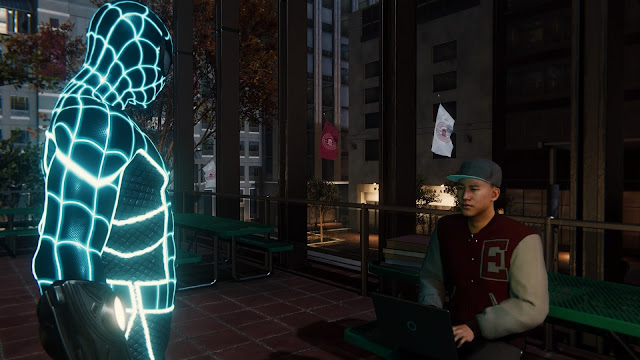
NPCs hand out side missions like candy, but these aren't as sweet of experiences as they could be.
Well, I say "optional", but by completing crimes, research stations, taking out enemy bases, collecting backpacks, and so on, you earn tokens that are required to spend on new gadgets, upgrades for said gadgets, and new Spider suits. It's really to your benefit to try to collect as many tokens as possible by doing as much side content as possible. After all, most tokens types are only available in specific varieties of side missions, and outfitting Spidey with one of over 30 different Spider suits, each with their own special ability, is too cool and enticing of a deal to pass on.

That's all just one piece of Marvel's Spider-Man. There's a whole other piece to it, and that comes in the form of combat. Combat in Spider-Man is most similar to Rocksteady's Batman: Arkham line of games. It's combo-based, but Spidey has many more options available to him due to his mobility, agility, and webbing prowess. You can start beating down a group of goons, traveling between each enemy by web, and effortlessly dispatch a group of foes quickly. Of course, like games are wont to do, the challenge ramps up when different enemy types are introduced. Some hold shields that you must punch and then slide between the carrier's legs to perform an attack to their exposed back. Others don't have much pugilistic pride, opting to use firearms of the pistol, machine gun, and rocket launcher variety. It becomes a bit of a juggling act, but thankfully, the webhead has his good ol' Spider Sense that emits white lines around his head as an indicator that it's time for the player to dodge an attack.

"I'd tell your boss The Kingpin that no amount of money is worth getting your butt kicked by Spider-Man."
The amount of possibilities in combat is really amazing, and this is helped in part due to new gadget unlocks that open up as the game progresses. There's the standard web shooter that needs to be shot multiple times to ensnare an enemy, but at the same time, its supply regenerates rather quickly. Then, there's the trip wire webbing that when an enemy crosses its path, the wire grabs onto them and webs them up against whatever the wire was attached to. Spidey is indeed one crafty inventor, having everything else from drones to electrical webbing that can turn on power in dark areas as well as shock enemies temporarily. Using a mix of Spider-Man's pure physicality, webbing, and gadgets makes for some truly emergent gameplay. 

Here's webbing in your eye!
Spider-Man himself gains focus energy as he successfully attacks enemies and builds up a combo. The higher of a combo he gains, the faster his focus gauge increases. When it fills, Spider-Man can perform a devastating finisher that immediately takes out any enemy it connects with. Tougher enemies than your standard foes, such as brutes, require two filled gauges to use a finisher on. Apart from using focus energy to unleash creative and visually fascinating finishers on foes, you can also use focus energy to recover Spidey's health mid-battle. This can be a literal lifesaver in particularly challenging encounters where Spider-Man's fighting off ten or more enemies at once who all want to get his number. ...And I don't mean to take him out on a date--merely because they want to take him OUT.

Unlike this baddie on the right, most enemies won't just stand there while you beat up on their buddies.
That notwithstanding, brawn and brute force won't always be what the situation calls for. Sometimes Spider-Man will have to use some stealth to take out an area or roomful of enemies without being detected. Thankfully, Spidey is perfectly suited for such scenarios. When playing as Spidey, you can take out foes silently through a multitude of means, such as take-downs from the air or from the ground. Of course, you don't want to let yourself get spotted by a foe whose pal you just wrapped up in webbing and is now hanging upside down from a ledge.

Spider-Man--in one of many of the available, special unlockable
suits--surveys the area before picking off each foe one by one.
Clicking in the right stick brings up another Batman: Arkham series-inspired game mechanic, Detective Mode. Here, you can see through Spidey's eyes and determine if taking out a foe is either safe or dangerous. If it's the latter, you're going to get caught if you try taking the foe in question out. This Detective-style mode also has many uses outside of stealth sections, offering views on points of interest and enemy weaknesses.

Didn't see that one coming, did you? That said, Spidey definitely saw you going.
Marvel's Spider-Man is a gorgeous game in all aspects. The way the windows of buildings shimmer when the sun shines directly on them, the way tree branches sway to and fro in the wind, and the immense draw distance available to players, particularly while Spider-Man is perched on the highest building in Manhattan are all spectacular sights. The amazing detail each character possesses is also something I can't help but gush about. Sure, some faces approach "uncanny valley" levels, but overall they look expressive, animate well, and are just impressive beyond words... save for the ones I just wrote.

Despite some side missions and optional activities being less than inspired, as well as stealth sections that mess with the pacing of the game a little bit, Marvel's Spider-Man is without question the best Spider-Man game I've had the pleasure and joy to play. Without delving too much into exaggeration, it might also be the best superhero game I've ever encountered. Never before have I felt more enamored with a superhero video game and felt more like Spider-Man thanks to his myriad tools, abilities, and ways to interact with the world--no matter if I was dispatching a gang of the Kingpin's men or just web-swinging through Times Square. Insomniac's vision of the Spider-Man as a series, the world, characters, and mythos shines brightly and is a testament to the original thought that the property was in good hands when it was given to the developer to create a Spider-Man game. It's a game that both casual and veteran fans will enjoy--as well as anyone else who just loves an amazing and spectacular video game.

[SPC Says: A-]

Tuesday, October 31, 2017

Marvel vs. Capcom: Infinite (PS4, XB1, PC) Review

Our final fighting game of Halloween is Marvel vs. Capcom: Infinite, which also just so happens to be the final review of October for SuperPhillip Central. Stay tuned for the October 2017 Review Round-Up tomorrow, by the way! Here are my thoughts on the latest Marvel and Capcom fighting game crossover.

The fate of two worlds depends on you.


Of all of the fighting games that come out from Capcom, my favorite has to be the crossover ones between Capcom and other companies. I have a fondness for Tatsunoko vs. Capcom on the Wii, particularly. Now, a returning crossover sees a new game in its historic fighting game series, Marvel vs. Capcom: Infinite. From lackluster demos to bad impressions from the media, is there any chance for Infinite to actually be good?

Compared to past Marvel vs. Capcom games, Infinite has a much slower pace to its fighting. This presents a more strategic flow to battle rather than the super fast and fluid fighting of the previous entries in the Marvel vs. Capcom series. However, a new system has been added to complement the slower style of combat in the form of the Infinity Stones, not-so-coincidentally a big part of the narrative in the most recent Marvel blockbuster films.

Infinite moves from a 3 on 3 battle system to a 2 on 2 system. While the lack of an extra character to choose from for your team is a disappointing one, what it overall amounts to is giving you an added amount of strategy in choosing an Infinity Stone to equip to your team that will play well with their combat styles. These Infinity Stones augment abilities, restore health to characters, and more. Choosing which one to use for the given battle can be a stark difference between victory and defeat, especially if you're playing against a skilled opponent.

After many cries and urges for his inclusion, Mega Man X is finally on a Marvel vs. Capcom roster.
The controls of Infinite are relatively beginner-friendly, as each face button is assigned to a weak and strong attack, either a punch or a kick depending on the particular button pressed. All fighters have the same button combinations for attacks, which is also something nice and accessible for newbies. After all, Marvel vs. Capcom hasn't really been a friendly game for beginners compared to other fighting game franchises on the market. However, with all moves using simple button combos that are similar across all fighters, there's less necessity to remember different button configurations and more emphasis put on concocting killer combos. Setting up your opponent for a multiple hit combo is simple enough in easier difficulties, but as the challenge ramps up, you really need to learn how opponents will be impacted from your attacks so you can continue your combo in the right direction. Otherwise, you'll open yourself up to be attacked yourself.

A great thing about Infinite is that while it's accessible to new players, there is a markedly deep game here for series veterans and those wanting more advanced tactics. The more involved combat tactics allow you to really get inside your mains and preferred fighters, coming up with pro-level strategies that a beginner could only dream of plotting out and performing.

Thankfully, if you're not a seasoned vet, Marvel vs. Capcom: Infinite comes supplied with multiple modes to get into the fighting system before engaging in battles online, where no doubt most players' energy and time will be put in to. The most helpful of these modes is Training, where you learn the basics of battle and start out with simple button combos to use against an AI opponent. Each combo completed is a mission finished. You can learn the ins and outs of Infinite with some overview tutorials or do character-specific tutorials, teaching you the most pronounced and effective combos for that particular combatant. This is terrific for some deeper learning of and training with a fighter you might want to main. If you're a more casual player like myself, you might just want to check out the introductory set of tutorial missions for each character to get a taste of what's available, as these combos can get very complex with both the button combinations and specific timing windows required for them.

Our two combatants zero in on one another for what is sure to be one exciting fight.
What Street Fighter V lacked when it originally released was a Story Mode, and Capcom seemed to have learned a lesson on this itself by including a mode within Marvel vs. Capcom: Infinite. Not much background is involved with the story to help players understand why folks in both Marvel and Capcom universes are together, but the story involves heroic forces made up of characters like Captain America, Iron Man, Thor, Mega Man X, Chris Redfield, and more taking on a new villain, a merge of Marvel's Ultron and Mega Man X's Sigma with the super powerful Ultron Sigma. After suffering a defeat by Ultron Sigma's hands, the resistance regroups and comes up with a plan to acquire the Infinity Stones, the only means to overcome their joint foe.

The story itself isn't too engaging plot-wise, but what really saves it for me is all of the clever interactions and banter between both Marvel's heroes and Capcom's. Though the latter understandably doesn't have as much importance due to Marvel being a household name and Capcom... well, being Capcom. Still, when you get scenes involving Spider-Man, Resident Evil's Chris Redfield, Dead Rising's Frank West, and Final Fight's Mike Haggar exploring a subterranean area owned by the Umbrella Corporation, it's pretty cool to see. While the story won't last you long, maybe 3-4 hours for most players, it is worthwhile to play through once, but maybe not again.

One of the biggest qualms many longtime fans of the Marvel vs. Capcom series have with Infinite is its roster selection, and I'm of the opinion that the complete roster has both pros and cons. To get the negatives out of the way, there are few completely new additions to the roster, as most are simply brought back from the previous game. Furthermore, a completely notable absence is that of the X-Men due to Marvel and Fox battling out rights for the characters, hence their exclusion in Infinite. It's still pretty lame to have a Marvel fighter without the likes of Wolverine, Magneto, and more included even if the legal situation is present.

Thor's mighty hammer vs. the Hulk's powerful fist: Which will come out the victor?
However, on the positive side, past Marvel vs. Capcom games had a lot of fighters that played similarly to one another. With Infinite, this issue is no longer pronounced at all. Each fighter presents their own combat style and combo potential without feeling samey compared to other additions on the roster. While the limitations on the Marvel side are disappointing, Capcom added enough of their own characters to make up for it decently enough. Of course, I expect more people would rather have the likes of Deadpool and Storm rather than the likes of Mega Man X and Darkstalkers' Jedah. Still, DLC is coming for those who want it, but the sickening part of that is that the characters of this first season were ready before Infinite even came to market, so your mileage may vary on if you feel it's worth supporting such a business practice.

Moving on from roster-related disappointment to the disappointment seen in the visuals, Marvel vs. Capcom: Infinite does not continue the series' trend of impressive graphics. The backgrounds, though highly detailed, don't offer much visual engagement to the player, and especially the character models are a severe dislike to me, particularly the faces. Capcom already received a lot of flak for their interpretation of Street Fighter's Chun-Li, which was later remedied, but at the same time, the other characters' faces and expressions are a bit jarring at best. These type of faces make you wonder what is exactly off with them, which isn't a judgment I expected to ever say coming off brilliant looking entries like Marvel vs. Capcom 2 and then later on 3 and its Ultimate version. Even the music is less than stellar, offering ruined electronic versions of classic character theme songs. Overall, one can surmise that the budget for Infinite was unfortunately mightily toned down for this sequel.

Dante and Rocket Raccoon go out guns blazing. Could it have ended any other way between these two?
Marvel vs. Capcom: Infinite gets the most important piece of a fighting game right, the actual fighting. It's everything else that seems a bit sub-par. Sure, the Story Mode is fun to play through once merely for the interactions between Marvel and Capcom all-stars, but the budget put into that mode could have gone to make the whole of Infinite better, such as creating a more interesting roster. Still, the content is there for those who want it and online play runs as expected for those who will desire to be the very best, or just rage quit a lot. Whichever, right?

[SPC Says: B-]