Monday, December 21, 2015

FAST Racing Neo (Wii U eShop) Review

Christmas is this Friday, and if you're looking for a gift for yourself (and you own a Wii U), why not treat yourself to the gift of gaming? In particular, how about a blazing fast racer with plenty of challenge to it? Then, you'll want to look into FAST Racing Neo for the Wii U eShop. Here's my review.

If speed is your thing, then go FAST.


If you're going to release a futuristic racer on a Nintendo system, then you probably already know that you're going to be compared to Nintendo's own F-Zero franchise. There is just no getting around that. While Shin'en Multimedia's FAST Racing Neo does have similarities to Nintendo's fantastic futuristic racing franchise, it does enough to distinguish itself from the competition, letting itself be favorably compared to F-Zero in the process.

FAST Racing Neo has multiple modes to keep players racing for a long time, far more than you'd expect for the $15 price tag. The main mode, Championship, pits players in four different cups consisting of four different circuits. When one cup has been completed, the next one unlocks. When all four cups are finished off, the next difficulty opens up, giving a major increase of speed in comparison. Completing cups not only unlocks new races, but it also unlocks one of ten vehicles with its own set of stats in acceleration and top speed, as well as weight type.

Papa's got a brand-new bag with this new, unlocked vehicle.
Alongside Championship Mode are time trials to beat the developer's times on all sixteen circuits in all three speed classes, as well as a Hero Mode that is more akin to F-Zero, where you have a set amount of health and crashing means failure. Local multiplayer for up to four players is available, as is online play for up to eight players, allowing friends to join one another's games or just play against randoms.

Outrace your friends and family members locally,
or hop online and race against the world.
If you're looking for a difficult game, you'll find one with FAST Racing Neo. Making a mistake while racing usually has you ending up crashing. However, unlike an F-Zero game, you don't lose a life. Instead, you're put back on the track with precious seconds lost. This is both a blessing and a curse. It's a blessing because there are plenty of obstacles and methods to crash and burn, which would otherwise end a race. However, it's also a curse because you can race perfectly for the first two laps, only to crash at the final lap. This will most likely result in you coming in a low finishing place, something that can completely cost you a cup. Seeing as cups take around ten minutes to finish, losing the cup because of one unfortunate mistake can be a real pain. 

Two rivals jockey for position in this space station-themed track.
That said, practice makes perfect. Crashing is something that will happen a lot to racers on their first go-around on FAST Racing Neo's sixteen tracks. Whether it's because you fall off the track, crash into a wall, or slam into an obstacle like the rotating blade of a fan or smash into a hole spewing fire, you will watch your piloted vehicle burst into flames and get obliterated on multiple occasions. Thus, on higher speeds you'll need to learn the tracks themselves instead of just reacting to curves, turns, and obstacles when you see them. Initiating a turn long before you hit it is recommended in later speeds and difficulties.

Not to make things easy, the creator of this course
made these upcoming strips of track swing from side to side.
FAST Racing Neo separates itself further from F-Zero in its gameplay and how machines handle. Each vehicle has two phases to it, an orange and a blue. Through passing over stretches of colored panels on each track while the same phase, you get an increase in speed. For straightaways and sections without colored portions of track, you can collect shining orbs that add energy to your boost gauge. With a press of the R button you can then power through straightaways and break through certain environmental objects that would otherwise slow you down. 

If you're approaching an orange sliver of track, switch to
your orange phase with a press of a button to take advantage.
It is mind-blowing the technical prowess that the small team at Shin'en has with its games, and this is no better shown than with FAST Racing Neo. The game is simply gorgeous, offering a blisteringly fast package, highly detailed tracks, and glorious visual effects like water running down along the screen when you drive through a waterfall. My only real gripe with the presentation of FAST is how lacking the game's personality feels. There isn't much character to the game outside of some token track environments. The vehicles and track names don't do much to mitigate this. 

FAST Racing NEO is beautiful in still screenshots,
but it's absolutely stunning in motion.
A hole that was missing in the Wii U lineup has been filled with Shin'en's answer to F-Zero, FAST Racing Neo. While its game doesn't have the same amount of character or personality compared to Nintendo's hallmark futuristic racer, FAST Racing Neo does deliver plenty of skillful, turbo-charged, lightning fast, challenging, and magnificent racing action. For $15, FAST Racing Neo is more than worth it for anyone hankering for a deviously difficult but fair futuristic racer.

[SPC Says: A-]

Review copy provided by Shin'en Multimedia.

SuperPhillip Central's Favorite VGMs - Winter Wonderland 2015 Edition

This week's a special one for SuperPhillip Central's Favorite VGMs. I have in store TWO-- count 'em-- TWO editions to share this week, the one today and one specially made for Christmas this Friday.

This first edition celebrates tomorrow's winter solstice with style, complete with five new VGM volumes. I have a battle theme from the Nintendo 3DS game Fantasy Life to start off with. Then we go mellow with Animal Crossing: Wild World. From there, we join Goku on his quest to rid the world of the Red Ribbon Army with Dragon Ball: Revenge of King Piccolo. Finally, we wrap this edition up with music from Kirby 64: The Crystal Shards and Sonic and the Black Knight.

v1031. Fantasy Life (3DS) - Dynamism when fighting


Fantasy Life isn't a serious game whatsoever. This Nintendo 3DS exclusive was packed with things to do, jobs to master, and creatures and enemies both big and small to defeat. This theme, punctuated by kazoo and rubber ducky noises, plays when you face a stronger-than-normal enemy. It's not for the most powerful foes, but when this theme plays, you know you are going to have a fight on your hands.

v1032. Animal Crossing: Wild World (DS) - 8PM


It's 8PM in your town, and what better way to mellow out than this theme? I have great memories of playing online with old friends, having scavenger hunts, chatting with the rather archaic text system, and just enjoying ourselves. There is no doubt that Animal Crossing as a series makes me nostalgic, and it helps that the franchise is one that is pretty much consistently great, unless we're talking about the less-than-satisfactory Wii U spin-off board game.

v1033. Dragon Ball: Revenge of King Piccolo (Wii) - Red Ribbon Army


This cool theme accentuated by electric guitar plays in the very first level of Dragon Ball: Revenge of King Piccolo, a very much overlooked Wii exclusive. It's a 2-1/2D brawler/platformer with a beautiful art style and an even pleasanter soundtrack. Even for someone like me who doesn't hold the Dragon Ball anime or manga to a high regard, the game was an enjoyable one.

v1034. Kirby 64: The Crystal Shards (N64) - Ruins


While this theme plays during the ruins levels of Kirby 64: The Crystal Shards, it sounds perfect for winter, thanks to the tubular bells playing as accompaniment. Kirby 64 was a fun entry in the series, sporting 2-1/2D levels that sprawled around geometry with paths that twisted and twirled. The game also is the only one to allow combining of power-ups, a really cool mechanic.

v1035. Sonic and the Black Knight (Wii) - Live Life


We wrap things up this edition with a vocal theme by Crush 40 for Sonic and the Black Knight, a Wii exclusive game. While the actual gameplay was a total letdown, Sonic Team successfully continued its streak of having a game with a tremendous soundtrack. This ending theme, Live Life, is a powerful rock ballad that really hits a high note... or maybe that was just my relief that I didn't have to play the game anymore.

Friday, December 18, 2015

First Things First: Best Openings in Gaming - Part One

Earlier in the week we took a look at some great credits sequences in games. To wrap up the work week here at SuperPhillip Central, there is a completely new series of articles that makes the rounds. The best games have a terrific opening to hook players into playing them. This new series of articles delves into the absolute best openings ever seen in gaming history. These can be completely cutscenes or they can be interactive. For part one of this list, we'll be dealing with the former. Click on the game name to watch the opening mentioned.

Final Fantasy VIII (PS1)


One of the most intense openings on this first part of this list, Final Fantasy VIII's opening is an epic menagerie of pulse-pounding scenes and imagery. From the beginning with the words protagonists and love interests Squall and Rinoa say to one another later in the game to the sensational battle of blades between Squall and Seifer which leads to both men receiving permanent scars on their faces, the opening of Final Fantasy VIII ups the pageantry and drama immensely. This is all while the excellent Nobuo Uematsu composed vocal theme Liberi Fatali plays. It all adds up to an unforgettable opening in an otherwise flawed, but still enjoyable, Final Fantasy game.

Chrono Cross (PS1)


"What was the start of this? When did the cogs of fate begin to turn? Perhaps it is impossible to grasp that answer now, From deep within the flow of time..." And with those words do the slow and steady start of Chrono Cross' opening begins. After the poetic words wrap up, the instruments and rhythm kick in, as do the gorgeous visuals. Through a series of brief glimpses at events that happen throughout the game, the icing on this enticing cake is Yasunori Mitsuda's brilliant composition, Time's Scar, also known as Scars of Time in some parts of the net. Chrono Cross isn't a perfect game, but if the quality of the title was as good as the opening throughout, it certainly would have been.

Wild ARMs (PS1)


Wrapping up our look at original PlayStation game openings, we have Mediavision's Wild ARMs opening to enjoy. This opening is unlike the prior two as it is devised up of sleek and stylish anime visuals instead of computer-generated graphics. The animation is top-notch, and the theme song heard invokes memories of the Old West, fitting for Wild ARMs' Western world mixed with sci-fi. The opening shows interactions between all three main characters of the game, Rudy, our silent protagonist; Jack, our treasure hunter; and Cecilia, our magic user. The combination of glorious anime visuals, awesome imagery, and sublime music makes for a memorable opening.

Mario Golf: Toadstool Tour (GCN)


We move away from serious openings to something more comical with this upcoming pair of Mario sports title openings for the GameCube. The first of which is Mario Golf: Toadstool Tour, colorful and great playing arcade golf game featuring the lovable Mushroom Kingdom cast. This opening shows Wario and Waluigi up to know good in very hilarious ways. Whether they're putting opponents to sleep in how long they take to sink a putt to being chased by Bowser due to hitting him with a stray drive, this dastardly duo definitely gets their just desserts in this incredibly humorous opening. Certainly makes the effort (or lack thereof) that went into Camelot's latest sports title, Mario Tennis: Ultra Smash look all the more disappointing.

Mario Power Tennis (GCN)


Wario and Waluigi just don't know when to quit, do they? After earning their comeuppance in Mario Golf: Toadstool Tour's opening, the two are at it again in the opening of Mario Power Tennis. Angry over their initial loss to the team of Mario and Luigi, Wario and Waluigi add some graffiti to the Mario Bros' tournament picture, resulting in getting some undesired attention by some police robots. The robots humorously chase Wario and Waluigi all around the Peach Dome before the two escape by entering a door. This door leads them to Bowser's secret training room where the King of the Koopas put the pair through the wringer. Through the torturous training, Wario and Waluigi feel strong enough to take on Mario and Luigi. However, instead of a traditional tennis match, the pair launch Bob-Ombs from a tennis ball shooter at the Mario Bros. All heck breaks loose with explosions everywhere, including one that destroys Bowser's flying blimp and Wario and Waluigi in the process. The comedy is rich in Mario Power Tennis, and the game itself is one of the better ones of the series.

Mega Man 2 (NES)


Sometimes all you need is some simplicity to have a memorable and awesome opening. That's at least the case with Mega Man 2's opening. It tells the tale of how Dr. Wily was defeated in the first game, and how he plans his revenge through creating eight of his own Robot Masters. What follows is the screen rising upward along the side of a tall building. At the very top stands Mega Man against the night sky, hair blowing in the wind. The riveting title music plays, energizing players to go on a new adventure with the Blue Bomber.

Thursday, December 17, 2015

Final Fantasy Explorers (3DS) Multiplayer Trailer

The first three months are absolutely packed for the Nintendo 3DS in the West. One of the many games being released in that time period is Final Fantasy Explorers, what looks to be a tremendously action-packed romp that allows up to four players to battle behemoth-sized monsters together online. This trailer delves directly into that subject, the multiplayer of the game.

Wednesday, December 16, 2015

Mario Tennis: Ultra Smash (Wii U) Review

I love Mario sports games, and after Camelot's excellent Mario Golf: World Tour on the Nintendo 3DS, I was quite hyped to see their first HD Mario sports title. Unfortunately, the game, Mario Tennis: Ultra Smash, lacks a lot of what I want out of the series... or any tennis game for $50 for that matter.

Serves up a tennis game that is extremely light on content


The Wii U's 2015 holiday season has been rocky at best. The early delay of the new Legend of Zelda game for Wii U into next year really took the sails out of the system, but the extra punch to the system's gut was the delay of Star Fox Zero. That game was supposed to release this past November. Instead, Nintendo was caught in precarious position, not having a big title for their typically huge November. What came to replace Star Fox Zero in the usually big November holiday shopping date was Mario Tennis: Ultra Smash. While the gameplay is still as excellent as ever, it is quite apparent that the game was rushed to market to fill in the gap that Zelda and Star Fox Zero left behind.

After all of Mario and Bowser's meetings, this duel on
the tennis court isn't the most epic to be found.
As the tagline of this review would lead you to believe, Mario Tennis: Ultra Smash is definitely hurting for modes. The typical, traditional, and quite frankly, expected modes from past Mario Tennis games are nowhere to be found. There aren't mini-games like Ring Shot, and there is not even a Tournament Mode, a mainstay for the series. Instead, what players get is one mode for solo players in the form Knockout Challenge. This mode pits you and an optional AI-controlled partner (the latter requires an amiibo) against a host of computer opponents. As you beat each opponent, the difficulty slowly but steadily ramps up. By using an amiibo, you can save data to it, improving your AI-controlled partner's stats after every five matches played. Beating 15 opponents in a row unlocks a more powerful version of the character you're currently playing as. Meanwhile, beating 30 opponents unlocks the credits, essentially the means to "beat" the game.

Doubles action with Mega Mushrooms is one crazy party.
Other modes include a party mode that features singles or doubles play, having the Toads on the sideline throw Mega Mushrooms onto the court. Touching one of these transforms your character into a mega-sized version, able to move around the court more easily and produce immensely powerful shots. There is also a Mega Ball Rally mode, which has you and an AI opponent trying to keep a giant ball in play for as many volleys as possible. Getting 100 volleys in a single game unlocks a secret character. Once this is done, there really is no reason to return to this mode unless you're a huge fan of rallies.

When a Super Mushroom won't do for Mario,
he nabs a Mega Mushroom to grow in size and stature.
Speaking of secret characters, there are four to unlock within Mario Tennis: Ultra Smash, and the means to do this are relatively simple, usually just playing a certain amount of matches in a given mode. This makes for a final roster count of 16 Mushroom Kingdom characters to play as. Ultra Smash houses 25 unique rewards to unlock as well as a way to add some kind of longevity to the game. These rewards are unlocked by either completing certain in-game tasks like playing a specific amount of matches, beating a set amount of opponents in the Knockout Challenge mode, or getting an amiibo AI opponent's stats to their fullest. Alternately, you can just spend coins earned through regular play to quickly unlock rewards. This is the better option as playing and winning 15 matches as every character in the game in Knockout Challenge would be incredibly tedious to do. Thus, paying the requisite 3,000 coins to unlock the more powerful Star character versions of each character is the smart thing to do. I ended up unlocking all of the 25 rewards in less than six hours time. If you factor in the price of the game, that's about ten dollars for every hour of play time.

And with this well placed shot, Yoshi went up one set to Waluigi's zero.
It's not just the modes that are light in Mario Tennis: Ultra Smash. There is honestly only one stadium within the game. The only thing that changes is the court type. This is astonishing to me and really pushes the idea that the game was rushed to the market. Part of the fun of past Mario Tennis games is having a deluge of different areas and courts to play on, whether it's a court in the clouds, a court within Donkey Kong's jungle, or a court in sunny Ricco Harbor like Mario Power Tennis. Having the same stadium for every match gets rather tiring on the eyes.

That said, the nine different court types available in Mario Tennis: Ultra Smash (most needing to be unlocked through playing a certain number of matches) do lend themselves to some variety in the tennis action. The carpet court has the fastest ball speeds, while the sand court doesn't lend well to the ball bouncing. Meanwhile, the ice court will have you slipping and sliding around, while the mushroom court contains material that makes the ball bounce its highest. While the variety of court types is nice, it doesn't make the lack of any additional eye candy in different stadiums hurt any less.

When they aren't being second bananas to Mario and Peach,
Luigi and Daisy spend time dueling on the tennis court.
Furthermore, while there is online play for up to two local friends to hop online and compete against players, there is no option to play against other friends on your Wii U's friends list. It's a baffling exclusion not being able to even form lobbies or communities like other Nintendo online offerings, and it just increases the idea that the bare minimum was given to this installment of Mario Tennis.

It is an amazing shame that Mario Tennis: Ultra Smash is so lacking in modes, courts, and content because the tennis action is some of the best the series has ever seen. The gameplay is tremendously fun, offering two types of standard tennis play, one with Mario Tennis Open's chance shots, and one that is a more traditional tennis experience like the original Nintendo 64 Mario Tennis.

It's a girls' day out on the tennis court today.
Chance shots from Mario Tennis Open behave like a Simon Says-like tennis offering, having differently colored markers on the court showing where the ball is going to land on your side of the court. Depending on the color, you are supposed to use a different kind of shot. For instance, a blue circle indicates the need to press the B button, while a yellow circle shows that you should hit the A button and then the B button to unleash a killer lob shot. It's not as simple as hitting the type of shot the game recommends. You can utilize strategy to confuse your opponent, hitting a different type of shot than what the colored circle dictates. This is a perfect strategy to catch your opponent off guard and potentially score some points.

Get to the glowing spot to unleash a massive Ultra Smash!
When a massive glowing purple circle appears on the court, usually after your opponent has to lunge for the ball in order to hit it, it's your opportunity to make a mad dash for that circle, jump up and perform the game's eponymous Ultra Smash move. This is a high powered offensive smash that blows past your opponent with an immense amount of speed. It's hard to counter such a smash shot, but it is indeed possible. The Ultra Smash feels extraordinarily good to blast down the throat of your opponent-- figuratively speaking, of course. The game is rated "E" for "Everyone", after all.

Mario gets ready to ram this ball down his opponent's
 throat with this Ultra Smash... again, figuratively speaking.
Thankfully, if chance shots aren't your bag (and it wasn't for many, as that was a big complaint regarding Mario Tennis Open), traditional tennis is available. This offers multiple types of shots, engaging and exciting rallies, more strategy, and a more typical type of tennis. Sure, it may not have all the frills of other modes, but it distills the Mario Tennis gameplay to a fine, well-tuned experience.

Mario Tennis: Ultra Smash boasts an absolutely astonishing visual style to it. The game looks bright, colorful, detailed, and gorgeous to the eyes. Characters are animated well, showing off plenty of character in their taunts, how they hit the ball, victory poses, and other animations. Courts also look great, offering effects like footprints in the sand court, beautiful reflections on the ice court, and plenty of other novel visual tricks. The menus are pretty basic, particularly the main menu. The lack of any kind of opening for the game also disappoints. Meanwhile, the music is typical Motoi Sakuraba at his most cruise control, but there are catchy themes to be heard.

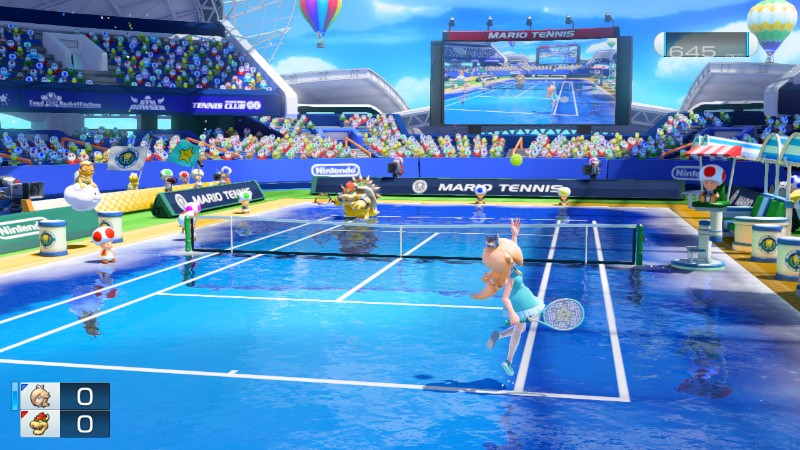
Bowser and Rosalina slip and slide away on the ice court.
While the actual tennis of Mario Tennis: Ultra Smash is excellent, the rest of the package falls short due to its incredible lack of content. Unless you have the desire to play against random opponents online in the most basic, vanilla online structure imaginable, or have local multiplayer experiences in mind, Mario Tennis: Ultra Smash is not worth the current MSRP of fifty bucks. While not an absolute disaster of a game, the obviousness of how rushed the game was to be released should turn most players off. Currently as it stands, Mario Tennis: Ultra Smash delivers a weak serve and an even weaker amount of content.

[SPC Says: D+]