Sunday, November 4, 2018

Luigi's Mansion (3DS) Review

I might have missed out on posting this on Halloween, but that's quite alright! Luigi's Mansion was a fun game to revisit when I did several years ago with the GameCube original version. How does it hold up on the Nintendo 3DS? Well, come see for yourself with the SuperPhillip Central review.

Bustin' doesn't make me feel too good


In 2001, my mom and I waited outside Toys 'R Us on a dreary, rainy morning to stand in line for the Nintendo GameCube. Upon being let inside after about three hours of waiting, we were let in, and I grabbed slips for three games--back when you took slips up to customer service to exchange for the actual games... and, y'know, when Toys 'R Us was still a thing in business. Nevertheless, we picked up three games: one of these was Luigi's Mansion. Now, it's 17 years later (dang, that makes me feel really old!), and now the gigantic mansion that I explored back in 2001 is available for tiptoeing through in the palm of my hand with this Nintendo 3DS remake of the game.

The premise of Luigi's Mansion has our green clad hero winning a mansion from a contest that suspiciously enough he never entered. His brother Mario went ahead to check the place out, but has yet to return. Thus, with the help of Professor E. Gadd, Luigi equips a trusty and dusty Poltergust ghost-busting device to enter into the mansion--reluctantly, of course--and find out what happened to his brother. It's the same story and setup as it ever was way back in 2001.


Luigi's Mansion has you patrolling the halls and rooms of the mysterious mansion, solving puzzles and battling ghosts to receive keys that open up new rooms throughout the mansion. Every once in a while you'll take on a major boss battle which unlocks access to an entirely new wing of the mansion, such as the second floor or attic, for instance. While navigating through the innards and outdoors of the mansion, an optional but rewarding objective to keep in mind is to find as much money as possible. The amount you earn from defeating portrait ghosts, discovering treasure, and sucking up coins from various objects sprinkled throughout the environments go a long way to determining what type of ending to the game you get.

In fact, that brings me to one of the new features of the 3DS remake of Luigi's Mansion--achievements. These add some longevity and replay value to an otherwise relatively short adventure. (I'm talking about a four hour playtime for one's first go through the mansion.) These achievements reveal themselves in tiers, starting with the Beginner difficulty. Complete all of the relatively simple achievements in this category, and the next batch opens up to try. Though if you've already finished off some of the achievements in future categories, then those are automatically checked off ahead of time. Achievements give players different ways to go about playing Luigi's Mansion in ways they might not have thought of before. For instance, it could be a less than three-hour speed run through the game or not having Luigi's HP fall below 50 at any time throughout his ghastly adventure.

There are other new touches and additions to Luigi's Mansion on the Nintendo 3DS compared to the GameCube original. For one, there is now a Gallery where you can take on any defeated portrait ghost you've already battled in the main game. These are essentially time trials to attempt to get as great a time as possible while also gunning for fast captures of ghosts--for this gives you a better frame around each portrait ghost you capture.

For those unaware, portrait ghosts are special ghosts within Luigi's Mansion that take different tricks to capture, much less make vulnerable in order to suck them up. An early portrait ghost requires you to blow the nearby curtain open, so the broken window it reveals sends a gust of wind at the ghost, causing her to become vulnerable when she gets up to close the curtain once more.

The Gallery mode can be played with a second player who simply needs a Nintendo 3DS to join up with you. The process takes a little while for Download Play to connect both players, but it makes taking down ghosts and bosses all the easier. Though, it doesn't necessarily make it more fun, as the connection between systems lends itself to a lot of lag. Still, it's a nice option to have. If both players have a copy of the game, both can play the main campaign cooperatively with one another. I did not get to try out co-op in this form, as the cost of buying two copies of the same game didn't really entice too terribly much.

No doubt you're wondering how Luigi's Mansion on the 3DS plays on the system compared to the GameCube. After all, the 3DS system lacks the analog triggers and second stick of the GameCube controller. Despite having a multitude of control options available, I never found one that really impressed me. In fact, most of the time it was quite the opposite.

While fighting ghosts, I found myself also fighting with the controls. Sure, with the New Nintendo 3DS XL I was playing with, I could move with the Circle Pad while aiming with the analog nub, but it's just that--a nub. It's no substitute for a second stick. Seeing the nub wasn't getting me anywhere fast (except incredibly frustrated), I turned to the D-Pad for aiming. Of course, having both the Circle Pad for movement and the D-Pad for aiming on the same side of the 3DS meant I couldn't use and do both at the same time. Well, unless I wanted to go old school Monster Hunter and do "the claw", but I'm SO over doing that.

The B button is used to sidestep when Luigi is facing the target he wants to keep an eye on. Unfortunately, most of the time I found that Luigi when using his vacuum would use the suction power on everything but my intended target. This is in part of the perspective of the camera, which is a serious pain when trying to judge depth and where enemies are in relation to Luigi. Even the 3D effect of the Nintendo 3DS does not help here. Instead, it merely causes all of the colors to bleed over on to dark parts of the screen for a "ghosting" effect, and not even the kind that Luigi can suck up with his Poltergust.

While the controls and camera positioning leave a lot to be desired, the presentation of Luigi's Mansion is a combination of improvement and being a downgrade. In some parts of the visuals, things are better off, such as the more detailed models and textures within the environments. On the other hand, several of the cooler visual effects of the GameCube original are less pronounced in the 3DS version, and most evident are the dust particle and lighting effects.

Luigi's Mansion on the 3DS is by no means a game I regret purchasing, but at the same time, I would have rather seen it as an appetizer for Switch owners to play as we get ready for Luigi's Mansion 3. Not because I'm starving for games on the Switch, but just because Nintendo's hybrid has more options with regards to controls. I'm certain I wouldn't have had anywhere near as much of a headache with Luigi's Mansion on the Switch compared to the 3DS. Regardless, I should be talking about what is and not what should have been. Luigi's Mansion's remake downgrades more than it improves, but the base game is still a solid one. By virtue on being on the Nintendo 3DS, though, Luigi's Mansion's remake never stood a ghost of a chance of being truly fantastic.

[SPC Says: C]

Tuesday, October 23, 2018

Spyro: Reignited Trilogy (PS4, XB1) Launch Trailer

Spyro the Dragon returns to the world of gaming, and it's not in grotesque Skylanders form either! Don't be fooled by the title of this trailer--Spyro: Reignited Trilogy, a collection of all-new HD remakes of Spyro the Dragon, Spyro 2: Ripto's Rage, and Spyro: Year of the Dragon, actually launches in three weeks. However, that isn't stopping the marketing gears at Activision from shifting. Check out the high definition transformation yourself with this trailer.

Sunday, October 21, 2018

Super Mario Party (NSW) Review

Next up on October's schedule of reviews is Super Mario Party. Ruin friendships on a brand-new system with the Mario Party series's debut on the Nintendo Switch. Here's SuperPhillip Central's review.

Party like it's 1999 all over again


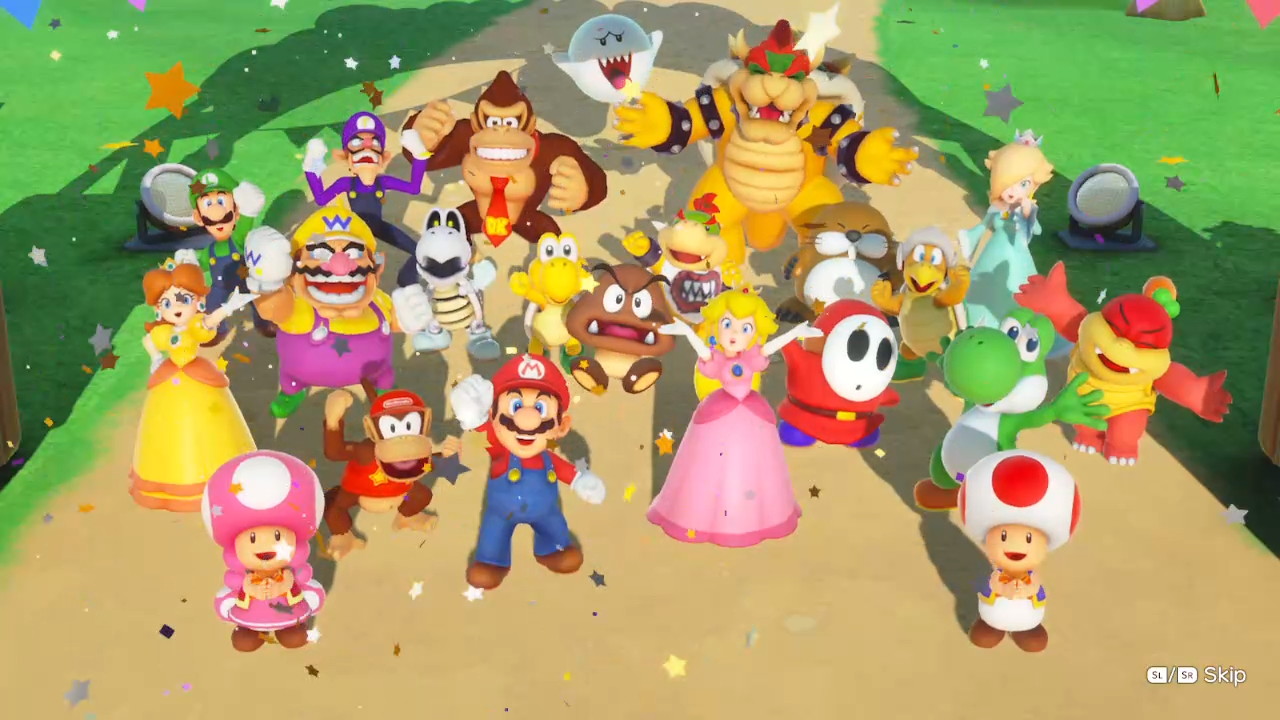
...And that's sort of the premise behind Super Mario Party, the eleventh mainline installment in the nearly 20-year-old Mario Party series. Ditching the "everyone rides in the same vehicle" car mechanic from Mario Party 9 and seen again in Mario Party 10 that saw a tepid response from series fans, Super Mario Party brings back individual movement across nonlinear boards. The goal? Collecting more Power Stars than your opponents by the end of the final turn.

The Mario Party mode is the most traditional of modes within the series's debut on the Switch. You take turns rolling dice blocks (and this time around each character has their own specific dice block--in addition to the standard 1-6 roll available to choose from), and then explore the four boards of the game. While these boards are indeed smaller than in past Mario Party games, this means that there aren't many--or even any--turns where nothing really happens. In Super Mario Party, a host of things can occur--from players landing on event spaces that affect the board and/or players in a variety of ways, collecting Stars, buying items from Flutter, stealing coins or Stars via Lakitu, participating in special "Rumble" mini-games, or falling prey to one of Kamek's Bad Luck Spaces, something is always happening regardless of the turn number. The point here is that there are no "worthless" turns where everyone is just moving around the board with little interactivity going on.

The boards are smaller than what veterans may be accustomed to,
but they're absolutely dense with activities and happenings.

After each player has moved during their turn, a mini-game occurs--a staple of the Mario Party series. While developer ND Cube has failed at delivering the type of Mushroom Kingdom bash that could rival the prior developer of the series, the now-defunct Hudson, one aspect that stays strong and even outdoes the older Mario Party titles is the fantastic amount of mini-games available. Super Mario Party utilizes a single Joy-Con for all players, making it so those with just one set of Joy-Con controllers that came packaged with the Switch can enjoy the game with another player at the very least.

The mini-games in Super Mario Party use the Joy-Con controller in a myriad of ways. From moving the Joy-Con to fly safely through swarms of killer Fuzzy obstructions, to using the analog stick to dodge oncoming Chargin' Chucks in Gridiron Gauntlet, to holding the Joy-Con vertically to flip a cube of meat on a frying pan--feeling the rumble to determine when a given side is sufficiently seared, the mini-games are well done and all control great.

Somehow I'm thinking that our players aren't suited up safely enough for this mini-game...
But, Super Mario Party is more than just the standard Mario Party mode. Returning from Mario Party: Star Rush is what the game calls Partner Party, where two teams of two travel around the same four boards of the Mario Party mode, except these are built like grids. The goal of earning as many Stars as possible is the same, but this time around you have to land on the space where the Star-seller Toadette is in order to purchase a Star. As the turn amount left decreases, the amount of Stars you can buy at once from Toadette increases up to three Stars. This can make for some seriously hilarious come-from-behind victories.

Here's pie in your eye!
What also makes for some good comeback wins is the two bonus stars handed out at the completion of a game. These reward players with Stars for performing certain tasks within a given game, such as getting first place in mini-games the most, landing on the most red spaces, partnering up with the most allies, and so forth. A point of contention here is that the category of Stars rewarded is completely random, so you can't just shoot for a specific Star like the Mini-Game Star, as it might not be one of the two bonus Stars handed out. This can make for some aggravating losses where the player who was the most skilled and had the most Stars before the end isn't the winner due to two random Stars being given to second place, giving them the edge over the player who was winning the whole game. Others like myself will note that this is what Mario Party is all about as a series, so it's not too irritating. Perhaps only when trying to earn the game's five Gems, which unlocks the ending of Super Mario Party.

Partner Party most closely resembles Mario Party: Star Rush's board design.
Yes, the main objective of Super Mario Party is to earn five Gems from completing five specific modes within the game. This includes the already mentioned Mario Party and Partner Party modes, but it also includes Challenge Road, River Survival, and the Sound Stage modes. With Mario Party and Partner Party, you need to finish at least in third place on each of the modes' four boards. Again, these are just the same four boards across both modes, just reconfigured based on whether you're playing the more traditional Mario Party mode or the more free-roaming grid-based Partner Party mode.

Challenge Road serves as the main single-player mode within Super Mario Party. It opens up for play once you've unlocked all mini-games. Based on that prerequisite, you can probably guess what you do in Challenge Road, then. You compete against the AI in six different worlds, challenging them in all 80 mini-games, one-by-one. Many of the mini-games don't just require you to win them, but to reach a specific point amount or time within the games. If you fail a mini-game three times in a row, you get the option to bypass it. Otherwise, failure does not result in any penalty besides having to try the mini-game again. What I like about this mode is that you can get a refresher on the controls and instructions on the game prior to playing it.

Mini-games occur in free-for-all, 2 vs. 2, or like this mini-game, 1 vs. 3!
This is, in fact, something I really found useful in the main "Party" modes of Super Mario Party. You can practice as much as you want in the instructions screen of each mini-game. No more wasting time entering a loading screen just to practice a mini-game, when you can do so straight from the instructions menu. When every player is ready, they just hit one of the shoulder buttons to prepare for the game.

Meanwhile, River Survival is less about competing against other players and more about cooperating with them. Your goal is to paddle down a raging river with multiple paths, dodging obstacles while picking up timers and completing mini-games to add precious seconds to (hopefully) reach the goal. The different paths along the way offer different rafting challenges, and it's really to your benefit to try to paddle down them all. Teamwork is a major factor in this mode, as if all players are paddling madly at once, the raft all four players inhabit won't maneuver well--hitting any and every obstacle that wades in their way.

The unlikeliest of allies can work together for one common goal: reaching the end of this branching river!

Teamwork's also paramount to success in the various mini-games, initiated by ramming in to red balloons along the river's path. These are all co-operative mini-games, offering the team of river-riders more seconds depending on how fast they complete a mini-game or in other cases how many points they earn. One mini-game requires all players to communicate with one another to lift a fishing net at the same time, thus capturing as many Cheep-Cheep fish as possible. Another is a maze of blocks that requires players to collect gems and place them in the center of it. Some paths are closed off, making it so another player needs to stand on a switch to open it up for them.

Lastly, Sound Stage is an all-rhythm based collection of mini-games, where every mini-game has you swinging the Joy-Con in time with the music. There are visual indicators regardless, for those who lack rhythm (like some writer for SuperPhillip Central who will remain nameless). Sound Stage has three difficulties total, and while the mini-games are a blast to play, their presence is missed in the main Mario Party mode. As is, there are a lot of repeated mini-games in the Mario Party mode, and I can't help but think they'd be better served as additional free-for-all mini-games within other modes.

Speaking of repeated mini-games, there's the online component of Super Mario Party--which before your ask, no, there is no option to play full rounds of Mario Party or Partner Party online with friends. Instead, what's here is an Online Mario-thon which is a selection of 10 mini-games that are cycled through for players to engage in. Frankly, while I didn't mind this too much, an option for a traditional Mario Party experience online would have been greatly preferred and much appreciated. As is, I just spent $20 on a Nintendo Switch Online subscription, and the very first new Nintendo game with online has the bare minimum incorporated in to it. Not the most reassuring thing there.

Off the Chain gives the "1" in this "1 vs. 3" mini-game the fun of steamrolling their opponents.
Super Mario Party is a much welcome return to form for the franchise after some shaky attempts to mix things up. While I did actually enjoy what Island Tour and Star Rush had to offer gameplay-wise it's nice in a sense that I feel that I'm back "home" with regards to the Mario Party series. The new additions like the extra modes, the character-specific dice blocks that add a whole new level of strategy to the game (do I risk attempting to roll a 10 when at the same time rolling a 0 is a distinct possibility?), and the mini-games are truly a terrific showcase for the Switch's Joy-Con controller.

What isn't so great is the limited online options--especially after the arrival of having to pay just to play them--and the limited number of boards (and how small they are) compared to past games in the series might put some series veterans off.

Regardless, Super Mario Party is a bash that deserves to be celebrated. Mario Party is back, and Super Mario Party itself is one of the grandest shindigs Mario and the rest of the Mushroom Kingdom gang has ever held.

[SPC Says: B] 

Saturday, October 20, 2018

Mega Man 11 (NSW, PS4, XB1, PC) Review

Our next review for the month of October is for a game in one of my favorite franchises in video games. It's Mega Man 11, and you can see why I enjoyed the Blue Bomber's latest with my full review.

Gears of War: 20XX


In the '90s and early 2000s, there were two things that were absolute: death and Mega Man games. You couldn't go a month or two without a new release in one of the Blue Bomber's many sub-series, whether in the Classic line, X line, Zero line, Battle Network line, etc. Then, poof! The series was gone from gaming for--at least in this reviewer's opinion--way too long of a time. But, perhaps this extended vacation was worthwhile after all, because with the latest in Classic series, Mega Man 11, the developers at Capcom have reinvigorated the series with a fresh new gameplay hook.

Dr. Wily is an old scientist, but he's back with some new tricks.
Yes, one of the things that got to me about Mega Man games was that they were getting a bit stale gameplay-wise. There were small incremental upgrades introduced to the series in a piecemeal basis, such as Mega Man 3's slide and Mega Man 4's Charge Shot, for instance. Meanwhile, Mega Man 11 finally adds something that fundamentally changes the gameplay with a feature that completely altered the way I took on stages and bosses: the Double Gear system.

Apart from being tied to the story of Mega Man 11, the Double Gear system allows players to use the left and right shoulder buttons to power up Mega Man's attack or slow time down respectively. When used, Mega Man can make short work of foes, and with his Power Gear, he can even super charge his special weapons taken from defeated Robot Masters. Meanwhile, the Speed Gear is perfect for a twofold reason: 1) It can give the player more time to react to oncoming obstacles, hazards and attacks, such as Torch Man stage's encroaching instant-death wall of flames that pursues Mega Man; and 2) It can grant Mega Man the ability to shoot off more shots from his Mega Buster while time is slowed down, enabling him to take out enemies and bosses in a faster fashion.

When the Power Gear is activated, special weapons like this
one of Block Man's fall down on enemies like a ton of bricks.
However, you can just spam either of the two gears making up the Double Gear system. As you use a gear, a meter builds energy. If it fills completely, Mega Man overheats--being more vulnerable to damage and shooting with less attack power. This weakened state lasts for several seconds, but in an all-out battle against one of Mega Man 11's multiple bosses, it can put you at a serious disadvantage at the exact wrong time.

Speaking of boss battles, Mega Man 11's bosses all utilize the Double Gear system in one way or another. For the Robot Masters, each of the eight bosses utilize either the Power Gear or the Speed Gear mid-fight to unleash a seriously devastating move or series of attacks--usually when their health has gone done at least halfway. For instance, while Bounce Man's... well, bounces across the screen occur at a much speedier pace with his Speed Gear activated, Block Man turns into a giant golem with his own set of attacks when he turns on his Power Gear.

Mega Man hopes to permanently pull the plug on Fuse Man.
The eight Robot Masters in Mega Man 11 themselves are some of my favorites in series history. Not just with their designs, but their attack patterns and personalities as well. The latter are represented well by both the charming voicework in the game and their aforementioned designs. As an example, Tundra Man is designed with a championship figure skater in mind, and all of his attacks implement that kind of ideology. It skates, spins, and speeds across the icy battlefield in Mega Man's encounter with the enemy, and the colorful dialog only helps accentuate the various bosses' personalities even more.

Not just the Robot Masters, but the special weapons that Mega Man obtains from defeating each and every one of them. All eight have their uses while outside of boss fights. Generally, in games like Mega Man 2 or Mega Man 9, there was really just one really great weapon to use throughout levels. In Mega Man 11, the different functions of each weapon helps in a multitude of situations, so you're never really relying on just one or two special weapons at once. Moreover, it's a godsend to be able to switch between weapons with movement from the right analog stick, and even more so by having the Rush Coil and Rush Jet assigned to two of the face buttons instead of having to select them from the pause menu.

It wouldn't be a Mega Man game without Sniper Joe dropping by for a visit.
As for the designs of levels, Mega Man 11 is relatively straightforward, offering extremely linear areas and rooms. There are no secret areas to be found, which is a bit of bummer, as I did enjoy hunting down collectibles in Mega Man 5, Mega Man 7, and of course, Mega Man 8. That said, this approach to the level design means it's less about superfluous content and more about no-nonsense, straight-up, get-to-the-boss action. Whether you're bouncing around the balloon walls, ceilings and floors of Bounce Man's stage (just remember to hold down the jump button to consistently bounce up high), or dodging spikes in the underwater currents of Acid Man's stage, each level in Mega Man 11 has its own feeling to it, and all of them I enjoyed.

These hazards are simply wanting to give a "hand" to Mega Man.
While Mega Man 11 does lack any sort of collectibles in levels, the game does offer a great deal of replay value regardless. There are four difficulties total in Mega Man 11, and not only does this present players of all skill levels an adequate challenge, but a fair amount of in-game achievements revolve around completing these difficulties with different objectives. It could be something as simple as beating the hardest difficulty mode (the one where levels do not house health or energy-recharging items, nor do the enemies drop them), completing the game without purchasing any ability-boosting chips from Dr. Light's Lab, or beating the game in an hour or less.

Fuse Man's stage is full of these electrodes looking to bring a shock to the Blue Bomber's system.
Additionally, Mega Man 11 has a category of modes called Extra Modes. Here, you can check out completed achievements, gaze at the character gallery, or take on challenges of varying types in each of the eight Robot Master stages. These range from simple time trials to more complex challenges where you try to complete the level with as few jumps as possible, with as few enemies destroyed as possible, or as few red balloons popped as possible. These do get somewhat repetitive playing the same stages over and over again with unique challenges, but it's an option there for those who want to compete against the world on the game's leaderboards.

Of course, all of this would not be worth a bolt if Mega Man handled like he was rusted and ready for the scrapyard. Thankfully, Mega Man 11 feels great when it comes to controlling the Blue Bomber, no matter the level and no matter the surface. Perhaps the only real issue I have is how much time it takes for Mega Man to recover upon taking damage. There's a slightly longer delay for Mega Man to return from his stunned form than in other games in the series. This occasionally resulted in me taking some rather frustrating deaths from getting hit and then falling into a bottomless pit. Still, that was mostly in the early goings of my more than 10 hours of play time with Mega Man 11. (And no, it didn't take 10+ hours just to beat the game once. I played through the game more than five times on various difficulties.)

The only one having any amusement in this park is Blast Man!
Mega Man 11 looks exceptional visually, in my eyes. The backgrounds are mixed between highly detailed at times to drab and almost unnoticeable other times. The models of characters and enemies look sharp and detailed, though Mega Man's running animation does little to not make him look like a dork, as it looks just a bit off. Furthermore, and something that every Mega Man game until 11 has gotten right--the Blue Bomber in Mega Man 11 drops to the ground if you jump into a boss door instead of coolly floating in air as he passes through it. What in Rockman World is up with that!?

Mega Man deftly dodges this duo of pickaxes.
In more important gripes with Mega Man 11's presentation, while the sound effects and voicework are rather nice, the music isn't so much. It's nothing to do with the composition or the melodies--it's more to do with how the music sounds thanks to the dubious instrumental used. I vastly preferred hearing the DLC's jazzy version of the soundtrack--even though it only spanned the eight Robot Master stages. Unfortunately, the DLC with this music was only available by pre-ordering Mega Man 11 and only from select retailers. I can only hope that Capcom eventually allows those who purchased the game late to have access to this music, as it made all the difference to me. And, darn are those tracks catchy!

Mega Man 11 shows the Titanium Titan in one of his greatest adventures yet. The platforming is overall tight as ever, as is the level design that returns to a no-nonsense, no-filler philosophy, which makes for a leaner and meaner gameplay experience. The means with which you can customize your experience with the various difficulties and helpful items in the game's shop allows Mega Man 11 to be enjoy by all ages and skill levels. While I didn't care much for the base music (and even then it's not horrid by any stretch of the imagination), the rest of the presentation--from the story that explores Dr. Light and Dr. Wily's university days, to the slick graphics and voicework--more than delivers. The Blue Bomber is back, and hopefully this time it's for good. And if not that, then for everlasting peace!

[SPC Says: B+]

Tuesday, October 9, 2018

Max: The Curse of Brotherhood (NSW, PS4, XB1, PC, 360) Review

The first review of October is perfect for the month of Halloween. It has curses, it has monsters, it has mayhem, and much more! It's Max: The Curse of Brotherhood, and it's the Nintendo Switch version which is the basis for this review.

Will Max's latest adventure draw you in?


If you've ever had a brother or sister when you were young, you might have sometimes wished that they'd just go away--disappear off the face of the earth. That's what our protagonist Max of Max: The Curse of Brotherhood asked of his younger brother Felix. After reciting an online poem (let that be a lesson to you kiddies on the dangers of the Internet), Max inadvertently calls upon a portal upon which a giant monster hand appears. It grabs Felix and pulls him inside into a harsh, dangerous world. Max makes no hesitation in jumping into the portal after Felix--whether as a show of actual caring for Felix or because he doesn't want to get screamed at by his parents, is anyone's guess.

Max: The Curse of Brotherhood is the followup to 2010's Max & the Magic Marker, which originally debuted on Nintendo's WiiWare service. In that game, Max used the eponymous marker and the player freely drew lines (as long as they had enough ink available to them) to create platforms and other helpful objects for Max to traverse.

As Max progresses in his journey to rescue his brother Felix, his magic marker gains new capabilities.
In Max: The Curse of Brotherhood, Max still has the aid of his magic marker, but this time around players can't just freely draw whenever and wherever they want. Instead, there are special drawing points upon where objects can be drawn from them. These take the form of different colors, thus creating different objects. Orange anchor points can spawn pillars to lift objects and Max himself to new heights. Green anchor points create vines and tree limbs that serve as a means to cross pits and chasms either by swinging across vines or walking across the tree limbs. Meanwhile, blue anchor points summon a flow of water that can push and fling Max across far distances. There are other colors used as well, and these are unlocked slowly and paced well enough that I never felt the game lingered on any one idea for too long. Likewise, I never felt that the game introduced too many gameplay concepts too quickly either.

Rise pillars directly from the earth when drawing points are orange.
Levels do introduce new ways to interact with draw points on a consistent basis. The aforementioned pillar that I drew to rise Max to a higher destination was also used to transport an enemy from a low location to a high one as well. I even pushed a rectangular box halfway on to a draw point, so when I drew a pillar, the box flipped so it changed from being length-ways to height-ways. I could then push the box onto the draw point, jump on top of the box, and with the newly created pillar, Max was able to reach the top of the cliff in order to proceed in the level. There's a lot of that kind of lateral thinking to be found within Max: The Curse of Brotherhood, and it can occasionally be a bit obtuse.


And use them to assist in some truly tricky puzzling challenges!
In the latter half of the game, Max: The Curse of Brotherhood also likes to employ puzzles that combine various types of draw points in to one challenge. A simple example early in the game required me to draw a pillar and a vine from two separate draw points in order to cross a deadly pit of thorns. I drew the pillar and instead of just drawing a vine that dangled by itself, I connected the vine to the pillar, using said pillar as anchor point. This allowed Max to shimmy from the pillar to the middle of the vine. Next, I destroyed the pillar so the vine would start swinging, allowing Max to safely leap to the next platform unharmed.

Now would NOT be a good time to be a butterfingers, Max.
As smart as some of the puzzles in Max: The Curse of Brotherhood are, what seems a bit off is that with the Switch version--complete with its own touch screen in handheld mode--does not utilize this for drawing objects. Instead, I had to use the analog stick while holding ZR and A buttons to draw objects, which wasn't always the most precise. Trying to draw something while a massive monster is chasing my character Max wasn't optimal. Sure, many times the game entered slow motion to allow me time to draw something quickly, but that option wasn't always available to me. That results in some... well, very unpleasant deaths, all things considered. Between Max screaming for his life as his body erupts into flames when he falls in lava and being swallowed whole by the previously mentioned monster, death is rather gauche when it concerns a kid character.

Regardless, these deaths don't really adversely affect the game by means of Max's adventure containing myriad checkpoints. Seldom would I have to complete an entire section of level over again because of an issue with a drawing of mine, botched physics (which does happen more often than I would have liked), failed platforming, or any other forced error. As levels can be upwards of fifteen minutes, this is most definitely a good thing.

Definitely look before you leap in this game, folks.
Max: The Curse of Brotherhood has the length of a typical fifteen dollar game. Though, you might ask me, "What the heck does that even mean, Phil?" Well, Max's story is a rather short one, containing seven chapters of around six hours to complete. Nevertheless, there are some optional tasks you can perform, such as destroying all "Evil Eye" plants hidden and placed around levels, as well as collecting a piece of a broken amulet, one found in each level. For those that want even more longevity--and don't mind putting up with the game's "sometimes wonky, sometimes not" physics--then you can try beating a given level without dying to earn a badge for that particular level. For those that enjoy the game enough, that's a pretty solid challenge. I, however, did not find much reason to do so, at least with the Switch version.

You'll need to use a series of draw points to survive this hot and spicy trial by fire.
A relatively solid game, Max: The Curse of Brotherhood easily beats its WiiWare predecessor in creating a more compelling and enjoyable adventure. The production values are definitely higher, the game has been more streamlined and tightly designed for less annoyances in gameplay, and the puzzles are more smartly made. That said, the lack of polish, occasionally troublesome physics, and absence of touch-based drawing for the Switch version make for an adventure that isn't one everybody will be "drawn" to. 

[SPC Says: C+]