Showing posts with label switch. Show all posts

Friday, November 13, 2020

Ori and the Will of the Wisps (NSW) Review

Earlier this year, SPC took a look at the Nintendo Switch version of Ori and the Blind Forest: Definitive Edition. Now, we're deeper into the nightmare that is 2020, but we have some brightness shining through in an excellent sequel to the original Ori with Ori and the Will of the Wisps. (Hey, we'll take whatever brightness we can get this year, right?) Here's the SPC review.

When there's a will, there's a wisp 

September 2019 saw a game announcement quite surprising to a lot of the gaming world: An Xbox Game Studios title that wasn't associated with the Minecraft brand was going to launch on the Nintendo Switch. This game title was none other than Ori and the Blind Forest from Moon Studios. Now, a year later, the game's sequel is available on Nintendo's hybrid platform, less than a year after the original Xbox One release. Ori and the Will of the Wisps offers multiple improvements over its predecessor, and is just as much of a worthwhile game to play--perhaps even more so!

Ori and the Will of the Wisps is just as heartfelt and emotional of a journey as its predecessor, Ori and the Blind Forest. The story sees Ori and his family assisting with raising Ku, a baby owl, in its formative years. We see them teaching Ku how to forage for food and things like that throughout the seasons, with Ku's most desired lesson to learn being flight. One day, Ku finally is able to fly, and Ori, riding on Ku's back, take an extended flight over a new land. When a thunderstorm strikes, the two are suddenly separated, and now it's up to Ori to reunite with Ku before anything bad happens. The story is touching, but it's the minute-to-minute moments that truly shine and tug at the heart.

Compared to Ori and the Blind Forest: Definitive Edition, the indomitable spirit Ori has plenty of new tools in his bag of tricks on his new adventure in parts unknown. One such trick is a blade of spirit energy that he can use as a sword to attack enemies much more directly than in his previous game. As the game progresses, Ori discovers several new abilities from various spirit trees sprinkled throughout the land that bestow him several powers old and new. 

Ori leaps into action for this spirit's second adventure!

One of the coolest means of traversal in Ori and the Blind Forest that carries over to Ori and the Will of the Wisps is that of the Bash attack. It allows Ori to sling into enemies directly, or to bounce off of their bodies to reach new areas. In addition to enemies, Ori can also bash directly off enemy projectiles, either sending them flying back into foes or using them to reach higher heights and new portions of the map as well. 

Ori has more offensive capabilities this time around in Will of the Wisps.
It's a good thing, too, because Ori will definitely need them to survive!

New to this Ori sequel is that of Shards. Shards serve similarly to the Charms of Hollow Knight, where they can be equipped in one of a handful of slots in Ori's possession, which can be upgraded by visiting and completing Combat Shrines. The latter are short endurance battles with multiple rounds where the goal is to defeat every enemy in sight at your leisure while surviving the onslaught. Regardless, back to Shards, they have numerous effects to them--some grant Ori the ability to collect Spirit Light from half a screen away instead of needing to be nearby to pick them up, while others boost his damage output while also lowering his defense. Unlike the aforementioned Charms of Hollow Knight, however, Shards in Ori and the Will of the Wisps can be upgraded with the game's main currency, bestowing even bigger bonuses when they're equipped.

Ori and the Will of the Wisps features ample opportunities for good old fashioned platforming fun.

Shards aren't the only thing new to Ori and the Will of the Wisps when compared to its predecessor. There are an abundance of side quests to take on in the game, with a major one being restoring a town to not just its former glory, but bigger and better than ever before. This is done by collecting special ore around the game's map, and returning it to an NPC in the town to start construction work. Alongside the town, there is one particularly enjoyable trading sequence a la The Legend of Zelda: Link's Awakening (no, that game didn't hardly invent the trading quest, but it's my go-to game example) that unlocks an incredibly helpful item to assist players who wish to fully complete Will of the Wisps at 100%.

The final new addition to freshen the experience over Ori and the Blind Forest is that of Spirit Trials. These are time trial races against the AI that reward Spirit Light currency for completing them. They demand repetition and multiple attempts usually to master the routes required and complete them fast enough to beat the ghosts in time. After you clear a Spirit Trial, you can upload your own time to a leaderboard and compete against other players this way. The reward of Spirit Light for clearing a trial is very much a nice one, as otherwise the process to grind to upgrade Shards would be a more tedious one. 

So, I've spoken about what is new to Ori and the Will of the Wisps--and these additions to the familiar Metroidvania formula are mostly well executed and welcomed--but there are some parts of the game that followed the old adage "if it ain't broke don't fix it". However, in some cases like Will of the Wisps' chase sequences, a part of the original Ori that I took issue with, this adage doesn't quite hold up.

The chase sequences in Ori and the Blind Forest featured Ori being chased by some kind of environmental danger, whether it was a flood or rising lava. In Will of the Wisps, Ori gets chased by more than just the environment, including huge, hulking bosses. This isn't so bad. What is less than satisfying is that just like Blind Forest, the chase sequences demand split-second precision and timing, little-to-no room for player error, and sometimes it just feels like you need luck to get through them issue-free if you wish to be successful on your first run. These are just as trial-and-error as in the original game, and without checkpoints in many of these sequences, they become quite annoying, despite how epic and amazing they are to play most of the time.

"I spy with my eight eyes, something in my den that doesn't belong."

Ori and the Will of the Wisps had a difficult time running on the Nintendo Switch at launch. It was plagued with reported hard crashes, which put me off from playing the game until they were addressed. Fortunately, they have been addressed and addressed well. In my nearly 15 hours of playing the game, I never encountered a crash at all. (Of course, I'm knocking on wood that I didn't just jinx myself if I were ever to return to the game anytime soon.) That said, I did encounter a loading issue with Will of the Wisps on multiple occasions. It would happen when moving Ori at a speed that was apparently too fast for the game to handle. Ori would get caught on the edge of the screen, and I'd have to wait a few seconds for the game to load the next "screen" of sorts. Very off-putting. Furthermore, speaking of loading, the initial loading time for Ori and the Will of the Wisps is also off-putting, taking at least a minute to load the title screen. I was reminded of the early PlayStation 2 days here, and these were not happy, nostalgic memories for me, either.

The Luma Pools was visually my favorite section of Ori and the Will of the Wisps.

All that notwithstanding, Ori and the Will of the Wisps is a gorgeous game with so much vibrant color, insanely detailed backdrops and foregrounds, amazing set pieces, and jaw-dropping destinations and locales that it's easy to forgive a lot of these aforementioned technical problems. Plus, if the Nintendo Switch version's crashes can be properly addressed, then no doubt the issues I encountered will eventually also be ironed out. Then, there's Gareth Coker's sensational symphonic score, somehow surpassing his work in the previous Ori. That's no small task, to be sure, and the music accentuated my joy playing this astounding game.

Ori and the Will of the Wisps suffers from some small technical issues on the Nintendo Switch version, and my issues with the series' chase sequences continues with this sequel. However, building off the strong foundation of the original Ori, Moon Studios has managed to craft an even bigger, better, and bolder sequel with Ori and the Will of the Wisps, telling a touching tale while making a marvelous Metroidvania in the process. 

[SPC Says: A-]

Saturday, May 16, 2020

Megabyte Punch (NSW) Review

Let's conclude this week of exciting SuperPhillip Central content with a second review for this month. It's a game that takes two things I love: Super Smash Bros. and customizable robots, and mashes them together for one explosive and awesome end result. It's Team Reptile's Megabyte Punch, and it's now available on the Nintendo Switch! Let's check it out with my review!

Custom Smash-bo


I had my eye on Team Reptile's Megabyte Punch ever since it released on PC more than a half-decade ago. The game takes two familiar enough concepts and mixes them into one interesting and overall engaging game. With gameplay akin to Nintendo's stellar Super Smash Bros. series as well as loosely borrowing the idea of equipping unique robot parts a la Custom Robo, Megabyte Punch is an 2.5D action platformer that has as much bark as it does "byte".

There are three main modes to Megabyte Punch: Adventure, Tournament, and Battle. The latter plays out similarly to battles from the Super Smash Bros. series, where the goal is to rack up damage on your opponents, and do this enough so they become more easily knocked off the screen, thus eliminating them. Meanwhile, Tournament gives you ten AI opponents to take on with brief pauses in between, and completing this mode unlocks new, exclusive parts unavailable in any other portion of the game.

Construct your custom robot creation and engage in battle!
The savory meat and potatoes of Megabyte Punch, at least for me, was Adventure. Here, you follow along with a mostly filler plot that failed to be too terribly engaging, but I was compelled to continue despite this. That's because Megabyte Punch's main gameplay hook is at its brightest in Adventure.

That hook is the ability to equip parts that are sometimes dropped from defeated enemies and bosses. You can equip six parts at a time, one for each section of your custom robo...t killing machine. Different parts bestow different abilities. Some make your attacks stronger by one point, some make you move with greater agility, while others provide you with various new attacks when they're equipped. Such attacks can be mapped in tried and true Smash Bros. fashion to an analog stick direction in combination with the special attack input. Thus, up to three attacks can be equipped at once to your robot (up + Y, down + Y, and side + Y).

Adventure's hub is this robotic village where all of the levels are interconnected.
This windmill structure serves as a shop, offering parts that can be purchased with bits found in levels.
As you can imagine, it's not just a question of form in Megabyte Punch with customizing your robot, but also function. Finding the right combination to suit a player's particular play style is something that I foresee a lot of the creative and customization-loving types digging deep into and enjoying. I most certainly did. Sometimes you'll want to change things up and swap in and out parts to fit the combat or exploration scenario at hand, and this is quite easy thanks to the ability to save multiple builds.

Playing through Adventure takes you through six worlds of three stages each, followed by a boss. The boss battles are generally one-on-one showdowns which start out simple enough. While the AI is quite crafty, you usually have more lives than the boss at the beginning. However, as you face later bosses, the live advantage is eliminated, and you must fight on steadier footing. Bosses can be real pieces of work and were the most frustrating part of Megabyte Punch's campaign. The way that my attacks seemingly failed to connect at times while the bosses' attacks seemingly never strayed away from hitting me was quite aggravating overall. It doesn't help that if you lose all of your lives, you're put back at your home base, forced to make the long, annoying, shameful trek back to the boss's lair all over again instead of being able to just hit a "retry" prompt.

One of the many bosses your robo will battle in Megabyte Punch's Adventure mode.
The stages in Megabyte Punch's Adventure mode offer a solid sense of reward for exploration, whether it's going off the beaten path to find a treasure chest in gold (a special part) or silver (currency) varieties, or discovering rare one-time color pods that allow you to alter the skin of your robot. These are hidden in the most creative and dastardly of locations within the game. There are abundance of paths in levels to take a lot of the time, and checkpoints are commonplace. These occur after what I like to call "battle rooms"--zones where you're locked inside a space and must defeat all spawning enemies before you can escape--are completed.

That said, also following the Smash Bros. route, Megabyte Punch's platforming feels rather floaty and loose. Not exactly the best combination to be found when you're at times having to make precision-focused jumps through tight, dangerous expanses. It's sort of why Smash Bros. stopped focusing on platforming-heavy gameplay and kept its focus more on the sensational, chaotic combat fans love about the franchise. Regardless, despite the light weight of the platforming, I still found myself eager to explore every which corner of Megabyte Punch's Adventure's expansive stages, even with the frustrations I faced.

Unlike Battle mode, defeat enemies (and be defeated) in Adventure mode by smashing them
into walls, ceilings and floors after they've taken enough damage.
Megabyte Punch offers multiplayer in most modes, and it's particularly helpful in Adventure. The difficulty does not take in account additional players, so there's no difficulty scaling to be found. So, as you can imagine, the more players you have--up to four via split-screen (sadly, no online is available to speak of at the time of this review)--the easier of a time you'll have. Players don't share lives, and can explore levels independently from one another, making it so more ground can be covered in a shorter amount of time. Really, it's going to be difficult for me to go back to playing Adventure solo-style after kicking butt--or "bot" in this case--in local co-op.

Up to four players can locally team up to take on Adventure mode.
Unfortunately, no online functionality is available in this Switch port.
The visual approach to Megabyte Punch is an incredibly simplistic one stylistically, comprised of basic polygons. It's a clean look, though nothing stunning. Even with such a simplistic style, there are some frame-rate hiccups that do occur. Not often enough to be a tremendous bother, but noticeable and frequent enough to occasionally get miffed towards. The soundtrack syncs with the action and moment-to-moment gameplay well, offering a retro and electronic sound.

Megabyte Punch isn't a particularly lengthy game, but that all depends on one's skill level and--with certain boss battles--luck. However, a plethora of parts and color combinations to collect, as well local multiplayer with bots or other players means that there is enough bot-bashing goodness to enjoy for at least a fair amount of hours. The lack of online hurts the chances of the game having a lasting impact in my Switch's library, but at the same token, I'm quite pleased to have finally played Megabyte Punch. It only took six years, after all!

[SPC Says: B-]

Team Reptile provided a code for the purpose of this review.

Monday, January 27, 2020

Pokemon Sword and Pokemon Shield (NSW) Review

I was recently once again bitten by the Pokemon bug after over a decade of being tired of the mainline games. Now, I return to a brand-new Pokemon pair of games with Pokemon Sword and Shield. Here's the SuperPhillip Central review.

Your adventures in the Galar region await.


I should very much preface this review with the mention that with regards to the Pokemon series, I have long since fallen out from the franchise. Somewhere between Pokemon Diamond/Pearl and Pokemon Black/White I lost interest in the mainline games completely. It wasn't until Pokemon: Let's Go, Pikachu! and Pokemon: Let's Go, Eevee! of all games that I jumped back into "Poke Fever", which the only cure for was more Pokemon games.

So, in essence, Pokemon Sword and Pokemon Shield are my first completely new installments in the franchise since Pokemon Black and White back on the Nintendo DS. Quite a lengthy hiatus. While for some players, the removal of features and Pokemon from previous games are some things that sting, I selfishly couldn't have cared less because I don't know most of the Pokemon or features lost nowadays anyway. Thus, I entered the Galar region with an open mind and ready for a fresh new Pokemon experience. And, for the most part, I wound up getting just that.

Route 1 is sort of a "blink and you miss it" kind of route. No worries, though--it's not
representative of the length of the other routes in Pokemon Sword and Shield.
Pokemon Sword and Pokemon Shield take place in the England-inspired Galar region, and have you starting your Pokemon journey being greeted by your mom and then your soon-to-be rival, Hop. A rival that if you're like me, you'll get incredibly sick of battling by the twelfth or so time the game forces you to do. Hop is the younger brother of the undefeated Galar League champion, Leon, and your quest is to collect the eight gym badges around the Galar region while contending with a healthy heaping of unique characters and personalities. Frankly, while a lot of the story is on the light side, but that said, the dialogue is a bit on the heavy side, having way too many interruptions to the otherwise enjoyable exploration and Pokemon searching, catching, and battling within the Galar region. That said, I personally didn't mind the overly done exposition, though the story is quite weak overall.

Select your starter, and begin your journey through the Galar region.
As for the aforementioned enjoyable Pokemon searching, catching, and battling, this is just as fun as ever in Pokemon Sword and Shield. There is a total of 400 Pokemon to catch within the Galar region, and just under 100 new Pokemon introduced in this pair of games. They're introduced steadily and rather quickly throughout the adventure, and discovering a new Pokemon you haven't yet encountered or even better yet, caught, is still a satisfying and exciting occurrence to have happen. Pokemon hide in tall grass, but taking a cue from Pokemon Let's Go, you can see most Pokemon in the grass and in dungeon areas before initiating a battle. This way you aren't always stuck with luck-of-the-draw random encounters, hoping to take on that Pokemon in your Pokedex that you've yet to catch. Though, there are Pokemon that only appear shrouded in tall grass and caught out of water via fishing that do require happenstance to encounter.

As a Pokemon game is wont to say, "It's super effective!"
If there's one thing I really like about Pokemon Sword and Shield it's how there's an abundance of quality of life features added to make for a more palatable experience. I've already talked about being able to see Pokemon on the field before deciding to battle them, but there's also things inside of battles themselves. One of these involves seeing if a given battle Pokemon's move will be effective against your opponent's. Another includes the use of sharing earned experience between all Pokemon in your party. While I'm sure some will miss being able to individually level up Pokemon to keep the game more challenging--and I would very much agree to having an option to turn the experience-sharing off--it makes for a leaner and more streamlined approach to training Pokemon. I personally have always found the slow method of having Pokemon games give experience only to Pokemon active in battle to be quite cumbersome, and perhaps that's a reason I dropped out of the games in the first place almost a decade ago.

That said, one can easily be over-leveled in Pokemon Sword and Shield, effortlessly steamrolling over Pokemon trainers met along the various routes and indoor areas in the game. It's a double-edged sword (or should I say a double-edged Honedge in this case?) in that by having an experience share, it's way too easy to have all of your Pokemon leveled too quickly. On the other hand, by having this experience share accessible, it allows less of a hassle to level up your Pokemon. It didn't have to be an either/or proposition here, and I think with a better balance by Game Freak, this wouldn't have been an issue at all.

Who's a good doggy? Why, yes, you are a good doggy, Boltund!
Regardless, Pokemon Sword and Shield brings more than new quality of life improvements to the series, it also brings new features as well. One such feature, and one highly advertised throughout the game's marketing, is the Wild Area. This is introduced early in your adventure, offering a wide expanse to travel, containing a multitude of Pokemon species to catch. Starting off in the Wild Area, you'll encounter Pokemon of such a high level that they're impossible to catch until you earn more gym badges, but being able to eventually catch an expansive variety of Pokemon all in one place is a fantastic inclusion to Pokemon Sword and Shield. The Wild Area is always changing weather-wise, with different parts essentially being different bio-mes, having vastly different weather. One step you could be in a bright, sunny expanse, while the next step it turns into a winter hailstorm where ice Pokemon reign supreme.

Welcome to the extraordinarily expansive Wild Area, introduced relatively early in Pokemon Sword and Shield.
Also new is that of Max Raid Battles, which also take place in the Wild Area. These have you team up with either three other Pokemon trainers via online or partner up with three AI trainers against a gigantic "Dynamax" Pokemon. These are terrifyingly large in size and unleash more devastating and powerful attacks than normal Pokemon. Among the four trainers, one of their Pokemon can fortunately also Dynamax, also growing to gargantuan Poke-proportions, using stronger versions of moves that they otherwise would be unable to use. The team of four trainers challenge and take on the "Dynamaxed" Pokemon, and if they're successful in taking it down within ten turns and without having four K.O.s between the four of them, they'll gain the opportunity to catch that Pokemon. Even if this catching attempt isn't successful, they're still rewarded with goodies like rare items like treasures and Technical Machines, used to teach their Pokemon new moves.

A gigantic Munchlax means a Pokemon with a gigantic case of the munchies.
Dynamaxing isn't exclusive to Max Raid Battles either, as they're a grand component of Gym Leader Battles this time around, where the final Pokemon each Gym Leader brings out is Dynamaxed to gigantic size as one last ditch effort to bring the match to their favor. One of your Pokemon can do the same at any time in the battle, and just like the Gym Leader's Pokemon, a Pokemon can only Dynamax for three turns before reverting back to normal, so there's some semblance of strategy to this otherwise superfluous spectacle.

Introducing your Galar League Pokemon Gym Leaders...
Collecting eight gym badges is as traditional as ever for the Pokemon series, but if it isn't broken, why fix it? That said, there is a change to how gyms work, as they all have Gym Challenges to take on and complete first in order to even gain the right to battle the Gym Leader. These have a wide range of tasks to accomplish, such as herding a group of Wooloo into a fenced area, hitting a series of buttons to switch on and off water from multicolored pipes, and riding in a Disney World teacup-like vehicle as you bounce around a Pachinko-like board. These are enjoyable excursions that don't just feel like filler or something extraneous to pad the game.

Gym Challenges will test all sorts of skills, but they won't all exactly
put the "challenge" in Gym Challenge.
Outside of going to gyms, taking on Gym Challenges, and moving on to battling their Gym Leaders, you'll be following along with a light story that doesn't really pick up until near the end of the game and then into the post-game afterwards. The culminating battles against the--for lack of a better term--"big bad(s)" don't really feel earned and don't feel natural to the overall game. The stakes just don't come across as very high, despite the scenario designers' best intentions.

Then, there's the return of camping with your Pokemon, but this is in a much more interactive form that what I witnessed in past games. You can play with your Pokemon, "talk" to them, and otherwise enjoy each other's company to build your friendship and trust with them. You can also create all sorts of curry-themed concoctions. While building up one's Currydex might be engaging for some, this entire feature just didn't strike any chord with me whatsoever, and I found myself using it sparingly at most.

Battling all day must be bad for a Pokemon. Why not spend some quality playtime
with them at a campsite occasionally so they can unwind?
Pokemon Sword and Pokemon Shield may be two games, but they're hardly two different experiences. You tackle the same story, with the same routes and gyms, and these gyms have the same Gym Challenges as well. The only real difference between the two games are which Pokemon are available to be caught, and which of two trainers you take on in the game. Thus, there's really no compelling reason to pick up both games unless you're a serious Poke-maniac.

Both games have a pleasant visual style to them on the Nintendo Switch, but I wouldn't exactly call them highly impressive. They're quaint, colorful, and nice enough to look at, but graphical powerhouses or showcases that put other first-party games to shame, they are not. The Pokemon, of course, are the stars of the show, offering plenty of unique personality in their animations, movements, and designs, and the environments sport adequate detail and have their own personalities as well. The online features can cause the frame-rate to chug and stutter a small amount when connecting with other players, but overall, Pokemon Sword and Shield aren't poorly optimized games. With regards to sound, the same 8-bit growls and buzzes from the Game Boy era are mostly used for Pokemon voices, save for a select few species, and this is a bit disappointing to me. Then again, it's practically tradition now, so I guess there's something quaint to be had with them. The music, however, is really splendid, offering plenty of jams and bops to enjoy.

Galar has an impressive variety of unique locales within its boundaries.
Pokemon Sword and Pokemon Shield may not have the most engaging story nor may be the most impressive running game on the Nintendo Switch, but they still meet the same prerequisite I require to enjoy a Pokemon a game--they're darn good fun. While absent features and Pokemon from past games will disappoint, as will the series not evolving as much as say, a Charmander to a Charmeleon to a Charizard, what is here in these two games was enough to satisfy me and make me eagerly await the upcoming Expansion Pass. I look forward to continuing my journey in the Galar region and quest to catch 'em all.

[SPC Says: B+]

Tuesday, October 22, 2019

AeternoBlade II (NSW) Review

SuperPhillip Central's next review as we inch towards the site's 900th total review is AeternoBlade II, the sequel to a game that originally debuted on the Nintendo 3DS. With a bigger scope and a larger scale, does that make for a game that's a better title?

Time isn't on this game's side.


I had a small interest in the original AeternoBlade which initially launched on the Nintendo 3DS. I played the eShop demo, but never got around to playing the full version. Shame on me, then, because since I didn't play through the story of the first game, I entered AeternoBlade II, a sequel with a much grander scale and scope, not knowing what the heck was going on story-wise.

AeternoBlade II starts out as a linear affair with players being introduced to the three playable characters in the game, each with their own play styles. However, the character that is the most prominent throughout the adventure is Freyja, a young woman who players can use yellow orbs from defeated enemies to level up her stats (such as HP, MP, Attack, and so forth) as well as level up her various abilities.


The game soon turns into a regular Metroidvania-structured game, having non-linear exploration, puzzle-solving, boss-battling, clearing out rooms filled with enemies to progress, and returning to past locations with new abilities to access previously unreachable areas.

Where AeternoBlade II attempts to shake things up and differentiate itself from the endless competition of Metroid and Castlevania-style clones to those games' thrones is with the game's time-manipulation abilities. These are used in a twofold way: in combat and to solve puzzles. Some abilities create clones of your character to be able to hit multiple switches at once to open gates, while others rewind time for everything except your character, allowing them to ride up platforms that would otherwise continuously move downward.

AeternoBlade II also splits up its gameplay between a traditional side-scrolling perspective that occasionally finds the camera in a 2.5D approach while other times it employs an over-the-shoulder look. Unfortunately, the latter creates more problems than the approach is worth, as the camera loves to get caught behind walls and geometry, and trying to dodge enemies coming at you from multiple directions is nothing but an impossibility.

What further aggravates with AeternoBlade II is how difficult the game is. Part of that is the clumsiness of the combat and collision detection, making it so enemies don't really have any tells to if they're taking damage. It also makes it a challenge to see what is happening on screen, meaning evading attacks is also obnoxious. And while it's nice to have an arsenal of attack types to each character (a weak attack, a strong attack, a launch attack, and the aforementioned time powers), the flow of combat just feels off when you can't cancel out of attacks easily.

AeternoBlade II attempts to be too big for its budget. The character models and environments are ghastly, the camera is terrible, the combat is too clumsy and stiff to be attractive, the difficulty is too high because of how atrocious combat is, the voice acting is awful, and I've lost progress multiple times due to the Switch version of the game crashing on me a handful of times. I appreciate the attempt at making a lengthy adventure, but with the developer's budget, the scope of the game should have been reined in and instead given more polish than what is currently here. As is, AeternoBlade II is a game that you should avoid, and no amount of manipulating time can fix that.

[SPC Says: D]

A review code was provided for this review.

Sunday, October 20, 2019

Little Town Hero (NSW) Review

Game Freak has a smaller series of games coming out next month called Pokemon Sword and Pokemon Shield, but all the hype right now is on Little Town Hero. Wait a minute. Sorry. I was writing up this introduction in an alternate dimension. Still though, Little Town Hero is an intriguing title from the makers of the Pokemon games with a creative but complex battle system. As the review tagline asks, "Izzit worth buying?" SPC has the answer with its review.

Little Town Hero: Izzit worth buying?


While most of the gaming world focuses on the developer's more prominent and popular property, Pokemon (especially as it receives a brand new duo of entries next month), Game Freak recently pushed out one of its smaller projects akin to its HarmoKnights, its Tembos, and its Giga Wreckers. Little Town Hero saw itself featured in a couple of Nintendo Direct video presentations, but to say that the game arrives with any fanfare would be a flat out lie. Still, with Game Freak's credentials and Undertale's Toby Fox providing some music to the game, does Little Town Hero deserve your attention, or would that be a bad idea?

Little Town Hero's tale brings to the table a precocious youth named Axe, who wishes to leave his hometown and explore the world beyond. However, there's just one catch: the people of his town are forbidden to leave as the world beyond is extremely dangerous. Thus, a castle and protective wall keeps the foreboding beasts and malicious monsters out of the town. At least, they're supposed to! One day, after training with a guard, Axe and his friends find themselves in the midst of a monster attack. Using a red stone that he found in the mines, Axe apparently gains enough power to vanquish the attacking monster and save the town from destruction in the process. 

There's no coincidence that Little Town Hero's full adventure happens within the confines of this little town.
While early on, Axe has a tremendous desire to leave his hometown, this desire diminishes about halfway through the game. The middle word in Little Town Hero's title is where the entire 15-hour adventure plays out. The town is a bit expansive, offering plenty of space, but many times you're limited to where you can go. Axe will stop himself from proceeding any further, usually saying that you, the player, as Axe need to go to the next quest destination. 

When there is some freedom in exploration, it becomes quite clear that there is little to do in Little Town Hero's town, apart from the occasional side quest. These side quests generally offer a rare glimpse and back story into some of the game's quirky characters, but more often than not they're simply busywork. 

The town itself is visually nice with its clear, crisp, and colorful charm, but unfortunately and some astoundingly, there are frame-rate hiccups that pop up while exploring and also in the game's battles, where Little Town Hero players will spend the majority of their time with the game. 

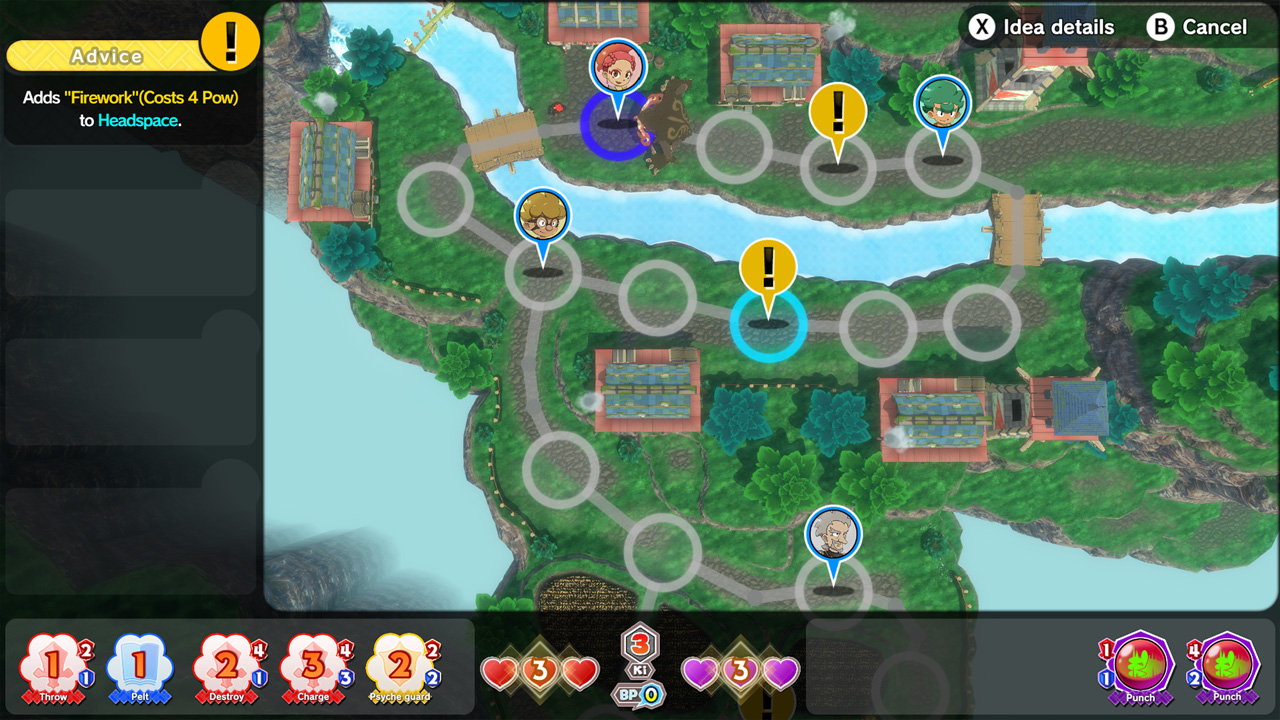
Getting my brain wrapped around Little Town Hero's battle system and its quirks was quite the challenge for me. Sure, battling Axe's rival Matock in the game for the 70th time in the story eventually made me a pro, but the combat is certainly quirky and definitely one that possesses a learning curve. It involves the concept of Izzits (ideas) and Dazzits (actions). Izzits require points to turn into Dazzits, and these Dazzits are then used to combat and counter your opponent's own set of attacks. Starting off in battles, you get a hand of five random Izzits from your collection of 13, as well as three points to utilize to turn Izzits into Dazzits. Generally, the more powerful and beneficial the Izzit, the more points you need to spend to turn it into a Dazzit. As battles progress, this number of points you get to use at the start of each turn increases.

Izzit? Dazzit?! Whazzit all mean?! It takes a bit to come to terms with Little Town Hero's
 battle system, and even when you do, it still is challenging to win battles!

There are three types of Izzits in battle: red, which are attack-based and can only be used once per turn; yellow, which are defensive and can be used as many times in a turn as you like until they are broken by the enemy, and blue, which have special abilities such as the power to pelt your opponent's set of Dazzits, lowering each Dazzit's defense by one. Some Dazzits, particularly ones tied to your enemy, have secondary effects, such as turning a spent Izzit back into a Dazzit, lowering all of your Izzit's attack and/or defensive levels, or dealing direct damage to your hearts. There's a puzzle aspect here in trying to figure out how to best combat and counter opposing Dazzits so they don't a close battle into a losing one.

Each side of the battle has three hearts which serve as their overall health. When all hearts are gone, the battle is over. Most battles, particularly ones against bosses, give the boss and you an extra shield which must be first whittled away before damage can be done to you or the boss's health. If you take damage to your hearts, then your shield returns to you. It's the same way with the boss. In order to injure an enemy's hearts, you must first defeat their hand of Dazzits, and also have an extra red attack Dazzit to dish damage to them. 

Each red and yellow Izzit and Dazzit has a pair of numbers attached to it. One signifies the attack power, while the other displays its shield, or its defensive power. In battles, you want to break as many of your opponent's currently active Dazzits as possible so they don't have any left over to attack your shield or worse yet, your hearts. Though, the latter grants you an automatic reshuffling of your Izzits so ones you've already used (or discarded in a card game sense) can be turned into Dazzits again. As an aside, Battle Points (or BP) can also be spent to reshuffle your Izzit "deck" as it were.

After each turn in Little Town Hero's battles, you get a roulette wheel that spins and the number it lands on determines your movement around a board game-like map. Landing on different spaces on the map can have various effects. Some allow you to call upon the help of a fellow townsperson, resulting in actions like allowing you to turn an Izzit into a Dazzit without needing to spend any points, or having that character directly attack the enemy's health. Some battles feature objects and traps that can be used to your advantage, but require a specific Dazzit attack to unleash them. Such an example is launching a rooster into a sheep-turned-boss with one of your Dazzits. No real explanation needed on that scenario since I'm sure we've all been there.

Some secondary Dazzit effects allow you to choose which nearby space you'd like to land on.
As the game goes on, battles become more and more arduous as well as taking a lengthy duration to complete. To give you an idea (or should I say "Izzit"?), the first boss battle in Little Town Hero took upwards of 20 minutes to complete. Later battles took over a half hour, and there are no checkpoints either. That means that if you lose, you just wasted a sizable amount of time. Sure, you get a pity Eureka point to spend in the game's skill tree of sorts (these are used to upgrade Izzits to make them stronger and more effective in battles), but it can be absolutely soul-crushing to be invested in winning a battle only to lose and have your progress halted. I found myself sometimes bashing my head against progression walls, as some encounters just didn't seem fair, much less fun for me. Throw in that many times you winning is dependent on how lucky you are with the Izzits you're dealt in your current hand, and things can get quite maddening and just plain cheap.

Little Town Hero certainly delivers a delightfully cozy setting with a unique and creative battle system. However, this sometimes luck-based combat and somewhat convoluted concept can make a poor first impression on players. It definitely did with this one. Fortunately, as I stuck with the game, came up with solid strategies, and persisted despite losing battle after battle, I made progress and enjoyed a fair amount of my time with the game. That said, I doubt as many players will have the same level of patience as I had, and I doubt that I would have continued with the game if I had not needed to review it.

[SPC Says: C+]

A review code was provided for this review.

Wednesday, October 2, 2019

Spyro Reignited Trilogy (NSW) Review

I listed Spyro Reignited Trilogy as my fourth favorite game of 2018. That was the PlayStation 4 version of the game, so when one of my favorite games of 2018 was released on the Nintendo Switch--a platform where I can comfortably enjoy some gaming without being stuck to my TV--you bet I was looking for any excuse to replay it! That's exactly what I did over the past month with Spyro Reignited Trilogy on the Nintendo Switch. Here's the full SPC review.

Check out my review of the PlayStation 4 and Xbox One original release of Spyro Reignited Trilogy by clicking on this link.

Of purple dragon's majesty...


Last year, developer Toys for Bob showed how remarkable remakes are done with its work on updating the original PlayStation Spyro the Dragon trilogy of games in one fantastic package on the PlayStation 4 and Xbox One. A year has since passed, and now the complete package, Spyro Reignited Trilogy, has arrived on the Nintendo Switch with the bonus of being able to take the experience anywhere you want with its portable play. Adding some refinements and some drawbacks as well, does Spyro Reignited Trilogy hold up as well on the less powerful Switch?

Sparx isn't just Spyro's companion on his adventures--he's also Spyro's health indicator.
Having played through Spyro's three games for the first time to completion last year on the PlayStation 4, my run through of the games on the Switch didn't take as long--but at the same time, it was just as enjoyable for me. There's easily over 25 hours' worth of content to delve into with Spyro Reignited Trilogy, and after the original, you can see how much each of the sequels builds off its predecessor.

While the original Spyro the Dragon employs a simple start-to-finish progression with its levels, and these are connected by hubs, each level begs to be explored. This is due to the fact that your transport between worlds requires a set amount of a particular collectible to proceed. Sometimes it's a number of gems, Dragon Elders to rescue, or Dragon eggs to nab back from pilfering (and quite cowardly) egg thieves upon which Spyro must give chase to return the eggs.

Come back here, you pesky egg thief!
Generally, levels in the original Spyro the Dragon are relatively brief affairs, but that's only if you're running from point A to point B without going off the beaten path. As stated, exploration from finding gems, Dragon Elders, and other collectibles is paramount to Spyro's progress. Plus, if you're a sucker for collectibles like myself, you probably won't be able to ward off the temptation of aiming for 100% completion in each level.

Spyro 2: Ripto's Rage introduces new characters, a more involved story, and more cinematics (including cutscenes that appear at the beginning and end of each level). Spyro also expands his arsenal of moves by paying off a particularly greedy ursine fellow with the gems he discovers throughout his platforming escapades. These moves include the ability to swim underwater, climb ladders, and perform a ground pound of sorts. In addition to these learned moves, Spyro has an incredibly helpful ability to cap off his winged descents across pits and other chasms by having the player press the X button to perform a quick ascent into the sky. No more "just" not having enough height to reach faraway platforms.

Of the three games in the trilogy, Spyro 2: Ripto's Rage slightly edges out the original as my favorite.
Additionally, Ripto's Rage brings with it side quests that have Spyro completing special challenges for special collectibles. Some are rewarded by surviving certain platforming perils while others involve mini-games such as controlling a train cart through a hazardous course, beating an NPC in a game of ice hockey, or defeating a group of enemies causing trouble in a level.

Spyro 2: Ripto's Rage introduces unique side quests that add even more variety to the series.
Spyro: Year of the Dragon rounds out the trilogy, and it adds even more gameplay variety to the series. This is both a positive and a negative. While being able to play as characters other than Spyro--such as a club-wielding yeti and a missile-toting bird--mostly brings about entertaining variety, some of the other types of variety on display in Spyro 3, such as mini-games like the woefully awkward and clumsy hoverboarding, don't give off as great of an impression.

Speaking of variety, being able to play as several new animal
companions turns the "variety dial" up to 11!
Staying with the theme of "not giving off as great of an impression," we have the boss battles. In Spyro the Dragon, the levels leading up to each boss battle are more challenging and lengthier than the actual bosses, which can usually be flamed or rammed into a quick defeat. In Spyro 2: Ripto's Rage and Spyro: Year of the Dragon, bosses are their own encounters without levels preceding them, but these range from total jokes to hair-pulling in their difficulties. The total lack of checkpoints in these encounters made these particular encounters more frustrating and annoying than they needed to be. It's a shame that with all of the updates and upgrades in both presentation and quality of life aspects of Spyro Reignited Trilogy that the addition of the occasional checkpoint in the more arduous boss battles was not included.

Not all boss fights are created equal. While all are pretty forgettable
in this trilogy, some are just frustrating as all get out!
As mentioned and as expected of remakes of this type, all three games in the Spyro Reignited Trilogy have been touched up dramatically, and although they don't have the same wow factor graphically as the PS4 and Xbox One versions (or especially the newly released PC version, for that matter), the fact that the games hold up rather well visually on the Switch--especially when considering you can play them on a single device that you can hold in your hands--makes for its own kind of wow factor. Something impressive as well is how that the only frame-rate hitches that I noticed were ones that happened during loading screens. Nothing out of the ordinary occurred during actual gameplay. An important point to mention: this didn't matter whether I was playing with the Switch placed in the dock or if I was playing the game in handheld form.

While the visuals may not be astonishing compared to the other versions, Spyro Reignited Trilogy running as flawlessly as it does on the Switch certainly is astonishing all on its own!
Spyro Reignited Trilogy may be a year late in coming to the Nintendo Switch, but it's on the system in style with surprisingly remarkable results. Though Spyro's adventures are dated in some regards when it comes to their designs, overall, each adventure is worthy of a play through (or several) and holds up exceptionally well. If you haven't played these sensationally remade versions of Spyro's original three platforming adventures already, own a Switch, and favor either the platform itself or portability, then enjoy Spyro Reignited Trilogy on Nintendo's hybrid system--because this port is a well done one.

[SPC Says: A-]

Friday, September 27, 2019

The Legend of Zelda: Link's Awakening (NSW) Review

SuperPhillip Central closes out the month of September with an onslaught of new reviews, beginning this evening with The Legend of Zelda: Link's Awakening, a 1993 classic fully remade on the Nintendo Switch. New audiences and old fans of the Game Boy original have something special to enjoy. Let's take a deep dive into this remake with the SPC review!

A legend reawakens from its slumber


The year 1993 saw many things: such as Bill Clinton officially starting his first term as the president of the United States, Jurassic Park and Free Willy making big bank as blockbusters in movie theaters, and obviously the most important (at least in the context of this review), Nintendo releasing the first handheld game in The Legend of Zelda series. Despite countless games in the series since, many longtime fans of the Zelda franchise continue to find that game released on the extraordinarily popular Game Boy, The Legend of Zelda: Link's Awakening, as one of the best entries in the series to date.

That's why so many of us found an immense amount of excitement and rekindled passion, whether from nostalgia of a simpler time in gaming or just from having a chance to re-experience a fantastic entry in the franchise, when Nintendo formally announced a Nintendo Switch remake of Link's Awakening, 26 years after the original. With new features, a gorgeous new graphical style, a redone soundtrack, and several improvements, The Legend of Zelda: Link's Awakening shines brightly with its return, but it's not quite as remarkable of a remake as this reviewer dreamed.

Mabe Village serves as the starting point of Link's journey.
The setting of Link's Awakening takes place on the fantastical Koholint Island, where our hero Link has found himself marooned on after a freak storm caused him to drift away in the sea. Despite teeming with monsters and beasts of various levels of danger, the island is a rather warm, homey, and cozy place to explore. It is as much of a character itself as the unique people and animals that Link comes across in his adventure. There are several villages that are full of lively townspeople, places to go, shops to spend rupees on, mini-games like fishing and a claw game to play, caves and hidden areas sprinkled throughout the environments, housing rewards for those bold and curious enough to uncover them.

Sword in hand, Link sets off to find a way to leave Koholint Island.
Koholint Island game design-wise is a sprawling overworld comprised of various regions, from the fog-covered Mysterious Woods to the sparkling waters of Martha's Bay. While you're limited somewhat in where you can go at the beginning of Link's Awakening, the overworld slowly opens up more and more as new items and equipment are earned, either from gaining them in small quests or acquiring them from the game's dungeons. Items like Pegasus Boots that bestow the ability to run, Roc's Feather that grants the ability to leap into the air, and bracelets that give Link the power to lift specific objects over his head and toss them allow you to access more of the island. Perhaps to also uncover hidden seashells and Heart Pieces, the latter of which is a mainstay of the series which gives our silent protagonist an extra heart of health when four pieces have been collected.

Items, such as the Hookshot, not only assist Link through the dungeons they're found in,
but also as a means to access new parts of Koholint Island.
For those who are used to The Legend of Zelda, the progression and flow of the game follows the familiar formula. You explore the overworld and make your way to various dungeons where puzzles need to be solved, keys need to be collected to open locked doors, treasure chests beg to have their contents looted, and the boss that awaits at the end of each dungeon needs to be beaten. Each of Link's Awakening's eight dungeons need to be beaten in a specific order, and once one dungeon has been completed, a clue reveals the general location of the next.

Each of the puzzles in Link's Awakening's dungeons are generally contained
to one room--except in special (and particularly cool) cases.
That's not to say Link's Awakening holds your hand. In fact, it's quite the opposite. The game is a product of its time, 1993, and a product of the system it was on, the Game Boy--and later Game Boy Color for its DX incarnation. You don't have the same degree of guidance and hand-holding that--up until The Legend of Zelda: Breath of the Wild--later Zelda games featured. While many of its then-contemporaries were marred by obtuse design, Link's Awakening doesn't really suffer from this at all. However, there is the need to fully explore the game world of Koholint Island, talk to characters to figure out where to go next, and rely on your own head to figure out puzzle solutions and what you need to do next to progress in the game. For those needing extra hints, various huts on the island house a phone with a helpful NPC ready to bestow advice on the next step to take in Link's adventure.

Some segments of Link's Awakening play out in a 2D space, such as this boss battle.
This Nintendo Switch remake of Link's Awakening adds a few new features to attempt to make for a better experience. The original Game Boy only had two buttons to assign items to in Link's inventory. This, players had to continually and constantly swap in and out items to the A and B buttons at a tedious rate. With the Switch's bounty of buttons by comparison, the need to enter and exit the inventory screen to swap items to the A and B buttons is a far less common occurrence than the Game Boy original. This is helped by many items being automatically assigned to Link's active equipment, such as his sword, shield, and items that he acquired along his adventure like the Pegasus Boots and Power Bracelet.

It's absolutely amazing to see the world that was limited to the Game Boy's
screen fully remade and realized with stunning detail.
Also new to this remake is the addition of Dampe's Cabin. This has taken the place of the Photo Hut of the original games. Inside Dampe's place of residency is the ability to create Chamber Dungeons, a Super Mario Maker-like (and lite) feature to create your own dungeon arrangements using rooms from dungeons you've already completed from the main game. Dampe assigns creation challenges that require you to connect rooms together to form a dungeon so that all the pieces fit together properly so your dungeon can be completed. You aren't actually placing anything inside the rooms yourself, as rooms already dictate what doors are locked, what enemies are inside, and if they contain treasures in the form of keys. All you're doing is making sure you're making a complete dungeon with properly connecting parts while following the constraints of construction.

These challenges of Dampe's are essentially their own types of puzzles, but they are also the only way of earning certain collectibles within the game. Considering it can be a drawn out process to complete all the challenges needed to unlock everything in this part of the game, I sort of dread replaying this part of the game--even though it's completely optional. Just not completely optional if you want every secret seashell, Heart Container, and Empty Bottle in the game--which as a Zelda purist, you're darn right I'll be wanting to get everything!

Finally, the most apparent change in this remake of Link's Awakening is that of the visuals. Nintendo and developer Grezzo opted for a toy-like diorama appearance, and it's a gorgeous graphical style. Instead of the overworld being split up between smaller sections that would scroll to the next when Link reached their edges, the entire overworld has a more connected feel to it. However, this doesn't make for a perfect experience, as the game is constantly loading in areas as Link is moving about, resulting in some occasional and noticeable frame-rate drops. The overworld also has a blur effect that blurs the top and bottom of the screen somewhat, but while some have found issue with this, I appreciated the effect greatly, as someone who enjoys toy photography and this blur effect associated with it. It feels right at home with the visual direction this remake employs.

Unfortunately, this remake does not employ the use of the D-Pad, which baffles me. Instead, you're required to use the control stick, which makes for a bit of a learning curve, particularly to those of us who have been playing top-down Zelda games for a while now. It creates issues in that certain parts of the game are much harder than they need to be, such as moving diagonally, or controlling a particular gadget in one of the game's final dungeons.

Thankfully, our green clad hero has no fear of heights!
Despite not considering this a perfect remake, I believe the positive and beneficial changes made in this Nintendo Switch remake of The Legend of Zelda: Link's Awakening when compared to the Game Boy and Game Boy Color originals far outweigh the negatives. This is still one of the better 2D Zelda games in the series--and it's been made even better on the Nintendo Switch. Now, a whole new generation of gamers can discover why older generations fell in love with Link's Awakening, a true classic, almost three decades ago.

[SPC Says: A-]