Showing posts with label nd cube. Show all posts

Wednesday, November 17, 2021

Mario Party Superstars (NSW) Review

We did our unpacking on Monday, and now since that is done, it's party time with Mario Party Superstars, SuperPhillip Central's latest review! Let's see how Mario's latest shindig is with this, the SPC review!

An entry that does this party favors.

In 1999, Nintendo and developer Hudson Soft teamed up together to release a new spin-off franchise in the much beloved Mario series. Introducing Mario Party on the Nintendo 64, a virtual board game where players rolled dice to earn coins in order to purchase the most stars by the end of the game. Interspersed between turns was an assortment of wild and wacky mini-games that every player participated in to win coins. 

Mario Party as a series would become an almost annual tradition for Nintendo systems with two more Mario Party games releasing on the Nintendo 64, four entries coming out on the N64's successor, the GameCube, and both numbered and non-mainline entries launching on various other systems. Essentially, every major Nintendo platform got a Mario Party game of some sort. Heck, even the failed e-Reader peripheral from Nintendo for the Game Boy Advance got in on the party action.

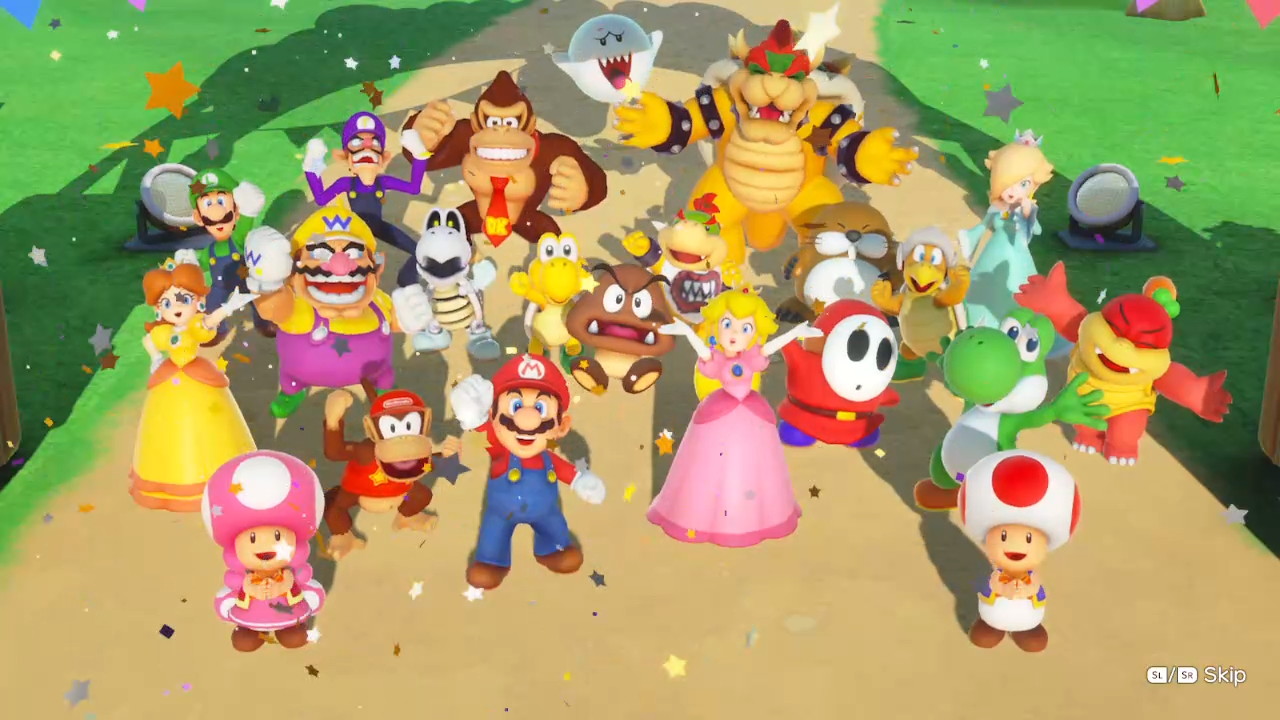
Now, after the major, breakout success of Super Mario Party on the Switch, breaking records for the series in a big way, now developer ND Cube (who took over the series with Mario Party 9) has what can be described as a "greatest hits" collection of Mario Party. A collection that is far greater than the rather dud of a party that the 3DS's "Mario Party: The Top 100" ended up being. This is Mario Party Superstars, offering five classic, remixed boards from the Nintendo 64 games, and a collection of over 100 mini-games selected from Mario Party 1-10. 

The flow of Mario Party Superstars harks back to the Nintendo 64 era of the Mario Party series. That makes sense since not only does Superstars borrow its collection of boards from the N64 trilogy of games, but it also features a heavier selection of mini-games from the earlier Mario Parties rather than the later ones. One could easily argue that this is because later Mario Party games relied more heavily on motion controls, which Mario Party Superstars does not include an option for whatsoever.

Reach Toadette with 20 coins to earn a much coveted Power Star.

Regardless, with each of the game's boards, the goal is the same: navigate around the myriad spaces to reach where Toadette is located. If a player has 20 coins (or 10 in some rarer occasions), they can purchase a Power Star from her. Some boards shuffle the location of where Toadette goes after a Star has been collected, while others Toadette remains in the same spot. Each turn players roll a dice block that goes from 1-10 and land on spaces around the boards with varying attributes. Some award coins, while some take them away. Some spaces reward lucky rollers with items, while others can initiate a battle mini-game or Chance Time, where the lander of the space hits a trio of dice block roulettes to determine which player gives what to whom, whether that be coins or worse case scenario: Stars.

Returning from earlier Mario Party games is that of items. Each player can purchase them from special stores around a given board for coins, and these range from adding spaces to a player's roll, slowing down another player, shuffling locations with another player on the board, stealing an item from another player, or being transported directly to the location of the Star. The economy in Mario Party Superstars offers lots of opportunities to earn coins and items due to the immense amount of Lucky Spaces and such, but this only adds to the fun in my book. It doesn't devalue any aspect of the game overall.

After a turn has ended, all four players participate in a mini-game for coins. Most mini-games have a familiar and similar payout of 10 coins for first place, 3 for second, 2 for third, and 0 for last place, but some are coin mini-games where players keep what they grab coin-wise in the mini-games. Depending on what space each player landed on in their turn, the type of mini-game can change from a free-for-all (where all players land on the same colored space) to a team-based mini-game like an even 2-vs-2 or a more skewed 1-vs-3. 

Revenge! In this mini-game, the bonk-ers have become the bonk-ees! 

The mini-games in Mario Party Superstars are all cherrypicked from past Mario Party games, namely the mainline numbered entries from the very first on the N64 to the Wii U's Mario Party 10. Most mini-games demand some level of skill to win (the occasional luck-based one does rear its head in, however, though these make for some hilarious moments, too), but each is easy enough to learn and is accessible enough to let all players enjoy themselves no matter their age or gaming experience. From mini-games where you bump into one another while rolling along bouncy balls, attempting to knock each other off a circular platform, to less stimulating games like carefully counting a cavalcade of parading, passing Goombas, the mini-games on offer are usually quick enough to never outwear their welcome. Well, that's save for a select handful, and these are usually dreaded when they come up in rotation by me.

Even though it's "Hammer Time", you definitely don't want to "stop" here in this mini-game!

Mario Party Superstars sports five unique boards: two from Mario Party with Yoshi's Tropical Island and Peach's Birthday Cake, two from Mario Party 2 with Space Land and Horror Land, and the odd game out, Mario Party 3, with only one represented board: Woody Woods. Each board has its own gimmicks to it. For example, despite its name, Yoshi's Tropical Island actually features two major isles. Both have a selection of spaces to move over, and are connected by two bridges guarded by hulking stone blocks known as Thwomps. Each time a player wishes to cross a bridge, they need to pay a coin toll. Players can raise the toll and set it as high as they can afford it to make it difficult for other players to cross. Meanwhile, stepping on specially marked green spaces results in the Toadette and Bowser's locations being switched, meaning that you can really mess over other players or yourself if you land on the right space at the wrong time. 

Even though it's Yoshi's Tropical Island, Thwomp doesn't play favorites.
Everyone's got to pay the toll to cross.

On the other end of the chaos spectrum with Mario Party Superstars are boards like Horror Land, where day and night passes every few turns, blocking pathways that were accessible during the day but are now unavailable at night and vice versa. Throw in a King Boo who can not only steal coins from all players, but also a single Star from each player (for the right price, of course), and you can have a high amount of havoc and hijinks.

And that's really what Mario Party as a series is known for: havoc and hijinks, and most players wouldn't have it any other way. If you're fine with the fact that the most skilled player doesn't always win, you're sure to have a terrific time. It comes down to a mixture of luck and skill, with sometimes a heavier focus on one over the other. You can do poorly in mini-games, and have your luck turn around with a stolen Star in your favor via Chance Time, or get rewarded via Bonus Stars at the end of the game from getting the best rolls or landing on the most spaces of some type. 

The most exciting part of Mario Party Superstars is that of online play. While Super Mario Party received online play via a late update, it never really cut the mustard in the end. I faced multiple disconnections, and at the same time, it was a bit too little too late, despite being most welcomed as an addition. Conversely with Mario Party Superstars, online play, with friends or random players, is present right out of the box, and overall, it works wonderfully. The game's stickers and stamps that can be used during the board sections of the game are great for communicating (or just grief-ing other players, of course, but *I* wouldn't do that...), and lag is surprisingly uncommon in games. 

Games can be saved and exited after a given turn to be picked up and resumed for later, and if a player exits mid-game, a CPU opponent takes over instead of just killing the game right then and there. Private lobbies can be made for friends, and these allow a lovely amount of customization of the rules. You can choose turn amount, if post-game Bonus Stars are on (and if they follow classic or modern Mario Party Bonus Star rules), and if you want to set a Star handicap for any particular players.

Hit a homer, and knock one (or several, ideally) out of the park in Dinger Derby.

Mario Party Superstars also sports its own series of achievements from completing certain in-game goals, some of which are tougher to obtain than others (especially those online-focused ones), and also its own shop. The shop, where you spend coins earned from participating in games, has a wide assortment of goodies--from stickers to spam with your friends and to total strangers alike, to songs to listen to outside of games, there is no shortage of extra stuff to unlock for players who would like some extended enjoyment out of their Mario Party if somehow just fun with friends and family isn't enough.

Some mini-games force would-be competitors to work together for some interesting dynamics.

There is one sizable issue I do have with Mario Party Superstars. While the five boards on offer are fun to play on, the amount is a bit paltry overall. The fact that Mario Party 3 does not have a second board is a bit of a shame, and it would have been nice to see some boards from later games in the series. Alas, perhaps as DLC or we'll just have to wait for a sequel for that. However, some more boards from Mario Party 1-3 would go a long way in extended the length and fun to be found in this game. 

Mario Party Superstars delivers a supersized party package that really feels like a proper successor to the Mario Party crown after all of this time. While for me, annual releases of the series did make for a dull series, requiring a change to the formula at the time, I'm very glad that ND Cube has returned the Mario Party series to its roots in utterly fantastic fashion. The number of boards is disappointing, and some mini-games chosen are a bit boring and worthy of a head scratch, but all in all, Mario Party Superstars is a bonafide bountiful bash worth celebrating with a few friends, family members, or thanks to online play, complete strangers as well.

[SPC Says: B+]

Saturday, June 27, 2020

Clubhouse Games: 51 Worldwide Classics (NSW) Review

The weekend is a great time to unwind and play a game or two... or one of 51! That's exactly what you get with Clubhouse Games: 51 Worldwide Classics for the Nintendo Switch, and here is SuperPhillip Central's review!

Nintendo's got game... and LOTS of them!


The original Clubhouse Games released on the Nintendo DS in 2005 as part of Nintendo's Touch! Generations lineup of casual-oriented software for the system. It brought about many digital family game nights and rowdy online sessions with friends alike almost 15 years ago. Now, it's 2020, and fortunately, Nintendo--with the help of Super Mario Party developer ND Cube--has decided to bring the series back out of long hibernation for a sequel. Clubhouse Games: 51 Worldwide Classics is no doubt packed with games from all around the world to enjoy, but some odd quirks stop it from being as terrific of a title as it could have been.

Clubhouse Games: 51 Worldwide Classics features--unsurprisingly--51 unique games from all around the world. You have various categories of games, from board games to parlor games, and card games to action games. There's definitely something for everybody in this collection of classic games.

While it was easy for me to dive in and play the games I already knew the rules for and enjoy them immediately, it was also a barrel of fun to pick up and learn the rules of new games, some of which I had never even heard of before this package. I'm alluding to titles like Mancala, Nine Man's Morris, Hare & Hounds, and Pig's Tail, for instance.

Mancala, pictured here, wasn't just one of the games I learned to play--it was one I learned to love.
Fortunately, each game not only houses an adorably cute opening video presentation of each game, complete with a family of wooden figurines interacting with one another in amusing ways, but the games have a comprehensive list of rules to interact with. For games like Chess and Shogi, for example, you can even turn on an assist grid that shows where there are safe and hazardous spaces for your pieces to move. Super helpful and there whenever you need them.

Clubhouse Games: 51 Worldwide Classics has easy-to-learn controls for players of all skill levels. Even playing with my game-averse dad was something that we both enjoyed, as he [eventually] learned the controls and even won a bunch of games--particularly some of his in-real-life favorites, Billiards and Bowling. The latter uses touch or Wii Sports-like motion controls so you feel like you're in a bowling alley yourself--save for the need to spend money on a rented pair of bowling shoes.

"Four-in-a-row!" More than just the name of the game; it's also the objective!
Multiplayer is of course a huge part of Clubhouse Games, and it works well enough with this Nintendo Switch sequel. The majority of the 51 classics in Clubhouse Games on Switch can be played locally on one screen. When you get to certain card games like Texas Hold'Em or the Uno-like Last Card, it gets trickier. You'll need a Switch for each player for these games, as they'd otherwise be impossible to play when everyone can see each others' cards. That said, only one copy of the game is needed across all Switches. The player or players without the game can download a free trial version of Clubhouse Games: 51 Worldwide Classics from the Nintendo eShop and link up with the Switch of the player who owns the full version. It's a charitable way to handle things--and moreover a most welcome one.

Texas Hold'Em is one of several games that requires multiple Switches to play locally.
What isn't so wonderful is playing multiplayer online, particularly with randoms. There is a twofold issue with Clubhouse Games: 51 Worldwide Classics' online on the Nintendo Switch. The first is that you need to have the Nintendo Switch Online app on a smart device to voice chat, which isn't new to Nintendo's online method with the Switch--just one that is woefully under-cooked and inefficient. Secondly, and most alarmingly, there is sometimes a hellish amount of lag present when playing online with other players. I'm not just talking about action-oriented games, either--I'm talked about turn-based ones as well, which is just amateurish from Nintendo. Considering the original Nintendo DS Clubhouse Games had competent online as well as voice chat directly in the game, and this Switch sequel has neither--and you're playing money to play online via Nintendo Switch Online--is an absolute travesty and unacceptable.

Still, as someone who prefers to play locally and with friends, Clubhouse Games: 51 Worldwide Classics' shameful online isn't that big of a deal, but for those who do want to play with players from across the country and around the world, it's a travesty. No hyperbole intended, either.

I'm having Mario Party flashbacks all of a sudden!
That said, even as a solo player in Clubhouse Games: 51 Worldwide Classics, there's plenty to accomplish. A clever medal system rewards players for beating the AI at various difficulties--and the AI can be quite challenging at later levels--and there's also some modest unlockables here and there. It will certainly take some time to play each game, master each game and, earn medals (which you can compare and contrast what medals other players on your friends list have for an alternate form of competition).

Sorry, Blue, but the old rope-a-dope technique won't save you here!
Clubhouse Games: 51 Worldwide Classics is one of those games that I see myself coming back to for the near and also distant future. It's perfect to bring out for parties, family get-togethers, and any not-so-special occasion as well, such as when you're bored and looking to play a quick game of Four-In-A-Row or Dominoes to kill some time. Though online is a ridiculously rough spot, Clubhouse Games: 51 Worldwide Classics is an otherwise highly competent and well put-together collection of gaming classics. Not all of the 51 games are winners, but the majority of the games brought and continue to bring loads of fun to the SuperPhillip household. I managed to accumulate armfuls of favorites. You certainly will, too.

[SPC Says: B+]

Sunday, October 21, 2018

Super Mario Party (NSW) Review

Next up on October's schedule of reviews is Super Mario Party. Ruin friendships on a brand-new system with the Mario Party series's debut on the Nintendo Switch. Here's SuperPhillip Central's review.

Party like it's 1999 all over again


...And that's sort of the premise behind Super Mario Party, the eleventh mainline installment in the nearly 20-year-old Mario Party series. Ditching the "everyone rides in the same vehicle" car mechanic from Mario Party 9 and seen again in Mario Party 10 that saw a tepid response from series fans, Super Mario Party brings back individual movement across nonlinear boards. The goal? Collecting more Power Stars than your opponents by the end of the final turn.

The Mario Party mode is the most traditional of modes within the series's debut on the Switch. You take turns rolling dice blocks (and this time around each character has their own specific dice block--in addition to the standard 1-6 roll available to choose from), and then explore the four boards of the game. While these boards are indeed smaller than in past Mario Party games, this means that there aren't many--or even any--turns where nothing really happens. In Super Mario Party, a host of things can occur--from players landing on event spaces that affect the board and/or players in a variety of ways, collecting Stars, buying items from Flutter, stealing coins or Stars via Lakitu, participating in special "Rumble" mini-games, or falling prey to one of Kamek's Bad Luck Spaces, something is always happening regardless of the turn number. The point here is that there are no "worthless" turns where everyone is just moving around the board with little interactivity going on.

The boards are smaller than what veterans may be accustomed to,
but they're absolutely dense with activities and happenings.

After each player has moved during their turn, a mini-game occurs--a staple of the Mario Party series. While developer ND Cube has failed at delivering the type of Mushroom Kingdom bash that could rival the prior developer of the series, the now-defunct Hudson, one aspect that stays strong and even outdoes the older Mario Party titles is the fantastic amount of mini-games available. Super Mario Party utilizes a single Joy-Con for all players, making it so those with just one set of Joy-Con controllers that came packaged with the Switch can enjoy the game with another player at the very least.

The mini-games in Super Mario Party use the Joy-Con controller in a myriad of ways. From moving the Joy-Con to fly safely through swarms of killer Fuzzy obstructions, to using the analog stick to dodge oncoming Chargin' Chucks in Gridiron Gauntlet, to holding the Joy-Con vertically to flip a cube of meat on a frying pan--feeling the rumble to determine when a given side is sufficiently seared, the mini-games are well done and all control great.

Somehow I'm thinking that our players aren't suited up safely enough for this mini-game...
But, Super Mario Party is more than just the standard Mario Party mode. Returning from Mario Party: Star Rush is what the game calls Partner Party, where two teams of two travel around the same four boards of the Mario Party mode, except these are built like grids. The goal of earning as many Stars as possible is the same, but this time around you have to land on the space where the Star-seller Toadette is in order to purchase a Star. As the turn amount left decreases, the amount of Stars you can buy at once from Toadette increases up to three Stars. This can make for some seriously hilarious come-from-behind victories.

Here's pie in your eye!
What also makes for some good comeback wins is the two bonus stars handed out at the completion of a game. These reward players with Stars for performing certain tasks within a given game, such as getting first place in mini-games the most, landing on the most red spaces, partnering up with the most allies, and so forth. A point of contention here is that the category of Stars rewarded is completely random, so you can't just shoot for a specific Star like the Mini-Game Star, as it might not be one of the two bonus Stars handed out. This can make for some aggravating losses where the player who was the most skilled and had the most Stars before the end isn't the winner due to two random Stars being given to second place, giving them the edge over the player who was winning the whole game. Others like myself will note that this is what Mario Party is all about as a series, so it's not too irritating. Perhaps only when trying to earn the game's five Gems, which unlocks the ending of Super Mario Party.

Partner Party most closely resembles Mario Party: Star Rush's board design.
Yes, the main objective of Super Mario Party is to earn five Gems from completing five specific modes within the game. This includes the already mentioned Mario Party and Partner Party modes, but it also includes Challenge Road, River Survival, and the Sound Stage modes. With Mario Party and Partner Party, you need to finish at least in third place on each of the modes' four boards. Again, these are just the same four boards across both modes, just reconfigured based on whether you're playing the more traditional Mario Party mode or the more free-roaming grid-based Partner Party mode.

Challenge Road serves as the main single-player mode within Super Mario Party. It opens up for play once you've unlocked all mini-games. Based on that prerequisite, you can probably guess what you do in Challenge Road, then. You compete against the AI in six different worlds, challenging them in all 80 mini-games, one-by-one. Many of the mini-games don't just require you to win them, but to reach a specific point amount or time within the games. If you fail a mini-game three times in a row, you get the option to bypass it. Otherwise, failure does not result in any penalty besides having to try the mini-game again. What I like about this mode is that you can get a refresher on the controls and instructions on the game prior to playing it.

Mini-games occur in free-for-all, 2 vs. 2, or like this mini-game, 1 vs. 3!
This is, in fact, something I really found useful in the main "Party" modes of Super Mario Party. You can practice as much as you want in the instructions screen of each mini-game. No more wasting time entering a loading screen just to practice a mini-game, when you can do so straight from the instructions menu. When every player is ready, they just hit one of the shoulder buttons to prepare for the game.

Meanwhile, River Survival is less about competing against other players and more about cooperating with them. Your goal is to paddle down a raging river with multiple paths, dodging obstacles while picking up timers and completing mini-games to add precious seconds to (hopefully) reach the goal. The different paths along the way offer different rafting challenges, and it's really to your benefit to try to paddle down them all. Teamwork is a major factor in this mode, as if all players are paddling madly at once, the raft all four players inhabit won't maneuver well--hitting any and every obstacle that wades in their way.

The unlikeliest of allies can work together for one common goal: reaching the end of this branching river!

Teamwork's also paramount to success in the various mini-games, initiated by ramming in to red balloons along the river's path. These are all co-operative mini-games, offering the team of river-riders more seconds depending on how fast they complete a mini-game or in other cases how many points they earn. One mini-game requires all players to communicate with one another to lift a fishing net at the same time, thus capturing as many Cheep-Cheep fish as possible. Another is a maze of blocks that requires players to collect gems and place them in the center of it. Some paths are closed off, making it so another player needs to stand on a switch to open it up for them.

Lastly, Sound Stage is an all-rhythm based collection of mini-games, where every mini-game has you swinging the Joy-Con in time with the music. There are visual indicators regardless, for those who lack rhythm (like some writer for SuperPhillip Central who will remain nameless). Sound Stage has three difficulties total, and while the mini-games are a blast to play, their presence is missed in the main Mario Party mode. As is, there are a lot of repeated mini-games in the Mario Party mode, and I can't help but think they'd be better served as additional free-for-all mini-games within other modes.

Speaking of repeated mini-games, there's the online component of Super Mario Party--which before your ask, no, there is no option to play full rounds of Mario Party or Partner Party online with friends. Instead, what's here is an Online Mario-thon which is a selection of 10 mini-games that are cycled through for players to engage in. Frankly, while I didn't mind this too much, an option for a traditional Mario Party experience online would have been greatly preferred and much appreciated. As is, I just spent $20 on a Nintendo Switch Online subscription, and the very first new Nintendo game with online has the bare minimum incorporated in to it. Not the most reassuring thing there.

Off the Chain gives the "1" in this "1 vs. 3" mini-game the fun of steamrolling their opponents.
Super Mario Party is a much welcome return to form for the franchise after some shaky attempts to mix things up. While I did actually enjoy what Island Tour and Star Rush had to offer gameplay-wise it's nice in a sense that I feel that I'm back "home" with regards to the Mario Party series. The new additions like the extra modes, the character-specific dice blocks that add a whole new level of strategy to the game (do I risk attempting to roll a 10 when at the same time rolling a 0 is a distinct possibility?), and the mini-games are truly a terrific showcase for the Switch's Joy-Con controller.

What isn't so great is the limited online options--especially after the arrival of having to pay just to play them--and the limited number of boards (and how small they are) compared to past games in the series might put some series veterans off.

Regardless, Super Mario Party is a bash that deserves to be celebrated. Mario Party is back, and Super Mario Party itself is one of the grandest shindigs Mario and the rest of the Mushroom Kingdom gang has ever held.

[SPC Says: B] 

Wednesday, March 28, 2018

Mario Party: The Top 100 (3DS) Review

Man, doesn't it feel like April! It's just felt like a really long month for March. It's almost like these reviews for March are late or something! Regardless, while I nervously sweat in this corner, check out this review of Mario Party: The Top 100 for the Nintendo 3DS.

A party where everyone goes home at 9:30


Mario Party has been around since 1999, where it initially debuted on the Nintendo 64. Since then, repeated sequels released that saw the party getting even crazier with new rules and strategies to consider. For instance, Mario Party 2 added items and duel games while Mario Party 9 added a car mechanic that put all four players in one vehicle, riding together across a linear board. The latter two numbered Mario Party games innovated on the franchise, though to many, it was for the worse. Still, that hasn't stopped developer of the series ND Cube from continuing to try its hand at mixing up the franchise.

Despite all of the changes to the formula that ND Cube and Nintendo have made to Mario Party as a series, one thing that hasn't been altered and one thing that remains a common element is that of the mini-games. Enter Mario Party: The Top 100 for the Nintendo 3DS. Now, taking ten mini-games from each mainline numbered Mario Party and putting them into one game sounds like the formula for easy success, right? Unfortunately, Mario Party: The Top 100 contains some issues that greatly detract from the overall experience, making for a party that ends too soon.

Right away if you like, you can leap right into the mini-games, selecting one of dozens that are initially already available. In order to have the full array of mini-games at your access, you'll need to partake in the single player campaign mode. This mode consists of moving across a New Super Mario Bros.-style map where instead of each spot on the map being a level to play, it's instead a mini-game. The mini-games start off with ones that are simple to grasp and win, and against AI opponents that pose little-to-no challenge whatsoever.

Minigame Island is Mario Party: The Top 100's short-lived single player mode.
As you progress through the four "worlds" of the single player mode, the AI gets more taxing, throwing at you "Hard" and "Very Hard" difficulty opponents as well as pitting you in 1 vs. 3 mini-games where you have to fend for yourself. It's never anything too daunting, as all you have to do is get better than last place in a mini-game to move on. If you fail a mini-game, however, you lose a life. Lose all of your lives, and it's game over. It's not as much of a pressure-filled situation as you might think at first because you're able to earn coins from completed mini-games and from specific coin roulette boxes that appear regularly on the map. While the goal is to just pass a mini-game without being in dead last, completionists will want to aim for first in every mini-game, as you're rewarded Mini-Stars for victories. Earn all of the Mini-Stars in the single player mode, and you earn an unlockable. Sadly, it's nothing as cool as a new character (there are no secret characters in Top 100), but it's an unlockable nevertheless.

One of the mainstays of Mario Party games outside of the obvious and already mentioned mini-games is that of the boards. It's always a blast to roll a die, plot a path through a board, and hope luck is on your side. With Mario Party: The Top 100, one of the important halves of the Mario Party experience is almost completely missing. What is here instead is in another mode of The Top 100, one for four players. It's a Mario Party: Star Rush-style board where all players roll a different die and move across the board simultaneously while moving around a grid-based board. This board commonly gets balloons of varying types floating down onto it, such as mini-game balloons and Power Star balloons. The goal of the mode is to earn coins by winning mini-games, landing on specific spaces, among other means, and purchasing stars from the popped Power Star balloons. The player at the end of the set number of turns is the winner. While at the beginning of the board, 1-3 Power Stars in a balloon are common, by the end of the game, there can be a Power Star balloon worth five stars to run into, though it does cost 50 coins to nab, as a Power Star costs 10 coins each.

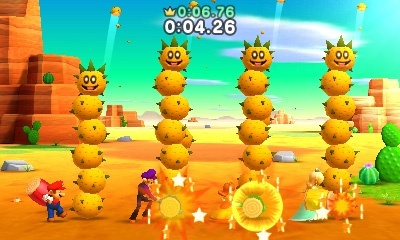
After being the bane of many players' existence in 2D Mario games,
doesn't it feel great to hammer these Pokeys to smithereens?
At the start of this mode, each player picks a package that possesses five mini-games. These are all themed in some way, whether they're sports mini-games, action mini-games, or mini-games from a particular Mario Party entry, to just name a few. Each time a mini-game balloon is popped, a mini-game selection screen comes up. Players select between their package of mini-games for the one they'd like to play, and a hand spins around a wheel with players hoping the hand lands in their portion of the wheel. Not only will they get their chosen mini-game selected, then, but they will also earn double the amount of coins based on their position in the mini-game. Being the one who popped the mini-game balloon nets the player more real estate space on the mini-game wheel in order to increase the chances their mini-game gets selected.

Either Yoshi's gotten larger or Waluigi, Luigi and Peach have gotten smaller.
This particular mode that is built for single players to compete against three AI opponents or for multiple human players (or a combination of both human and AI) is wonderfully fun and worth playing. It's a really cool take on the Mario Party formula. The big problem with this mode, though, is that there is only the one board. Again, Mario Party is all about the boards, and seeing a Mario Party game have so little to offer when it comes to that is severely disappointing. There are only so many times you can play the same small board over and over again before you get tired of it and the mode in general. It happens as quickly as you might think, too.

That's the main problem with Mario Party: The Top 100 that seeps through the game's other modes. There is just too little content in the modes, so much so that you'll only want to play through them once and then realize you've seen everything they have to offer. With The Top 100, there is no real mode with enough longevity and variety to complement all of the excellent mini-games (stupid, luck-based ones notwithstanding) the game contains.

Ah yes. If it isn't my old nemesis, Bowser's Big Blast.
Those darn eyes counting down to my destruction will forever haunt my dreams.
It's a shame, too, because the mini-game selection in Mario Party: The Top 100 is really dynamite. There's a lot to like with fan faves like Bumper Balls, Shy Guy Says, Face Lift, Hexagon Heat, Slot Car Derby, Speed Hockey, Chip Shot Challenge, Eatsa Pizza, Ice Rink Risk, Three Throw, Trace Race, Dinger Derby, Later Skater, Snow Whirled, Track & Yield, Aim of the Game, Speeding Bullets, Tackle Takedown, Jewel Drop, and Soar to Score. The embarrassment of enjoyable mini-game riches only makes it hurt even more that they're not tied into a better package of modes. Instead, all you have is a sequence of repeated mini-games that shortly becomes monotonous to play for an extended length of time. These little gameplay bursts aren't enough to hold a game on their own, and this is where Mario Party: The Top 100 seriously disappoints.

Poor Luigi gets the shock of his life in Track & Yield.
While Mario Party: The Top 100 is not an awful game, it is an awful entry in the Mario Party series. It misses the point of what makes the series so entertaining. It isn't just the mini-games that fans love about Mario Party; it's the combination of the mini-games, the boards, and the strategy of play that fans continue to crave from the series. Even with Download Play where only one person needs the game to allow other 3DS owners to play on their own systems as a cool inclusion, as is, Mario Party: The Top 100's collection of mini-games, while mostly pleasing, come in a package that is just too shallow to wholeheartedly recommend.

[SPC Says: D+]

Wednesday, November 16, 2016

Mario Party: Star Rush (3DS) Review

A new review is here for your Wednesday night. Mario Party: Star Rush is the latest in the long-running franchise that debuted way back on the Nintendo 64. The series has seen a lot of changes and shake-ups to the formula as of late. Star Rush is another one of those examples. See if this installment's new rules make for a fun take on the formula with the SuperPhillip Central review.

Mario and ND Cube's Party Politics 


Mario Party has seen a bit of a metamorphosis over the years. It wasn't that long ago that many critics and fans were growing tired of the series, bored with the same old, same old. When ND Cube was founded, the developers there became the new team behind Mario Party. Their first foray was Mario Party 9, and to its credit, the game did try to change things up, despite not being a fan favorite. Now, ND Cube is at it again, trying to shake things up to make what many had considered a stale series into one with new life. Mario Party: Star Rush is the second game in the series on the Nintendo 3DS, and after devoting quite a bit of time with it both alone and with friends, it's without a doubt my favorite Mario Party from ND Cube so far, and just a good party game in general.

Toad Scramble is the main mode of Mario Party: Star Rush, and it is front and center in the game, being the only mode available from the beginning. By playing games and finishing rounds, you earn experience points that when you reach the next level, you unlock a new piece of content, whether new modes or unlockable characters like Rosalina and Donkey Kong.

The premise of Toad Scramble pits four Toads against one another on a grid-like board of which there are five "worlds" devised up of three board designs each. This isn't your traditional linear board design of past Mario Party games. Also different in Toad Scramble and many other modes in Star Rush is the ability for all players to roll a die at the same time. When you've rolled, you can go from your current location and move spaces nearby on the grid in any direction you want. You just can't go back and forth between the same spaces, and that is pretty much the limit to the limitations of movement.

Toads can land on item spaces to get items to boost their dice rolls, Poison Mushrooms to punish a player and stifle their roll amount, and a warp block to immediately transport to another Toad's space. In addition to item spaces, coins are littered on boards, serving as a means to buy items from special item shop spaces as well as giving players a Power Star for every ten coins they hold at the conclusion of the game.

Plot a course through one of 15 themed boards in Toad Scramble.
Occasionally, several assist and support characters from the roster of playable characters appear on the boards in Toad Scramble. Reaching them and passing by their space puts them on your team. Not only do they give you bonus movements from your rolls, they also have unique dice blocks they can use and special abilities on boards. For instance, Mario and Luigi can sometimes find a Goomba in a patch of grass to stomp on, earning that player five coins each time it happens. When two Toads land on the same space and one or both of them have an ally on their team (each Toad can have up to four allies at once), a very brief ally battle ensues, where the winner takes one of the loser's allies. These ally battles range from picking a higher numbered card than the opponent or timing a button press so the player is the closest to five seconds.

The means to progress in Toad Scramble is to reach the current boss on the board. This is done by having a player roll the exact number needed to land on the boss space, initiating the boss mini-game. Once a boss has been defeated, the next boss appears somewhere else on the board. Some boards are quick engagements with only three bosses to contend with, but other boards with more expanses to them offer up to five bosses to beat. The winner of a boss mini-game earns a Power Star. Other players earn a varied amount of coins. The final boss mini-game is worth double the reward for each player.

Land directly on a boss space to engage in a boss mini-game. You're goin' down Mega Monty Mole!
The player or players who land on the boss space earn a five coin bonus as well as being able to play from the beginning of the boss mini-game. Depending on how far away the other players were from the boss space, they will have to mash the A button to reach the boss space and enter into the mini-game, so it's crucial to at least be near the boss space when the mini-game begins. The alternative is giving one player a great advantage. Another advantage one can gain from boss mini-games is the ability to have all allies on your team play with you as AI helpers. In games where each shot on the boss is worth a point, one can earn a ridiculous amount of points, making victory all but assured.

You'll definitely get by with a little help from your friends.
Toad Scramble is quite an engaging mode and fresh take on the Mario Party series. There is a decent amount of strategy to be found and actual skill seems to be rewarded way more than luck is. If you play smartly, you'll usually find yourself the victor, unless you totally fail at the mini-games being played.

After doing some playing in Toad Scramble, you'll unlock the Coinathlon. This mode features a multi-lap race around an oval racetrack, where how you perform in the mini-games determines how much you move. You're constantly cycled between three mode-exclusive mini-games, and each coin you collect as you play these solo games makes you move one space on the racetrack. After all three mini-games are played, you start at an upgraded version of the mini-games, playing as many levels of these games as necessary until someone crosses the finish line. It's a fun mode to play against friends, but it's also rather rewarding trying to take on CPU opponents, attempting to win ten rounds against progressively harder opponents.

Then there is Balloon Bash. This is also a mode where everyone moves at the same time, just like Toad Scramble, but instead of playing as only Toads, you play as any member of the cast of Star Rush. Balloon Bash, as the name hints, has players moving around small boards trying to collide with various balloons. Some offer coins that begin mini-games, which happens a good amount in this mode. Others offer up to three Power Stars if you have enough coins to buy them (it's 10 coins per star). After a set number of rounds, the game is over, and whomever has the most Power Stars is deemed the victor. While Balloon Bash takes on a more traditional board game style, it can be highly dependent on the luck of the role of the dice. If you happen to get caught with low rolls, you might find you win all of the mini-games but end of with a limited amount of stars due to not reaching specific balloons.

Luigi's ready to cash in some coins for three Power Stars in Balloon Bash.
Other modes include the utterly boring Mario Shuffle, where two teams of three characters try to reach the opposing side's end of the board through strategic rolls of the dice. The total lack of mini-games and little variety make for a challenging game to enjoy more than once, if even that. Then there's Rhythm Recital, a rhythm-based mini-game where you play one of four instruments, tapping the screen as triggers appear on the screen, while you play along with one of many classic Super Mario series songs. As you rank well, new songs unlock. Finally, two puzzle modes: one falling block game to play against a human or AI opponent, and a game where you have to plan out a route to climb a tower, trying to use logic to avoid spaces where Amps lie, round out the package.

Wario on drums. What could possibly go wrong?
While Mario Party: Star Rush sports a smaller amount of mini-games than what most fans are probably used to, what games there are are quite fun. Very few are dependent on luck at all, which is great. Some use traditional button controls while others make use of the touch screen and stylus controls. Whether you're using two jump buttons, one that jumps one space and one that jumps two spaces, to climb up a series of steps where some are hazards; racing through a series of haunted rooms to find where the exit is; or doing something as elementary as counting how many oranges are carried through a dining hall by Shy Guys, the mini-games featured in Star Rush are varied and mostly enjoyable. Like more recent Mario Party games, certain mini-games, like races, for instance, aren't over as soon as first place is determined. Instead, it ends when third place finishes. All mini-games award coins to first through fourth place, with obviously the winner receiving the most coinage and fourth place receiving a pity coin for their efforts.

A new take on an old classic: Luigi loses by doing nothing.
The boss mini-games have different goals to them than the standard mini-games. These are all about beating a boss somehow or making the gauge reach maximum. For instance, in the Mega Goomba boss mini-game, the game ends when enough apples have been brought back to the starting basket. Whereas with a battle against Petey Piranha where shells must be thrown into the boss to earn points, this game ends when Petey's health has been completely emptied. The player who scores the final "hit" in a boss mini-game earns a three point bonus, which can sometimes be the difference between a first place finish and a second place one in more heated matches.

Gather apples and return to them to the starting basket to earn points in this Mega Goomba boss mini-game.
Mario Party: Star Rush may lack an online component, as all the games in the series do, but it more than makes up for that with its local multiplayer offerings. One player with the full game can have other 3DS players use Download Play to join their room. With the free Mario Party: Star Rush Party Guest software, available on the Nintendo 3DS eShop, those who have a friend with the full game can join their lobby, getting access to play with that player and all of the content they have unlocked. The Party Guest software even tracks experience points and earns unlockables. So if you're sad that you can't play with someone from across the nation or around the world, there is some solace to be found in the fact that you can practically play the full game with anyone nearby with their own 3DS system, as long as one of you owns the full version of the game.

Mario Party: Star Rush's mini-games are mostly short and sweet bits of gaming goodness.
ND Cube has long tried to find a working formula for the Mario Party series. I think they have now found it with Mario Party: Star Rush. As the main mode, Toad Scramble is a brilliant shift to the long-standing rules of the series, offering less downtime and more entertainment compared to previous ND Cube-developed Mario Party games. Not all of the modes in the game are winners, but overall, Mario Party: Star Rush aims for the stars and doesn't crater by any stretch of the imagination.

[SPC Says: B-]

Friday, March 27, 2015

Mario Party 10 (Wii U) Review

The work week ends and the weekend begins with celebratory fashion. Party hard with Mario and friends in the tenth installment of the Mario Party franchise, Mario Party 10. Is this party worthy of RSVPing to? Find out with my in-depth review!

Bowser's crashed this party. It's recommended
that you go ahead and crash it, too.


Mario Party games used to be like Maroon 5. It was everywhere, and you couldn't get away from it no matter how much you'd want to and how many times you'd smash your head against a brick wall to suffer enough brain damage to forget it forever. However, over the years and with a change of development team (Hudson to ND Cube, which to be fair is made up of former Hudson employees), Mario Party has dialed it back a bit. For instance, the Wii only had two Mario Party games released for it when the Nintendo 64 and GameCube had three and four respectively. Now, over 15 years later since his very first party, Mario is back with friends (and a ticked off Bowser) in Mario Party 10, the first entry to hit the Wii U. Does this party deliver a fiesta of fun?

Mario Party 10's main mode, the aptly titled Mario Party, is structured similarly to Mario Party 9's. It has all four players riding along a fairly linear board, occasionally offering a duo of paths to venture down, in the same vehicle. The player whose turn it is controls the vehicle by rolling a die, and whatever spaces they land on or events they pass through happen solely to them. The goal of the Mario Party mode is to possess the most Mini Stars by the end of the board. This is performed through playing mini-games which happen sporadically through landing on special spaces, collecting coins from special event spaces, and a myriad of other means.

Mushroom Park, the first of only five boards.
Captain events from Mario Party 9 are absent, but this is seen by me as a good thing. Captain events had the player who controlled the vehicle upon reaching the event the choice of trying to influence the game with some strategy. However, these events generally took so long that they became annoying on repeated play-throughs. With Mario Party 10 removing these, play is much faster.

The player in control of the vehicle is about to get
that bundle of Mini Stars laying there.
In fact, play in general in Mario Party 10 is much faster and streamlined. Gone is the waiting for a CPU player to choose a special dice block in their possession and slowly rolling it. Instead, the block is chosen without any scene showing them selecting it, and they roll. Mini-games load faster, offering simple explanations via a quick video and short, scrolling description. There's little "now what button do I press again?" in this Mario Party.

The Mushroom Kingdoms crew will do just
about anything for their daily dose of Vitamin C.
In the Mario Party mode, there are five boards to play on, a departure from past games that usually have six full boards at the very least. These boards feature plenty of chances for the tides to turn, allowing some players to make a daring comeback-- perhaps TOO many. It can seem sometimes that the first 75% of a board has little bearing on the outcome of a game when the last 25% has a heavy influence on who is deemed the winner and who goes home a last-second loser... and an understandably bitter one at that. When one board has it where if you end up in the path of a fireball near the end and you lose half of your Mini Stars-- which is very easy to do-- games can be decided a bit unfairly at times. What's the point of playing the first three quarters of a board, you might ask? That would be a good question, in all honesty.

Halfway through and at the end of each Mario Party mode board is a fortress that serves as a place in a game for one of two boss mini-games. These pit four players against one boss with the goal of earning the most hits against the boss to earn the most points. There are mini-games where you try to memorize and avoid the locations of Boos to traverse a series of tiles leading to one of many spotlights to shine in King Boo's naught face, and games where you try to stumble your way through a maze to reach one of four cannons first to blast a colossal Monty Mole.

A barrage of bombs are blasted in Petey
Piranha's unattractive mug.
Meanwhile, Bowser Party pits four players against Bowser, once again highlighting the Wii U's ability to use asymmetrical gameplay in a beneficial way. The four players use Wii Remotes while the Bowser player utilizes the Wii U GamePad for rolling die and controlling one of ten specially made mini-games for this mode.

Each player on the competing side begins in the same vehicle with a set amount of hearts. Each player rolls a die, earning a special and quite helpful dice block when they land on a blue space. These can be used strategically to gain create some distance between the players and Bowser. Once the players roll, Bowser gets several dice blocks to roll at once. Depending on how well or poorly the Bowser player does, the always loyal Bowser Jr. either assists his father with the addition of more dice blocks or to cause havoc for the other players.

Faced with the other option of being destroyed
by Bowser, I think it's understandable to run away.
When Bowser catches up with the other players, a mini-game begins with the goal of Bowser to defeat the other players (or at least rough them up real good) and for the other side to just survive. The mini-games have Bowser employing a varied amount of means to damage the other players, costing them hearts in the process. All the while the players need to evade Bowser's assaults. One mini-game has the players needing to quickly alternate between the A and 2 buttons to climb up a tower to avoid Bowser's advances, who pursues and shuffles up behind them. The majority of the mini-games are all about dodges Bowser's attacks with just one of them being based on luck for both sides. The mini-games seen in Bowser Party are fun to play, much like the other mini-games in general, but I can't help but wish there were at least five or ten more. With only ten mini-games total in Bowser Party, one can fly through all of them within one or two games.

Careful, Mario and friends, or Bowser
is going to hand it to you-- literally!
The most controversial mode in Mario Party 10 is Amiibo Party, controversial due to the fact that it's hidden behind a paywall, the price of an amiibo figurine. This is closest to the traditional Mario Party rules of old. There are ten turns, and four players roll the die to move around a square board. The goal is to earn coins either through the mini-games that play after each round of turns is over or through landing on special spaces and areas to afford Power Stars. The player with the most Power Stars at the conclusion of ten turns is deemed the winner.

Depending on the Amiibo used, the board in
Amiibo Party will have different properties to it.
While it definitely stinks that you have to possess a $12-$13 figurine to play this mode, it sort of is offset by Mario Party 10 costing $50 MSRP instead of the full $60. Buying a figure makes it so you're basically paying the price of a full game anyway. Those mental and financial gymnastics by me aside, this isn't optimal for most people, especially those on a budget. It definitely is geared towards those who collect amiibo like myself. It's sort of underhanded by Nintendo and ND Cube to have a mode locked behind requiring a $12 toy.

Mario Party 10's mini-games are one of the best batches in series history. There are a lot of things you can slight developer ND Cube for with their installments of the Mario Party series (9, 10, and the Nintendo 3DS's Island Tour), but the mini-game selection is not one of them. Games are played in a free-for-all setting, 2 vs. 2 team setting, or 1 vs. 3 setting. Thankfully, the majority of these are skill-based with maybe just one relying a little on luck.

I don't want your honey-- honest! Leave me "bee"!
The games presented here in Mario Party 10 are generally really fun. Bob-Omb Bogey, for instance, has players trying to be the first to hit a golf ball that appears onto a tee to earn the most points. However, occasionally a Bob-Omb appears, which takes away points if it's hit by a player. Beeline Shrine features a challenge of avoiding bees that appear in various patterns. Meanwhile, Snake Block Party is a bit of platforming peril, having players scurry along in the sky on moving snake blocks, trying to reach the goal first.

Mario fans finally get that paintball game
that they have been wanting.
Outside of the three main modes, there are multiple miniature modes in the mix as well, such as Coin Challenge that pits four players to compete in a series of seven randomly selected mini-game to determine the winner by coin amount at the very end. There are also two more complicated mini-games in the form of Badminton Bash and Jewel Drop.

This mini-game looks simple enough,
but then you get tilt controls to worry about.
In addition to the modes presented in Mario Party 10, you can spend Mario Party Points earned from playing the game on various in-shop items in Toad's Room. From two secret characters to different vehicles for Mario Party mode, backgrounds and character models for the Photo Mode (which you can share your pics with folks on Miiverse), and music, there's a lot to spend your hard-earned points on. There are also challenges that unlock when specific conditions are met, earning players hundreds of Mario Party Points and adding some longevity to Mario Party 10 in the process.

Ground pounds are a hazard to your butts, kiddies.
Make note of this.
Many of the modes in Mario Party 10 offer a more streamlined approach, and it seems that has bled over into the presentation of the game, too. Basic and minimalist menus are what Mario Party 10 delivers, and while they look serviceable enough, I do miss the personality that was apparent in the presentation of past Mario Party games. What is present in Mario Party 10 is much more sterile in comparison. The visuals are quite pleasant on the other hand, possessing tremendous amounts of character and polish. This is best displayed in the mini-games, which are bursting with personality. The music features competent melodic tunes with a suitably amount of cheeriness to them, though nothing that I could currently hum back to you. They just aren't that memorable this time around.

Mario Party 10 might not be the great game that fans were hoping for the milestone tenth installment, but it's a fun game in small doses and solely if you have other friends to play with. A lack of online play of any kind-- even if just for mini-games, is pretty much inexcusable in 2015, once again showing Nintendo's archaic stance on online play, and hiding Amiibo Party behind a $12 paywall is sort of slimy. However, with some of the best mini-games ever seen in a Mario Party game, great boards, and a wide selection of playing choices, Mario Party 10 manages to make for a hearty party.

[SPC Says: C+]