Showing posts with label party game. Show all posts

Wednesday, March 28, 2018

Mario Party: The Top 100 (3DS) Review

Man, doesn't it feel like April! It's just felt like a really long month for March. It's almost like these reviews for March are late or something! Regardless, while I nervously sweat in this corner, check out this review of Mario Party: The Top 100 for the Nintendo 3DS.

A party where everyone goes home at 9:30


Mario Party has been around since 1999, where it initially debuted on the Nintendo 64. Since then, repeated sequels released that saw the party getting even crazier with new rules and strategies to consider. For instance, Mario Party 2 added items and duel games while Mario Party 9 added a car mechanic that put all four players in one vehicle, riding together across a linear board. The latter two numbered Mario Party games innovated on the franchise, though to many, it was for the worse. Still, that hasn't stopped developer of the series ND Cube from continuing to try its hand at mixing up the franchise.

Despite all of the changes to the formula that ND Cube and Nintendo have made to Mario Party as a series, one thing that hasn't been altered and one thing that remains a common element is that of the mini-games. Enter Mario Party: The Top 100 for the Nintendo 3DS. Now, taking ten mini-games from each mainline numbered Mario Party and putting them into one game sounds like the formula for easy success, right? Unfortunately, Mario Party: The Top 100 contains some issues that greatly detract from the overall experience, making for a party that ends too soon.

Right away if you like, you can leap right into the mini-games, selecting one of dozens that are initially already available. In order to have the full array of mini-games at your access, you'll need to partake in the single player campaign mode. This mode consists of moving across a New Super Mario Bros.-style map where instead of each spot on the map being a level to play, it's instead a mini-game. The mini-games start off with ones that are simple to grasp and win, and against AI opponents that pose little-to-no challenge whatsoever.

Minigame Island is Mario Party: The Top 100's short-lived single player mode.
As you progress through the four "worlds" of the single player mode, the AI gets more taxing, throwing at you "Hard" and "Very Hard" difficulty opponents as well as pitting you in 1 vs. 3 mini-games where you have to fend for yourself. It's never anything too daunting, as all you have to do is get better than last place in a mini-game to move on. If you fail a mini-game, however, you lose a life. Lose all of your lives, and it's game over. It's not as much of a pressure-filled situation as you might think at first because you're able to earn coins from completed mini-games and from specific coin roulette boxes that appear regularly on the map. While the goal is to just pass a mini-game without being in dead last, completionists will want to aim for first in every mini-game, as you're rewarded Mini-Stars for victories. Earn all of the Mini-Stars in the single player mode, and you earn an unlockable. Sadly, it's nothing as cool as a new character (there are no secret characters in Top 100), but it's an unlockable nevertheless.

One of the mainstays of Mario Party games outside of the obvious and already mentioned mini-games is that of the boards. It's always a blast to roll a die, plot a path through a board, and hope luck is on your side. With Mario Party: The Top 100, one of the important halves of the Mario Party experience is almost completely missing. What is here instead is in another mode of The Top 100, one for four players. It's a Mario Party: Star Rush-style board where all players roll a different die and move across the board simultaneously while moving around a grid-based board. This board commonly gets balloons of varying types floating down onto it, such as mini-game balloons and Power Star balloons. The goal of the mode is to earn coins by winning mini-games, landing on specific spaces, among other means, and purchasing stars from the popped Power Star balloons. The player at the end of the set number of turns is the winner. While at the beginning of the board, 1-3 Power Stars in a balloon are common, by the end of the game, there can be a Power Star balloon worth five stars to run into, though it does cost 50 coins to nab, as a Power Star costs 10 coins each.

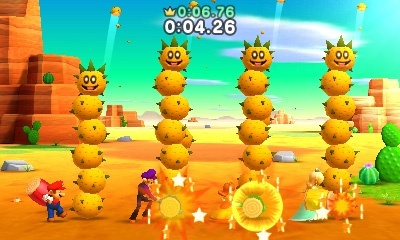
After being the bane of many players' existence in 2D Mario games,
doesn't it feel great to hammer these Pokeys to smithereens?
At the start of this mode, each player picks a package that possesses five mini-games. These are all themed in some way, whether they're sports mini-games, action mini-games, or mini-games from a particular Mario Party entry, to just name a few. Each time a mini-game balloon is popped, a mini-game selection screen comes up. Players select between their package of mini-games for the one they'd like to play, and a hand spins around a wheel with players hoping the hand lands in their portion of the wheel. Not only will they get their chosen mini-game selected, then, but they will also earn double the amount of coins based on their position in the mini-game. Being the one who popped the mini-game balloon nets the player more real estate space on the mini-game wheel in order to increase the chances their mini-game gets selected.

Either Yoshi's gotten larger or Waluigi, Luigi and Peach have gotten smaller.
This particular mode that is built for single players to compete against three AI opponents or for multiple human players (or a combination of both human and AI) is wonderfully fun and worth playing. It's a really cool take on the Mario Party formula. The big problem with this mode, though, is that there is only the one board. Again, Mario Party is all about the boards, and seeing a Mario Party game have so little to offer when it comes to that is severely disappointing. There are only so many times you can play the same small board over and over again before you get tired of it and the mode in general. It happens as quickly as you might think, too.

That's the main problem with Mario Party: The Top 100 that seeps through the game's other modes. There is just too little content in the modes, so much so that you'll only want to play through them once and then realize you've seen everything they have to offer. With The Top 100, there is no real mode with enough longevity and variety to complement all of the excellent mini-games (stupid, luck-based ones notwithstanding) the game contains.

Ah yes. If it isn't my old nemesis, Bowser's Big Blast.
Those darn eyes counting down to my destruction will forever haunt my dreams.
It's a shame, too, because the mini-game selection in Mario Party: The Top 100 is really dynamite. There's a lot to like with fan faves like Bumper Balls, Shy Guy Says, Face Lift, Hexagon Heat, Slot Car Derby, Speed Hockey, Chip Shot Challenge, Eatsa Pizza, Ice Rink Risk, Three Throw, Trace Race, Dinger Derby, Later Skater, Snow Whirled, Track & Yield, Aim of the Game, Speeding Bullets, Tackle Takedown, Jewel Drop, and Soar to Score. The embarrassment of enjoyable mini-game riches only makes it hurt even more that they're not tied into a better package of modes. Instead, all you have is a sequence of repeated mini-games that shortly becomes monotonous to play for an extended length of time. These little gameplay bursts aren't enough to hold a game on their own, and this is where Mario Party: The Top 100 seriously disappoints.

Poor Luigi gets the shock of his life in Track & Yield.
While Mario Party: The Top 100 is not an awful game, it is an awful entry in the Mario Party series. It misses the point of what makes the series so entertaining. It isn't just the mini-games that fans love about Mario Party; it's the combination of the mini-games, the boards, and the strategy of play that fans continue to crave from the series. Even with Download Play where only one person needs the game to allow other 3DS owners to play on their own systems as a cool inclusion, as is, Mario Party: The Top 100's collection of mini-games, while mostly pleasing, come in a package that is just too shallow to wholeheartedly recommend.

[SPC Says: D+]

Monday, February 27, 2017

Runbow: Deluxe Edition (Wii U) Review

As promised, I end my birthday with a bang with the second of two reviews, and what better way to celebrate a birthday than with a party... game! Like Hue before it, we have another game with a color-switching mechanic. However, this one is totally involuntarily and, as stated, is a party game as well as a platformer. It's Runbow, but not the digital version-- no, the retail release from this past November, Runbow: Deluxe Edition!

Runbow, party of up to nine? Your fun is waiting.


13AM Games was a brand-new indie studio when they released Runbow back in 2015 on the Wii U. It saw moderate success, so much so that a year later the game received a special retail release. That physical version of the game is Runbow: Deluxe Edition, and it's all the fun of the Runbow experience without taking up room on your Wii U hard drive!

Runbow at its core is a fast and frenetic 2D platformer that feels great to play. What separates it from other indie darlings of the platforming variety is the game's constant color switching mechanic, where the background routinely shifts between different colors. When the screen shifts colors, say from red to yellow, what platforms were yellow have now disappeared into the background, and what platforms were red, previously removed, appear to platform on. Initial levels bounce slowly between two colors while later challenges task you with running through obstacle courses that routinely shift between a multitude of colors at a rapid pace. This background color-changing mechanic not only forces you to be aware of where the visible platforms are, but it also forces you to be cognizant of when they will vanish and where new ones will appear.

This multiplayer match of survival is just as hot and heated as the lava here!
Despite its poor sales, the Wii U happily established itself as the local multiplayer machine when compared to the PlayStation 4 and Xbox One (though that isn't to say that those systems lack games for local couch play). Runbow cheerfully leaps into the local multiplayer library of the Wii U, offering up to nine players locally with the use of Wii Remotes, Nunchuks, Wii Classic Controllers, the Wii U Pro Controller, and of course the Wii U GamePad.

Local multiplayer's competitive offerings sport four unique modes. You get standard races where the goal is to foil your opponents with or without the aid of items to reach the level's goal, a trophy. You also have the wicked and wild king-of-the-hill style mode, which sees each opponent trying to stand on a level's platform for a specific amount of time (though this does not need to be done all in one mounting of the hill). Then, there is pure survival, where opponents attempt to slam others off the level into lava or some other type of hazard, and the player left standing is the victor. Finally--and this is the mode that unlike the other competitive multiplayer modes, cannot be played online-- is Defeat the Color Master, where the GamePad player does the background color-switching themselves, doing their best to foil his or her opponents run to the goal by tricking as well as tripping them up.

Don't worry, you can very much become the queen of the hill too.
Outside of those competitive modes, there is the opportunity to play cooperatively in the Adventure mode. You can also play this mode by oneself, which for some of the level designs, the mode works best this way. Regardless, whether alone or with a friend (three or more is usually a recipe for disaster-- though a fun disaster), Adventure mode comes complete with over 120 levels (including the DLC levels of Satura's Space Adventure) set across several grids. Since levels are usually less than a minute to complete, deaths aren't annoying despite putting you back at the start of your run.

It's a rainbow stampede of colorful characters all vying for that prestigious trophy.
The sense of progression in Adventure mode is nice and nonlinear, having adjacent levels on the grid open up next to the one just completed. If a particular level proves too much of a challenge currently, you can try a different level and path to the opposite corner of the grid's starting position. At this corner is a boss level, quite similar to most of the traditional levels only there's a boss to smack at the level's end.

Other than running for the goal, there are two other level types, though rarer in appearance: one where you take out a set number of enemies, and one where you need to collect a certain number of trinkets.

It's just fine and dandy to simply complete each level, but you also can earn up to three stars based on your completion time of each level. As rewards such as achievements and bonuses like concept art are unlocked through acquiring stars on levels, it's a good motivation to try your best and master the Adventure mode.

Don't just complete Adventure mode levels-- race to the finish to score those wonderful three stars!
Achievements and art aren't the only types of unlockables in Runbow: Deluxe Edition either. Performing certain tasks unlocks a host of indie and downloadable game all-stars, sort of like a Super Smash Bros. of indie characters. Whether it's Commander Video from the Bit.Trip series, Gunvolt from Inti Creates' Azure Striker Gunvolt, Freedom Planet's Lilac, Rusty from Image and Form's SteamWorld series, or an abundance of other characters who are purely visual in difference (possessing different animations as well as funny taunts to annoy your opponents), the amount of different characters both familiar and new to play as is really cool.

This familiar cast of characters is just half of the indie faces available to unlock in Runbow: Deluxe Edition.
The Adventure mode isn't the only single-player or cooperative mode available. Once you think you've become an expert at Runbow's massive amount of challenge, the game will prove your thinking wrong with the Bowhemoth mode. This mode has you running through increasingly more difficult chambers, one after the other without the ability to save. Making it to the finish is quite the challenge, and doing so with limited deaths or in a fast time (both things that aren't mandatory to do, but they are for unlocking certain content) are even more arduous of tasks. You're a near Runbow master if you can stay strong and persevere the Bowhemoth's challenges.

As stated, part of the fun of Runbow is how simple it is. That goes for the controls as well, which are as pick-up-and-play as any game I've recently played. There are but three actions in Runbow: moving, jumping, and punching. You can double jump and use your punch as a final boost either upward or to the side. Though the punch can see your cooperative buddies occasionally throwing shade at you for hitting them into a pit. However, this uppercut move is great for defensive reasons, such as getting extra height or rescuing yourself with a last second save. The only issue with the punch is that it's so easy to double tap the punch button that you might do a dashing punch when you don't want to and at an inopportune time.

Keep an eye on the background in order to gauge which platforms will be safe to jump on and off of.
What separates the original version of Runbow and this Deluxe Edition? Well, obviously other than one being digital only and one being a physical disc with a voucher to digitally download the peppy salsa soundtrack, the Deluxe Edition has all the individual DLC packs included without multiple separate downloads. You're technically paying the same amount of money whether you get the digital version and all the separate DLC packs or the physical Deluxe Edition with everything included. The only big differences are freeing up some much-needed space on your Wii U's hard drive and the included voucher for the soundtrack.

I've read that the original version of Runbow initially suffered from performance problems that greatly affected the frame-rate, something that would be seriously annoying for a precision and timing-based platforming game like this. However, and for at least the Deluxe Edition, these performance problems have been completely ironed out. No frame-rate issues of any kind were experienced through my 10+ hours with the game. The only concerning part of Runbow, regardless of which version you get, is that the online isn't too popular anymore. Definitely make sure you have friends or family members to play with.

Runbow: Deluxe Edition takes everything players loved about the original Wii U exclusive and makes it available in physical form. For those who were new to the game like me, then you'll get a bevy of awesome content, crazy multiplayer, and a tremendous amount of laughter. While the Adventure and Bowhemoth modes won't last you too terribly long, Runbow: Deluxe Edition definitely deserves a space in your Wii U library, especially if you don't already own the original digital release.

[SPC Says: A-]

Wednesday, November 16, 2016

Mario Party: Star Rush (3DS) Review

A new review is here for your Wednesday night. Mario Party: Star Rush is the latest in the long-running franchise that debuted way back on the Nintendo 64. The series has seen a lot of changes and shake-ups to the formula as of late. Star Rush is another one of those examples. See if this installment's new rules make for a fun take on the formula with the SuperPhillip Central review.

Mario and ND Cube's Party Politics 


Mario Party has seen a bit of a metamorphosis over the years. It wasn't that long ago that many critics and fans were growing tired of the series, bored with the same old, same old. When ND Cube was founded, the developers there became the new team behind Mario Party. Their first foray was Mario Party 9, and to its credit, the game did try to change things up, despite not being a fan favorite. Now, ND Cube is at it again, trying to shake things up to make what many had considered a stale series into one with new life. Mario Party: Star Rush is the second game in the series on the Nintendo 3DS, and after devoting quite a bit of time with it both alone and with friends, it's without a doubt my favorite Mario Party from ND Cube so far, and just a good party game in general.

Toad Scramble is the main mode of Mario Party: Star Rush, and it is front and center in the game, being the only mode available from the beginning. By playing games and finishing rounds, you earn experience points that when you reach the next level, you unlock a new piece of content, whether new modes or unlockable characters like Rosalina and Donkey Kong.

The premise of Toad Scramble pits four Toads against one another on a grid-like board of which there are five "worlds" devised up of three board designs each. This isn't your traditional linear board design of past Mario Party games. Also different in Toad Scramble and many other modes in Star Rush is the ability for all players to roll a die at the same time. When you've rolled, you can go from your current location and move spaces nearby on the grid in any direction you want. You just can't go back and forth between the same spaces, and that is pretty much the limit to the limitations of movement.

Toads can land on item spaces to get items to boost their dice rolls, Poison Mushrooms to punish a player and stifle their roll amount, and a warp block to immediately transport to another Toad's space. In addition to item spaces, coins are littered on boards, serving as a means to buy items from special item shop spaces as well as giving players a Power Star for every ten coins they hold at the conclusion of the game.

Plot a course through one of 15 themed boards in Toad Scramble.
Occasionally, several assist and support characters from the roster of playable characters appear on the boards in Toad Scramble. Reaching them and passing by their space puts them on your team. Not only do they give you bonus movements from your rolls, they also have unique dice blocks they can use and special abilities on boards. For instance, Mario and Luigi can sometimes find a Goomba in a patch of grass to stomp on, earning that player five coins each time it happens. When two Toads land on the same space and one or both of them have an ally on their team (each Toad can have up to four allies at once), a very brief ally battle ensues, where the winner takes one of the loser's allies. These ally battles range from picking a higher numbered card than the opponent or timing a button press so the player is the closest to five seconds.

The means to progress in Toad Scramble is to reach the current boss on the board. This is done by having a player roll the exact number needed to land on the boss space, initiating the boss mini-game. Once a boss has been defeated, the next boss appears somewhere else on the board. Some boards are quick engagements with only three bosses to contend with, but other boards with more expanses to them offer up to five bosses to beat. The winner of a boss mini-game earns a Power Star. Other players earn a varied amount of coins. The final boss mini-game is worth double the reward for each player.

Land directly on a boss space to engage in a boss mini-game. You're goin' down Mega Monty Mole!
The player or players who land on the boss space earn a five coin bonus as well as being able to play from the beginning of the boss mini-game. Depending on how far away the other players were from the boss space, they will have to mash the A button to reach the boss space and enter into the mini-game, so it's crucial to at least be near the boss space when the mini-game begins. The alternative is giving one player a great advantage. Another advantage one can gain from boss mini-games is the ability to have all allies on your team play with you as AI helpers. In games where each shot on the boss is worth a point, one can earn a ridiculous amount of points, making victory all but assured.

You'll definitely get by with a little help from your friends.
Toad Scramble is quite an engaging mode and fresh take on the Mario Party series. There is a decent amount of strategy to be found and actual skill seems to be rewarded way more than luck is. If you play smartly, you'll usually find yourself the victor, unless you totally fail at the mini-games being played.

After doing some playing in Toad Scramble, you'll unlock the Coinathlon. This mode features a multi-lap race around an oval racetrack, where how you perform in the mini-games determines how much you move. You're constantly cycled between three mode-exclusive mini-games, and each coin you collect as you play these solo games makes you move one space on the racetrack. After all three mini-games are played, you start at an upgraded version of the mini-games, playing as many levels of these games as necessary until someone crosses the finish line. It's a fun mode to play against friends, but it's also rather rewarding trying to take on CPU opponents, attempting to win ten rounds against progressively harder opponents.

Then there is Balloon Bash. This is also a mode where everyone moves at the same time, just like Toad Scramble, but instead of playing as only Toads, you play as any member of the cast of Star Rush. Balloon Bash, as the name hints, has players moving around small boards trying to collide with various balloons. Some offer coins that begin mini-games, which happens a good amount in this mode. Others offer up to three Power Stars if you have enough coins to buy them (it's 10 coins per star). After a set number of rounds, the game is over, and whomever has the most Power Stars is deemed the victor. While Balloon Bash takes on a more traditional board game style, it can be highly dependent on the luck of the role of the dice. If you happen to get caught with low rolls, you might find you win all of the mini-games but end of with a limited amount of stars due to not reaching specific balloons.

Luigi's ready to cash in some coins for three Power Stars in Balloon Bash.
Other modes include the utterly boring Mario Shuffle, where two teams of three characters try to reach the opposing side's end of the board through strategic rolls of the dice. The total lack of mini-games and little variety make for a challenging game to enjoy more than once, if even that. Then there's Rhythm Recital, a rhythm-based mini-game where you play one of four instruments, tapping the screen as triggers appear on the screen, while you play along with one of many classic Super Mario series songs. As you rank well, new songs unlock. Finally, two puzzle modes: one falling block game to play against a human or AI opponent, and a game where you have to plan out a route to climb a tower, trying to use logic to avoid spaces where Amps lie, round out the package.

Wario on drums. What could possibly go wrong?
While Mario Party: Star Rush sports a smaller amount of mini-games than what most fans are probably used to, what games there are are quite fun. Very few are dependent on luck at all, which is great. Some use traditional button controls while others make use of the touch screen and stylus controls. Whether you're using two jump buttons, one that jumps one space and one that jumps two spaces, to climb up a series of steps where some are hazards; racing through a series of haunted rooms to find where the exit is; or doing something as elementary as counting how many oranges are carried through a dining hall by Shy Guys, the mini-games featured in Star Rush are varied and mostly enjoyable. Like more recent Mario Party games, certain mini-games, like races, for instance, aren't over as soon as first place is determined. Instead, it ends when third place finishes. All mini-games award coins to first through fourth place, with obviously the winner receiving the most coinage and fourth place receiving a pity coin for their efforts.

A new take on an old classic: Luigi loses by doing nothing.
The boss mini-games have different goals to them than the standard mini-games. These are all about beating a boss somehow or making the gauge reach maximum. For instance, in the Mega Goomba boss mini-game, the game ends when enough apples have been brought back to the starting basket. Whereas with a battle against Petey Piranha where shells must be thrown into the boss to earn points, this game ends when Petey's health has been completely emptied. The player who scores the final "hit" in a boss mini-game earns a three point bonus, which can sometimes be the difference between a first place finish and a second place one in more heated matches.

Gather apples and return to them to the starting basket to earn points in this Mega Goomba boss mini-game.
Mario Party: Star Rush may lack an online component, as all the games in the series do, but it more than makes up for that with its local multiplayer offerings. One player with the full game can have other 3DS players use Download Play to join their room. With the free Mario Party: Star Rush Party Guest software, available on the Nintendo 3DS eShop, those who have a friend with the full game can join their lobby, getting access to play with that player and all of the content they have unlocked. The Party Guest software even tracks experience points and earns unlockables. So if you're sad that you can't play with someone from across the nation or around the world, there is some solace to be found in the fact that you can practically play the full game with anyone nearby with their own 3DS system, as long as one of you owns the full version of the game.

Mario Party: Star Rush's mini-games are mostly short and sweet bits of gaming goodness.
ND Cube has long tried to find a working formula for the Mario Party series. I think they have now found it with Mario Party: Star Rush. As the main mode, Toad Scramble is a brilliant shift to the long-standing rules of the series, offering less downtime and more entertainment compared to previous ND Cube-developed Mario Party games. Not all of the modes in the game are winners, but overall, Mario Party: Star Rush aims for the stars and doesn't crater by any stretch of the imagination.

[SPC Says: B-]

Wednesday, November 25, 2015

Word Party (Wii U eShop) Review

Thanksgiving is tomorrow in the United States, where SuperPhillip Central is headquartered. The next game to be reviewed seems like a perfect one for casual and core gamers and family members to sit around the TV after a big turkey dinner to enjoy together. It's Word Party, and here is SPC's review.

A party game that's true to its words


From the creators of Word Search by POWGI, Lightwood Games is back with another word-oriented wonder for the Wii U eShop. This time the studio's offering moves away from the single player experience of playing word searches and goes towards the mayhem that is known as local multiplayer with Word Party, sporting 28 unique mini-games for up to six players to enjoy. Does this party disappoint, or does it deliver beyond words?

Word Party sports a robust amount of mini-games, and as you can probably suspect, all of them relate to words in some form or another. All games utilize the Wii Remote as the main controller for inputs, and you use the IR functionality to point at the screen to choose from menus and make selections.

Take turns changing letters to spell new words. The pots with
more flowers in them will earn you more points.
The games have great variety to them. Some games task you with clicking on the right bee among a horde of them with different three letter combinations on them like "ill" or "uoy", making sure the one you click on forms a word that begins with the letter "B". Other games have you pointing at magnetic letters on a refrigerator door, creating words up to six letters; competing in a word search where the player that finds the most words is deemed the winner; and a multiple choice game where you click the word the definition in the center of the screen is describing.

In Spelling Bee, point and press the A button on the bees
that will spell out a word beginning with "B" to earn points.
Starting off, you have a selection of 14 mini-games that are randomly chosen from in the standard play mode. The play mode chooses a handful of mini-games in a random order for up to six players to play. Points are earned each round based on each player's position in a given mini-game. For example, 1st gets 10 points while 2nd gets a little less, and so forth. The winner of the multiplayer match is the one with the highest number of points at the end of all of the randomly chosen mini-games.

If you wish to just play mini-games from YOUR choosing rather than the game's own selection, you can play practice mode. This gives you the opportunity to replay mini-games however many times you want without waiting for them to pop up in the game's rotation in play mode. That notwithstanding, if you want to unlock mini-games, you'll have to go through the somewhat tedious process of playing multiplayer games in play mode over and over again. It's unfortunate because half of the mini-games in Word Party is locked up content that you have to satisfy conditions to open up for play.

This robot building game is one of the more challenging ones in Word Party.
Furthermore, each round in Word Party in play mode is rather short, lasting at most 30 seconds. Many times our multiplayer fun would be short lived because the round would be over before we knew it, making us want more. It would have been nice to see options allowing for beefing up or selecting the time limit for the mini-games, so our word party wouldn't be over so fast each round.

Word Party sports a charming art style and a pleasant user interface. The ability to use Miis for player icons make for an additionally nice touch. By no means is what is shown on screen during menus or mid-mini-games mind-blowing, but the art direction and cute style gets the job done, adding to the festive personality of the game. The music is suitably bouncy and upbeat, though it's nothing that you'll want to listen to outside of the game.

Each round sets aside points for each player based on
their position in the last mini-game played.
If you like word games like crossword puzzles, word searches, definition games, etc., don't mind the double digit price tag, and you have at least two players to share the experience with, then Word Party is an enjoyable game. It's decidedly not for everyone, but it's also a game that serves its niche well. If you like to party hearty with words, it only makes sense to look into Word Party.

[SPC Says: C]

Review copy provided by Lightwood Games.

Friday, March 27, 2015

Mario Party 10 (Wii U) Review

The work week ends and the weekend begins with celebratory fashion. Party hard with Mario and friends in the tenth installment of the Mario Party franchise, Mario Party 10. Is this party worthy of RSVPing to? Find out with my in-depth review!

Bowser's crashed this party. It's recommended
that you go ahead and crash it, too.


Mario Party games used to be like Maroon 5. It was everywhere, and you couldn't get away from it no matter how much you'd want to and how many times you'd smash your head against a brick wall to suffer enough brain damage to forget it forever. However, over the years and with a change of development team (Hudson to ND Cube, which to be fair is made up of former Hudson employees), Mario Party has dialed it back a bit. For instance, the Wii only had two Mario Party games released for it when the Nintendo 64 and GameCube had three and four respectively. Now, over 15 years later since his very first party, Mario is back with friends (and a ticked off Bowser) in Mario Party 10, the first entry to hit the Wii U. Does this party deliver a fiesta of fun?

Mario Party 10's main mode, the aptly titled Mario Party, is structured similarly to Mario Party 9's. It has all four players riding along a fairly linear board, occasionally offering a duo of paths to venture down, in the same vehicle. The player whose turn it is controls the vehicle by rolling a die, and whatever spaces they land on or events they pass through happen solely to them. The goal of the Mario Party mode is to possess the most Mini Stars by the end of the board. This is performed through playing mini-games which happen sporadically through landing on special spaces, collecting coins from special event spaces, and a myriad of other means.

Mushroom Park, the first of only five boards.
Captain events from Mario Party 9 are absent, but this is seen by me as a good thing. Captain events had the player who controlled the vehicle upon reaching the event the choice of trying to influence the game with some strategy. However, these events generally took so long that they became annoying on repeated play-throughs. With Mario Party 10 removing these, play is much faster.

The player in control of the vehicle is about to get
that bundle of Mini Stars laying there.
In fact, play in general in Mario Party 10 is much faster and streamlined. Gone is the waiting for a CPU player to choose a special dice block in their possession and slowly rolling it. Instead, the block is chosen without any scene showing them selecting it, and they roll. Mini-games load faster, offering simple explanations via a quick video and short, scrolling description. There's little "now what button do I press again?" in this Mario Party.

The Mushroom Kingdoms crew will do just
about anything for their daily dose of Vitamin C.
In the Mario Party mode, there are five boards to play on, a departure from past games that usually have six full boards at the very least. These boards feature plenty of chances for the tides to turn, allowing some players to make a daring comeback-- perhaps TOO many. It can seem sometimes that the first 75% of a board has little bearing on the outcome of a game when the last 25% has a heavy influence on who is deemed the winner and who goes home a last-second loser... and an understandably bitter one at that. When one board has it where if you end up in the path of a fireball near the end and you lose half of your Mini Stars-- which is very easy to do-- games can be decided a bit unfairly at times. What's the point of playing the first three quarters of a board, you might ask? That would be a good question, in all honesty.

Halfway through and at the end of each Mario Party mode board is a fortress that serves as a place in a game for one of two boss mini-games. These pit four players against one boss with the goal of earning the most hits against the boss to earn the most points. There are mini-games where you try to memorize and avoid the locations of Boos to traverse a series of tiles leading to one of many spotlights to shine in King Boo's naught face, and games where you try to stumble your way through a maze to reach one of four cannons first to blast a colossal Monty Mole.

A barrage of bombs are blasted in Petey
Piranha's unattractive mug.
Meanwhile, Bowser Party pits four players against Bowser, once again highlighting the Wii U's ability to use asymmetrical gameplay in a beneficial way. The four players use Wii Remotes while the Bowser player utilizes the Wii U GamePad for rolling die and controlling one of ten specially made mini-games for this mode.

Each player on the competing side begins in the same vehicle with a set amount of hearts. Each player rolls a die, earning a special and quite helpful dice block when they land on a blue space. These can be used strategically to gain create some distance between the players and Bowser. Once the players roll, Bowser gets several dice blocks to roll at once. Depending on how well or poorly the Bowser player does, the always loyal Bowser Jr. either assists his father with the addition of more dice blocks or to cause havoc for the other players.

Faced with the other option of being destroyed
by Bowser, I think it's understandable to run away.
When Bowser catches up with the other players, a mini-game begins with the goal of Bowser to defeat the other players (or at least rough them up real good) and for the other side to just survive. The mini-games have Bowser employing a varied amount of means to damage the other players, costing them hearts in the process. All the while the players need to evade Bowser's assaults. One mini-game has the players needing to quickly alternate between the A and 2 buttons to climb up a tower to avoid Bowser's advances, who pursues and shuffles up behind them. The majority of the mini-games are all about dodges Bowser's attacks with just one of them being based on luck for both sides. The mini-games seen in Bowser Party are fun to play, much like the other mini-games in general, but I can't help but wish there were at least five or ten more. With only ten mini-games total in Bowser Party, one can fly through all of them within one or two games.

Careful, Mario and friends, or Bowser
is going to hand it to you-- literally!
The most controversial mode in Mario Party 10 is Amiibo Party, controversial due to the fact that it's hidden behind a paywall, the price of an amiibo figurine. This is closest to the traditional Mario Party rules of old. There are ten turns, and four players roll the die to move around a square board. The goal is to earn coins either through the mini-games that play after each round of turns is over or through landing on special spaces and areas to afford Power Stars. The player with the most Power Stars at the conclusion of ten turns is deemed the winner.

Depending on the Amiibo used, the board in
Amiibo Party will have different properties to it.
While it definitely stinks that you have to possess a $12-$13 figurine to play this mode, it sort of is offset by Mario Party 10 costing $50 MSRP instead of the full $60. Buying a figure makes it so you're basically paying the price of a full game anyway. Those mental and financial gymnastics by me aside, this isn't optimal for most people, especially those on a budget. It definitely is geared towards those who collect amiibo like myself. It's sort of underhanded by Nintendo and ND Cube to have a mode locked behind requiring a $12 toy.

Mario Party 10's mini-games are one of the best batches in series history. There are a lot of things you can slight developer ND Cube for with their installments of the Mario Party series (9, 10, and the Nintendo 3DS's Island Tour), but the mini-game selection is not one of them. Games are played in a free-for-all setting, 2 vs. 2 team setting, or 1 vs. 3 setting. Thankfully, the majority of these are skill-based with maybe just one relying a little on luck.

I don't want your honey-- honest! Leave me "bee"!
The games presented here in Mario Party 10 are generally really fun. Bob-Omb Bogey, for instance, has players trying to be the first to hit a golf ball that appears onto a tee to earn the most points. However, occasionally a Bob-Omb appears, which takes away points if it's hit by a player. Beeline Shrine features a challenge of avoiding bees that appear in various patterns. Meanwhile, Snake Block Party is a bit of platforming peril, having players scurry along in the sky on moving snake blocks, trying to reach the goal first.

Mario fans finally get that paintball game
that they have been wanting.
Outside of the three main modes, there are multiple miniature modes in the mix as well, such as Coin Challenge that pits four players to compete in a series of seven randomly selected mini-game to determine the winner by coin amount at the very end. There are also two more complicated mini-games in the form of Badminton Bash and Jewel Drop.

This mini-game looks simple enough,
but then you get tilt controls to worry about.
In addition to the modes presented in Mario Party 10, you can spend Mario Party Points earned from playing the game on various in-shop items in Toad's Room. From two secret characters to different vehicles for Mario Party mode, backgrounds and character models for the Photo Mode (which you can share your pics with folks on Miiverse), and music, there's a lot to spend your hard-earned points on. There are also challenges that unlock when specific conditions are met, earning players hundreds of Mario Party Points and adding some longevity to Mario Party 10 in the process.

Ground pounds are a hazard to your butts, kiddies.
Make note of this.
Many of the modes in Mario Party 10 offer a more streamlined approach, and it seems that has bled over into the presentation of the game, too. Basic and minimalist menus are what Mario Party 10 delivers, and while they look serviceable enough, I do miss the personality that was apparent in the presentation of past Mario Party games. What is present in Mario Party 10 is much more sterile in comparison. The visuals are quite pleasant on the other hand, possessing tremendous amounts of character and polish. This is best displayed in the mini-games, which are bursting with personality. The music features competent melodic tunes with a suitably amount of cheeriness to them, though nothing that I could currently hum back to you. They just aren't that memorable this time around.

Mario Party 10 might not be the great game that fans were hoping for the milestone tenth installment, but it's a fun game in small doses and solely if you have other friends to play with. A lack of online play of any kind-- even if just for mini-games, is pretty much inexcusable in 2015, once again showing Nintendo's archaic stance on online play, and hiding Amiibo Party behind a $12 paywall is sort of slimy. However, with some of the best mini-games ever seen in a Mario Party game, great boards, and a wide selection of playing choices, Mario Party 10 manages to make for a hearty party.

[SPC Says: C+]


Thursday, January 2, 2014

Mario Party: Island Tour (3DS) Review

It's SuperPhillip Central's first review of 2014! However, we still can't get away from 2013 because we have a game from last year to review. Mario Party: Island Tour is the third handheld installment. Is it better than Mario Party DS? Well, it's at least better than Mario Party Advance! Read the full details in our review.

Not a party worth having alone.


After a decade of minimal changes to the basic formula of the franchise, many critics and fans of the series alike were growing restless towards Nintendo for not changing up the Mario Party series enough. Then came Mario Party 9, and it seemed that many thought that the then-new Wii iteration wasn't enough like the old games. This type of reaction isn't exclusive to Nintendo's games and franchises, but it certainly seems like it happens more often than it should. That said, ND Cube, a company founded by several old members of Hudson, is trying their luck again, this time on the Nintendo 3DS with Mario Party: Island Tour.

Mario Party: Island Tour contains seven new boards for players to enjoy. However, unfortunately, only six of them are available to solo players. The odd board out, Shy Guy's Shuffle City is only playable with two other human opponents. This makes the absence of any online play all the more frustrating considering the majority of the boards are much shorter than what previous Mario Party games have seen. Still, if you have friends or family in your community, you can play with them with all of you only needing one game card to play off of. This is in contrast to games like Kid Icarus: Uprising where all players need a copy of the game to participate in any kind of multiplayer.

The brevity of most boards is a blessing and a curse for Island Tour. The blessing is that games don't take overly long to play, and it makes it perfect for bite-size gaming sessions. Also, if you're trying to win a given board and find yourself getting on the receiving end of an unlucky sandwich, the game will be over much faster than usual. You need not suffer for long! The curse here is that with how short most boards are, you will be done with them rather quickly, with little to persuade you to play them again besides boredom.

Those 47 spaces go by much
faster than you'd think.
However, there are much worse things than having to replay these boards. Unlike pre-Mario Party 9 iterations of the series, where players went around a board and the person who collected the most stars won, ND Cube's takes on the series have shaken things up considerably. While the popular opinion of Mario Party 9 was that the new vehicle system was a failed experiment, Island Tour's "different rules for each board" philosophy works rather well.

On this board, the goal is to collect
the most Mini Stars by the end.
Take Perilous Palace Path, for instance. Most boards require you to reach the end before everyone else, and Perilous Palace Path is no exception. The thing that makes this board interesting is the use of items, gained by landing on specially marked spaces. These items can do different effects like adding to the number of spaces you move on your turn, cutting the amount of spaces your opponent moves by half, or totally switching the locations of all players. Then there's the super-short Banzai Bill's Mad Mountain, where you play a game of risk vs. reward against a Banzai Bill. On this board there are multiple small alcoves that serve as safety points. When a Banzai Bill side of the die is rolled, the monstrous Mario enemy launches, knocking all players in its way that haven't found safety in an alcove back several spaces.

Someone set us up the Banzai Bill.
The variety of each boards' objectives and how you play them make for some very nice diversity. There's even a board where the rules of Island Tour stand on their collective head, requiring the winner to be the one farthest away from the goal. These rules shake things up well, but I can see how many want to see the Mario Party formula return to its star-obtaining routes.

From dodging Pokeys in Pokey Corral...
Depending on the board, mini-games show up at various intervals. First place through third usually get a bonus dice block to work with in addition to the die they regularly roll. Every mini-game featured in Party Mode is a free-for-all. Gone are 1 vs. 3 affairs or tag team contests. You might think this is a bad thing, but the cutthroat level of competition makes things more interesting. It also doesn't hurt that this litter of mini-games is one of the best in series history.

...To practicing your driving skills...
Whether you're pounding sections of an illuminated cube for points, solving tile-sliding puzzles with a stylus, competing in 3D tank battles, dodging electrified Amps, climbing ladders while avoiding stones that fall from above, or topping a cake with decorations, Mario Party: Island Tour has really great mini-games under its belt. There are still a handful of luck-based games in the rotation, but they're too few to really be bothered by.

...Mario Party: Island Tour's collection
of mini-games is one of the series' best.
There's plenty to party about in Party Mode, but what about a mode that isn't focused on multiplayer play? Unfortunately, this is an area where Island Tour falls a bit flat. While it's appreciated that one need not dread playing against a trio of cheating computer players just to unlock some new content like past Mario Party games, what is here is very brief, Bowser's Tower. Bowser's Tower is a series of thirty floors that has you taking on computer players in various mini-games.

A green Toad joins you in your
ascent of Bowser's Tower.
Every fifth floor pits you against a boss character in one their custom designed boss mini-games. These can be as simple as memorizing and inputting a button combination in time to making conveyor belts line up with the stylus. These encounters are pretty creative and fun to play through a few times. That's pretty the story of Bowser's Tower. It's fun to play through a few times, but then it has served its purpose and you've experienced all there is to see. Given the mode takes but an hour to and hour-and-a-half to complete, there isn't much for solo gamers.

Make a conveyor path from Wario to the cannon
to bring King Bob-Omb the boom.
Mario Party: Island Tour isn't the most technologically amazing 3DS game there is, but it looks serviceable and runs rather nicely. The game is suitably colorful, has plenty of things for the eye to be amazed by, and character models translate well to the small screen. Yes, there are a lot of jaggies to be found, but all in all Island Tour looks just fine. After all, you didn't come to this party for the eye candy, did you? As for the sound, the typical Mario cast and crew's cheers, moans, groans, and one-liners are fully represented in Island Tour. The music is what you'd expect from the series. It isn't fantastic, but what there is is pretty memorable or at the very least decent (i.e. not grating on the ears).

A Tox Box triple threat
Essentially, Mario Party: Island Tour is a fantastic purchase, given you have friends with Nintendo 3DS's to play with. (Remember that only one of you needs a game card. Awesome.) Otherwise, you might grow tired of playing the same six relatively short boards and even the masterful mini-games after a while. Overall, ND Cube's second offering with the Mario Party franchise in Island Tour is a superior effort compared to Mario Party 9. It's just a shame that it's so weak on the single player front. Online play-- even just to play mini-games with friends and strangers-- would have went a long way to making this game worth more than it is now.

[SPC Says: 7.0/10]