Showing posts with label japan studio. Show all posts

Sunday, November 18, 2018

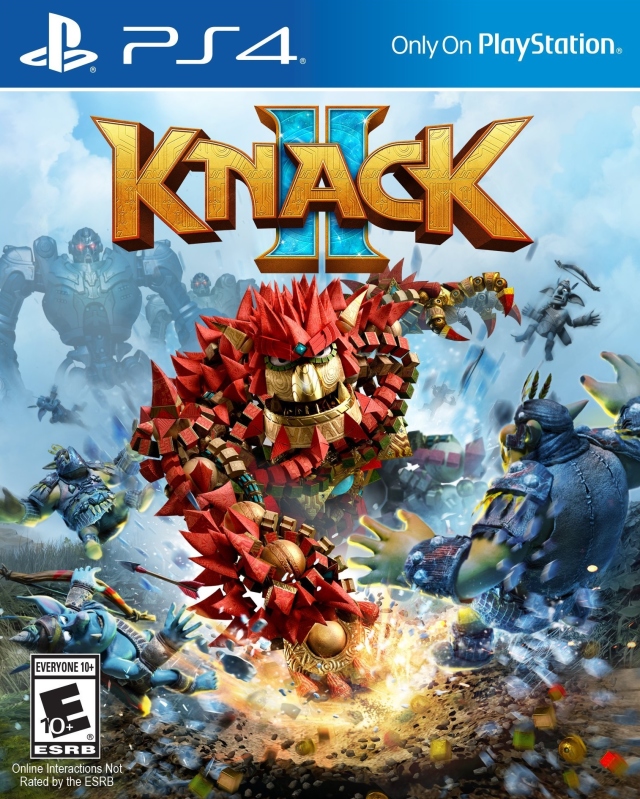
Knack 2 (PS4) Review

Though the game's over a year old now, I returned to Knack 2 after a long hiatus. I must say--I did not expect to like Knack 2 as much as I did. Dare I say, I loved it? Let's see what's so enjoyable about Knack 2 with my review.

Knack - Take 2


Oh, Knack. You whiffed your debut with a less than spectacular launch title for the PlayStation 4. Though you sold well (again, since you were a launch title and all), enough people got burned by you that they didn't bother checking out your much improved sequel. It's a darn shame, too, because Knack 2 improves on the original Knack in every way. And, just to make it clear since being better than the first Knack might not be a huge bar to clear for most PS4 owners out there, I can safely and unequivocally say that Knack 2 on its own is a terrific game worthy of playing.

Knack 2 begins in media res with a city being overrun and invaded by a nasty onslaught of robots. Who or what is behind it is uncertain, but just as things begin to look seriously bad for our hero, we get a flashback to show off the events leading up to the city's invasion. Knack 2 features the story of Lucas and his companion, the size-shifting hero of the first game, Knack. Surrounded by several supporting characters--many from the original game--the two tangle with a whole host of villains, high goblin mythology, robots, and much more. Knack 2's story interested me enough that I looked forward to see how each chapter would play out, but the humor didn't do much for me. I imagine it would be more welcomed by a younger audience than I, but I'd be lying if I said if I didn't chuckle or smile here and there.

Knack, Lucas, and friends will explore ancient ruins, snowy mountains, chaotic
city streets, and dense jungles alike throughout the enjoyable journey that is Knack 2.
Knack himself has the special ability to accumulate relic shards sprinkled throughout the game in order to grow to a larger size. Many levels in Knack 2 will require our protagonist to get to a certain weight or a specific height by nabbing enough of these shards in order to progress. The game features multiple puzzles where Knack must switch between his larger form and his small form voluntarily. Whether it's to fit inside a hole that only small Knack can fit through, walk along an incredibly narrow beam or ledge, or make his way through an otherwise claustrophobic crevasse, Knack needs his smaller self as well as his larger, much more brawny form to survive the perilous adventure.

For some reason, I don't think a 16-foot Knack would fit inside this passage here.
Additionally, some particularly clever platforming moments in Knack 2 require Knack to switch between sizes on the fly, and you'll be doing that a lot throughout the game's 10 hour time span. Such an example early in the game had me using Knack to leap on a moving platform and quickly needing to shrink down to small size to avoid getting Knack smashed to death by a spinning row of spikes as the platform passes below them. Not below enough for big Knack to pass by unscathed, but perfect for small Knack to get by.

Platforming is well integrated into levels, making for some truly fun and occasionally tricky challenges.
In Knack's journey he'll come across different materials to attach to his body at specific points during the game. For instance, coming in contact with ice shards will make our hero Ice Knack, able to freeze enemies with breath, as well as freeze gears and switches solid to hold open doors and platforms. Metal Knack can weigh down switches in addition to linking electric floor panels together to turn on machinery in levels. Finally, Stealth Knack can leisurely stroll through otherwise deadly lasers to reach otherwise impossible to visit areas.

"Ice is nice," says Ice Knack. "Oh, God..." groans Phil.
While these forms of Knack never show up in conjunction with one another, they do split up the standard platforming gameplay and combat (which I'll focus on soon), and make for some of the smartest puzzles within the game. A handful of times I sat confused at what to do with a particular puzzle, but once the solution presented itself to me (by my own intuition or the optional "hint" system included), I smiled at how clever the puzzle and level design I just saw was.

Would you say it's "time" to traverse up this clock tower?
"Oh, God..." groans all of you.
Meanwhile, Knack 2's combat serves its game well, allowing an "easy to pick up" fighting system that revolves around punches, kicks, guards, dodges, and parries in unison with one another against everything from solo encounters to group engagements--usually the latter. As you move forward during the game, you'll come across steadily more challenging enemies with different means to dispatch them, such as holding down the punch button to smash through an enemy's block, or chucking a boomerang to temporarily shut off electrified enemies for safe beat-downs.

For the most part, although what you'll be taking on in Knack 2 amounts to mainly two types of enemies: robots and goblins--there are such a multitude of varieties and fighting styles and tactics for each that combating these foes seldom gets tiring or repetitive. It also helps that just mashing buttons didn't do me much good even on the easiest difficulty. I had to learn when to attack, when to dodge, when to parry, and when all else failed, when to hightail it and retreat for a few moments while my damaged Knack eventually replenished his size.

And a third type of enemy revealed early enough in the game: living relics just like Knack.
You see, as Knack takes damage, the relic shards attached to him break apart. When Knack is at his smallest size, one hit from an enemy will result in death. When it came to the harder difficulty settings, I had to pick my shots, time my guards and evasions well, and sometimes just get a little lucky to survive. Ample amounts of checkpoints throughout Knack 2 made it, however, that I never had to redo sizable sections of the game at all.

Knack is about to teach this attacking foe that turnabout is fair play.
Knack earns experience for defeating foes as well from discovering treasure chests strewn about the Knack 2's levels that can be used on a skill tree of sorts. Each point on the skill tree filled unlocks new moves as well as a new combat bonuses, such as faster cooldown times per moves, higher attack or defense, and wider fields of attack for attacks. There are four sections of the skill tree total, and these unlock as previous trees are completed. It's really worthwhile to explore each level for treasure chests and to defeat enemies, as upgrading Knack with these aforementioned truly helpful moves and stat bonuses make Knack 2 much more manageable to beat. Plus, the treasures are hidden so cleverly and the level design is so well done that it's simply a joy to explore.

A well timed parry will launch this foe's laser right back at it.
When Knack 2 isn't have you take on some platforming, puzzle-solving, and fighting gameplay, the game mixes things up nicely with some alternate ways of play. One section has you aiming a turret at enemies (rest easy, forlorn Dead Space players--it's not as hard as that game), controlling a tank through an outdoor fortress, and even entering the cockpit of a gigantic robot. Furthermore, quick time events lend themselves nicely to game levels when they appear and readily telegraph themselves to not sneak up on unassuming players.

Knack 2 doesn't have to end after the initial campaign is beaten once. Almost every level in the game has well hidden treasures to find, and these special chests unlock beneficial gadgets for use in game. These range from a gadget that teleports Knack to safety if he falls into a pit, to new skins for Knack to wear (which also have bonus abilities).

Moreover, each level has three stars to earn for completing specific objectives. These can range from beating a level within a specific time limit, opening all treasure chests in a given level, defeating a set number of enemies as small Knack, and so forth. Levels can be selected from the world map at any time--even if you've not beaten the game yet.

Co-op is also a feature in Knack 2. Two players can team up together, and I do mean it quite literally. One player can charge up while the other player punches their back to let loose a barrage of spiky shards at enemies in front. Two Knacks are indeed better than one, and co-op is a perfect mode for those less experienced with Knack 2 or gaming in general to partner with a more skilled player. The latter player can take the lead while the second player is free to help. If they get too far behind, they will automatically warp close to the player who's up front.

These teeny, tiny goblins defeating Knack will definitely be a "tall" order.
Knack 2 is--without any semblance of irony--a very good game. It routinely introduces new enemy types, platforming challenges, and story scenarios to make for an engaging game from beginning to end. While the story and characters won't win over everyone--and definitely not folks in my bitter age bracket--Knack 2's tale kept me interested and continuing to play. And even if it didn't--certainly the well done level design, platforming, puzzles, and combat did the trick regardless. After a rough debut, Knack is back and he stars in one excellent action-platforming adventure.

[SPC Says: B+]

Thursday, April 26, 2018

Everybody's Golf (PS4) Review

Two more reviews are coming in April before we bid this month adieu. The first is an August release from last year, Everybody's Golf. Does a new name (for North America) and new features make for a better golf game for this long-running PlayStation franchise? You know what I always like to say, "Let's find out!"

A golf game where everybody's welcome


The Everybody's Golf series is one of the PlayStation brand's longest-running franchises, dating back all the way to the original PlayStation. The series is one of the few that has released on every PlayStation platform under the sun. In North America the series was given a name change for its localization. It was previously Hot Shots Golf, but now the franchise retains its worldwide name and comes to the PlayStation 4 with a brand-new game. Simply titled "Everybody's Golf", developer Clap Hanz creates a much more approachable and accessible game of golf than ever before.

Your destination in Everybody's Golf is Golf Island, and this is the hub where you can perform a myriad of tasks, the first of which is creating your custom avatar. It's absolutely amazing how many features can be altered to create a golfer that is as close a likeness to you as possible, or if you like, something incredibly off-the-wall with freaky proportions that will give other golfers nightmares on the links. Even with the limited (compared to what you can buy, earn, and unlock later in the game) selection of customization parts, you can tailor and outfit your golfer to your liking with an abundance of options.

My golf game's future is so bright I gotta wear shades!
You begin at the lowest rank on Golf Island, and it's your objective to go as high as possible, Rank 1. Through completing tournaments--9 or 18 hole rounds where you try to get the best score against the rest of the competing field--you earn experience points. More is earned upon making first place. When enough experience points have accumulated, you are challenged by an AI opponent for a one-on-one match. Different competitors offer varying rules. Some might have you win holes by points, while others might impose one stroke penalties on you for hitting into the rough, or a bunker. There are three opponents per rank, and beating the third opponent in Match Play awards you with an increased rank.

Look, Ma! I'm about to drive this ball with my eyes closed!
The first couple ranks can be a bit of a grind to move forward as you're limited to just one golf course at the beginning. There are only so many times you can play either the front or back 9 of the beginner course Eagle City before you start growing tired of its sunny, city surroundings. Thankfully, there is an option to speed things up by turning on Serious Mode. This mode makes the competitors in tournaments get better scores, making for a greater challenge while having the benefit of increasing how much experience and money you earn per round. It doesn't quite solve the problem of having to replay the same course over and over again until a later rank, but it does hasten the time it takes to get to your next rank. 

My opponent Laura is about to get schooled in golf by
my custom avatar (of which you can create eight different ones).
Still, there are some perpetual carrots on sticks to get you to keep playing rounds. You earn coins after rounds are complete that can be used to purchase new customization options like clothing, hair styles, and accessories. Additionally, after each round, you also are awarded with bonus goodies such as gear in the form of clothing and specialized limited-use golf balls of varying abilities as well.

Everybody's Golf uses a tried and true three-button-press system--one to start the swing gauge, one to set the power, and one to set the accuracy. You can hold the D-Pad in one of four directions upon setting the accuracy to unleash topspin, backspin, and sidespin. Later in the game you learn how to perform the incredibly helpful super forms of these aforementioned shot types. Also while determining accuracy, you want to have the meter inside the pink area upon pressing the button the third time to set the accuracy. Otherwise you run the risk of having the ball stray off course significantly, ruining your chance at par in the process.

Too fast of a button press. This ball will go a bit off course.
|
V
Button pressed right within the zone. This ball should stay right on track.
As you use clubs, you slowly but surely level them up, increasing their aptitude and ability. Each club in your bag has four different stats that increase in level upon using them properly: power, control, sidespin, and backdoor. Increasing a club's power level strengthens the maximum distance a ball can be hit. A control increase means your shot won't be as susceptible to sway and off course shots. Sidespin gives you more control and ability out of your spins, and backdoor grants a higher probability of golf balls, whether chipped or putted, of going into the hole if they hit the cup's rim. Having each club level up individually means that you'll want to vary which clubs you use and not stick to just one or two. However, it also means that there's a bit of a grind here as well, especially for clubs you don't always use. While your 1-Wood might be spectacular at driving large distances, it doesn't mean anything if your Putter or Wedges are at low levels and can't help out your short game for beans.

Everybody's Golf provides tips in the form of info messages to help you out on the links.
 Fortunately, if you don't want them, you can turn them off.
One of my biggest beefs with past Everybody's Golf games is how brutal they could get when it concerned difficulty. Some of the games featured some truly tricky holes and greens that offered little leeway to mess up, making for a blood pressure-raising experience instead of a relaxing, engaging, and fun one. Everybody's Golf on PlayStation 4 is not just easier in difficulty, but it's also much more inviting, allowing players of all skill levels to fully enjoy the game. There aren't many insanely narrow, extremely undulating greens to make next-to-impossible putts on, or hazard-filled monstrosities packed with small patches of fairway and large patches of bodies of water or other penalty-inducing hazards to be immensely intimidated by. 

That isn't to say that the latest Everybody's Golf is a breeze to play through. While the Match Play competitors you'll face make a multitude of mistakes like errant shots and failed putts, later challengers provide quite the, well, challenge! It's not uncommon for miracle shots to be performed such as 150 yard chip-ins, though it's more dependent on if unrealistic rules like Mega Cups or Tornado Cups are used, where the latter sucks in nearby balls within a close proximity to the hole. The latter two courses (Everybody's Golf sadly only has five total courses included on the disc with three as rather pricey DLC) are a bit more unforgiving, making one really miss the relatively easygoing feeling of the first three courses.

One of many picturesque views of the second course introduced in Everybody's Golf, Alpina Forest.
A new mechanic to Everybody's Golf in this edition of the game is the ability to freely traverse courses as you explore, ride golf carts, and--once the ability is unlocked--fish around them. The online open course exploration allows players to meet up, converse, message, play rounds (or play any hole they like... repeatedly until they finally get that much desired condor they've been wanting--but enough about me), and more. There are even monthly tournaments where players around the globe compete to get the best score possible on that tournament's selected course and rules in order to earn exclusive prizes. 

Better hope your short game is up to snuff if you want that birdie, Phil!
Meanwhile, there are Turf Wars, though this mode isn't the most populated one in Everybody's Golf. Regardless, this mode provides players with a timer and the need to rush as they complete holes and traverse holes to get the lowest score between themselves. This can get absolutely insane when golf carts are smashing into one another and players speed through strokes to finish the round first while also hoping to score under par. It's just a shame that this mode isn't as popular as it should be, given how exciting it can be.

The artist formerly known as Hot Shots Golf (at least in North America), Everybody's Golf is a content-rich golf game that unlike past installments in the series features gameplay that is welcoming to both newbies to the franchise and veterans alike. The single player offers a bit of a grind, and the limited number of available courses that comes packaged with the game disappoints a little, but that notwithstanding, Everybody's Golf is golfing for the masses. Well, the masses that don't mind anime-inspired characters and some creative liberties with the sport.

[SPC Says: B]

Saturday, December 5, 2015

New Hot Shots Golf (PS4) PSX 2015 Trailer

Given an English trailer, New Hot Shots Golf is a tentative title for a big new game in the series. With the ability to zoom around courses on golf carts, putt and drive like a pro, and much more, this Hot Shots Golf game looks to be mighty interesting!

Tuesday, September 15, 2015

Gravity Rush 2 (PS4) Announcement Trailer

Another gem from SCEJ's Tokyo Game Show showing is Gravity Rush 2, a sequel to a game that was critically acclaimed on the PlayStation Vita. Now the series gets a second chance in the spotlight with a remaster of the original game and a sequel, both on the PlayStation 4.

New Minna no Golf (PS4) Announcement Trailer

One of my favorite PlayStation franchises is Hot Shots Golf, known in Japan as Minna no Golf and in PAL territories as Everybody's Golf. This new Minna no Golf trailer from Tokyo Game Show has me absolutely excited beyond belief. Yet another reason to pick up a PlayStation 4 in the near future!

Thursday, October 31, 2013

Puppeteer (PS3) Review

Tuesday's review made for a really long headline! Today's review, a special Halloween night one, has a headline that's really short! We don't know why we felt the need to address this, but there you go. Today's review is for a severely overlooked 2 1/2D platformer for the PlayStation 3, Puppeteer.

Fun With A Few Strings Attached


Sony's Japan Studio has been rather quiet on the PlayStation 3, releasing very little for the platform. They have finally come out of hibernation/off hiatus to deliver to PlayStation 3 owners the ultra-quirky and super-charming Puppeteer. Is Puppeteer a cut above the rest, or is playing it "shear" torture?

The Moon Bear King was once loyal to the Moon Goddess, but he soon overthrew her, stole both the Black and White Moonstones (the latter being broken by the Moon Bear King and given to his 12 Generals) and went on to start his rule on the moon. When the moon is lit, the Moon Bear King steals the souls of innocent children and turns them into his controlled grunts. One such boy is Kutaro, who unluckily the Moon Bear tyrant decapitates, swallows his head, and tosses our protagonist aside like garbage. However, Kutaro gains the aid of several allies, finds replacement heads, and steals the mystical pair of golden scissors known as Calibrus. With all of this, Kutaro hopes to regain his head and head back home where he belongs.

Calibrus is invaluable to Kutaro's quest. With these sensational shears, Kutaro can cut across rugs, flags, and other cut-able objects to use them as a means to cross chasms and reach high up platforms. As long as there is something to shear through, Kutaro can stay in the air. There are even threads that Kutaro can cut along, sending him traveling across a predetermined path in fast fashion. Calibrus is also used for combat, allowing Kutaro to slice and dice grunts, saving children's souls in the process.

Kutaro is certainly one kooky cut-up.
Outside of Calibrus, Kutaro gains other helpful items along his adventure. There is a shield that grants Kutaro the ability to deflect and guard against certain attacks, a chain that can pull enemies, objects and larger obstacles towards Kutaro, and an item that gives Kutaro the ability to body slam enemies and objects, as well as push and pull certain points of interest. These items increase the skills in Kutaro's repertoire, and they allowed more possibilities to Puppeteer's superb level design.

The Moon Witch teaches you how
to properly use new abilities.
Something that Puppeteer really gets right are the boss battles, which are creative through and through, much like the game they are featured in. Calibrus certainly gets a workout in these frantic fights. One such battle early on has Kutaro facing off against General Tiger. When the fierce feline smashes his palm to the ground, he emits an electric charge. Through leaping over it, Kutaro can then use his shield ability to give the swiping General's hand a world of hurt. When his hand hurts enough, General Tiger's fur will allow Kutaro to climb it by having Calibrus cut it and traverse up the tiger's arm, eventually taking out one of his sharp fangs.

What big teeth you have!
The better to floss?
Thanks to the tyrant known as the Moon Bear King, Kutaro is without his own head. Thus, our hero needs to fill that empty space where his noggin should be with other objects. Through using your partner similar to a mouse cursor and tapping the R2 button to investigate areas of interest, Kutaro can come across objects that can be substituted for his head-- things like spiders, crowns, fossils, and even burgers! When damaged, Kutaro's current head falls off and bounces around. For a limited time, he can recollect his head, but it will eventually disappear. Kutaro can hold up to three heads, but if the last one in his collection disappears and gets lost, the player loses a life and must restart from a checkpoint.

Kutaro wonders what's cookin'.
The concept of collecting different heads sounds nice, and it would look appealing on a feature list for Puppeteer. However, the way it is executed leaves a little to be desired. Outside of accessing hidden bonus areas or collecting secret Moonsparkles, using a specific head at a specific spot in Puppeteer doesn't do anything. I kept telling myself, "If only each head had its own power to use at any time, this game would be much more interesting." As it stands in Puppeteer, different heads are merely there as a cosmetic change and little else.

Climb aboard General Snake
as you make your way to its head.
Having the right head for the right situation to reach a bonus area seems completely random. It's basically a crap shoot on whether or not you have the correct head the first time you come across a place where you are meant to utilize your head's ability. There are plenty of bonus areas that can only be accessed by returning to a previous level with a head gained from a later level. It just seems like an artificial way to extend the game, especially as many levels just go on for way too long.

Heads actually have a limited use
in Puppeteer, which is a shame.
One of the reasons the levels seem to go on forever is that there are a lot of sections of story exposition thrown in that break up the platforming. It's charming at first, but eventually you grow tired of watching scene after scene. Even though these can skipped, you have to pause the game and select "Skip" each time. This is a further frustration when there are multiple story segments in a row. Quite frankly, these otherwise charming scenes become intrusive to the gameplay, and really, the last thing platformers fans want in the genre are to be taken out of the running and jumping for extended periods of time.

Despite all this, Puppeteer is still a very fun and engaging game. There are seven acts, each housing three curtains (or levels) each. Each level has a number of souls to save, heads to find, and a bonus area to complete. Completing all of this in the game's 21 levels is no simple task and will make even the most veteran of gamers feel the challenge. Puppeteer has a lot of content, so someone who picks the game up will have a meaty title to play through.

Puppeteer is presented like a play. There's even an audience (though unseen) that applauds, cheers, and gasps depending on what happens on the stage. This is extremely clever in how it is done. Worlds and levels are made up of arts and crafts and characters are as whimsical as you'd expect. The art design is really well done and ensures that Puppeteer doesn't look like any other game on the market. The voice work is also implemented in fine fashion, having a narrator and cast that doesn't mind breaking the fourth wall consistently. The music is also fantastic, performed by an orchestra and presenting the player with mysterious and marvelous pieces to listen to. While the gameplay might leave a little something to be desired, the presentation of Puppeteer is among this year's best.

Talk about a bad case of acne!
Puppeteer might not be the most properly executed 2-1/2D platformer on the market, but it truly does fill a hole in the PlayStation 3 library. It might be too niche for the mainstream market, but those who give Puppeteer a chance will find a game that plays well, and is charming, challenging, and cheap to buy. The concept of heads might not have been fully realized, and story elements might destroy any kind of flow within the game, but these gripes aside, Puppeteer is the kind of game that won't string you along.

[SPC Says: 8.5/10]