Showing posts with label sony. Show all posts

Saturday, July 19, 2025

Speed Punks (PS1) Retro Review

I feel like we're stuck on a racing game trend here on SuperPhillip Central lately--what, with Chocobo Racing, Mario Kart World, and yes, now Speed Punks for the original PlayStation. I must really have the need for speed, and while I'm on this theme of racing, let's take to the track with this oft overlooked PS1 kart racer!

Whether you know them as punks or as freaks, these folks sure have some speed!


Back in the 1990s, every publisher wanted a piece of the Mario Kart pie, and Sony with its then-newly established PlayStation were no different. Coming at Nintendo's prestigious Mario Kart franchise with not one but two karting efforts within the span of about a year: Naughty Dog's Crash Team Racing and the subject of today's review, Funcom's Speed Punks (aka Speed Freaks outside of North America), it's safe to say the latter is more forgotten in the annals of gaming history. That said, while CTR is definitely the more popular of the two, does that mean that Speed Punks deserved to slip through the cracks? 

Well, yes and no, depending on what context you're approaching the game from. But, we'll get more into that in a teeny tiny bit. Let's go with an overview of what is inside the Speed Punks package before we delve any further. 

The starting circuits offer gentle turns, wide tracks, and plenty of room to maneuver.

The main single player content of Speed Punks is its Tournament mode. Here, players race against five other drivers in your standard Grand Prix contest, featuring four tracks. There are three batches of four tracks, beginning with the Easy Tournament. The tracks here showcase gentle turns, wide open straightaways, and little in the way of hazards compared to later difficulties. Successfully completing each tournament unlocks the next difficulty in an Easy to Normal to Hard progression. By the time you reach the Hard Tournament, tracks are much more windier, have intense and tight curves, plentiful narrow sections, easy spots to fall off via careless driving, and numerous hazards to evade. 

 Depending on the place racers achieve in the Tournament mode, they receive different amounts of points, with first place earning the most, and sixth earning the least. However, if the player hits fourth or worse in a race, they must use up one of their finite retries to start the race over and try again for a higher place. Races can also be restarted mid-lap, though also at the cost of retry. You might think this is a foolish maneuver, but there is a reason to do this aside of knowing you're probably going to place fourth or worse.

Life is a highway, and I want to ride it for five laps.

Aside from that reason, what if you're in second place and coming in on the finish line? What possible excuse could you have to restart then, you ask? The main reason to do this is because you're awarded a chance to face a boss character for winning all races in a given Tournament in first place. Winning the trial against this boss character adds them to roster to race as. 

In total, there are six characters in the base roster with three more as unlockable through winning each of the three Tournaments in first place in all races, and thus, beating the boss character to unlock them into the roster. Each character sports their own stats in three categories: weight, top speed, and acceleration. 

Get first place in all of a given Tournament's difficulty, and you'll earn the right to face a boss!
Win, and you'll add them to your repertoire of racers!
    

Totaling just twelve tracks might seem like a bummer, especially compared to Mario Kart, which at the time sported 16 unique tracks, and that's because it sort of is! While it is a bit disappointing to see Speed Punks with a smaller number of tracks, what is available are fun and entertaining circuits. These are five laps apiece as opposed to the typical three seen in other kart racers, and they give you enough time to enjoy each circuit before moving onto the next. Even with five laps, they don't overextend their individual welcomes or grow tedious. Well, maybe that's less true of the final track within the Hard Tournament, as that one even if it were three laps is a test of the endurance, for sure!

Regardless, the tracks are well designed, and the shortcuts within them offer some smart design too. Whether that's driving through a bush within the opening of a fence to reach a whole new part of track within the speedway that is Silver City, or shortcuts that only appear later in a given race, like a cavern's opening within the volcanic Thunder Trail--these are cleverly hidden for the most part and offer great skips ahead of one's opponents.

Of course, a kart racer, especially one with a goofy aesthetic and unrealistic approach, isn't worth putting the pedal to the metal if its selection of items isn't worthwhile. Fortunately, there's plenty here in Speed Punks to sow strife on straightaways, cause chaos at corners, and tremendous terror on the track in general. There are of course green shell and red shell equivalents with missiles and homing missiles respectively, slime puddles that serve as Speed Punks' banana peel equivalent, and yes, even a pesky blue shell equivalent, as well. However, there are also other power-ups that don't necessarily take from the Mario Kart playbook, such as machine guns, shockwaves, and a tire pop that will inflate your tires until they burst (though this can be battled against by mashing on a specific button), for starters.

Excuse me, sir. You dropped this bomb!

While the items and power-ups within Speed Punks add to the vehicular carnage and motor mayhem as one would expect, not everything brings chaos to the game in the best of ways. For one, Speed Punks' driving physics and handling constantly make you feel like you're driving on a Teflon surface. It's beyond slippery and frustratingly so. Secondly, the AI isn't the fairest of them all, let's say. They'll unload on to you with items, power-ups, and just make for an aggravating time on the track in Tournament mode.  

Fortunately, what positives I can say about Speed Punks' racing action are more numerous than its negatives. The aforementioned items are enjoyable to use, races are generally incredibly thrilling and especially rewarding if and when you emerge victorious, tracks are well designed, and the boost system is helpful in cutting corners, making shortcuts, and otherwise navigating through and speeding back up after all of the item spam you will face. 

Who's a good racer? Why, yes, you are! Yes, you are!

That notwithstanding, content-wise Speed Punks is lacking. The twelve total tracks are a paltry amount for a kart racer, no matter how well designed they come across. The amount of modes is lackluster, and the inability to play the Tournament mode with a local player is disappointing to me at the very least.

Like the Speed Punks track Millennium Park's roller coaster is much like Speed Punks and this review, as we're constantly going up and down these last few paragraphs with criticism and praise. Here we go again, as Speed Punk absolutely nails its presentation. The colors are crisp, colorful, and vibrant. The characters exude enough personality and animate well for a PS1 title, and the environments are delightful to take in and look at as you speed past them. The D&B soundtrack won't everyone's cup of tea (or is it motor oil? Ew.), but it's certainly serviceable and complements the racing mayhem well. 

Neither Speed Punks nor its developer Funcom may have survived into the present, but both their pasts offer plentiful amounts of entertainment. Speed Punks itself doesn't have the content to last most players an overly lengthy amount of time, and it can also be frustratingly difficult--sometimes for all the wrong reasons. That said, the game does deliver an all-around good time on the track, even if it's one that most players won't stick with for all too long. What it lacks in content and control, it more than makes up for in challenge and creativity. 

[SPC Says: C+]

Sunday, January 26, 2020

MediEvil (PS4) Review

To start the week of content on SuperPhillip Central early, a new review is here. It's for a remake of a game from PS1 era: MediEvil. No worries--the skeleton puns and other associated humor in this review is no charge.

Make no bones about it--this remake's beauty is only skin deep.


Legends tell of the tale of Sir Daniel Fortesque, a hero who bravely led the charge of an army against the evil sorcerer Zarok and his minions. What the legends leave out, however, is that said hero quickly exited the battle from a stray arrow to the eye. A select number of people are aware of this, though, and many happen to be part of the prestigious Hall of Heroes, who shun Sir Daniel. Now, Zarok is back and causing all sorts of trouble in the kingdom of Gallowmere, and a hero shall rise from the grave to take on Zarok and his forces once more. Hopefully, this time around, he won't be defeated by a stray arrow, and will instead more than prove himself to all those who doubt him.

MediEvil is the latest relic from the original PlayStation that receives a full fledged remake, and while the game sees a gorgeous graphical improvement, the gameplay sticks a little too close to the original for my liking.

Let's begin with the tremendous graphical upgrade in this PlayStation 4 revival of MediEvil. Areas are now brimming with color and amazing detail, giving each level and area a more unique personality and character. The lighting on display in MediEvil shows off these levels in... and forgive the play-on words here... such a new light that many seem indistinguishable from the originals, aside from their basic designs. Sir Dan and the rest of the cast look sensational and animate well, too. The orchestrated score, centered on a whimsical Gothic, Medieval fantasy sound, never failed to amuse my ears.

The moon shines bright for the start of Sir Dan's adventure.
So, yes, the most obvious thing here is that the graphics when compared to the original MediEvil have been vastly improved in this remake. But, what of the gameplay? Well, unfortunately, not many tweaks at all were made here, and it's somewhat mystifying as to why considering all of the faults that the original MediEvil had.

In Sir Dan's journey, he starts out relatively weak, armed only with a sword and shield (and a literal arm as well, which can be used as a weapon). Along his multiple level journey, he picks up several new weapons to take down Zarok's plentiful amount of pesky enemies, such as zombies, imps, shadow demons, and more. Weapons like clubs, serve more than just for offensive purposes--they can be used to break boulders and walls to reveal new paths, and can be set on fire to light torches to solve puzzles. Apart from melee weapons like swords, clubs, and hammers, Sir Dan acquires plenty of long-range weaponry in the form of throwing knives, bows, spears, and even magic.

Exquisite graphics? Yes. Highly capable combat? No.
Levels in MediEvil have Sir Dan moving through them, collecting rune stones to unlock doors and gates to new areas, and sometimes performing the necessary occasionally-awkward platforming challenge. That said, most of the time MediEvil is all about light combat, exploration, and puzzle-solving. The former isn't too spectacular. In fact, I'd call it rather clumsy and ungraceful overall. More times than not when it concerned melee combat, I'd find myself running around like a chicken with its head cut off, flailing Sir Dan's sword around while hoping I wouldn't take too much collision damage from enemies in the process. Sadly, that seemed to be the best strategy starting out with the game.

Even the simple act of pushing blocks can be more difficult than it needs to be in MediEvil.
Defeating enemies is a major part of unlocking even better weapons for Sir Dan to use, as when an enemy is slain, a percentage of a level's chalice fills up. When the percentage reaches a full 100%, Sir Dan can scour the level to pick up the chalice. The chalice is usually hidden in an out-of-the-way location, but observant players can see that slain enemies have their spirits fly away in the direction of where the chalice is, which helps in discovering each chalice's location. What is a bit obnoxious is when the chalice location is back near the beginning of the level, so that means a relatively tedious trip back to collect it, just to have to make another trip back to where you turned around at originally in order to make the original trip to the chalice.

Without a long-range weapon, this battle would be a pain in the glass.
Thankfully, Sir Dan isn't unarmed!
Upon clearing the level with said chalice filled and collected, he gains access to the Hall of Heroes where he can earn a reward from one of the heroes waiting inside. These are pretty much required to obtain to have a fighting chance in later levels, as enemies can otherwise take a pretty good licking before they stop ticking. Rewards include upgraded and improved weapons like longbows, bows with flaming arrows, bows with magical arrows, hammers that serve as stronger clubs without the ability to break after repeated use, axes that can also be thrown, and Life Potions that give Sir Dan extra health to work with. Life Potions can also be found hidden in some levels themselves.

Sir Dan will need all the help he can get because MediEvil is old school challenging in its difficulty. While nowhere near so-called "NES hard", MediEvil will put you through your paces quite easily, and part of that is because of its design which is deeply rooted in older gaming. For one, losing all of your health in a level results in a game over, which means you must restart a level from the beginning again. Some levels are quite involved and can be a particular pain in Sir Dan's bony butt. One mid-game level that takes place in a garden maze is rather long due to its puzzles placed in the form of riddles, and dying so close to the end of the level--one that can easily go on for a half-hour--can be a serious gut punch and motivation-killer to continue the game. A checkpoint here and there would have been a terrific addition to MediEvil. As is, the game skews too closely towards cheap and unfair.

Further, the camera isn't always generous in giving you the best angles to work with, and the platforming leaves some things to be desired as it's hardly a game with the tightest jumping controls available. Seeing as missed jumps into bottomless pits, pools of water, or lava, results in an instant loss of a full bar of health, you can quickly breeze through what seemed like a safe amount of health to work with and end up with a frustrating "game over."

A level surrounded by pools of water makes this particular player a wee bit uneasy!
MediEvil does add a new feature to the game, which is that of lost souls. When you open a particular chest in a late-game level, lost souls appear in each of the game's main levels, and each give you a riddle to be solved in another level. These generally task you with opening up your inventory at a specific spot in a level, and then summoning the soul you collected based on the given riddle's clue. Upon finding all of the lost souls and solving their riddles, you unlock a rather cool bonus that rewards you with MediEvil in its original PS1 form.

Overall, MediEvil is an enjoyable enough romp, but one that I wish the developers had given an equal amount of time to improving the game's design and gameplay rather than obviously merely focusing on upgrading the visuals--as impressive and delightful as they are. As is, MediEvil has the appearance of current-gen game, but underneath its HD flesh is a skeleton filled with occasionally cheap design, frustrating deaths, and lackluster combat and platforming.

[SPC Says: C-]

Tuesday, February 5, 2019

850th Review! God of War (PS4) Review

It's a special occasion here at SuperPhillip Central--well, a MORE special occasion. It's the site's 850th review! Join me as I take a late look at one of 2018's best games, God of War for the PlayStation 4. Here's SuperPhillip Central's full review.

God of Wow


I've made it no secret that despite enjoying the God of War series in the past that regardless of the "M" for "Mature" rating these games have, they're anything but mature. However, like Kratos's arc in the latest in the series and the first on the PlayStation 4, simply titled God of War, the franchise has gone a long way to grow up and mature. What we have now is a more mellowed out Kratos, less motivated by hate, no sacrificing innocents to get through puzzles, no awkward and borderline offensive sex scenes--now we have a God of War that is actually for adults and not edgy teenagers.

But that's giving God of War's PlayStation 4 debut feint praise. The game does so much more than just present a more mature, more heartwarming story than past entries in the series. Now, Kratos is in Norse world, and he has a son, Atreus. The two recently lost someone special to them, Kratos' wife and Atreus' mother, and they seek to spread her ashes on top of the highest mountain in the land. I felt compelled to see the journey through, and like Kratos and Atreus, my motivation was to see this journey through. The levels of emotion displayed throughout the story and the evolution of the father and son dynamic in God of War are some of the most heartfelt I've seen in gaming in quite a while.

The past God of War games were tasty "junk food", but not this God of War.
It's still tasty, but is a lot more thought-provoking and engaging than past entries.
God of War not only does away with the infantile story and characterization of past installments prior to this PS4 masterpiece, but it also does away with the camera angles that originated in very first game in the series. Now, the player is directly behind Kratos in an over-the-shoulder perspective, and perhaps the most impressive part of this is that God of War's world is both interconnected and open, as well as taking place in one continuous shot. There are no loading screens to speak of between visiting new areas, and every story beat occurs with the player in Kratos' shoes. The only cuts in the action take place when Kratos dies and the game needs to reload to previous checkpoint or when you warp from one area to another via fast travel--which unlocks relatively late in the adventure.

No doubt you can believe that the new camera perspective presents a much more cerebral experience when it concerns gameplay, especially combat. Kratos' main weapon in God of War is the all-powerful Leviathan Axe. It's not just used to carve up enemies both small and behemoth-sized, but it also is used to solve puzzles. The axe can be chucked away from Kratos, and with the press of a button, it can be called back to his hand, slicing through any enemy that stands in its way in the process. As players gain experience from defeated enemies and completed quests alike, Kratos and his axe can be upgraded to enable more combat abilities and advantages in battle.

Want to be put out of your misery, you nasty-looking foe? Then, just "axe"!
Of course, Kratos isn't by his lonesome this time around, as Atreus is always nearby. While the game could have been one large, engaging escort mission, instead Atreus holds his own in battle and in puzzle thanks to both his smart AI and his near invulnerability. You can call on Atreus to fire arrows of various elemental properties at enemies to stun them or whittle away at their health to help out Kratos in battle, all the while being cognizant of the cool off period Atreus has to fire more arrows. The two are a force to be reckoned with, for certain.

As if the God of War series hasn't proven this multiple times already,
size really doesn't matter when you're up against Kratos.
Battles are engaging experiences due to each enemy being worthy opponents--and this goes for your typical human-sized encounters as well. There are seldom a time when an opponent will just stand there and take your attacks without countering back. Smart use of Kratos' Leviathan Axe, abilities, moves, and Atreus' assistance make the difference between an easygoing encounter and one that results in a sloppy execution, if not death.

Kratos and Atreus might not always get along, but when push comes to shove, they're one formidable duo.
While the fights against grunts and other ordinary enemies are thoroughly enjoyable and stand out on their own merits, it's the boss battles that the God of War series is known for--with their immense scale and high stakes--and this God of War continues that tradition superbly. The only real gripe I have with the boss fights in the game is that there simply aren't enough of them, but every other part of God of War lends itself so well to the overall game that I can't really complain too much. After all, what bosses there are indeed make for a riveting and explosive experience.

Yikes. I'm glad Kratos isn't MY dentist!
When they're not in battle, Kratos and Atreus explore the Norse worlds. As stated before, the game is open and connected--though not an open world in general. Areas seamlessly transition between each other without any loading screens or cuts, and the amount of exploration and chances for discovery in God of War's world is absolutely tremendous. The central area in God of War is the Lake of Nine, and this stellar and splendidly designed hub of sorts branches out between all of the other regions in the game. As you progress, the Lake of Nine's water level drops more and more, revealing new areas to visit and venture.

Just playing through the story and going to the mandatory sections of the Norse world will take about 20 to 25 hours or so. However, if you engage in the high number of side quests, optional areas to explore, and nonessential boss battles, you'll find yourself adding another 10 to 15 hours to that playtime. There is a lot to experience and enjoy in God of War, and all of it is rewarding and worthwhile--whether you're finding out a solution to a puzzle, discovering a well hidden treasure chest, or uncovering a wholly new region in the game world by accident.

Possibly the greatest game of 2018? We'll cross that bridge when we come to it.
God of War is a jaw-dropping game graphically. The character models impress immensely in their own right, but combined with the drop-dead gorgeous landscapes, environments, and areas that ooze with personality, God of War is astounding, mind-blowing game to look at. Performance is relatively sound, though the atypical 30 frames-per-second--at least for an action game--might put some players off. Still, with only a handful of truly off-putting (but rare all the same) frame-rate drops throughout my time with God of War on my launch PS4 system, the game is a remarkable one on the technical side of things.

Those giant icicles here were formed by my frozen-over drool while viewing this graphically gorgeous game.
Like Kratos himself--away from the anger-motivated, woman-using, hate-filled caricature that was presented in past games in the series--God of War as a franchise has finally grown up and matured. This astonishing new direction for the franchise is more than welcomed, offering a deep and highly satisfying story, as well as delivering a wonderful amount of character development within its main cast, especially the father and son dynamic between Kratos and Atreus. Battles are more compelling and cerebral than ever, exploration is absolutely delightful, and God of War as a series has never been better. It's more than a great game in the series--2018's God of War is a masterful piece of design and storytelling that reaches magnificent heights as one of the best games of both the year and the generation.

[SPC Says: A]

Sunday, November 18, 2018

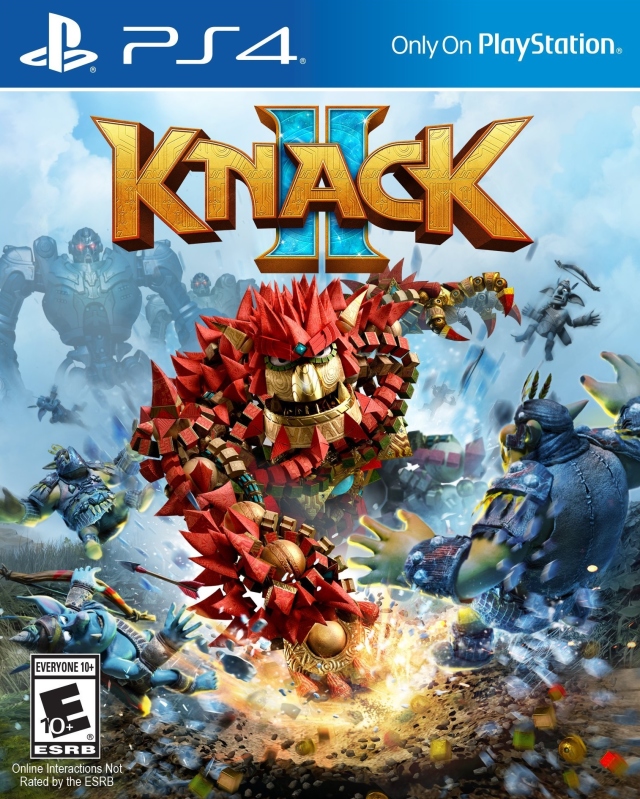
Knack 2 (PS4) Review

Though the game's over a year old now, I returned to Knack 2 after a long hiatus. I must say--I did not expect to like Knack 2 as much as I did. Dare I say, I loved it? Let's see what's so enjoyable about Knack 2 with my review.

Knack - Take 2


Oh, Knack. You whiffed your debut with a less than spectacular launch title for the PlayStation 4. Though you sold well (again, since you were a launch title and all), enough people got burned by you that they didn't bother checking out your much improved sequel. It's a darn shame, too, because Knack 2 improves on the original Knack in every way. And, just to make it clear since being better than the first Knack might not be a huge bar to clear for most PS4 owners out there, I can safely and unequivocally say that Knack 2 on its own is a terrific game worthy of playing.

Knack 2 begins in media res with a city being overrun and invaded by a nasty onslaught of robots. Who or what is behind it is uncertain, but just as things begin to look seriously bad for our hero, we get a flashback to show off the events leading up to the city's invasion. Knack 2 features the story of Lucas and his companion, the size-shifting hero of the first game, Knack. Surrounded by several supporting characters--many from the original game--the two tangle with a whole host of villains, high goblin mythology, robots, and much more. Knack 2's story interested me enough that I looked forward to see how each chapter would play out, but the humor didn't do much for me. I imagine it would be more welcomed by a younger audience than I, but I'd be lying if I said if I didn't chuckle or smile here and there.

Knack, Lucas, and friends will explore ancient ruins, snowy mountains, chaotic
city streets, and dense jungles alike throughout the enjoyable journey that is Knack 2.
Knack himself has the special ability to accumulate relic shards sprinkled throughout the game in order to grow to a larger size. Many levels in Knack 2 will require our protagonist to get to a certain weight or a specific height by nabbing enough of these shards in order to progress. The game features multiple puzzles where Knack must switch between his larger form and his small form voluntarily. Whether it's to fit inside a hole that only small Knack can fit through, walk along an incredibly narrow beam or ledge, or make his way through an otherwise claustrophobic crevasse, Knack needs his smaller self as well as his larger, much more brawny form to survive the perilous adventure.

For some reason, I don't think a 16-foot Knack would fit inside this passage here.
Additionally, some particularly clever platforming moments in Knack 2 require Knack to switch between sizes on the fly, and you'll be doing that a lot throughout the game's 10 hour time span. Such an example early in the game had me using Knack to leap on a moving platform and quickly needing to shrink down to small size to avoid getting Knack smashed to death by a spinning row of spikes as the platform passes below them. Not below enough for big Knack to pass by unscathed, but perfect for small Knack to get by.

Platforming is well integrated into levels, making for some truly fun and occasionally tricky challenges.
In Knack's journey he'll come across different materials to attach to his body at specific points during the game. For instance, coming in contact with ice shards will make our hero Ice Knack, able to freeze enemies with breath, as well as freeze gears and switches solid to hold open doors and platforms. Metal Knack can weigh down switches in addition to linking electric floor panels together to turn on machinery in levels. Finally, Stealth Knack can leisurely stroll through otherwise deadly lasers to reach otherwise impossible to visit areas.

"Ice is nice," says Ice Knack. "Oh, God..." groans Phil.
While these forms of Knack never show up in conjunction with one another, they do split up the standard platforming gameplay and combat (which I'll focus on soon), and make for some of the smartest puzzles within the game. A handful of times I sat confused at what to do with a particular puzzle, but once the solution presented itself to me (by my own intuition or the optional "hint" system included), I smiled at how clever the puzzle and level design I just saw was.

Would you say it's "time" to traverse up this clock tower?
"Oh, God..." groans all of you.
Meanwhile, Knack 2's combat serves its game well, allowing an "easy to pick up" fighting system that revolves around punches, kicks, guards, dodges, and parries in unison with one another against everything from solo encounters to group engagements--usually the latter. As you move forward during the game, you'll come across steadily more challenging enemies with different means to dispatch them, such as holding down the punch button to smash through an enemy's block, or chucking a boomerang to temporarily shut off electrified enemies for safe beat-downs.

For the most part, although what you'll be taking on in Knack 2 amounts to mainly two types of enemies: robots and goblins--there are such a multitude of varieties and fighting styles and tactics for each that combating these foes seldom gets tiring or repetitive. It also helps that just mashing buttons didn't do me much good even on the easiest difficulty. I had to learn when to attack, when to dodge, when to parry, and when all else failed, when to hightail it and retreat for a few moments while my damaged Knack eventually replenished his size.

And a third type of enemy revealed early enough in the game: living relics just like Knack.
You see, as Knack takes damage, the relic shards attached to him break apart. When Knack is at his smallest size, one hit from an enemy will result in death. When it came to the harder difficulty settings, I had to pick my shots, time my guards and evasions well, and sometimes just get a little lucky to survive. Ample amounts of checkpoints throughout Knack 2 made it, however, that I never had to redo sizable sections of the game at all.

Knack is about to teach this attacking foe that turnabout is fair play.
Knack earns experience for defeating foes as well from discovering treasure chests strewn about the Knack 2's levels that can be used on a skill tree of sorts. Each point on the skill tree filled unlocks new moves as well as a new combat bonuses, such as faster cooldown times per moves, higher attack or defense, and wider fields of attack for attacks. There are four sections of the skill tree total, and these unlock as previous trees are completed. It's really worthwhile to explore each level for treasure chests and to defeat enemies, as upgrading Knack with these aforementioned truly helpful moves and stat bonuses make Knack 2 much more manageable to beat. Plus, the treasures are hidden so cleverly and the level design is so well done that it's simply a joy to explore.

A well timed parry will launch this foe's laser right back at it.
When Knack 2 isn't have you take on some platforming, puzzle-solving, and fighting gameplay, the game mixes things up nicely with some alternate ways of play. One section has you aiming a turret at enemies (rest easy, forlorn Dead Space players--it's not as hard as that game), controlling a tank through an outdoor fortress, and even entering the cockpit of a gigantic robot. Furthermore, quick time events lend themselves nicely to game levels when they appear and readily telegraph themselves to not sneak up on unassuming players.

Knack 2 doesn't have to end after the initial campaign is beaten once. Almost every level in the game has well hidden treasures to find, and these special chests unlock beneficial gadgets for use in game. These range from a gadget that teleports Knack to safety if he falls into a pit, to new skins for Knack to wear (which also have bonus abilities).

Moreover, each level has three stars to earn for completing specific objectives. These can range from beating a level within a specific time limit, opening all treasure chests in a given level, defeating a set number of enemies as small Knack, and so forth. Levels can be selected from the world map at any time--even if you've not beaten the game yet.

Co-op is also a feature in Knack 2. Two players can team up together, and I do mean it quite literally. One player can charge up while the other player punches their back to let loose a barrage of spiky shards at enemies in front. Two Knacks are indeed better than one, and co-op is a perfect mode for those less experienced with Knack 2 or gaming in general to partner with a more skilled player. The latter player can take the lead while the second player is free to help. If they get too far behind, they will automatically warp close to the player who's up front.

These teeny, tiny goblins defeating Knack will definitely be a "tall" order.
Knack 2 is--without any semblance of irony--a very good game. It routinely introduces new enemy types, platforming challenges, and story scenarios to make for an engaging game from beginning to end. While the story and characters won't win over everyone--and definitely not folks in my bitter age bracket--Knack 2's tale kept me interested and continuing to play. And even if it didn't--certainly the well done level design, platforming, puzzles, and combat did the trick regardless. After a rough debut, Knack is back and he stars in one excellent action-platforming adventure.

[SPC Says: B+]

Thursday, April 26, 2018

Everybody's Golf (PS4) Review

Two more reviews are coming in April before we bid this month adieu. The first is an August release from last year, Everybody's Golf. Does a new name (for North America) and new features make for a better golf game for this long-running PlayStation franchise? You know what I always like to say, "Let's find out!"

A golf game where everybody's welcome


The Everybody's Golf series is one of the PlayStation brand's longest-running franchises, dating back all the way to the original PlayStation. The series is one of the few that has released on every PlayStation platform under the sun. In North America the series was given a name change for its localization. It was previously Hot Shots Golf, but now the franchise retains its worldwide name and comes to the PlayStation 4 with a brand-new game. Simply titled "Everybody's Golf", developer Clap Hanz creates a much more approachable and accessible game of golf than ever before.

Your destination in Everybody's Golf is Golf Island, and this is the hub where you can perform a myriad of tasks, the first of which is creating your custom avatar. It's absolutely amazing how many features can be altered to create a golfer that is as close a likeness to you as possible, or if you like, something incredibly off-the-wall with freaky proportions that will give other golfers nightmares on the links. Even with the limited (compared to what you can buy, earn, and unlock later in the game) selection of customization parts, you can tailor and outfit your golfer to your liking with an abundance of options.

My golf game's future is so bright I gotta wear shades!
You begin at the lowest rank on Golf Island, and it's your objective to go as high as possible, Rank 1. Through completing tournaments--9 or 18 hole rounds where you try to get the best score against the rest of the competing field--you earn experience points. More is earned upon making first place. When enough experience points have accumulated, you are challenged by an AI opponent for a one-on-one match. Different competitors offer varying rules. Some might have you win holes by points, while others might impose one stroke penalties on you for hitting into the rough, or a bunker. There are three opponents per rank, and beating the third opponent in Match Play awards you with an increased rank.

Look, Ma! I'm about to drive this ball with my eyes closed!
The first couple ranks can be a bit of a grind to move forward as you're limited to just one golf course at the beginning. There are only so many times you can play either the front or back 9 of the beginner course Eagle City before you start growing tired of its sunny, city surroundings. Thankfully, there is an option to speed things up by turning on Serious Mode. This mode makes the competitors in tournaments get better scores, making for a greater challenge while having the benefit of increasing how much experience and money you earn per round. It doesn't quite solve the problem of having to replay the same course over and over again until a later rank, but it does hasten the time it takes to get to your next rank. 

My opponent Laura is about to get schooled in golf by
my custom avatar (of which you can create eight different ones).
Still, there are some perpetual carrots on sticks to get you to keep playing rounds. You earn coins after rounds are complete that can be used to purchase new customization options like clothing, hair styles, and accessories. Additionally, after each round, you also are awarded with bonus goodies such as gear in the form of clothing and specialized limited-use golf balls of varying abilities as well.

Everybody's Golf uses a tried and true three-button-press system--one to start the swing gauge, one to set the power, and one to set the accuracy. You can hold the D-Pad in one of four directions upon setting the accuracy to unleash topspin, backspin, and sidespin. Later in the game you learn how to perform the incredibly helpful super forms of these aforementioned shot types. Also while determining accuracy, you want to have the meter inside the pink area upon pressing the button the third time to set the accuracy. Otherwise you run the risk of having the ball stray off course significantly, ruining your chance at par in the process.

Too fast of a button press. This ball will go a bit off course.
|
V
Button pressed right within the zone. This ball should stay right on track.
As you use clubs, you slowly but surely level them up, increasing their aptitude and ability. Each club in your bag has four different stats that increase in level upon using them properly: power, control, sidespin, and backdoor. Increasing a club's power level strengthens the maximum distance a ball can be hit. A control increase means your shot won't be as susceptible to sway and off course shots. Sidespin gives you more control and ability out of your spins, and backdoor grants a higher probability of golf balls, whether chipped or putted, of going into the hole if they hit the cup's rim. Having each club level up individually means that you'll want to vary which clubs you use and not stick to just one or two. However, it also means that there's a bit of a grind here as well, especially for clubs you don't always use. While your 1-Wood might be spectacular at driving large distances, it doesn't mean anything if your Putter or Wedges are at low levels and can't help out your short game for beans.

Everybody's Golf provides tips in the form of info messages to help you out on the links.
 Fortunately, if you don't want them, you can turn them off.
One of my biggest beefs with past Everybody's Golf games is how brutal they could get when it concerned difficulty. Some of the games featured some truly tricky holes and greens that offered little leeway to mess up, making for a blood pressure-raising experience instead of a relaxing, engaging, and fun one. Everybody's Golf on PlayStation 4 is not just easier in difficulty, but it's also much more inviting, allowing players of all skill levels to fully enjoy the game. There aren't many insanely narrow, extremely undulating greens to make next-to-impossible putts on, or hazard-filled monstrosities packed with small patches of fairway and large patches of bodies of water or other penalty-inducing hazards to be immensely intimidated by. 

That isn't to say that the latest Everybody's Golf is a breeze to play through. While the Match Play competitors you'll face make a multitude of mistakes like errant shots and failed putts, later challengers provide quite the, well, challenge! It's not uncommon for miracle shots to be performed such as 150 yard chip-ins, though it's more dependent on if unrealistic rules like Mega Cups or Tornado Cups are used, where the latter sucks in nearby balls within a close proximity to the hole. The latter two courses (Everybody's Golf sadly only has five total courses included on the disc with three as rather pricey DLC) are a bit more unforgiving, making one really miss the relatively easygoing feeling of the first three courses.

One of many picturesque views of the second course introduced in Everybody's Golf, Alpina Forest.
A new mechanic to Everybody's Golf in this edition of the game is the ability to freely traverse courses as you explore, ride golf carts, and--once the ability is unlocked--fish around them. The online open course exploration allows players to meet up, converse, message, play rounds (or play any hole they like... repeatedly until they finally get that much desired condor they've been wanting--but enough about me), and more. There are even monthly tournaments where players around the globe compete to get the best score possible on that tournament's selected course and rules in order to earn exclusive prizes. 

Better hope your short game is up to snuff if you want that birdie, Phil!
Meanwhile, there are Turf Wars, though this mode isn't the most populated one in Everybody's Golf. Regardless, this mode provides players with a timer and the need to rush as they complete holes and traverse holes to get the lowest score between themselves. This can get absolutely insane when golf carts are smashing into one another and players speed through strokes to finish the round first while also hoping to score under par. It's just a shame that this mode isn't as popular as it should be, given how exciting it can be.

The artist formerly known as Hot Shots Golf (at least in North America), Everybody's Golf is a content-rich golf game that unlike past installments in the series features gameplay that is welcoming to both newbies to the franchise and veterans alike. The single player offers a bit of a grind, and the limited number of available courses that comes packaged with the game disappoints a little, but that notwithstanding, Everybody's Golf is golfing for the masses. Well, the masses that don't mind anime-inspired characters and some creative liberties with the sport.

[SPC Says: B]

Wednesday, June 7, 2017

Dissidia Final Fantasy NT (PS4) Announcement Trailer

After being in Japanese arcades for a while and ideas of the game appearing on the PlayStation 4, Dissidia Final Fantasy is now officially coming to Sony's system with Dissidia Final Fantasy NT. This new fighting game in the series boasts an all-star cast of Final Fantasy heroes and villains, a new story, and new experience systems to boost character customization! Planned for an early 2018 release, we're sure to see and hear more about Dissidia Final Fantasy NT at E3 next week!

Friday, May 5, 2017

Horizon: Zero Dawn (PS4) Review

We've arrived at the first review of the month of May, and it's a big one. Horizon: Zero Dawn has already sold nearly three million copies worldwide, making it the PlayStation 4's greatest selling new franchise. But were these sales worth it? Well, let me answer that simply: Yes. Now see my rationale with the SuperPhillip Central review!

Rage Against the Machines


For what seems like eons, Guerrilla Games has been stuck working on the Killzone series, Sony's answer to Halo and Call of Duty. While the series has had its own success, many PlayStation fans were wanting to see what else the Killzone developer could come up with. Seeing as their first end result is Horizon: Zero Dawn, an exciting open world adventure set in post-apocalyptic machine-ruled world, maybe Guerrilla Games should have moved on from Killzone ages ago!

Horizon: Zero Dawn tells the story of a world set in the distant future, ravaged by an unknown calamity that completely took humanity to the proverbial clearns. Now, survivors live in the most basic of tribes who constantly face the threat of hostile machines. The heroine is Aloy, a child born under strange circumstances and taken care of by an outcast, Rost. Because of this, her fellow Nora tribesmen and women treat her with utter contempt, prejudice, and refuse contact. When a young Aloy falls into some ancient ruins, she comes across a unique device known as a Focus that allows her to not only increase her powers of perception but also gives her the ability to interact with machines.

Events that follow give her the desire to find her true mother, and Rost trains her over the course of her adolescence, as she can only ask the Nora Matriarchs the truth about her mother if she survives a ritual to join the Nora tribe. The game fast forwards time to Nora as a young woman, ready, able and willing to complete the Proving ritual and uncover the knowledge behind her mother, and unbeknownst to her, soon the knowledge as to what caused the calamity that wiped out humanity so many years ago.

Aloy, always ready to help a friend (or total stranger) in need.
Horizon's main quests follow Aloy's journey from the Proving to finding out her place in the world. The beginning is so focused and strong, so it's a bit of a bummer that the story doesn't maintain that level of quality the whole way. It drags a bit here and there before ramping back up to a satisfying conclusion. Side quests are another story (no pun intended), as these aren't very enjoyable to play through. They all sport one of the following scenarios or a combination: using Aloy's Focus to follow the tracks of someone, getting an item of some kind, or defeating enemies. There's little variety, and most of the time I found myself just fast traveling from one campfire to another to complete side quests as quickly as possible. I couldn't have cared less about the side characters as they weren't really intriguing, unlike the main story that set its hooks in on me early and never really let go.

These mountains may not be of purple majesty, but they're darn tootin' impressive all the same.
The open world setting of Horizon is gorgeous and breathtaking, from gazing upon hazy mountains and vistas in the distance to taking an up close glimpse at the bark of trees and collective grass blades on the ground. It's just a shame that the game sports a seemingly thrown-in checklist of things to do to add to its longevity in this open world. Whether it's metal flowers to pick, vantage points to climb up to and uncover, or ancient relics to discover from piles of debris, there is a lot of stuff to acquire in the expansive world of Horizon. There's even the must-have feature seemingly taken from Ubisoft games of all titles, towers that show the areas of nearby collectibles. Except rather than stationary targets they are roaming, docile machines that must be jumped onto from a high point, scaled, and then overridden to accumulate data. That said, finding stuff is indeed fun.

Radio towers by any other name, these are Tallnecks that Aloy must ascend to reveal local map data.
When you're discovering new towns and campfires (both serve as fast travel points while the latter serve as quick save and manual save points), you're most likely to come across a hostile machine or two. Some are harmless creatures (though they will get rowdy when provoked), but most thirst to cause any trespasser in their territory a terrible time, and possibly their life. Thankfully, Guerrilla Games have given Aloy a multitude of means to take out machines no matter how big or small. From traps that can shock and stun any machine that crosses over them to holding machines down with ropes to temporarily stop them in their tracks, Aloy can use brains over brawn, but when it comes to pure muscle, she has her trusty bow and arrows, as well as a spear.

An up close and personal enemy makes for an easy target.
Sometimes, though, Aloy might not want to get the attention of an entire horde of Scrappers, for instance. If that's the case, she can use tall grass to hide in, toss rocks or whistle to lure nearby Scrappers to her location, and when they're close enough-- wham! Stealth kill! ...Or for stronger machines, a considerable decrease to their health. It's fun to pick off a swath of machines one after the other until there's nothing left. Aloy's Focus can be used by pushing in the right stick. This allows players to see the paths that each prey takes as well as their weak points. Dealing damage to these parts takes off more health from them than hitting anywhere else. With enough power, special pieces of each machine can be shot off, and Aloy can get stronger arrows which have the job of more easily blasting them off. Some pieces can even be used as weapons against the machine itself, such as the Disc Launcher of a Thunderjaw, one of the most powerful machines in the world of Horizon.

Don't mind the mess, Aloy is just making scrap metal out of your buddies.
There's nothing like rolling away from a rushing Ravager while flanking the machine, slowing down time to unleash an arrow or two at its weak points, knocking some of its topside weapons off of it in the process. Each machine requires a different approach to it. Simple Watchers can be taken out with a well placed arrow to their eyes or a few spear thrusts and slashes. Meanwhile, something like the Stormbird is a battle of endurance, taking out each one of the capsules on its wings to make it crash down to the ground where Aloy can go to town on the avian machine.

An attack from behind might not be sporting, but it's a machine-eat-machine world out there.
Still, there is an annoyance to be found with facing faster machines. It can be difficult to see the direction in which Aloy rolls away from an attack. It's easy to lose sight of an enemy, especially quick ones. I wish there was a way to lock on to a specific enemy like in a 3D Zelda game where the foe would always be in Aloy's sight.

Nonetheless, other times Aloy will want to even the odds even if by just a little bit. After all, why should she have to do all the work? By moving close to a machine not on alert, Aloy can use her spear to override it. This process takes anywhere from a second to several seconds depending on the machine type, and she can be interrupted by an alerted machine. What overriding does, however, is make a hostile machine turn friendly, suddenly attacking its brothers and make the odds all the more fairer. Some machines can even get mounted, making for quick coverage of ground or a means to attack other hordes. That said, Aloy starts out with a limited number of machine types she can override. As she ventures into optional Cauldrons, cavernous dungeons, she can access new functions to her spear that allow a greater number of machine types to override.

Aloy watches the sunset atop her trusty, overridden steed.
Making machines friendly is an option, but if not, then the goal in the heat of battle is to just make them scrap. When this happens, Aloy can scavenge and salvage the remains, picking up materials to be used to upgrade things in her inventory, such as how many weapons and resources she can carry. Aloy can also use resources found from fallen machines to receive a great amount of weapons, armor, items, and more. These are traded to various merchants throughout the game world, whether they be in settlements or sprinkled about in the wilderness.

Outside of machines, there is another type of enemy in Horizon, and that is of humans. These encounters happen during bandit camp raids, which are optional, but also a lot during the story missions. It's in these battles where the complexity and depth of Horizon's combat merely turns into a bog standard third-person shooter. The enemy AI on display from humans isn't too impressive, offering only the most basic of tactics. They won't try to flank Aloy, they won't try to outsmart Aloy. They will merely hide behind the occasional cover or just stand out in the open, firing arrows or running at Aloy for a melee attack. While I didn't feel these types of combat situations heavily brought my experience with Horizon: Zero Dawn down, they weren't the highest highs of battles in the game.

Human opponents are much less exciting to face than machine ones.
General exploration is enjoyable, though I never really took time to really learn the world because of a combination of how easy it was to fast travel between locations (depending on how far you are from the fast travel spot is how much longer the loading will take) and the UI always showing the path I needed to take in the open world to reach my destination. The real fun came from the aforementioned collectibles of sorts that made me have to discover ways to reach my destination or find a hidden doodad in a specific zone of the map. Horizon has some Uncharted-like platforming in the game, though this is just as basic as its inspiration. Aloy will automatically grab ledges, and these are always plainly marked compared to the rest of the environment, so you really have to try to miss a jump.

Climbing, crawling, tightrope-walking-- Aloy can do it all.
Horizon: Zero Dawn has some RPG elements to it, though they aren't particularly strong ones. Through defeating enemies and completing quests, Aloy gains experience. When enough experience has been gained, she earns a level, gaining more health and skill points. Skill points can be spent in one of three categories of skills. There isn't too much to think about here, though, as eventually you'll have more than enough skill points to learn everything. The skills themselves are helpful, offering things like greater stealth, the ability to power spear-based attacks, increase machine override time, and so forth.

As you've seen, there are some elements of Horizon: Zero Dawn that I'm iffy on, but what I'm absolutely not is the presentation. After Naughty Dog's utterly jaw-dropping visuals with Uncharted 4, Guerrilla Games throws the gauntlet down even harder with a beautiful and glorious graphical tour de force. From the delightful day and night cycle, weather system (the rain is killer!), fantastic lighting, lifelike human characters, impressive special effects, and everything happening on screen at once, there is little to dislike here. Maybe the 30 FPS cap, but it didn't bother me at all. The soundtrack sports an atmospheric flair while the voice acting is top of the line in every department. Horizon: Zero Dawn has a tremendous presentation package to it.

For Aloy's sake, I hope there's no sandstorm in the forecast.
Overall, the 30-35 hour to Platinum adventure that was Horizon: Zero Dawn was a joyous journey with a great story limited by many dull characters that did little to fascinate. The ones that did, however, were strong. Though the story can lose focus thanks to the size of its open world, the world itself is a thing of beauty, but limited in what you can do in it. Still, from the impressive combat and wild battles with killer machines to its marvel of a presentation, Horizon: Zero Dawn is an adventure that PlayStation 4 owners need to play, pending don't mind yet another open world game.

[SPC Says: A-]