Showing posts with label namco bandai. Show all posts

Thursday, June 3, 2021

New Pokémon Snap (NSW) Review

Pokémon, photography, and fun--that's what you get with this next game reviewed on SuperPhillip Central, and the first review for the month of June. It's New Pokémon Snap, so without further ado, let's snap to it and get our cameras at the ready for the SPC review!

Pokémon photo fun for almost everyone


The original Pokémon Snap launched on the Nintendo 64 within a year of the Pokémon series' Western debut. Poké-mania was officially in full swing. For two decades, fan desires of a sequel to Pokémon Snap fell on deaf ears. Even with systems like the Wii and then Wii U offering perfect avenues for possible new innovations for snapping Pokémon on film, a sequel never arrived. That is until now and with the Nintendo Switch. New Pokémon Snap is essentially Pokémon Snap's foundation only with a lot more added to it to not only give the game some much need longevity, but also give players enough value for its $60 price tag. What the game ends up being is a soothing, relaxing, and most importantly, enjoyable sequel well worth the 20+ year wait.

New Pokémon Snap puts you in the shoes--and behind the camera lens--of a beginning Pokémon photographer. This player avatar is yours to customize at the beginning--though the options are incredibly limited, but this avatar is an extension of you all the same. You arrive in the Lental Region and help a professor named Mirror with his research of mystical and magical Illumina Pokémon, going as far as to reveal the secrets of over two millennia that the region possesses. The story isn't anything mind-blowing, but it serves its purpose as to present some motivation if somehow the fun and thrill of capturing Pokémon (though on film this time around) in their natural habitats doesn't already serve that purpose.

Something tells me that you're going to be a natural with that camera!
And yes, New Pokémon Snap is all about taking photos of Pokémon through its dozens of levels. Your ride inside the ZERO-ONE is automatic, moving on its own as you spin the camera around to attempt to get the best shots of Pokémon possible. This time around, not only are there day and night versions to snap photos in, but there are also alternate versions of levels, earned by gaining expedition points from photos snapped. These alternate versions have distinct differences, some more obvious than others, such as simple as having different Pokémon or as varied as putting you on a different path through the level. The very first level of the game features the beaver Pokémon Bidoof busily building a dam in the original version of the level. By the final alteration of this level, the dam has been fully built, offering an alternate path along the dam to reach a completely new area of the level. 

Have you shutter button finger ready--there are Pokémon photo ops to be found!
New Pokémon Snap keeps things engaging whether you're on your first run through an area or your seventh. There's always something new to discover, whether it's an alternate path through a level--and some of these take some serious work to figure out--or a new way to interact with the plentiful Pokémon you'll encounter along your photographical journey.

Starting out in New Pokémon Snap, you're simply armed with your trusty camera device, a roll of film, and an infinite supply of Fluffruit to toss at Pokémon and to coax them into all sorts of shenanigans, whether it's leading them to where you want them go, or simply getting a rare photo op. As you progress in your adventure, you earn all sorts of helpful gadgets and tools, from Illumina Orbs that light up and trigger various reactions from Pokémon, to a melody that can make various Pokémon react in numerous, entertaining ways.

Though not mentioned in the review body, it should be noted that sometimes you'll be required to snap these mythical Illumina Pokemon in their natural habitats. These "levels" were less than thrilling for me.
Unlike the original Pokémon Snap, this Switch sequel features more to it than just getting one excellent photo of a specific Pokémon and then calling it a day for snapping that particular Pokémon. Instead, there are four unique star ratings for each Pokémon in New Pokémon Snap. Each series of star ratings--one, two, three, and four-star ratings--occur from coaxing your Pokémon subjects into specific poses. For instance, a one-star rating of a Pikachu is as simple as taking its photo while it's standing or walking normally around, while different star ratings come from rarer, more interesting poses, such as it eating a Fluffruit or performing its patented Thunder Shock attack. 

Depending on how well you capture your specific subject on film, you're awarded a certain number of points. This is where New Pokémon Snap more closely resembles the original's scoring system, with points awarded for the Pokémon subject's pose, size, how centered it is, if it's facing the camera, if it has other Pokémon in the picture, and so forth. If you want to earn a Platinum score (which is 4,000 points or more), you'll need to time your shots appropriately and with a lot of patience and precision. With four ratings per Pokémon, over 200 Pokémon species in the game, and Platinum ratings to earn for each (optionally, of course), there is plenty of photographic fun to be found in New Pokémon Snap.

Different poses of particular Pokemon mean different star ratings to be had.
Can you discover and photograph them all?
That's not even the extent of the longevity and replay value to be discovered within New Pokémon Snap, either. Within the game are requests from various NPCs that unlock after each initial expedition through a level. These requests generally involve luring Pokémon into specific situations and capturing them on film at the correct moment. A lot of these require plenty of experimentation in levels to do. Many times you'll need to trigger something earlier in an expedition to make something happen far later in the level. 

Now, now. You're just showing off, Machamp!
Then, there's knowing what to do from the somewhat limited hints each request gives you. Case in point, you're required to do a lot of toying about with your tools--Fluffruit, Illumina Orbs, Melody, scanning, and more--in order to figure out exactly what exactly a request requires in order for you to complete it. Then, there's the struggle of sometimes being oblivious as to what the game actually wants the subject of the photo to be. You'll occasionally need to have more than one Pokémon in the frame to satisfy the request. It can be really tedious to not satisfy requests when you think you have, and because you can only select one photo of a given Pokémon to submit to Professor Mirror per expedition, this can be quite annoying. If there is one key to not burning out on requests that I have to offer players, it's that you shouldn't actively go out of your way to complete requests until you gain a late-game upgrade for the ZERO-ONE. You'll know what it is immediately once you get it.

I call this photograph: "The predator and the prey".
Still, it's beyond rewarding to finally figure out what a given request requires you to do, because you'll get an opportunity to capture a Pokémon performing a truly unique reaction, whether it's a Gengar spooking a Toxicroak, a Pidgeot swooping up a Magikarp from a lake, or the arrival of a Pokémon you didn't even expect to appear during your expedition. While requests are of course optional, they do reward things like player icons, frames and stickers to decorate your photos with.

And now, we've reached the dance number portion of this review.
One of my favorite parts of New Pokémon Snap is the ability to view and share photos online. You can add filters, unique unlockable frames, stickers, and even caption your photos and post them online. While it's a shame that you can only have six personally selected photos from your own curation at one time on your online profile, you can remove and add new photos at any time you like. You won't lose Sweet Medals, which is the currency awarded for other players "liking" your photos, for doing so either, which is nice. 

Requests may generally be a pain in the neck to figure out, 
but once you do, they produce some fascinating and fun moments such as this.
New Pokémon Snap is without question the most technologically and graphically impressive Pokémon game to date. The Pokémon are adorably expressive, the environments are large, vibrant and colorful, and the game is just a solid treat for the eyes. That isn't to say that there aren't moments where technical issues reveal themselves, such as one blatant, frame-rate-tanking example featuring a whale-like Pokémon emerging from the ocean waves, but overall, New Pokémon Snap runs well and looks wonderful. The game also features some voicework as well, which sounds pleasant enough, and the music, while nothing that will top the original's soundtrack, offers suitably soothing sounds all the same.

As a much awaited sequel to the original Pokémon Snap, the less-than-imaginatively-titled New Pokémon Snap serves as a much welcomed, much improved, and worth waiting for game. It's basically "Pokémon Snap Plus A Heck of a Lot More: The Game". I guess "New Pokémon Snap" serves as a better title than my own offering, but you get the gist. With 10-15 hours of playtime to complete the initial campaign, and dozens of hours more to snap every Pokémon, fully explore every area, and earn every title (achievement-like challenges), New Pokémon Snap is very much worth its price tag. It won't enthuse every player out there, but if you're the type who loves Pokémon, the idea of seeing them in natural surroundings, and taking pictures of some Pocket Monsters, then I certainly recommend that you snap up New Pokémon Snap.

[SPC Says: B+]

Tuesday, June 4, 2019

Dragon Ball FighterZ (NSW) Review

There's no slowing SuperPhillip Central down now! A new review is here for the site, and it's for Dragon Ball FighterZ's Nintendo Switch port. Readers! Lend me your eyes, so we can read this review together!

To Z or not to Z on the Nintendo Switch with Dragon Ball FighterZ...


Last year I reviewed Dragon Ball FighterZ on PS4, Xbox One, and PC. I enjoyed it so much that it wound up being one of my favorite games of 2018 completely. You can bet that I jumped at the chance to play this excellent and enthralling three-on-three anime fighter once again because now FighterZ arrives on the Nintendo Switch. How does Dragon Ball FighterZ translate from the twin powerhouses known as the PlayStation 4 and Xbox One to the smaller scale Switch? Well, thankfully, the answer is really well! 

One of the primary reasons I loved the original versions of Dragon Ball FighterZ was how accessible it was. There's no need to memorize complex control stick, D-Pad or button combos that are exclusive to one character or another. Each fighter's main moves are unleashed with the same button combos--generally a half circle motion with the D-Pad or control stick and a press of a shoulder button or attack button. Sure, to gain an advantage in battle you'll need to know which combination of inputs performs what attack so you're not using a move that is meant for aerial opponents while they're standing on the ground, but it's overall easy enough to learn the basics.

Apparently androids do feel pain... y'know, down... there.
The Nintendo Switch Joy-Cons together or with the Pro Controller there's a generous amount of buttons and each serves their purpose, whether it's charging at an opponent, unleashing a Ki blast, light attacks, medium attacks, or heavy attacks (all three of these are assigned to a different face button and even mashing on the same button can present some pretty awesome and impressive attacks). If you're lacking controllers, you can always opt to split up the Joy-Cons between two players and play that way, though it's obviously not going to be the preference of competitive players.

One of the only characters in Dragon Ball FighterZ who uses
a physical weapon, Trunks slices into Super Saiyan Goku.
Dragon Ball FighterZ on the Nintendo Switch sports the same amount of modes as the other consoles of which this version's a port. You have your arcade mode that has three unique paths that alters which opponents you face based off of your fighting performance, tournament mode, spectator mode, local multiplayer, online multiplayer, a shop where you can spend earned Zenny to unlock new profile titles and windows as well as avatars to play as in the game's online or offline lobbies, and much more, including character tutorials and the story mode.

The story mode presents several entertaining and high quality cutscenes that look absolutely glorious. Some scenes that play out only occur if you have a specific duo or trio of characters on your team in the same fight, so there's some motivation to go back and replay chapters once the final story arc of the three has been completed. That said, that motivation quickly loses steam when you realize how much of a grind story mode is. 

The fun moments between characters will certainly make any Dragon Ball fan happy.
You're moving along a map, choosing which adjacent point on the map to go to, and encountering a seemingly endless amount of clones in the process. Each map houses a boss to take on--usually just another team of clones--which then completes the map and typically reveals a new piece of the story. Your reward and carrot on the stick to continue playing and participating in the grind is those aforementioned enjoyable cutscenes that deliver an original story regarding a brand new villain made exclusively for the game.

Yikes! Android 17 and 18 make poor Krillin eat some asphalt.
The Nintendo Switch version of Dragon Ball FighterZ is a highly impressive beast of a game. It's an amazing accomplishment how the developer was able to bring the high octane, high powered visuals of the PS4, Xbox One, and PC versions and seemingly effortlessly transition them to look almost just as amazing on the Switch. Holding a steady frame-rate in the process is one HFIL of a trick, too! There's seldom any noticeable slow-down and that goes for the stellar online play as well.

A true battle of the baldies--Nappa versus Tien!
The majority of online features presented in the original versions of Dragon Ball FighterZ are present and accounted for in the Switch port. There's the hustling and bustling lobbies where you can challenge other players at will and at your leisure, select from one of many game modes, and feel like you're part of a thriving community, which the Switch version does have in spades, surprisingly. Selecting ranked or casual matches with the ability to filter out other players who have a poor online connection is still here, and matches generally play nice and smoothly when both players sport a satisfactory connection together. 

Also like the other versions, DLC characters like Cooler
must be purchased separately in the Switch version.
Dragon Ball FighterZ on the Nintendo Switch is some kind of a miracle in how well it runs on the little hybrid console that could. Seriously, some must have summoned Shenron and wished for the game to run as great as it does on the Switch. Whether you're in love with the Dragon Ball franchise like so many millions are out there and wish to have battles that are true to the anime in both action and visuals, or if you're like me and have little to no interest in the series at all, as long as you have a love for highly competent, accessible 2D fighters, Dragon Ball FighterZ is a superb pick for your Nintendo Switch library.

[SPC Says: B+]

Tuesday, April 24, 2018

Dragon Ball FighterZ (PS4, XB1, PC) Review

We've arrived at the first retail release review of April. It's for a recent fighting game inspired by Dragon Ball Super, it's Dragon Ball FighterZ from publisher Namco Bandai and developer Arc System Works. The following review is based off of the PlayStation 4 build.

HFIL hath no fury like a fighter scorned


How do you make a good, licensed fighter? Well, it's a much easier answer than you might think. You take one part good, licensed property--let's say... Dragon Ball Super--and throw in one part one of the most accomplished fighting game makers of all time. For this one, let's say... Arc System Works. What you get from this recipe is what some might consider one of the very best anime fighting games ever conceived: Dragon Ball FighterZ. Its combination of accessibility and depth make for one fighter that serious packs a punch.

One of the things that puts me off of so many fighting games out there is having to memorize an excessive, exhaustive list of button combos just to pull off moves, or having to use such complicated inputs that require a severe degree of finger-fu. This isn't so much the case with Dragon Ball FighterZ. Right from the get-go I was able to pull off powerful, flashy moves with the same, shared button inputs across all characters. The only hardcore memorization needed is in pulling off multi-hit combos that can juggle opponents in the air for a good while until the combo is complete. Considering Dragon Ball FighterZ is the type of fighting game where you can have up to three characters, it's nice that there isn't a lot of learning involved for each character. After all, it'd be ridiculous having to go through the process of learning not just one character in extreme depth, but also two others just to have a capable trio of fighters to work with.
 
Goku versus Frieza: a feud for the ages!
Because of the lack of overwrought move memorization skills and complex inputs (such as rotating the control stick 360 degrees), Dragon Ball FighterZ is a highly accessible fighting game and a good entry point for novices of the genre. The game uses four buttons for attacking: a light attack, a medium attack, a heavy attack, and a special move. Using these in combination produce some really cool and impressive-looking moves that will allow you to live out your fantasies of taking on Frieza as Goku while actually looking somewhat competent doing it. Of course, while the barrier of entry for Dragon Ball FighterZ is low, the skill ceiling is quite high. Yes, you can spam moves easily and probably win against a beginner, but if you try to pull off that kind of play against a seasoned player, you'll quickly find yourself on the receiving end of a virtual beat-down. 

Even with all that fat cushioning his stomach, that kick from Goku has got to hurt!
The ability to effortlessly slam your elbow into your opponent's face, follow them with a dash as they fall backwards, smack them up into the air, teleport behind them and then deliver a mighty Kamehameha blast to their surprised face is just tremendously satisfying to both pull off and to just plain see. The further ability to be able to perform all of this rather easily (while also being able to counter it just as easily) is why I love Dragon Ball FighterZ's level of accessibility.

Majin Buu losing to Goku this time around? That's a bit of a stretch.
Being a three-on-three fighter, there are a lot of strategies to think about mid-battle. Between thinking of when to call another fighter in to assist or to just take that character's place so they can rest, to considering whether to use most of your Ki energy gauge to unleash a massive attack that deals a lot of damage but has a higher probability of missing or hitting your opponent with weaker attacks that consume less Ki energy, battles can unfold myriad ways depending on your split-second decisions. This is the mark of a complex and deep fighter, and that's to be expected when Arc System Works is involved. 

Krillin powers up his signature move, the Destructo Disc.
Dragon Ball FighterZ is packed to the proverbial gills with modes. Those thirsting for a substantial single-player experience will be happy with both offerings from FighterZ. For one, there is a Story mode, which features an all-new character in Android 21 to take part in. While this mode eventually gets quite long in the tooth thanks to how it is organized (going around a map fighting the same clones over and over again for experience points, bonus abilities and Zenny isn't all it's cracked up to be), the unique, sometimes hidden interactions between Dragon Ball series characters is positively golden. Many put characters together that never interacted much in the actual series, or even at all. This makes for some really hysterical, sometimes awkward encounters that never fail to entertain. With the option to play with Japanese or English voices, you can tailor your trip through Dragon Ball FighterZ's Story mode to your liking.

Sometimes it feels like Cell comes back more times than Jason Voorhies.
Alongside the ten-hour or so Story mode is Arcade mode. While this mode is traditional in that you fight a series of opponents until the final bout, what makes Dragon Ball FighterZ's Arcade mode unique is that it is tailored to your skill level. If you handily defeat an opponent, your next battle will be more difficult. There are different routes to the goal in each Arcade difficulty setting, and depending on how well or how poorly you do, you move up or down different routes. The lower routes are the easiest while the higher routes are, of course, the hardest. Thus, replaying Arcade mode with varied teams of characters is much less repetitive than it otherwise would be.

Dragon Ball FighterZ asks upon startup each session whether you wish to play offline or online. Going online means you can go to one of hundreds of servers around the world, playing in a virtual hub world as a chibi avatar character. You can move to the various modes in the game this way, chat with the numerous players who inhabit the hub lobby, and participate in online matches. The online is hit or miss currently as of the writing of this review, with many more hits than misses. In my dozen hours fighting other players online, only a handful of battles were complete slideshow messes, and that was mostly due to my own mistake of playing against FighterZ players with low latency on their connection settings. 

Some characters call in special guest stars to assist them in battle such as Goku Black is doing here.
Outside of battling online or off, you can use Zenny earned throughout your FighterZ play history and spend it on random draws of prizes. These are all nothing that affect fights either aesthetically or worse off, gameplay-wise. Instead, you use Zenny to buy new avatars, stickers and titles to be placed on your online profile. Even by earning less than a million Zenny over my duration of time with Dragon Ball FighterZ, I was able to purchase most of what was on offer in the game, and I could have easily gone further if there was any real, tangible reason for doing so.

Like father...
Each fight in Dragon Ball FighterZ is essentially an interactive episode where you are at the controls. It's damn near impossible to tell the difference between the game and the actual series of shows when the more dynamic camera angles present themselves. This is all thanks to the painstakingly crafted character models, the gorgeous backgrounds, the highly articulated animations and the fast and fluid frame-rate that is smoother than the bottom of Baby Trunks. The voicework, whether the aforementioned original Japanese or English dub, is equally terrific (though I imagine every series fan will have their own preference), and the music is suitably rock-oriented and fitting for the intense action displayed during the high octane battles within FighterZ.

...Like son.
Dragon Ball FighterZ succeeds at being three things: an accessible game, a great Dragon Ball series game and just a superb fighting game in general. While the somewhat simplistic controls lend themselves to the ability to spam moves against less enlightened players, the level of depth within the mechanics breathe forth a fighter that can shine with the best of them. Dragon Ball FighterZ doesn't quite reach Super Saiyan God level, but it does impress all the same.

[SPC Says: B+]

Friday, March 2, 2018

Pokken Tournament DX (NSW) Review

We're not resting on our laurels here at SuperPhillip Central. No, immediately into March we're leaping into our first review! Pokken Tournament originally released on the Wii U near the end of that system's life cycle in 2016. Now, Pokken gets a second time to shine with the Nintendo Switch's Pokken Tournament DX.

Fight for your right to Poké -- Again!


The fighting game genre is one I am definitely not adept in. Quite the opposite, actually. Despite my love of the genre and the zany cast of characters, explosive action and awesome combos that these games deliver, I just can't wrap my head around them (or I guess, "my fingers around the controller to hit all the required buttons", in this case). 2016's Pokken Tournament on Wii U was one of those fighting games that I could actually hold my own in, which definitely didn't hurt my thoughts on it. Nearly two years later, and I have returned to the game with this Nintendo Switch port of the game, Pokken Tournament DX. With more Pokemon to get skilled with and more modes to master, is Pokken Tournament's Switch port worth checking out again?

Pokken Tournament DX is an atypical fighting game in that it sometimes takes place in a 3D arena while on other occasions occurring on a 2D plane. These two different planes are known as phases. Battles begin with opposing Pokemon facing off in a wide open arena, able to circle around one another and avoid attacks. When one Pokemon deals enough damage through a specific type of attack, what occurs is a Phase Shift, changing the battle dynamically from a 3D one to a more traditional side-scrolling 2D encounter. Phase Shifts regularly occur in battle, and they tend to result in lots of HP being depleted by the opponent on the receiving end of it.

With a fiery and fast punch to the face from Blaziken, Lucario goes stumbling backward in pain.
The game's 20+ Pokemon (with this deluxe version introducing several new Pokemon into the mix like the arcade version's exclusives, Scizor, Empoleon, Croagunk, and Darkrai, as well as the Switch exclusive Decidueye) each feature their own repertoire of moves, ones great for smashing through defenses, ones that are perfect for setting up Phase Shifts, and much more. Learning a given Pokemon's move set is imperative to earn that coveted "W" in the win column, and if you find a Pokemon that you like, you should think about sticking with it to improve your comfort level with that Pokemon. Or you can play like me and switch between Pokemon at your leisure, which is just as fine as an option thanks to the helpful tutorial mode, which not just doles out the basics of Pokken Tournament DX's rules and controls, but it also supplies you with a set of moves and combos for each Pokemon you use in a safe practice setting.

The arrow-aiming Decidueye is an exclusive Battle Pokemon in this version of Pokken Tournament.
Pokemon like the mascot of the series, Pikachu, and his much more mobile and technical fighting counterpart, Pikachu Libre lead the charge (literally, with their electric attacks) with speed-based attacks, while other Pokemon like Charizard, Machamp, and Garchomp use their power to seal the deal and hopefully the win. Each Pokemon plays uniquely enough (even potential clones like the aforementioned duo of Pikachu and the characters of Mewtwo and final boss of the game Shadow Mewtwo), allowing for a wide spectacle of moves to learn, involved combos to pull off, and timing to get down.

Battles are exciting endeavors that really get my pulse pounding and palms sweaty. Timing your attacks so you don't leave yourself open for a counter by your opponent is always key in a fighting game, but Pokken Tournament DX furthers the strategy involved by incorporating a rock-paper-scissors aspect to attacking. There are three types of attacks and each one is bested by and strong against another. For instance, a grab can be stopped dead in its tracks by a normal attack, whereas a normal attack will get bodied by a counterattack, and a counterattack will easily be nullified by a grab. This attack triangle means that if you are on the receiving end of a counter, you have much more damage taken off of your health gauge than you would otherwise. Needless to say, it's good to vary types of attacks used and to concentrate so you can counter and react well to your opponent's actions.

Phase Shifts come about from all sorts of attacks, such as this
headache-inducing dropkick from Machamp to Gengar.
As battles wage on, your trainer and Pokemon's Synergy gauge increases. When it's full, you can let loose a Synergy Boost, an offensive and defensive boost that puts your Pokemon in an almost Zen-like state, able to ward off most weak attacks without flinching. You can also use your Pokemon combatant's ultra-strong special move once per Synergy Burst, and if it connects, it deals great damage to your opponent. It can be the difference between clinching the current round and creating the start of a marvelous comeback. 

In addition to the Synergy Gauge, there is also a smaller gauge, the Support Gauge. Before beginning a match, you select from 20+ duos of Support Pokemon. These are Pokemon that couldn't quite muster a full move set to be on the actual roster of Pokken Tournament DX, but still get a role to play in battles anyway. At the start of each round, you pick from one of your two Support Pokemon to assist you when your Support Gauge is full and you press the proper button to call them in. Some have offensive properties while others use defensive or healing ones to help out. A perfect call-in for a Support Pokemon can interrupt your opponent's flow, making a match that was going their way start shifting towards yours. 

The first time you turn on Pokken Tournament DX, you'll be greeted by an NPC named Nia, who is more of hassle to listen to than a help. Besides being grating to listen to, she has "wonderful" advice mid-battle such as telling you when battles aren't going your way. Thanks, Nia. Wouldn't have known that without your help and without your need to sort of rub that in. Fortunately, you can remove her appearance entirely from battles so you won't hear any of her unhelpful commentary. 

Other than a quick introduction of the game from Nia, you get to make a character that serves as your avatar. Starting out, the customization options aren't too expansive, but as you complete matches in the Ferrum League, the main single player mode of Pokken Tournament DX, more and more outfitting options are unlocked. Everything from sports jackets to graduation gowns, glasses to monocles, and even sunset backgrounds to accessories like surfboards are available eventually, and they can be purchased with currency earned from battle. 

As I said, the Ferrum League is the primary mode for those wanting some hands-on time with Pokken Tournament DX before jumping in with the sharks for online play. The Ferrum League features a series of leagues that get progressively more difficult, having you start each league at the 100th rank and earning your way within the top eight. This is performed by winning battles against opponents of varying ranks in sets of five, and after each set, your performance is evaluated and you move up or back in rank. Once you reach the top eight, you enter a tournament to determine who the winner will be. Win that, and you do battle with the current league champion to allow you to move on to the next league.

Empoleon isn't entirely new to the world of Pokken Tournament. This piercing penguin Pokemon made waves in the arcade release.
As the leagues play out, a story unfolds relating to a mysterious Pokemon dubbed by the people of the island as Shadow Pokemon. This strange Pokemon is causing havoc across the island, and while you're participating in the Ferrum League, you occasionally are forced to do battle against the powerful Pokemon. Thus, you're not just fighting through league battles and ordinary matches of that type over and over again. There are some breaks in the mode for story-related reasons. 

Also included in Ferrum League this time around for the Nintendo Switch version of Pokken Tournament is the addition of challenge walls in each of the mode's leagues. This is a set of 16 challenges per wall that task you with completing optional goals (e.g. use a specific Battle Pokemon multiple times in battle, get a Phase Shift a certain amount of times total, etc.) for awards. As you complete these goals, panels on the wall will be removed, ultimately showing a picture for completion, and netting you with a unique reward in the process. Some of these panels are a bit tedious to finish off, as having to meet the requirements (such as winning 45 matches in a given league) can requiring quite a bit of grinding. Throw in the fact that later leagues have multiple walls of panels to tackle, and by the end of the Ferrum League, I was thanking Arceus that these were entirely optional. (But the completionist in me still tried to go after them anyway.)

Score the battle's first hit for some nice and well earned bragging rights!
Other modes in Pokken Tournament DX include a versus mode against the AI where you can face any Pokemon at any difficulty on any arena for practice and for fun. There is a new 3-vs-3 mode exclusive to the Nintendo Switch version that pits three Pokemon against another team of three in an elimination-style bout. Two Pokemon face off at once, and when one is defeated, the next on that player's team comes in to take its place. Meanwhile, the opponent's Pokemon must stay in and keep fighting until it either carries the entire team to victory or falls in battle and must, too, be switched out. (Sorry, Marvel fans. No mid-battle character switching here!) A separate versus mode can be played between two local players, either on two different Nintendo Switch screens or in split-screen, another new inclusion in this Switch port. However, split-screen suffers from a spotty frame-rate, so it's not the most recommended way to play with nearby friends and family.

I think Charizard mistook Garchomp for a pile of charcoal in this picture.
Additionally, there are also Daily Challenges that pop up which by the virtue of their name, change every day. The win conditions are always the same, but the Battle Pokemon or Pokemon team you use is pre-determined. Winning these earns you skill points that can be used on your Pokemon to increase their attack strength power, defensive ability, and Synergy or Support capabilities. 

Once you've gotten accustomed enough to the controls of Pokken Tournament DX and have developed a nice sampling of skill, you can choose to hop online to battle players internationally. You can play with friends, setting up private rooms that require passwords to enter, or you can try out battles against total strangers in either casual fights or the more tense Ranked matches. Starting in Ranked, you begin at rank E5. Winning battles increases this rank slowly, from E5 to E4, E4 to E3, and when you get to E1, E1 to D5. This allows you to face off against players who are at your skill level so you're not immediately overwhelmed. That's mostly how it works in Pokken Tournament DX, though you get the occasional battle against someone who's way too good for his or her rank who just flat out owns you 2-0. 

Swing your partner 'round and 'round, Machamp!
Pokken Tournament DX offers a robust and comprehensive fighting system that possesses a large amount of depth to it, perfect enough to master for fighting game professionals but accessible enough to not leave any other players behind. Both fighting game fanatics and Pokemaniacs alike can enjoy Pokken Tournament DX. With already released and upcoming DLC in the form of new Battle and Support Pokemon and constant updates, Pokken Tournament DX delivers a fighting game fever that Pokemon trainers the world 'round will want to catch and train their Pokemon to do battle in.

[SPC Says: B+]

Tuesday, October 31, 2017

Dragon Ball Xenoverse 2 (NS) Review

It's an evening of fighting games this Halloween night. Things start off with this review of Dragon Ball Xenoverse 2, as released on the Nintendo Switch last month. Stay tuned for more fighting game goodness later tonight, but first, here's SuperPhillip Central's review of Dragon Ball Xenoverse 2 for Nintendo Switch.

Preserve the past while forging a hopeful future


Dragon Ball is back and in a big way as of late. A new anime that continues the adventures of Goku and crew marches along with Dragon Ball Super, and a jaw-dropping new fighting game for the series is due out early next year with Dragon Ball FighterZ. Before looking completely into the future, Nintendo Switch owners recently got in on the Dragon Ball fun with a port of 2016's Dragon Ball Xenoverse 2. Does being able to relive parts of the Dragon Ball Z and Dragon Ball Super anime series, as well as being able to grind on the go (or on the toilet) make for a worthwhile game for Switch owners?

Dragon Ball Xenoverse 2 returns the story to a familiar concept. One very reminiscent of the first Xenoverse. Once more Towa and Mira are at it again, altering events within the Dragon Ball Z chronology to ensure the bad guys win. It's up to your avatar and Trunks to serve as the front lines of the Time Patrol, fixing various complications caused within the events of the game. Do you remember that one part on Dragon Ball Z during the Saiyan Saga where both Vegeta and Nappa turned into Great Apes? Well, that didn't actually happen, but with Towa and Mira's meddling, it does in Xenoverse 2's story. That's but one of the many alterations within the game. Xenoverse 2's story mode chronicles changes from Dragon Ball Z's Saiyan Saga all the way up to Dragon Ball Super's Frieza arc.

Battle like you've never battled before, Goku and Vegeta; The tournament crowd demands it!
Your avatar character is a custom creation made by you using various pieces of other Dragon Ball characters. Before you get down to the nitty-gritty, you first choose from one of five races like Human, Saiyan, or Namekian, for instance. Everything from the gender and color of your character's hair and skin to the sound of their voice can be customized.

Once you finish customizing your avatar, you're thrust into Xenoverse 2's new setting, Conton City, a much larger and less tedious place to travel around in than the original's Toki Toki City. However, on the Nintendo Switch version this overworld where all of Xenoverse 2's points of interest are interconnected chugs along at an inconsistent frame-rate at best. Still, it's a negative performance effect that doesn't mean much unless you're really sensitive to frame-rate. In my case, the stuttering didn't bother me whatsoever and I quickly learned to deal with it.

Looking pretty fly there, chief!
Conton City itself is home to an exhaustive list of things to do. The Time Nest houses the means to continue along with story quests while a counter in the westernmost part of the main city is where Parallel Quests can be tried out. As you progress in the story, more Parallel Quests unlock, bringing quests with varying scenarios, all of which never happened on the show. Whether it's battling Saiyan after Saiyan one after another, taking on the Ginyu Force in West City, or eliminating seven Cell Jr. enemies before taking on the head honcho Cell afterwards, the quests follow the same overall goal: beating the hell out of your opponents.

All Parallel Quests have secondary objectives (albeit hidden from sight) that when completed, introduces more fighting to the current quest. New opponents might appear yearning to fight or defeated ones might take a never say die attitude with you. Although failing a Parallel Quest after satisfying the primary objective but not finishing the secondary objective means you still complete the quest, it also means you won't be able to get an Ultimate Finish on that battle. This condition usually means better post-battle prizes and grades. Though the grade system itself in Xenoverse 2 doesn't generally follow any logical reasoning. One fight with a mediocre performance can give you the best grade, a Z, while a fight you thought you did well on nets you a B. The prizes you earn come in the form of items, costume pieces for your avatar, new moves to equip to your avatar, and money. Moves and costume pieces are the rarest to obtain, so even if you get an Ultimate Finish on a particular Parallel Quest, you're not guaranteed a rare item. In fact, there can be some annoying grinding involved to get desired items, but not nearly as bad as what was seen in the original Xenoverse.

Enter into some of the most memorable battles in Dragon Ball Z history... and some that never happened.
These Parallel Quests can be played offline with two other AI partners to assist you, or they can be played online with opponents the world over. Just don't expect to matched up all too quickly with people in the lobby. That said, once you're locked into a battle, everything runs steadily without much in the way of stuttering or lag, which was really great and satisfying to see in motion. Outside of Parallel Quests, multiplayer online battles are also available in both ranking and standard bouts. Meanwhile, local multiplayer can be played on one Switch with two controllers. The characters you've unlocked through normal play are the ones available to you, and with over 40 to choose from, the roster of fighters is quite impressive. (Alternatively, you can download a free code to unlock all characters instantaneously, but of course not the DLC ones that cost money.)

Dragon Ball Xenoverse 2's combat is mostly unchanged since the original game, but it still runs as fluidly on the Nintendo Switch with this port. Instead of up to eight characters on screen at once, the more limited hardware power of the Nintendo Switch results in only up to six characters being able to battle simultaneously. The Switch's Pro controller or Joycon grip work wonderfully with the game, granting the same experience as the earlier versions of Xenoverse 2 on the Switch's competing platforms. There's one face button each for weak and heavy attacks, one button to rise up while holding down the left stick results in your character lowering to the ground. one shoulder button blocks while the other provides a boost of speed to jet across the ground and through the air to get in the face of opponents, and holding down ZL, ZR, or a combination of the two presents a list of special moves that can be used (each assigned to a face button) as long as you have enough Ki energy to use them.

A boot to the gut will make even the strongest of fighters let out some serious air.
Ki is displayed on the HUD with an orange bar divided up between rectangles. It depletes as special moves are used, even if they miss their intended target (which is easy if you're just spamming them as there are few moves with actual homing capabilities). To restore it, you can either use an Energy Charge move, use a Ki-replenishing item, or deal damage to an opponent. Another bar on the HUD is the stamina gauge which is a series of blue rectangles that get used up each time you teleport behind your opponent, usually used to evade melee strikes and getting caught in a combo. Stamina also decreases when blocking. When the gauge is emptied completely, your character becomes dazed, and if they were blocking, their guard is broken, leaving them open to enemy attacks.

Xenoverse's 2 battles are just hectic as the anime they're based off of, just without any filler involved. Sure, you still have chatty characters like heroes cheering their teammates on or giving them words of encouragement while villains taunt your ability, but it's all in good fun. My only real gripe with battles is the unwieldy camera, which can obscure the view of players, especially when nearby objects like trees and buildings, and it does very little to help out when surrounded by enemies. Behind-the-back attacks happen more often than I would like, and with Xenoverse 2's camera these become a lot more frustrating when they happen (which is one problem that unfortunately reappears from the OG Xenoverse).

I'm glad Cell evolved from his first form. In this form he has a monstrous case of pinkeye.
Dragon Ball Xenoverse 2 has a ton of content to it. From all of the quests -- both story and Parallel -- to training with the over 20 teachers in the game to learn their exclusive moves, leveling up your character's stats in any way you like, and doing battles online and off, Xenoverse 2 kept me coming back for more long after my avatar gave Towa and Mira a history lesson (and that lesson was "don't f--- with history". Performance in the Conton City hub isn't spectacular (in fact, it's not good at all), but in battles where it matters, it's aces. If you have yet to check out Dragon Ball Xenoverse 2 and want to hype yourself up for the continuing adventures of Goku and friends in Dragon Ball Super or the upcoming fighter Dragon Ball FighterZ, this game will keep your hype in check. There's no need for Switch owners to call upon Shenron with the Dragon Ball to make a wish. An excellent Dragon Ball game is right here for them with Dragon Ball Xenoverse 2.

[SPC Says: B-]
Friday, June 9, 2017

Ace Combat 7: Skies Unknown (PS4, XB1, PC) E3 2017 Trailer

GameSpot got a nice exclusive for its site in the form of the E3 2017 trailer for Namco Bandai's Ace Combat 7: Skies Unknown. Showing off both story elements with some of the most intense aerial combat the series has ever known, Ace Combat 7's trailer and showing for E3 2017 makes the wait until next year for its release much more harder!

Tuesday, January 31, 2017

Dragon Ball Fusions (3DS) Review

SuperPhillip Central's final review of January is for a game that released late last year. It's Dragon Ball Fusions, and if you're looking for a different kind of Dragon Ball game that is quite good, then Fusions will deliver for you! Here's my review.

Fusion... HA!


Dragon Ball Z is one of the most popular anime in the West for a good reason. It's very easy to get into, the characters are likable and have grown over the years, and the action is amazing. Meanwhile, the games over the years haven't been the most consistent. Compared to the early years of Dragon Ball video games, we're in a special time thanks to Namco Bandai's efforts, such as its most recent Dragon Ball Xenoverse duo of fighters. Now, the company has delivered a unique title to the Nintendo 3DS in Dragon Ball Fusions. While more of a fast-paced RPG than a fighter, Fusions offers plenty of playtime and strategy for those Nintendo 3DS owners who crave it.

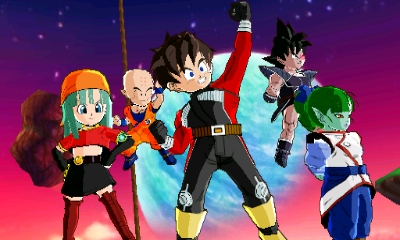
Dragon Ball Fusions begins with you creating a custom avatar based on five races; Earthling, Saiyan, Namekian, Offworlder, or Alien. Each race possesses its own strengths and weaknesses, but most will probably just choose the race that appeals to them best aesthetically. From there, the choice of facial features, hairstyle, and voice are available to tinkered with, though each feature is modeled after a particular character in the game.

Dragon Ball games usually have told the tale of the series and its various sagas ad infinitum by this point, so it's quite refreshing that Dragon Ball Fusions goes a different road. It starts off with you and your friendly rival Pinich having all seven Dragon Balls in your collection. Your joint wish is to hold a special fighting tournament to determine the ultimate warrior. This pulls both you and Pinich into an alternate world where the tournament is set to take place.

Story progression is made by flying around the open world maps of Fusions, talking to NPCs and performing various tasks and objectives for them. As you complete these tasks, new events are available and new combatants join your ranks. Characters in Fusions are from the entirety of the Dragon Ball mythos, including the original Dragon Ball, Dragon Ball Z, Dragon Ball GT, Dragon Ball Super, and many of the movies in between.

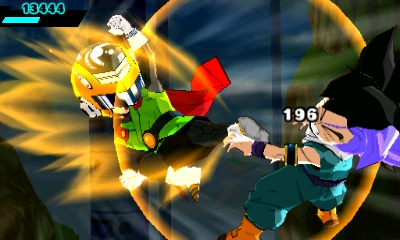
The Great Saiyaman is one of countless Dragon Ball heroes available to recruit.
However, the usual means to have new combatants to join your side is to recruit them in battle, which can be quite the annoyance for more notable and rarer characters. The majority of recruit-able characters in Dragon Ball Fusions are generic fighters based on the various races in the game and not big names like Goku or Frieza. Regardless of who the character is, through, to recruit them in battle, that character must not only have a star next to its name on the bottom screen, but you must take them out with a Zenkai Attack, a special attack in Fusions that uses energy in a meter that grows from performing and taking damage from Ki-based attacks. Even then, it's not always 100% that a defeated enemy will automatically be recruited, especially for the stronger fighters in the game. There's quite a bit of luck involved.

Recruiting opponents isn't just used to gain a strong stable of fighters. Each race has a particular type of energy assigned to it, and many story barriers in the game require you to have a specific amount of energy available to open them. Recruiting fighters of different races increases the amount of that energy you can collect, and fighting and beating opponents of a certain race earns energy. This energy requirement to open barriers to new areas of Dragon Ball Fusions can be an annoying roadblock for many players.

Power pole... Extend!
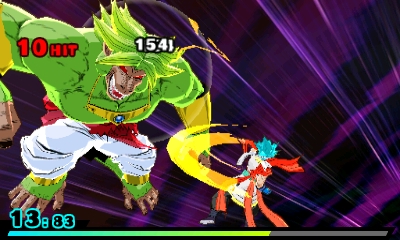
Battles in general take place in an arena setting and play like a turn-based RPG of sorts. Each fighter's icon is shown on a timeline, slowly inching their way to the right side, giving them a turn once it reaches that destination. During their turn, they can perform one of a myriad of actions, performing a melee attack that can be blocked by the opponent, a Ki attack that can't be dodged but does less damage, or a special attack that are energy-based like Kamehameha or melee-based like the Power Pole Extension if they have enough Ki orbs to use them. Depending on the turn timeline, if the next fighter or even fighters in the turn order are on the same team as the attacker, they will get some early attacks in one the unfortunate target.

Arenas such as this one are where battles in Dragon Ball Fusions happen.
Like I said, melee-based attacks can be guarded against, and this is possible through a mini-game of sorts where the attacker selects a direction to hit the opponent in and the defender selecting a direction as well in hopes of correctly guessing the attacker's intended direction. If they are correct, then the damage is minimized and the knock-back isn't as severe. When I say knock-back, I mean that several types of attacks can launch an opponent backwards, either into their own teammates to deal damage to them or into your teammates who will attack them for some extra damage.

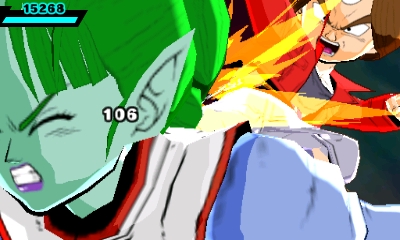
C'mon now, where's your sense of sportsmanship?
The length of a given battle can greatly vary depending on the strength of your foes. Some battles can last as quickly as one minute against a group of throwaway foes while a battle against a powerful group of enemies can take upwards of ten minutes. A big part of this is being forced to watch the attack animations of every move, with no option to skip these. Repeatedly seeing the same animations can grow old, but thankfully, the majority of them are less than ten seconds. Winning these battles earns each active teammate experience points as well as the occasional new move for defeating an opponent through simultaneously K.O.-ing them and hitting them out of the ring. Each fighter can only hold three moves at a time with an option to hold 30 moves as a backup for all fighters.

The "Fusions" part of Dragon Ball Fusions is a major mechanic of the game. Literally every character, even the generic ones, can fuse with one or several specific characters, pending they have met the requirements to do so. There are standard ones like Gohan and Trunks turning into Gotenks, but there are more humorous ones like Tien and Yamcha combining into one to form a being that is more powerful than Yamcha will ever be. There is also the ability to perform a five-way fusion in battle through the same means as doing a Zenkai attack (i.e. having enough energy in your team's special gauge). This temporary form allows you to enter a real time battle where you attempt to attack the enemy as much as possible while they try to attack you to lessen the amount of time you have in the fusion. Once time is up, a big blast occurs, dealing significant damage on top of the hurt you've already laid into your target(s).

Perform a five way fusion to turn the tide of battle... or put victory out of reach for the other team.
Visually, Dragon Ball Fusions shows that the aging Nintendo 3DS still can produce some very impressive graphics. The chibi models are the standouts in the visual department, as are the detailed backgrounds, all adding up to limited slowdown. It's a demanding game on the 3DS, as evident by the total lack of stereoscopic 3D. All of the voice work is left in Japanese, but most of the dialogue isn't voice anyway, just "Hai"-s and short voice clips of that sort. The music is typical of the Dragon Ball series with lots of rock and uptempo tunes.

Dragon Ball Fusions continues Namco Bandai's successes with the Dragon Ball license that it recently started with the Xenoverse line of games. Battles are strategic and engaging, collecting an assortment of fighters of all types is enjoyable (though the luck required to recruit some of them is ridiculous), and the original story is a good one for fans of the series to once again revisit their favorite characters. The repeated need to see battle animations and the requirement to collect enough energy to progress in the story can both be obnoxious things to contend with, but overall, Dragon Ball Fusions nails its fusion of turn-based RPG gameplay and high octane action.

[SPC Says: B]