Showing posts with label sphinx and the cursed mummy. Show all posts

Sunday, December 6, 2020

One & Done: Games Without Sequels - Part Four

Welcome to the return of One & Done, an article series on SPC that talks about games that never became franchises. They were literally one and done! Now, the purpose of these articles isn't to beg for sequels, as some of these games don't need them and not every game needs to become a franchise. Instead, we're just exploring and fondly remembering these terrific titles from generations' past and giving them some more time in the old spotlight.

Speaking of the old spotlight, check out the games featured in the spotlight on past editions of One & Done with these links:

Part One
Part Two
Part Three

The Last Story (Wii)

From the creator of Final Fantasy, Hironobu Sakaguchi, comes a game with a title that really WAS the final, last, and only game in the IP--unlike Final Fantasy. It's none other than The Last Story. It's a shame that Nintendo of America did not decide to localize the title during the Wii era, as not only could the game been a strong release when the system was winding down in popularity, but it's just an excellent game outright. Xseed Games ended up localizing and releasing The Last Story in North America, and it's a great thing that the publisher did, as Wii owners would have missed out on this ode to classic RPGs with modern window dressing. Between the highly capable and deep combat system with an action-RPG feel, and its abundance of quests to highlight the cast of characters, The Last Story remains a solid RPG, not just for the Wii, but in today's market as well.

Opoona (Wii)

We go from a classic-style RPG on the Wii to one that's quite the refreshing and utterly adorable type with the Koei-published Opoona. The big thing that distinguished Opoona from its contemporaries--other than the obvious whimsical characters with floating orbs over their heads--was the ability to play the game solely with the Wii Nunchuk, if one desired, harkening back to days and nights of playing PS1 RPGs with that one-handed controller, if you remember that. The Nunchuk wasn't just for ease of playing with one hand, one used it to flick forward to attack enemies with projectiles, whose firing angles could be altered based on the combat situation. No worries, though, if motion controls aren't for you, as Opoona does allow the Classic Controller to be used. Though Opoona never received a sequel, the character has appeared in another game: Warriors All-Stars aka Musou Stars in Japan.

Puppeteer (PS3)

Most likely mentioned in one of SPC's Most Overlooked games articles, Puppeteer had the ill fortune of releasing on the PlayStation 3 after the launch of the system's successor, the PlayStation 4. While many PlayStation gamers had moved on to the new hotness that was the PS4, Puppeteer was left to languish on store shelves and out of the spotlight completely. It's a shame because Puppeteer was yet another insanely creative and crafty platformer from PlayStation's excellent first-party studios, this time around Japan Studio. Protagonist Kutaro wielded a mighty pair of shears to slash and slice through the game's myriad levels and fascinating worlds. Speaking of which, the whole world was a stage essentially, as Puppeteer was presented with a clever play-like atmosphere, complete with curtains and the occasional audience. Sony hasn't forgotten Kutaro or Puppeteer, thankfully, as one familiar with the game can see a callback to the game--among many, many other PlayStation games--inside the PlayStation 5 pack-in title Astro's Playroom.

Jeanne d'Arc (PSP)

Jeanne d'Arc has all the makings of an awesome game--tactical RPG, based on the story of Joan of Arc (albeit decidedly incredibly loose in its interpretation), beautiful visuals, and Level-5 as the developer back when it had better success stories. Fortunately, with all of these makings of an awesome game came... an awesome game! There are influences from lots of games within Jeanne d'Arc's genre, such as Fire Emblem most notably with its rock, paper, scissors-like affinity system, and it made for strategic and quite frankly, satisfyingly challenging battles! All of this was balanced wonderfully with battles that weren't slow and plodding but instead fast and fluid in their pace. Really, Jeanne d'Arc stands with the greatest tactical titles in the PSP's impressive arsenal, including the greatest of them all (in this writer's opinion, at least) Final Fantasy Tactics: War of the Lions.

Sphinx and the Cursed Mummy (Multi)

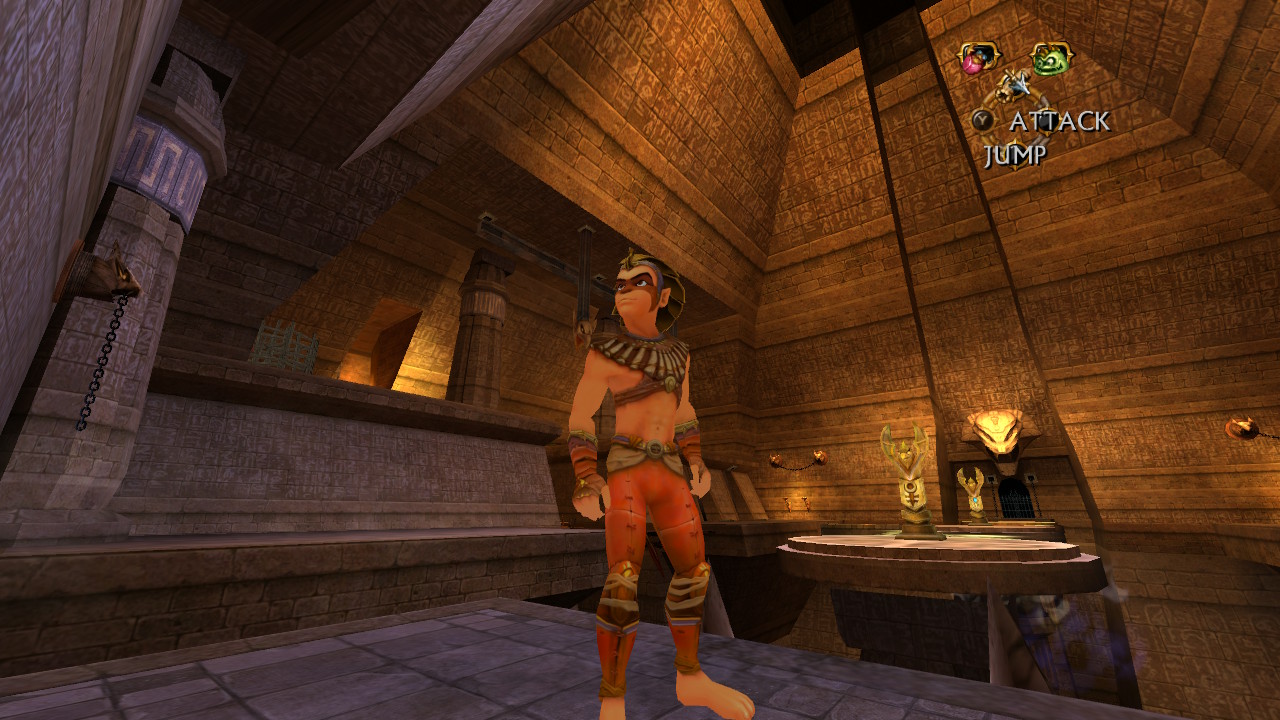
Alternating between two different playable characters, Sphinx and--if it wasn't obvious from the title--a mummy who was originally a prince who received a curse from the game's main villain. While Sphinx's sections play out like a traditional Zelda-like with action-focused combat, exploration, and dungeon-crawling--and who can't have enough of those!--the mummy's sections were dungeon-based but focused heavily on puzzles, particularly involving the mummy being crushed, shocked, set ablaze, and all other manners of non-painful torture to make progress. Although Sphinx and the Cursed Mummy originally released back in the PlayStation 2 era, the game recently received a remastered version on the Nintendo Switch, which by the by, the above screenshots come from. Is it possible we'll see more from Sphinx in the future?

Geist (GCN)

The final game of this edition of One & Done is a first-person shooter with a fresh possession mechanic, though one that wasn't executed to its full potential. It's the GameCube's Geist. The game's story was one of conspiracies and a protagonist whose specter was separated from its body, allowing them to freely enter all sorts of objects and living creatures. The latter, however, had to be spooked first in order to be possessed. So, in essence, part of Geist wasn't just focused on high-octane action with run and gun blasting at baddies, but also puzzle aspects in how to approach possessing specific targets. Geist is an idea that again, wasn't executed perfectly, as the game was quite linear. I would have loved to see more freedom in tackling challenges rather than the game having just one way to go about accomplishing things, but overall, it was an enjoyable shooter published by Nintendo in an era of interesting titles published by the world's biggest game creator.

===

What games without sequels are your favorites? Do you want to see sequels to them? Let the SPC community know your thoughts in the comments section below.

Monday, April 29, 2019

Sphinx and the Cursed Mummy (NSW) Review

April's end is approaching, but there's lots of reviews to come to SuperPhillip Central before then. Our next review is for the Nintendo Switch remaster of Sphinx and the Cursed Mummy. What's next--a revival of Metal Arms: Glitch in the System?! Actually, that'd be pretty cool, too. Regardless, here's the SPC review of Sphinx and the Cursed Mummy.

Not all that it's wrapped up to be


With the recent surprising announcement of XIII being remastered for all current platforms, I couldn't help but think of other games from the past decade that have been revived much to my amazement. Now don't get me wrong--games like the stylish third-person shooter XIII and games like de Blob on Wii of all titles, are good surprises, but on the list of games that I just couldn't wait to see remastered, they sort of weren't at the top of my list.

Here comes Sphinx and the Cursed Mummy, a game that like XIII, released during the PlayStation 2, GameCube, and Xbox generation--though this time around it was published by THQ. This 16 year-old action-adventure game set in an Ancient Egyptian world and clearly inspired by The Legend of Zelda is a blast from the past, but while the visuals have been improved, unfortunately nothing else really has. It makes for a game that is a product of 2003, cracks in its foundation and all.

Thankfully, Sphinx has no fear of heights.
Sphinx and the Cursed Mummy is split up between two characters, and the title of the game sort of gives away who these two characters are. There's our primary protagonist, Sphinx, who you'll spend the majority of the game playing as, and the titular Cursed Mummy, a poor soul who was once a prince.

While both gameplay styles feature plenty of platforming and puzzle solving, whereas Sphinx throws in combat and lots of exploration, the Mummy is simply focused on puzzles and platforms. Both Sphinx and the Mummy are completely in separate areas of the game and only cross paths at the very conclusion of the 15-hour adventure. Generally, when Sphinx needs a special item or ability to continue in his journey, the Mummy will be called upon, awakened, and tasked with finding the item in the hazard-filled castle he's imprisoned in.

Sphinx slices this skeleton down to size. That'll teach you to have a bone to pick with our hero!
Unlike Sphinx, the Mummy has no health gauge to worry about. He can fall in pits, get crushed, set ablaze, electrocuted, and sawed into thirds without you receiving any game overs to speak of. In fact, all of these otherwise dangerous occurrences that would kill Sphinx in a snap of a finger actually benefit the Mummy in order to solve environmental puzzles. Certain doors and gates can only be opened by turning on a generator via an electrocuted Mummy, whereas wooden obstacles in the Mummy's way burn up with ease while he's on fire. It's all about figuring out how to transport the Mummy to the areas he needs to electrify or set fire to without stepping foot in or being doused with water, which will cancel any elemental effects happening to him.

Positively shocking. (Yes, that was a really easy joke to make, and I hate myself for it.)
Meanwhile, Sphinx is the more traditional character in the game, armed with a sword and as his adventure progresses, receives new items and abilities in true action-adventure game style. While Sphinx and the Cursed Mummy no doubt has its clear inspirations from The Legend of Zelda series (such as collecting four Heart Pieces--I mean, Gold Ankhs--to increase Link's--I mean, Sphinx's health by one), the structure is vastly different. Yes, there are still things like dungeons to conquer, where keys are needed to unlock doors, but there's seldom a boss to battle at the end. Instead, these encounters pop up here and there throughout the story. Though, what bosses Sphinx and the Cursed Mummy does have are mostly rather mediocre.

One of many dungeons filled with dangers, enemies and puzzles to tackle.
Sphinx and the Cursed Mummy is just like one of the artifacts from the Ancient Egyptian world the game takes place in--rather antiquated. The camera can get stuck at times, especially in narrow passageways, unable to turn around quickly enough. Combat is a bit clunky, and would have greatly benefited from a certain series's lock-on targeting. Jumping and platforming lack polish, resulting in more missed jumps than I would have liked to experience, plus many occasions where I'd think I could jump on something, only to fall to my doom.

Lastly, and most egregious to me, is the save system in Sphinx and the Cursed Mummy. Utilizing save statues at various points in the game, these are quite frankly way too spaced out, particularly in the Mummy segments. In these you simply get the save point at the start of the section, and you must play through the segment of jumps and puzzles--some taking over a half-hour to complete--without the ability to save. This is most frustrating when playing as Sphinx, as if you don't save and you perish in battle or while exploring, you get kicked out of the game to the title screen with all of your progress past the last time you saved at a save statue gone. I once lost 30 minutes of progress because of this once, and it almost made me stop playing the game completely. And let's not even talk about the point of no return near the end of the game that you can save your progress in, blocking you from ever revisiting past areas...

Sphinx won't say it because he's the strong, silent type, but you know what he's thinking: "WHEEEEEEEEE!"
Sadly, Sphinx and the Cursed Mummy is a bare-bones remaster of a 16-year-old game that only went so far as to touch up on the visuals of the game than add gameplay improvements and refine parts that didn't hold up so well. This could have been a chance to rework negative aspects of the adventure, such as the aforementioned save system, but instead, what you have is a basic HD remastering of what is a competent and engaging game, but one that is definitely a product of its time, with all of the wrinkles of that time included.

[SPC Says: C+]