Showing posts with label spike chunsoft. Show all posts

Wednesday, May 27, 2015

Fossil Fighters: Frontier (3DS) Review

Fossil Fighters: Frontier released in Japan back in February of last year. It only just released in North America in March of this year, and it releases in PAL territories later this week. As we continue this Nintendo 3DS-themed month, I review the game with as much depth as the dirt between a shovel and a fossil buried deep within the earth. Did that analogy make any sense? While I ponder this, you check out my review!

Dig, battle and explore until you're vivo-sore.


It's been a lengthy localization journey, but more than a year later, the third entry in the under-appreciated Fossil Fighters series has hit the West. An uptempo and endearingly cheesy theme song begins a quest to become a warden in the Fossil Parks all around the world. This leads to taking down the return of a sinister group which uses dinosaur-like vivosaurs for their own evil plans. Thankfully, you have a crew of helpful NPCs and vivosaurs of your own to combat this threat.

Contrasting greatly with the catchy and fast-paced theme song of the game, Fossil Fighters: Frontier begins with a very slow pace, getting you accustomed to the game's systems, the concept of exploring Fossil Park dig sites, selecting and upgrading your buggy to travel in said dig sites, digging for fossils, and battling other vivosaurs. Fortunately, after a couple of hours, the game takes off the training wheels and allows you almost total freedom.

You can also select a female avatar to play as.
That said, grinding is an issue with Fossil Fighters: Frontier. It's not just doing combat to gain experience points to level up individual vivosaurs-- it's grinding for money to upgrade your bone buggy, the vehicle used to travel in the dig sites. At the beginning of the game, your selection of bone buggies is limited, but as you progress in the game, you can upgrade your buggies as you see fit-- upgrading the battery, digging tools to make digging up fossils all the quicker and easier, and engine to make the buggy go much faster. The latter enables it to not only drive with greater speed, but it also assists in going off ramps and catching bigger air, reaching otherwise inaccessible locations with rarer fossils to excavate.

Thankfully, these vivosaurs aren't deadly like
the ones in the upcoming film Jurassic World.
There are three main Fossil Parks in Fossil Fighters: Frontier: Asia, America, and Europe. Each has their own leader and head warden that hands out orders to complete tasks within the various dig sites, of which there are three in each Fossil Park. These range from rescuing a stalled buggy to encountering and doing battle with troublemakers in the park. Along the way to these locations at dig sites, you're free to explore and find digging locations to excavate fossils.

Excavating fossils is a simple enough process, and as stated, as you upgrade your buggy's digging tools, fossil excavation becomes quicker and easier to accomplish. As you play through the game, the selection of hammers and drills used to dig up fossils grows. Each excavation requires you to use the combination of hammers and drills to remove dirt from fossil all the while taking caution in not damaging the fossil itself. You will see damage to the fossil by purple marks left on the bones where you went a little to hardcore in your excavation.

Use your stylus with grace and precision to
unearth fossils of all shapes and sizes.
You can score up to 100 points on an excavation of a fossil type, and this score is finalized by how much of the fossil is freed and if any damage was done to it. The more damage you do to a fossil, the less your max point score on it can be. This is all the while you racing against the clock to unearth a given fossil. When you upgrade your bone buggy's battery, you also increase the amount of time you have to work with.

When a fossil is unearthed, it gets revitalized into a living vivosaur. There are four parts to a given vivosaur-- head, body, arms, and legs. Each part excavated of a vivosaur gives it experience points (the same number as the amount of points you earned in excavating it) and a new move to use in battle. Since a vivosaur is made up of four parts, each part is a different move to utilize in combat.

Combat in Fossil Fighters: Frontier can be a bit confusing the first few hours you play. However, after some practice and understanding of the game's combat system, you can quickly learn the ins and outs soon enough. There are five elemental types of vivosaur, and each aside from the neutral type, is weak against another. Water beats fire, fire beats air (yeah, I don't know why either), air beats earth, and earth beats water.

Battles can be highly contested whether you're
with a Paleo Pal or by your lonesome.
Not only this, but each vivosaur variety has a physical stance where they are strongest and weakest when standing in. These stances are entered by performing and taking attacks. For example, one vivosaur might use an attack that allows it to stand upright, boosting its offense. Meanwhile, an attack on it from a rival vivosaur might make it turn around backwards, making it much more vulnerable to enemy vivosaur strikes.

You can have up to three party members, including yourself. The other two are Paleo Pals, AI-controlled teammates that you can select from before embarking in your bone buggy to a dig site. Not only are they a big help to take down enemies that would otherwise be too strong for your lone vivosaur to take down alone, they can also use support shots to beef up your vivosaur during and attack or defensive phase of battle. You can also stock up your bone buggy with support shots to help your teammates in battle. An example of this is if your opponent is attacking your side. As every attack shows the amount of LP (life points, the health attribute in Fossil Fighters) that the attack is set to take off, as well as the percentage chance the attack with make contact and the percentage chance of a critical hit, you can use an evasion shot (or several) to lower the likelihood that the enemy's attack will hit the vivosaur it is aiming for on your side.

That yellow and orange mark displays where a fossil is in hiding.
Aside from exploring Fossil Park dig sites, excavating fossils and doing battle with other vivosaurs, at each Fossil Park headquarters is a set of points of interest that add even more longevity to Fossil Fighters: Frontier. For one, there's a machine called the Missionator 4000 in each park's HQ that awards you money and other goods for capturing roaming vivosaurs through defeating them in battle and digging up specific fossils in the various dig sites. Additionally, there are daily tournaments at the local stadium that you can enter to win money and boost your warden ranking, a special rank that gives you certain benefits in battle.

So, I'll get the trophy on odd days, and you two
can battle over who gets it on even days.
The performance of Fossil Fighters: Frontier is pretty good overall. While the environments are full of rather gnarly textures when viewed up close, the areas look nice to the eye. The combat is the highlight of the presentation package, offering well animated vivosaurs that look as slippery with their wet skin as you'd expect from a prehistoric creature. Sure, there are lots of vivosaurs to collect, but a lot of them are simple pallet swaps with a few added geometric features. The music isn't much to take note of, but it's serviceable enough and it doesn't get grating.

Fossil Fighters: Frontier offers a lot of fun gameplay and a Pokemon-style story that features plenty of humorous dialogue and some laughs. Yes, there is some grinding to be had, and the game is slow to begin. However, once it lets go of holding your hand, things pick up and pick up rather fast. Despite having old school issues like excessive grinding and a lot of tutorials in the beginning, Fossil Fighters: Frontier doesn't feel at all like a game stuck in the prehistoric era of gaming.

[SPC Says: B-]

Tuesday, October 29, 2013

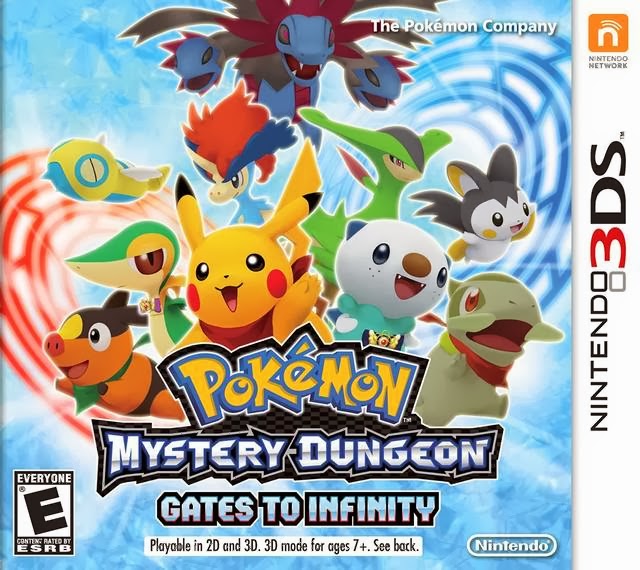
Better Late Than Never Reviews: Pokemon Mystery Dungeon: Gates to Infinity (3DS) Review

What a long-winded headline! Anyhow, while many Pokemaniacs are deeply engaged with Pokemon X and Pokemon Y, we have a review for another Pokemon game. However, this one released earlier in the year and is not of the same genre. Pokemon Mystery Dungeon: Gates to Infinity brought the Pokemon Mystery Dungeon spin-off series into three-dimensions. Here is our review.

To the Gates to Infinity and Beyond!


The Pokemon brand is one that isn't just limited to the mainline games, releasing a new generation once every few years or so. No, Pokemon is a brand that has spun off into many sub-series and games, such as Pokemon Snap, Pokemon Stadium, Pokemon Ranger, Pokemon Rumble, PokePark, et al. One such spin-off series is Pokemon Mystery Dungeon, a series that dates back to the Game Boy Advance. The latest addition to this sub-series is Pokemon Mystery Dungeon: Gates to Infinity for the Nintendo 3DS. It foregoes the 2D sprites of past games with fully polygonal 3D models for characters and backgrounds. Should you bother to explore Gates to Infinity's world?

Pick two Pokemon-- one you play as,
and one that serves as your partner.
Pokemon Mystery Dungeon: Gates to Infinity's story begins with you, the player, receiving a cry for help within a dream. When you wake up, you find yourself within the Pokemon world, yourself turned into one of a handful of Pokemon choices, such as Pikachu, Axew, and Tepig, for instance. You also select your Pokemon partner, which will join you throughout your adventure. What the actual adventure comes down to is that the Pokemon world is in danger of destruction, and only you have the power to save it. The story is rather enjoyable, with various intriguing plot points. The problem, however, is just how chatty the Pokemon are. This wouldn't be an issue if you could skip dialogue or speed through it somehow. This isn't possible, however, making for occasional long sessions of dialogue that the player needs to sit through. Still, the interactions between Pokemon are really endearing, so I can't really say I didn't enjoy some conversations.

These Pokemon can be Chatty Cathys.
Think of Pokemon Mystery Dungeon as a beginner's take on the Mystery Dungeon genre (i.e. roguelike). You explore dungeons that are randomly generated-- each time you visit a dungeon, the layout is completely different in its design of hallways and chambers. Your goal is to defeat enemy Pokemon as you traverse through each dungeon, finding the stairs that will take you to the next floor until you reach the end. At the end is usually a boss fight or a Pokemon that must be saved or defeated.

Found it! The way to the next floor!
Movement within a dungeon is on a grid. You can move in eight directions, and each time you move one space or perform an action such as using an item, attacking, or using one of your Pokemon's four abilities, every other Pokemon in the dungeon also gets to move once or perform an action.

The spoils of war.
Like the main Pokemon games, each Pokemon and ability has its own type or types, like Fire, Water, Electric, Grass, Rock, and so forth. The rock-paper-scissors approach to Pokemon battles is still present in Pokemon Mystery Dungeon. For example, an Electric move on a Water Pokemon will be super effective, causing major damage, while a Grass move on a Fire Pokemon will hardly make that Pokemon flinch.

Like the mainline games, Pokemon learn new
moves at various different levels.
This is pretty much where the complexity of the game ends. It's very basic combat. It's easy enough to gain levels that you can pretty much plow through any battle or boss fight with little danger. The addition of items that can make enemy attacks miss the player's party more or revives a fallen Pokemon makes the game even easier. I was able to get through most combat situations without even using defensive items. All I needed were healing Oran Berries, as if your or your partner's HP hits 0, you fail the current dungeon.

If you're looking for a challenge,
this game might make you fall asleep, too.
Dungeons themselves aren't too interesting either. They are pretty much the same in structure only with a different aesthetic. By the third or fourth floor of a ten floor dungeon, I started to grow bored of the environment and running through the same room types and long hallways leading to dead end after dead end. Yes, there are some things to liven up dungeons, such as some floors taking away the ability to regenerate HP through movement, but these don't liven things up enough. Extra dungeons unlock after the game is beaten, a 20-hour task, and special dungeons can be created on the fly through using the Nintendo 3DS system's camera to find circular objects within its viewpoint.

No time to take in what little sights there are--
we have a Pokemon world to save!
Pokemon-wise, what is available is only an extremely small sampling of pre-fifth generation Pokemon. Every other Pocket Monster is from the Black and White games. As someone who skipped out on playing heavily through both titles, I didn't recognize a good majority of the Pokemon represented. Still, there are some very nice designs present. Occasionally, you will defeat a Pokemon and they will ask to join your party. You can accept and have them added to your ranks, or you can reject their offer and gain experience from them, just like any ordinary felled foe Pokemon. Thankfully, a Pokemon need not be in your party to gain experience. They will simply need to be in your party to gain all of the levels they acquired while in your reserve of Pokemon pals.

The bottom screen can serve
as a helpful map for you.
Outside of dungeons, there rests Post Town, where many story events take place, as well as Pokemon shops and destinations to break up any dungeon monotony. Outside Post Town is Paradise, a place founded by your partner Pokemon and yourself. In the game, you eventually can have sections of wasteland turned into expansions for Paradise. You can ask a certain fiend turned friend Pokemon to build specific locales in each expansion area, like fields to grow berries, training dojos to learn new moves, and a lot more. This adds to the lengthy replay value of Gates to Infinity.

The graphical upgrade of this 3DS debut of the Pokemon Mystery Dungeon series makes for an appealing title to look at. The Pokemon have a fair amount of detail to them and animate well. Areas are suitably colorful, though there is occasional frame-rate hiccups to be wary of. The 3D effect of the Nintendo 3DS is nothing to gloat about, but it is sometimes nice to have on. The audio in the game is really nice. I remember a fair number of tracks, and have even listened to them outside of the game. That's how much I liked them. Overall, the presentation of Gates to Infinity is an excellent one.

Pokemon Mystery Dungeon: Gates to Infinity won't excite or engage more experienced players of roguelike titles. It is really an easy game to play through, but Pokemaniacs and those new to the genre will find a lot to love. The story segments overstay their welcome at times, and the dungeons aren't the most interesting to explore, but the positives shine brighter than the negatives. Those searching for a relatively safe addition to the Pokemon Mystery Dungeon series will find that the Gates to Infinity will be open for you.

[SPC Says: 7.0/10]