Monday, March 31, 2014

DuckTales Remastered (Wii U, PS3, 360, PC) Review

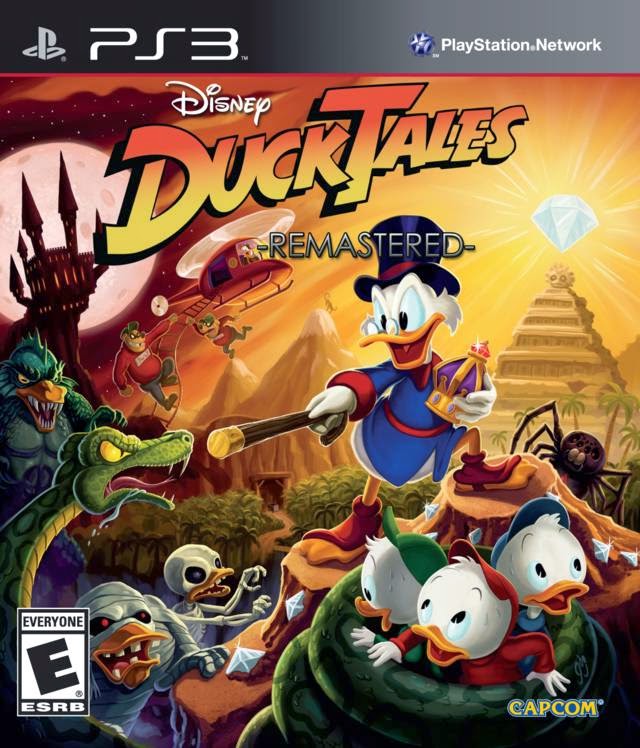
We close out what has become a month of platformers with DuckTales Remastered, a remake of the classic NES DuckTales. Phil gives us his verdict on Scrooge McDuck's long-awaited return to gaming.

A Retro Quack Attack


While Capcom is obviously well known for such popular classic franchises such as Street Fighter, Mega Man, and Strider, back in the NES era the company was proficient in creating excellent Disney licensed games, whether based off films or television cartoons. It certainly would be quicker to name the games that weren't so great rather than the ones that were. DuckTales was one of these truly great games that fans of the NES can still find immense enjoyment out of. Now, Capcom and WayForward have teamed up to craft an HD remake for not only those who wax nostalgic for the NES original, but also for a whole new generation of gamers. It all adds up to DuckTales Remastered. Is this remake all that it is "quacked" up to be?

The NES DuckTales didn't provide any semblance of a story. There was no explanation for Scrooge McDuck venturing to five seemingly picked-out-of-a-hat locations to find five treasures. DuckTales Remastered creates a story that explains all of this, and even goes the distance in clearing up questions formed by players of the original game. Ever wanted to know how in the heck Scrooge McDuck and companions could breathe on the surface of the moon, or why a certain pair of villains teamed up at the end of the game? You'll most likely be happy with the explanations the developers have come up with.

"But first I'm gonna dive into my pile o' money!"
DuckTales Remastered isn't just the five original levels of the NES game. To further add some longevity to the game and to iron out story elements, there are two brand-new areas within the game. The first serves as an introductory level, bringing players up to speed with the basics of how Scrooge McDuck controls. The second replaces Scrooge McDuck's return trip from the original DuckTales to Transylvania for the final showdown of the game. Instead, the level takes place in Mount Vesuvius, and it feels just as well made as every other level in DuckTales Remastered.

It's certainly (and literally) a jungle out there.
As for the returning levels, these have been altered slightly. These are welcomed changes that make levels play out much better than the NES original. In said original, one could simply stumble into a boss's lair without doing any thorough exploring of a typical level. In DuckTales Remastered, there's a various goal in each level that Disney's billionaire duck needs to take care of before moving onto the boss. For instance, in the Amazon, Scrooge must acquire eight ancient coins to lead him and Launchpad to the temple where the treasure rests. Meanwhile, in Transylvania's haunted castle, Scrooge needs to rescue Huey, Dewey, and Louie from their captors.

Alongside completing these mandatory tasks, players can stumble upon treasure and riches just like in the original DuckTales game. This added encouragement to explore levels is much appreciated, and it makes for a longer game that never at all feels like simple padding. Every jewel and treasure collected adds up to a tally once Scrooge returns to the hub, his office. The money earned isn't just for show; it's an in-game currency as well, used to purchase character profiles, concept art, and music. Unlocking all goodies will take a few play-throughs to complete, and with the game's multiple difficulty levels, replaying this relatively short game remains fun.

Look high, low, and everywhere in
between for treasure!
Scrooge McDuck retains all of his nimble platforming and offensive tricks, the most notable being his trademark pogo routine,. This allows him to continuously bounce up and down, off the heads of enemies, and even on spikes. For classic purists, there's an option to keep the old school pogo controls (i.e. holding the d-pad down as the pogo button is pressed). However, harder difficulties require this control setup. Also with his cane, Scrooge can swing and hit rocks, blocks, and open treasures. In the Transylvania level he can even smack the iron ball attached to a mummy's ankle to have it plow into the enemy, defeating him.

"Thanks for the assistance
in practicing me pogo technique!"
If there's one issue that many will find with DuckTales Remastered, it's that the game constantly interrupts the gameplay for story sequences. These generally happen when Scrooge comes across a dead end or comes across an item necessary for progression. These can be skipped, though, and they are highly entertaining, as the dialogue is full of funny banter between characters, and true to the cartoon and its characters. It's simply that the need to pause the game and skip the cinematic for replays of the game can get tiring to some. It didn't bother me per se, but it's something to be wary of for prospective players.

These guys wouldn't even make
it in the peewee leagues.
As if the game itself wasn't wonderful, the visuals of DuckTales Remastered are nothing short of sensational, too. The formerly 8-bit sprites of the NES game have been updated with an incredible level of detail in animations and now look absolutely true to the cartoon. Levels have 3D foregrounds while the backgrounds are a 2D delight. Playing the game, I felt like I was controlling a genuinely faithful recreation of Scrooge McDuck in a highly animated and alive cartoon world.

And with a tip of his hat, the
enemy explodes at Scrooge's will.
...Okay, maybe the robo duck did that.
What further helped me grasp the dedication to the legitimacy of the cartoon is the return of the original cast, reprising their roles and sounding like they had never been on a two decade-long hiatus. The music has been recreated with new instruments and sounds really well done, but if you do get misty eyed for the original 8-bit themes, you can unlock them once you've beaten the game. All of this adds up to a game that represents the classic DuckTales cartoon in fantastic form.

The boss battles feature some creativity
that is very much appreciated!
WayForward's team has gone beyond the call of duty to make DuckTales Remastered a faithful tribute to not just the NES classic, but also to the Disney cartoon. The gameplay remains relatively unchanged, but the altered in addition to the brand-new levels gives new twists to a game that's familiar for many twenty-somethings on up. If you're new to the game, Remastered also shines in that regard. It's not nostalgia that makes DuckTales Remastered great. It's the tried and true gameplay, characters, and mechanics that keep Remastered from feeling dated. All in all, DuckTales Remastered is a game that will make most players go "Whoo-hoo!"

[SPC Says: 9.0/10]

Sunday, March 30, 2014

Fan-Made Mario Games You Should Have Played

The following is a post written by a friend.

If you enjoy exploring new worlds with Mario, you'll love the wide selection of Mario Games at JeuxJeuxJeux.fr. You can ground-pound your way through familiar and new enemies in all sorts of Mario World challenges. The adventures feature Mario's favorite pals, including Luigi, Yoshi, and Princess Peach. Put your retro gaming skills to the test, and try to conquer the infamous Bowser! Every Mario game features exciting side-scrolling or 3D action with addictive Nintendo gameplay.


Have you ever wanted to face Goombas and Piranha Plants in never-before-seen levels? Super Mario Star Scramble 2 features an entirely new platform world. Stuck on a colorful island, you must collect coins and special stars before time expires. This 8-bit Mario game pits you against flying Goombas, dangerous Koopa Troopas, and other foes. You can jump onto bricks and search for cloud platforms to reach new heights. Each level features a hidden coin, which you can collect for bonus points. Bounce on trampolines, bash Mystery Blocks, and guide Mario through tricky platforms to win!


Brave fighters will enjoy the fist-to-fist battles in Mario Combat. This unique fighting game sends Mario into the bowels of Bowser's lair. You will face grave dangers in every section within the antagonist's home. One punch can send you flying to your doom in fiery lava! To avoid an untimely death, Mario must punch through every evil Koopa Troopa. Throw fists quickly to perform combos and knock out the tiny minions. The intense battle will escalate as you wall-jump and fight on moving platforms. When you reach the final stage, Bowser will be ready for the ultimate duel. Dodge his flaming blasts, and deliver a deadly uppercut to defeat Mario's mortal enemy!

Friday, March 28, 2014

Crash Bandicoot (PS1, PSN) Retro Review

This past Wednesday we took at look at Klonoa: Door to Phantomile, a charming PS1 era platformer. Now we take a look at what is the system's most well known platformer, Crash Bandicoot. Bean gives us his opinion on the game with this retro review.

Crash Course


Way back before Naughty Dog was making cinematic-oriented games, they were a company that was struggling to find a direction for themselves. Mark Cerny, who at the time worked at Universal Interactive Studios, liked the promise that the team had and asked the studio to try and put that ability into making a new platformer. Many had tried to compete with Nintendo's series in the past, but at the time, only Sonic the Hedgehog had seen any semblance of lasting success. It seemed an odd move, but there was one advantage the team had. The game would not be a simple side-scroller, but a 3D-based one instead. The game, of course, would be none other than Crash Bandicoot, and it would be one that Sony quickly signed on to their Playstation in order to compete with Nintendo. How was this first game that helped put Naughty Dog on the map? You don't have to answer that. I will.

Crash Bandicoot has the titular character mutated into his hero-to-be self by one Dr. Cortex and the sinister scientist's Evolvo-Ray. The animal is subjected to a mind-control experiment from another invention known as the Cortex Vortex, but this machine fails, and the marsupial is tossed out with the trash. During his time in captivity, the bandicoot found a love interest, so I guess we have our standard save the world and get the girl plot that this genre is famous for!


As stated earlier, Crash Bandicoot isn't a standard platformer. The game focuses on platforming in 3D, even in levels that look like they would be traditional, 2D side-scrolling stages. The object of the game is to not only reach the end of the level, but also break every box in your path along the way. This is actually easier said than done in a lot of cases as a good many levels offer a decent degree of challenge to them, whether it be with enemies placed in spots that will hinder your movement or stage hazards that will cause you to plummet to your doom in no time at all. It's certainly not an easy task considering the decent variety in levels and sometimes the not so decent flaws that come along with it.


There's plenty of level types to get going through. Standard stages see Crash running forward through a jungle environment and dealing with the local wildlife such as crabs or aggressive plants. To combat these annoyances, you have the old-school ability to hop right on their heads with the X button or go and use Crash's patented spin attack by pressing square instead. In some cases, you'll have to use both techniques in tandem to be able to take down an enemy. For instance, one level early on in the game sees Crash trying to scale a wooden fortress. Along the way, he'll run into tribesmen that are carrying shields. If you try to spin into them right off the bat, you'll be bounced back until you're most likely pushed right into a pit. That said, if you jump direct on top of a tribesman at first, he'll raise his shield to block you, giving players a chance to spin him out of the way. I do like how it's pretty easy to tell which enemies you'll need to do this on. It's something a lot of platformers, even today, can get wrong at times. Yeah, I'm looking right at you, Sonic: Lost World.


Again, the variety of levels you'll go through in this game's three islands is a nice thing. Even better, many of these types get more than a one-and-done treatment, and I think it's good to refine what you have instead of throwing in everything and the kitchen sink. Platforming on moving lilypads, climbing temple structures, running towards the screen to avoid getting squashed by a giant boulder, and hopping on a hog for a little animal buddy stage, these levels will are generally fun and manage to get the whole fun factor thing down right. There are two examples, though, where I found that not to be the case. These are the bridge and darkness levels.

The former will see you doing thin platform jumps, with some of those breaking almost instantly on you if you mistime your jumps in any fashion. To make matters worse, there are parts in both bridge stages where planks will be invisible until you walk right up to them. This happens at the start or end, depending on which bridge you're on. I absolutely loathed going through Road to Nowhere and falling to my doom after reaching a hidden path just beyond the goal as you have to make a few leaps of faith to cross planks. Miss one jump, and bye-bye boxes. Did I mention that checkpoints in this game don't save your boxes broken progress as they all respawn? Yeah, you have to clear these in one go, or you might as well just back out and start the stage over.


The issue with the darkness levels are that there is that the terrain itself will get in your way more often or not. Taking place in a castle, some parts to these stages have you jumping around doors that I had Crash get stuck on a few times. The worst level in the game, Fumbling in the Dark, is one where you have to jump around doors four times in succession and angle yourself to the sides of the room to both break the level's first few boxes and not fall into the giant pit in the middle of the area. The moment Crash gets caught on the wall, his momentum just halts, and you will fall into said pit more times than you'd care for. As a guy that already can't stand darkness gimmicks to begin with, mixing in more frustration due to a geometry glitch is something I could have done without. Luckily, Naughty Dog agreed as other entries in the series would not have you platforming against the game's physics engine. Good.


So you're going through and breaking boxes, but what's the point? Well, your reward for making it through a level with every busted box is a gem. Most of the time, these will be simple silver-colored ones that do nothing but increase your percentage progress, but there are a few stages that offer a better reward. By making it to the end of those, you'll receive a colored gem. You see, some levels have paths that would otherwise be inaccessible until you earn these crystals. This does make you have to do some forced backtracking to clear out the small number of boxes you were previously missing, but these paths are generally easy enough to get through. I can't get too annoyed with this, but I will say that I wish the gem paths would have occurred in levels beyond the point where I earned them instead of in previous ones.


Boxes themselves have plenty of goodies inside of them. Aside from the game's version of coins known as Wumpa Fruit and extra life ones, there's also a floating mask known as Aku Aku. This magical mask grants Crash the ability to take an extra hit or two depending on how many crates of Aku's you can find. If you get three without taking a hit, you'll turn invincible. Not only does this allow you to plow through enemies like there's no tomorrow, but you'll also tear through boxes and see an increase to your speed. It's only a temporary thing before it reverts back into its level two form, but it's nice when you can earn it. The last item that you can get from boxes are tokens of either Crash's girlfriend, Cortex, or his assistant. In levels where they appear, they always show up in threes. Collect all three, and you'll be able to enter into a bonus round. Depending on which three tokens were collected, you can either collect quite a few more lives and instantly make a superfluous save or get sent to a more challenging area. The two Cortex ones will unlock hidden levels if you can make it to the end of them.


The goal of all this is to get through all three of the game's islands and put a stop to Cortex and his army of both natives and mutants. That said, the bosses in this game are so basic that it's almost a wonder if they were just tacked on for the sake of having them. Most involve you just slowly dodging obstacles that will have no chance of hitting you even on an off day and only take a handful of hits before going down. Even Dr. Cortex himself is simply a matter of dodging his slow-moving chemical concoctions while spinning the correct one back into him. If there's one flaw that Naughty Dog has had over the years, it's that they're usually unable to design an engaging boss encounter.


In the end, I left feeling satisfied but also thought there were enough flaws to keep me from outright recommending it. It has some interesting design decisions at the very least, even if those decisions are a mixed bag. Thankfully, the foundation that was established with this game would be built upon in future installments. That said, Crash Bandicoot is a respectful first attempt at creating a game in a genre that was trying to take off in the mid-90s. As such, I do think it's worth your time, but I won't be surprised if you some of you Crash and burn after playing this game.

[SPC Says: 7.0/10]

- Bean

Thursday, March 27, 2014

Despite Being the "Uncool" Platforms, I'm Proud to Own a Wii U and Vita.


If systems were children in middle school, Nintendo's Wii U and Sony's PlayStation Vita would be the ones that were bullied all the time. Of course, there's really no emotional scarring when video game hardware is considered, unless you are VERY emotionally involved in gaming, but my analogy still holds some weight. The point here is that these two platforms are sort of like the fish floating at the top of the bowl, while the PlayStation 4, Xbox One, and Nintendo 3DS swim around happily below. ...I don't know why I felt the need to do yet another analogy.

ANYWAY... the Wii U and PlayStation Vita are on life support with poor hardware sales, worse software sales, and little hope of gaining any traction in the market. With the Wii U, many are doubting Nintendo's relevance in the industry, something that would have been shocking to think about a generation ago. It simply shows how quickly success comes and goes. We've learned that with Sony's transition between the ultra-successful PS2 and the once floundering PS3.

Regardless, even if these platforms are seen as "uncool" by gamers, I can't help but love and find both platforms severely underrated. Excuse me while I stand up and admit this to the group as if this were an A.A. meeting-- "I'm Phil Stortzum. I'm a gamer... and I'm proud to own a Wii U and PlayStation Vita."


I remember the feeling I had walking into Best Buy a cold December night, picking up a deluxe Wii U, paying for it, wrapping it up when I got home, and sitting it under the Christmas tree. It's always been somewhat of a tradition for my family to get Nintendo platforms close to each of their launches.

However, I didn't really think Nintendo would blow their momentum from the Wii in such an astronomical and historic way. Software sales are not impressive by any means, and that resulted in third-parties cancelling projects or straight out abandoning the platform. Even knowing that I won't be getting games in series like Batman, Need for Speed, Final Fantasy, and Kingdom Hearts, for starters, doesn't really do much to annoy me. With a collection of 24 retail Wii U games, 13 of which are from third-parties, I'm more than satisfied with my purchase, even if the system takes an early retirement.

I've already got to revisit one of the more beloved Legend of Zelda games with The Wind Waker HD, was able to conquer one of the greatest 2D platformers ever in Donkey Kong Country: Tropical Freeze, had a blast playing co-op with my brother in the fantastic Super Mario 3D World, explored the streets of LEGO City with the best LEGO game yet in LEGO City Undercover, survived the terror and fright of the game that probably makes the best use of the Wii U GamePad in ZombiU, smiled more than I gritted my teeth in frustration with Sonic: Lost World, had fun gatherings with friends and family thanks to both Nintendo Land and Wii Party U, and took down mighty behemoths in Monster Hunter 3 Ultimate online with friends across the world. It would be an apt statement to say that I've more than made my Wii U purchase worth it.

Those who harass Wii U owners and the system they possess always seem like so very bitter individuals. It wouldn't surprise me if most of them had never touched the system or its unique controller. If they had, perhaps they would see exactly what they're missing. I know that I no longer take for granted being able to peek at a map in an open world game without needing to pause my progress, or decide between playing a console game or watching TV because now I can do both via off-TV play for most titles. The Wii U started off with me hesitant and unsure of whether I felt screwed out of money, but now I can't imagine my gaming life without it.

Shifting gears (or rather systems), I recently received a PlayStation Vita from a trade on a gaming site (GameTZ). It came with a 16 GB memory card and a charger. Already I own nine games for the system, with a tenth coming in the mail next week sometime. Like the Wii U, it absolutely bewilders me how anyone can say that the system is lacking in games. The great thing about owning a platform that isn't selling well (as weird as that is to say) is that one can find terrific deals for software, even in brand-new and sealed form. The most I've spent on a game so far is $30.00 exactly, and that was for a more niche and rarer game, Ys: Memories of Celceta.

I'm looking through my collection of nine PlayStation Vita games, and I'm still realizing how much I'm missing from my library. I still have Person 4 Golden, Uncharted: Golden Abyss, Final Fantasy X/X-2, and Ragnarok Odyssey Ace to acquire. There's too many worthwhile titles available, and that's not even counting all of the digital software already on the PlayStation Store with more content coming in week after week. Sony has established the PlayStation line of hardware as the go-to place for indies. The company makes no attempts to hide this fact, even championing it frequently. I have to be stingy on my PS Store purchases, however, because I have but 16 GB of data on my memory card.

That reveals itself to be my main problem with the PlayStation Vita, and it's no secret to any owner or potential owner of the sexy device. The Vita uses Sony's proprietary memory cards, seen in storage amounts of 8 GB, 16 GB, 32 GB, and 64 GB. However, even the 8 GB card, which hardly holds enough content as is, is rather expensive. When you're looking at upwards of nearly $100 to upgrade to the 64 GB card, you know that your memory cards are too pricey!

Not the actual size.
(It's actually MUCH smaller!)
Still, I can't stay mad at my Vita. Its features and technology just amaze me. As a kid of the early 90's, I would have never believed you if you said that games so complex and full of technical detail could be possible on a machine that fits in the palms of my hands. We've come a long way since the Game & Watch and Game Boy, that's for sure!

The following wasn't supposed to come off as me trying to rationalize my purchases as a way to say "Hey, Phil. You DIDN'T waste your money." No, it was more to show that both platforms have a wide variety and amount of software and features that make them worth getting, and to show how a typical owner like myself can find great enjoyment from both platforms. The negative press doesn't affect me as an owner of both, but it obviously affects those on the fence about getting either the Wii U or Vita. Who wants a system that is constantly called doomed or a failure?

My approach with this editorial was to show that both the Wii U and PlayStation Vita are worthwhile choices for anyone who has the spare time and money to fully invest themselves in the platforms. By simply giving them a chance, one will find that each offers an abundance of software and features that cannot be found anywhere else. Even if this approach doesn't work, my happiness derived from both Wii U and the Vita will most likely ignore any negativity surrounding either.

Wednesday, March 26, 2014

Klonoa: Door to Phantomile (PS1, PSN) Retro Review

Time for a review of the retro variety with Klonoa's debut! Phil previously reviewed the Wii remake of Klonoa: Door to Phantomile in 2009 with his early review. A handful of years later, and he's at it again. This time Phil is reviewing the original game that hit the PlayStation One back in 1998. Is it better or worse than the Wii-make? Let's find out.

Is Klonoa's Game Good?
Well, Do His Ears Hang Low?


Poor Klonoa. It seems you're always overlooked by the gaming masses. It's a shame, too, as your games are seldom not an entertaining time. In 1998, the floppy eared feline known as Klonoa debuted in the gaming world on the original PlayStation with Klonoa: Door to Phantomile. Since then, Klonoa has seen various sequels and spinoffs, as well as a Wii remake of his first game. Is the Door to Phantomile one you should still want to open, even after all of these years?

"My precious..."
Klonoa and his best friend Huepow, an animated water bubble that rests inside Klonoa's ring, live in Phantomile. One day, a spaceship crashes into a mountain. Klonoa and Huepow immediately investigate, eventually getting involved in a quarrel with Gladius, a nightmare spirit who wants nothing more than total destruction. While there is the typical good vs. evil story trope here, there's also some heartfelt and even somber moments in Door to Phantomile that makes for a story that stays with you after the Klonoa's quest is complete. Outside a few full-motion video clips, the story is mainly told through in-game scenes, where the characters speak in a fictional Phantomile language while text boxes display their words. All of these scenes can be skipped through if one feels the need.

Maybe someone hit the rewind button...
There's plenty of interesting ideas that separates Klonoa: Door to Phantomile from the rest of the PlayStation era platforming pack. For one, levels are modeled in 3D, but Klonoa and other characters move along a 2D plane. This 2-1/2D (or if you're more computer literate, 2.5D) gameplay means you'll be running around objects; get greeted by split paths, each meandering their own ways; and having multiple points where paths intersect, allowing you to access new areas. You can even interact with objects in the background and foreground, opening up some clever puzzles and secrets. It feels like a 3D world, yet you're running along a 2D plane the entire time.

Level paths curve, twist, and cross
one another to impressive effect.
The other concept that shows immense novelty is Klonoa's Wind Bullet. With a shot of the Wind Bullet, a gust of wind can pick up nearby enemies. These then are held above Klonoa's head. Through jumping up into the air and then pressing the jump button again, you can make Klonoa use the enemy as a means to initiate a double jump. This allows Klonoa to access otherwise impossible to reach platforms. Seeing as this move also throws the enemy downward, you can clear out enemies from above mid double jump.

Enemies nabbed by the Wind Bullet
will inflate up like a balloon.
Aside from using enemies for extra height, Klonoa can chuck enemies into other foes and objects. There's times where you will have to chuck an enemy into the background to activate a switch or destroy a piece of scenery to reveal a secret. This element of gameplay remains unique and very much innovative.

Such secrets include six Phantomillians that have been captured inside bubbles that are strewn about the game's levels, usually in hazardous areas or ones that are the road less traveled. Not only does rescuing all 72 Phantomillians unlock an extra level to check out, but Klonoa: Door to Phantomile possesses 12 relatively lengthy levels for its story. Still, the game won't last players for too long. Simply breezing through the game (although it does contain some challenge here and there) offers players but three or four hours of game time. However, Door to Phantomile is one of those titles that just begs to be played over and over again. It's the perfect length for that, right alongside Super Mario Bros. 3, Mega Man 2, and Sonic the Hedgehog, for instance.

Are you... Are you hovering over
the walkway? Based Klonoa!
Each second level of Door to Phantomile, or as the game refers to each as a vision, concludes with a boss fight. Most take place in a circular arena of some sort, and utilize the Wind Bullet mechanic in a lot of ingenious ways. One boss requires you to launch Klonoa up in the air with a spring and then toss an enemy into the boss's open mouth to damage it. Another takes place on a swinging log that moves backward and forward. When the log sways close to the player, that's Klonoa's cue to grab an enemy. When the log sways towards the boss, Klonoa needs to chuck the enemy forward into one of the creature's colored weak points.

If this boss and Klonoa kept circling the
arena, Yakety Sax would be a good song choice.
Obviously comparing Klonoa's first outing to games of today's standards would not be fair, so let's make note of the game's graphics compared to its contemporaries. Many PS1 era games that had 3D modeling oftentimes give me headaches after extended play sessions. However, Door to Phantomile isn't one of those games. While backgrounds, environments, and bosses are polygonal, other characters such as Klonoa and enemies are 2D sprites. This creates a lovely visual style that holds up pretty well. Door to Phantomile exudes charm from every orifice. Furthermore, the music of Door to Phantomile is memorable, offering many melodies and tunes that can easily be hummed as you play along. The gibberish voice acting applied to each character's speech is a cute touch, but when Klonoa screams, it can be a bit grating to the ears.

Klonoa: Door to Phantomile is a PlayStation One classic that any platformer fan should not go without. It's charming, it plays great, it features a gameplay mechanic that is still novel to this day, and it welcomes you to play through it multiple times every now and then. Although the gaming world and even Namco Bandai have turned their collective back on the character, I'm still enamored by that long-eared cat with the power of the wind. Me-wow! ...Forget I just said that.

[SPC Says: 8.5/10]