Showing posts with label xbla. Show all posts

Saturday, July 4, 2015

600th Review! Perfect Dark (N64, XBLA) Retro Review

Here's where the true fireworks are tonight! It's time for SuperPhillip Central's 600th review! Think of all of the books on figuring out world problems like hunger and curing cancer that I might have written with the words used instead for the previous 599 reviews!

...Actually, don't. Instead, let's celebrate this occasion with one of my favorite video games of all time, Perfect Dark! This game comes from a genre I don't hold much love to, so it's obviously something special if it managed to hook your buddy, jaded old Phil! See why I love Perfect Dark so much with my review!

You're really on the mark, Ms. Dark.


I'm a bit of an old fart when it comes to certain gaming genres. For instance, the first-person shooter has come really far as a genre, especially this past decade. However, I still enjoy the basic gameplay of games like GoldenEye, and yes, the subject of this review, Perfect Dark. There's something special about how these games were designed that make them preferable to me than something like Halo or Call of Duty-- though I'm not saying both of the latter series are totally similar. To this day I find Perfect Dark one of the greatest first-person shooters around. It's a philosophy and foundation that developer Rareware had that makes this game still so enjoyable to me that we don't see in first-person shooters of today. A real shame, too, as I'd probably love and play the genre more if more games went the Perfect Dark route with its design.

Perfect Dark has the lead Joanna Dark, an up and coming special agent for the Carrington Institute on her premiere mission, an extraction at the DataDyne Corporation of a person of great interest, Dr. Caroll. What follows is a (pardon the pun) dark scheme and conspiracy that runs all the way to involve the presidency and two alien races. The story unfolds throughout the single player campaign in cutscenes, and these are relatively acted out okay. No big expense was given to the voice actors, as most are from Rareware's own developers. Still, it's an engaging enough story with some clever dialogue sprinkled in to keep players hooked if the missions don't do so themselves.

However, this is probably impossible, as the missions in the single player campaign are absolutely superbly designed. Unlike the majority of first-person shooters out today, Perfect Dark uses an objective-based mission system instead of the typical corridor shooters available en masse on the market nowadays. Levels feature split paths, multiple ways of completing missions, and plenty of ways to succeed and fail at the many objectives in Joanna's missions. Sometimes the objectives can feel a bit obtuse, making the player a bit confused as to what he or she actually needs to do to succeed and complete them. However, most of the time one can simply pause the game and read the mission briefing details to get a better idea on what needs to be accomplished.

A secret agent always has to dress the part, right?
There are three main difficulties in Perfect Dark, and each of these brings a different number of objectives each per mission to complete. Sometimes the location of objectives changes as well pending the difficulty. On the easiest difficulty, Agent, it's usually as simple as doing one or two objectives while not really having to worry about the poor aim and weak damage Joanna takes from gunfire. While on Perfect Agent, there are a multitude of objectives, enemies do greater damage, have better aim, and there are no shields, an extension of Joanna's health bar, to acquire whatsoever. To this day beating Perfect Agent mode back in my younger high school days is one of my proudest gaming accomplishments, as the mode is quite taxing, but all the enjoyable. Sure, it can be distressing to fail at the tail-end of a mission, meaning you have to make up ten minutes or more of gameplay as there are no checkpoints to be found, but the effort and satisfaction when you finally beat a difficult mission are something special.

Though I'm starting to think Joanna's finding
dressing up for missions to be a bit stimulating.
Completing missions in Perfect Dark awards players with cheats that can be used a la GoldenEye 007. These are things like big head mode, using certain weapons that you otherwise wouldn't be able to use in a particular mission, and much more. Also like GoldenEye, the more worthwhile cheats are locked behind beating target times in levels on particular difficulties. These cheats require the most work to unlock, but the rewards are usually well worth it. For example, who doesn't want invincibility, unlimited ammo, or the ability to not need to reload weapons!

Play cooperatively with a friend...
The solo campaign can be played cooperatively or competitively with another player. It is a lot of fun splitting up objectives or teaming up to take down squadrons of enemies effectively and efficiently. Both players have less health to work with than in solo, but if one has a great partner, the cooperative campaign is a hell of a lot of fun. Conversely, two players can compete against one another with one serving as Joanna Dark, trying to complete the mission while the other player has an endless amount of enemies they can play as, trying to thwart the Joanna player from completing their objectives. This is a nice twist to a classic mode offering, and it only makes the entire package all the more enticing an feeling fully loaded.

...Or turn a friend into an enemy with the Counter Operative mode.
An agent's only as good as his or her guns, and Perfect Dark offers a robust set of amazing weaponry. Most single-hand weapons offer dual-wielding functionality, and every weapon in the game brings with it a secondary function. For instance, even something as simple as grenades have a unique hook as their secondary function allows them to bounce off ceilings and walls like a ball in a pinball table until an enemy (or if your luck is bad, yourself or a companion) winds up in their proximity.

There is also a myriad of guns that feel excellent to hold and unleash death with. There are assault rifles that second as grenade launchers, fly-by-wire remote controlled rockets, a gun that takes the form of a laptop which can be tossed onto a wall or ceiling to be used as an automatically firing sentry gun, combat knives that can either slash into or be chucked into a foe's flesh, a gun that can enter an enemy into psychosis, flushing drugs into them that makes them turn on their allies, and so many more awesome guns. The creativity in the weaponry is only rivaled by the Ratchet & Clank series, which is high praise, if not a weird contrast-- one mature shooter and one cartoony action-platformer.

From shotguns to high capacity machine guns,
Joanna Dark has a license to kill and thrill.
What makes Perfect Dark even better and giving players an immense amount of replay value is the multiplayer, known as the Combat Simulator. This multiplayer mode features an abundance of options for players locally and, for the Xbox Live Arcade verison, online to create the match types of their dreams. You can select which of the great amount of weapons they prefer to have in the match; which of the wide range of large, but not too large maps to play in, featuring plenty of hiding spots, points of contention, and places to explore and become familiar with; how many bots (yes, hallelujah! Bots are here as should be mandatory for any first-person shooter) are in the match, what their personalities are (you can make bots go after the player that last killed them, have a bot only use their fists, have a bot that doesn't mind blowing himself up to get a kill, and so on), what difficulty they are set at, and so much more; set up teams; set player handicaps; set the music for the match (or just have what is essentially a mixtape for the match play); and so many other options that cannot fit into just one paragraph. The Combat Simulator's range of options is absolutely immense and might be a bit intimidating at first, and I'd argue that the multiplayer's myriad options have yet to be matched by most first-person shooters since.

Yes, even some GoldenEye relics have returned
for Perfect Dark's multiplayer madness.
Along with matches with other players in the Combat Simulator there are dozens of challenges for up to four players to take on. These put you into different scenarios that pit you against a team of bots with certain victory conditions. Some require a simple kill limit, while others put all players into slow motion, have one hit kills, or utilize one of the multiplayer's many modes, like Capture the Case (a version of Capture the Flag), Hold the Briefcase (the goal is to find and hold onto the briefcase to earn points over time), and Pop A Cap (essentially a mode where you must target and eliminate the person who is designated as the "cap"). Completing challenges unlocks new costumes, new weapons, and in the Nintendo 64 version, new arenas, of which there are over a dozen easily.

Perfect Dark is one of the Nintendo 64's best looking games, and it's because of the expansion pack that so much content is available. For those without the necessary peripheral inside their Nintendo 64, most of the game is locked away, so it's really important to acquire that accessory. Meanwhile, the Nintendo 64 version can suffer some tremendous slowdown at times, putting the game in single digit frame-rates at times. The Xbox Live Arcade version is in full HD, offering little in the way of slowdown. Its controls take some getting used to (it is particularly hard to move at maximum speed with the default controls), but overall it is the better version. Both versions utilize the same extraordinary soundtrack that switches between regular and action-packed versions of themes when the action gets intense.

Not exactly dressed for this sort of thing, is she?
It is for all of these reasons why I still love Perfect Dark and find it to be my favorite first-person shooter of all time. Some things have been done better by future FPS games, but at the same token, a lot of things still haven't been beaten that Perfect Dark mastered. If you're looking for a content-heavy first-person shooter with an engaging single player campaign full of different ways to go about fulfilling objectives and completing missions, a robust multiplayer mode that is bursting with options, and a presentation that is top-notch, Perfect Dark is the game that is most on the mark in those categories.

[SPC Says: A]

Wednesday, July 1, 2015

Castle of Illusion Starring Mickey Mouse (PSN, XBLA) Review

While I couldn't reach the 600th review last month in time for the seven-year anniversary month of SuperPhillip Central, that allows me to not rush it this month. After this review, there is but one more to the 600th review.

However, I'm once again getting ahead of myself. For now, let's take a look at a game that was a SEGA Genesis / Mega Drive classic that received the remake treatment. It's Castle of Illusion Starring Mickey Mouse for PSN and XBLA.

CAUTION: The quality of this remake is no illusion. 


Remakes of old games are nothing new to the industry. Whereas Capcom remade DuckTales on the NES, SEGA has taken it upon itself to remake a classic SEGA Genesis / Mega Drive game in Castle of Illusion Starring Mickey Mouse. While Capcom's DuckTales Remastered was more of a strict 2D remake, some liberties were taken with Castle of Illusion-- ones that make for a new experience even for those who know the SEGA Genesis / Mega Drive original like the back of their hand.

Castle of Illusion plays like an interactive novel with a voice narrating the events of the game during and out of gameplay. Things begin with Mickey and Minnie Mouse having an enjoyable picnic in the forest together. Suddenly, the evil witch Mizrabel (the same evil witch and queen from Snow White, only utilizing an alternate name) drops in and mouse-naps Minnie, intending on using her magic to capture Minnie's beauty. As any hero worth their weight would do, Mickey pursues Mizrabel to the titular Castle of Illusion, cautious but ready to handle the many trials that await inside.

A stroll through the Enchanted Forest is just the way
to start a platforming adventure, no?
The goal of Castle of Illusion is to collect the seven rainbow gems in order to construct a rainbow bridge across the chasm between the castle and Mizrabel's tower. Most of the gems are under the watch of one of five rainbow masters, bosses which require the most of Mickey's cunning to defeat. From bosses like a jack-in-the-box that requires it to knock itself out with its own punching glove to a dragon made out of licorice and parade of Merpeople, a team of aquatic baddies who swim in a pattern that Mickey must avoid. These boss battles aren't too challenging, and they're pretty much the main part of Castle of Illusion that poses a significant difficulty outside of the later platforming levels of the game.

This licorice dragon has quite the sweet tooth-- literally!
The final boss serves as an interesting battle, but the problem with this is that if you fail it, you have to questionably sit through a thirty second cutscene which starts the encounter each time you lose a life. This is one of the only points in the game where you have to sit through a cutscene, and seeing how the final boss is the most arduous challenge in the game, this can be very frustrating upon repeated fight attempts.

As for the platforming levels, Castle of Illusion doesn't strictly adhere to its 2D roots. Many levels feature paths that wrap around other objects in the background, consist of incredible set pieces, and even possess fully 3D elements. The latter can be a little iffy, especially in more precision-based platforming challenges. You see, Mickey's jumps are a bit floaty, which can make it hard to gauge jumps in a 3D space. While this didn't cause me many problems, your mileage may vary on this issue.

Toyland is a world made up of five-year-old kids' dreams everywhere.
Still, falling into a pit or other chasm does not result in a loss of a life. Instead, it just takes off one of Mickey's health, seen as one of five stars. Mickey starts out with three stars to begin with, and he can earn up to two more through collecting them, allowing him and the player more mistakes as levels get more difficult.

You can hold the jump button when bouncing off an enemy
to get some extra height, great for reaching secret areas.
In Mickey's adventure he will navigate a river of milk aboard the tops of sugary cookie platforms, bounce through a land of toys, and maneuver through a clock tower full of rotating and moving parts which can easily ruin the day of an unaware mouse.

Castle of Illusion is a relatively short game for the price. You can honestly beat the game in one sitting, but then at the same time you won't have seen and unlocked everything the Illusion has to offer. There are 75 diamonds to collect in each non-boss level, there are statue pieces, playing cards, and chili peppers to nab as well, hidden in some very clever locations. Then there is just the fun of replaying levels in time attack mode. It all adds up to a game that may be over too soon, but one that also contains enough charm and entertainment for repeated play sessions.

The visuals of Castle of Illusion look exceptional, offering crisp graphics, colorful worlds, enchanting environments, and well articulated and animated characters. There are a few moments of slowdown here and there, but for the most part, it won't cause that many hits or deaths to Mickey. The music delivers a mysterious and magical feel to the game, also allowing the classic soundtrack to be heard if deemed preferable by the player.

Don't let this castle drive you batty, Mickey.
Castle of Illusion is a short ride, but it's one that was mighty enjoyable to me. Even after Mizrabel was thwarted, I still had diamonds to return to levels for and the desire to play through the game again. The jumping may be a bit floaty, particularly noticeable in 3D parts of levels, but overall, Castle of Illusion is a spirited take on an old Genesis and Mega Drive classic.

[SPC Says: B]

Thursday, April 23, 2015

Banjo-Kazooie (N64, XBLA) Retro Review

After taking two days off to ruminate, I am back with a new review. This one is another part of SuperPhillip Central's 3D Platforming Month, Banjo-Kazooie! Replaying this game recently, I remembered why I hold Banjo-Kazooie with such high esteem. Read on, dear SPC faithful, and see why!

Grin and Bear It (No, seriously. 
This game will make you grin.)


The similarities between Super Mario 64 and Banjo-Kazooie are definitely apparent. It's no secret that Rare indeed developed Banjo-Kazooie with great inspiration from Nintendo's launch title for the 64. However, there's enough newness here that Banjo-Kazooie doesn't feel like a total ripoff of Nintendo's work. Instead, what we get is a 3D platformer that I have no qualms with saying is a superior product to Super Mario 64.

Banjo-Kazooie begins with the bear and bird pair (that's Banjo the bear and Kazooie the bird, for those of the uninitiated) resting in bed. Meanwhile, Banjo's sister Tooty waits outside, anxious to go out on an adventure. All of a sudden, the wicked witch Gruntilda, known for speaking in verse, rides upon her broom, swoops down, and nabs Tooty. Grunty's plan is to rob Tooty of her beauty while making herself thin and beautiful. Hearing the commotion, Banjo and Kazooie leap outside to find Tooty bearnapped and a helpful mole named Bottles ready to give them advice to help the bear and bird pair rescue Banjo's sister.

Without question, Banjo-Kazooie brims with personality and charm. Gruntilda certainly steals the show with her funny rhymes, as well as her unconventional ways she goes about her business as a villain. This is seen through a late-game game show hosted by Grunty herself that tests the player's knowledge on many aspects of the entire game-- from distinguishing between areas of the game from closeup pictures to deciphering between character voices. Then there is the comedic banter between Banjo and Kazooie, the latter of the which isn't shy about insulting any and every character the duo come across.

Banjo, you're not going to be able to take this bull by the horns.
Banjo-Kazooie is very much a product of inspiration of Super Mario 64. However, Banjo-Kazooie goes a little deeper with the amount of collectibles to gather throughout the duo's adventure. Whereas Mario's 3D platforming romp featured the main collectible in the form of the Power Stars and side collectibles as red and gold coins, Banjo-Kazooie offers much more to acquire if you want to go for 100%.

This Jiggy requires Banjo to play a game of
"Simon Says" off the backs of these turtles.
For one, Banjo-Kazooie's Jiggies, golden jigsaw pieces, serve as the game's equivalent of Super Mario 64's Power Stars. These are the main collectible, and they are used to open new worlds within the game. However, that's just the start of what needs to be gathered. In levels, collecting five differently colored Jinjo characters reveals a Jiggy to collect. There are also Blue Eggs, Red Feathers, and Gold Feathers, providing ammo, the power of flight, and the power of invincibility respectively.

As birds tend to do, Kazooie gets distracted by a shiny object.
Musical Notes, of which there are 100 in each world, need to be collected in some capacity to open locked doors within Gruntilda's lair. The doors lead to new chambers of Grunty's hideout where new worlds await. However, the process of opening new worlds is more involved, albeit slightly so.

Each level has an accompanying picture that is missing Jiggies from it and needs to be completed. Through finding the picture, piecing it together for a finished product, only then will the way to that picture's world open.

Aside from those collectibles, there is one final one to go after, silver Mumbo Tokens. These are the currency in which you deliver to the game's shaman, Mumbo Jumbo, in exchange for him to work his magic and turn Banjo and Kazooie into one of many world-specific transformations. For instance, the first world of the game sees Mumbo Jumbo turning Banjo into a termite, able to trek on slopes that would otherwise be deemed too awkward to climb on for the bear and bird by themselves. Many times a transformation has more than one purpose within a world, but sometimes a transformation is just there for one reason-- to get a Jiggy that wouldn't be reachable without Mumbo's magic.

While Super Mario 64 kicked you out of a level once you collected a Power Star, Banjo-Kazooie allows you full exploration of worlds even after a Jiggy has been collected. Whereas Super Mario 64 had seven Power Stars per level, Banjo-Kazooie has ten, in addition to the 100 Musical Notes to collect, and one Gruntilda switch to stomp on that summons a Jiggy in Gruntilda's lair, the hub world of the game.

There's no time to monkey around when there's Jiggies to get.
Starting in Mumbo's Mountain, the tasks that Banjo-Kazooie asks players to do in order to acquire Jiggies are relatively simple. For honeycomb's sake, some of the Jiggies are right out in the open with no interference from enemies. As you proceed through the nine worlds of the game, the objectives to nab more Jiggies become more and more complicated, making it so that Jiggies that were right out in the open now require more platforming prowess to collect. Meanwhile, some Jiggies require a sequence of events, albeit a bit basic (this is a game meant for everyone, after all), to acquire the golden prize.

With the speed shoes, Kazooie is quick enough to
nab this Jiggy before the hand closes.
The worlds are well designed and feature plenty of nooks and crannies to explore. Each has a set theme and set of challenges presented to the player. The starting world, Mumbo's Mountain, introduces basic platforming challenges, whereas the next world, Treasure Trove Cove, implements a greater focus on puzzles, swimming, and even flying challenges. From the frozen heights of Freezeey Peak to the four unique seasons of Click Clock Wood, Banjo-Kazooie's set of worlds are amazing in both concept and execution.

No, thanks. We don't have the time for a snowball fight!
Unlike Super Mario 64, Banjo and Kazooie do not have their full arsenal of moves immediately from the get-go. Instead, they have to come across Bottles' mole mounds in the various worlds of their adventure to save Tooty. While baseline moves like a flutter jump, great for precision platforming, and a backflip are available, among other moves, Banjo and Kazooie can learn multiple new abilities. For one, Kazooie can learn to shoot eggs out of her mouth as well from her rear end (ouch). Then, there's the Talon Trot, allowing Kazooie's apparently strong legs to carry Banjo up otherwise slippery and steep slopes. By the sixth world of Banjo-Kazooie, the pair will have learned every move in the game. It may feel unnecessarily limiting to some players, but I found it that with all of the moves Banjo and Kazooie can learn, having all of them available at once would have been a bit overwhelming. Not only that, but learning new moves meant that new platforming challenges based off of them could be implemented at a steady pace. It makes for a perfect amount of pacing.

Also unlike Super Mario 64, the camera seldom causes trouble or unintended deaths. Now, to be fair, Super Mario 64 was the pioneer of the 3D camera, not having many contemporaries to take notes off of. However, Banjo-Kazooie does, and it makes for an experience with the camera that rarely causes aggravation and headaches. Another example of the superiority of Banjo-Kazooie over Super Mario 64.

Don't look down. Don't look down. Don't look down.
I find myself preferring Banjo-Kazooie over Super Mario 64 for several reasons other than just the camera. For one, a handful of courses within Super Mario 64 featured plenty of tedious tasks and Power Stars to obtain. Not only does Banjo-Kazooie feature far less of these tedious tasks, but it also doesn't kick you out of the level once you've nabbed a Jiggy. Now, obviously Super Mario 64 modestly altered levels based off what Power Star you selected as the one you were going for, but still, this meant that you were oftentimes required to play through the same portion of level again and again just to acquire a different Power Star. I don't want to remember how many times I've scaled Tall, Tall Mountain in Super Mario 64. Needless to say, the lack of repetition in Banjo-Kazooie makes it easier to replay for me.

"There's sand in my shorts!"
Banjo-Kazooie also possesses a lot more wit and humor, offering a cast of supporting characters that deliver humorous conversations and characters in levels that adorably refer to themselves in the third-person. I adore the dynamic soundtrack by Grant Kirkhope, delivering the same theme in a given level, only in a different octave or key depending on the area traveled to. Combine all of this with tight controls and a more beginner-friendly move set (thank you, Kazooie's wing-flapping to slow my ascent on jumps), and you have why I can't get enough Banjo-Kazooie.

[SPC Says: A+]

Tuesday, February 3, 2015

Better Late Than Never Reviews: Jet Set Radio (PS3, 360, Vita) Review

Happy Tuesday morning, everyone! Hope your Monday night went well and that you sleep well, too! I'm already up and at 'em with a new review, a Better Late Than Never Review, to be exact. These are for games that are too new to be retro and too old to be considered new. Don't understand? Don't worry about it. You can blame it on having just wakened up.

We kick off this Tuesday with a review of an HD version of a Dreamcast classic. If you read this post headline, then you probably know what it is. If not... well.. maybe you need some more sleep.

Skating Powered By The "Cel"


Oh, dear Dreamcast, how you met a cruel and quick fate, but your library will forever be heralded for the wild, wacky, and wonderful games you gave the industry and our hobby. Jet Set Radio (known as Jet Grind Radio originally in North America) was one of those games, and it is well known for being an eclectic title, as well as for pioneering the cel-shaded art style. That alone makes it a winner in my book. However, I didn't actually own a Dreamcast, so the downloadable version on the PlayStation Vita (also available on the PS3 and 360) was my first go at it. While the art style certain holds up to modern standards, the actual gameplay is another story.

It's pretty in stills, but it's even better in motion.
First, I'd like to just say how fantastic the new high-definition visuals for this digital version of Jet Set Radio really is. The original was a looker and still is today, but this HD remastering is on a whole different level. The colors are bright, vibrant, and pop out splendidly. The characters are modeled with great detail, too. Finally, speaking of details, the levels have seen their geometry upgraded by a sizable amount. Tokyo-to feels even more like an inviting place to skate, grind, and cause trouble for the man in with this HD iteration.

With Tokyo-to's traffic, it's usually
not the best of ideas to skate in the street.
Jet Set Radio has you controlling one of the members of The GGs as you skate, jump, grind, skitch, and spray your way through one of over a dozen individual levels. It's much less like Tony Hawk's Pro Skater and more like a 3D platformer, except instead of a pair of running shoes, your characters wear a pair of inline skates.

The goal of most levels is to find and spray over other gangs' graffiti with your own. Once all of these spots have been tagged over by The GGs, you successfully complete the level. The other type of levels have you chasing after three moving targets of rival gang members with the objective to spray each ten times on the back within the time limit. There is no greater diss than marking your territory (in spray paint form, you dirty birdies) on a rival gang member's back.

Tab is about to pop open a can on these gang fools!
Levels start out as small sections of each of the three regions of Tokyo-to, but as you progress through the game, these small section become interconnected, allowing for some very satisfying exploration, especially if you're a fan of hunting for the elusive Graffiti Souls collectibles like I was! That said, levels are also timed and have everyone from policemen and swat dogs to gang members and attack helicopters attacking you if you aren't careful.

The helmets are for these officers' own protection.
In order to spray over gang graffiti and blank walls, you need to collect spray cans which are littered throughout the many levels of Jet Set Radio. While small graffiti spots only require a quick tap of the left shoulder button to spray them, mid-size and larger spray spots require something less passive. When you spray such a spot, and as long as you have enough paint, you enter a mini-game of sorts where you move the analog stick in the required movements (e.g. a 360 clockwise circle, a counterclockwise half-circle) with quick timing. The more you paint in one fell swoop, the higher the amount of points you get.

I call this masterpiece "The Beat Special."
Points are not necessary to worry about when just going through the story for fun. However, if you want to unlock every character, you need to get "Jet" rankings on every level. Not only are successful spray painting sessions mandatory, but performing tricks is encouraged as well. Thankfully, these are limited in Jet Set Radio to nothing complicated. There is just grinding, wall rides, and midair tricks that are automatically performed if you have enough speed... and the game decides it's going to do one for you.

Other skaters will ask to challenge you
in order for you to recruit them to The GGs' side.
Yes, that is one of the few yet major places upon which Jet Set Radio bails and lands on its face. The game is highly inconsistent. This is no further showcased than in the actual platforming and exploration of the game. A lot of times you will have to grind on a rail to reach higher places. However, this is easier said than accomplished, as there is no grind button to speak of. Instead, you aim towards a rail or whatever, and you hope the Jet Set Radio gods deem that you worthy to grind on it. Sometimes it works, sometimes it doesn't.

The controls are simple to learn,
but they don't do their job 100% of the time.
How about when you have a lot of speed going into a grind and then magically have all your momentum disappear? Jumping from a platform to something far away is finicky whether you land the jump or not. It is highly frustrating, especially when a fall causes you to have to restart from an earlier portion of a level.

Then there is the clunky way each member of The GGs feels. The controls never felt like I was actually in control, which as any video game player worth their weight in ollies could tell you, is pretty counterproductive. Each skater feels very slow, and that's even with the boost ability. Delicate platforming is sometimes required, and this is pretty much impossible with how each skater controls. Nothing like making a jump only to have Beat, Gum, Dopey, or Bashful automatically turn around, making you fall off the platform with your face burrowing itself in one of your palms.

Just a bridge and a Beat with his thoughts.
All that said, Jet Set Radio is still indubitably fun even if the actual jumping, skating, and movement mechanics are a bit dated and sometimes archaic. There is a lot of enjoyable exploration of the wonderfully designed levels, great variety of objectives, a killer soundtrack, and undeniable charm emanating from this Dreamcast classic turned digital delight. Jet Set Radio does bail and bail HARD concerning some aspects, but overall, it is a wild and worthwhile ride. Just watch out for the Rokkaku!

[SPC Says: C]

Monday, March 31, 2014

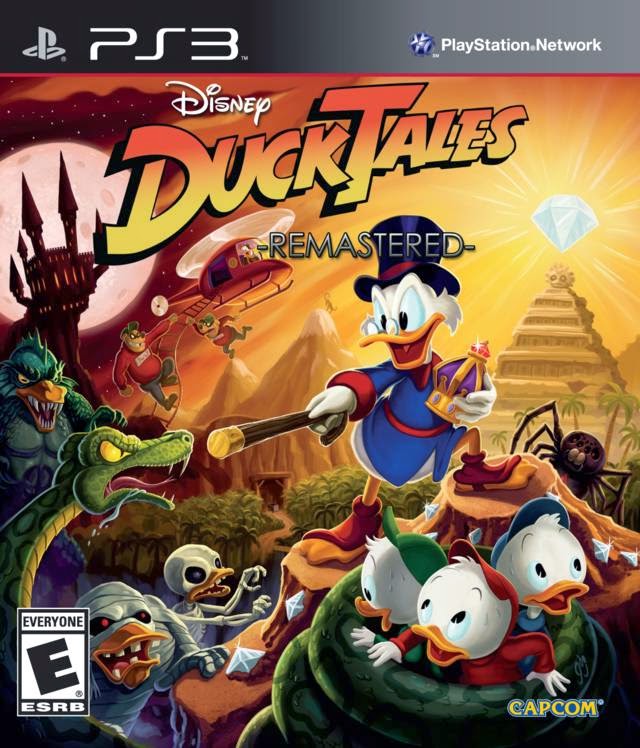
DuckTales Remastered (Wii U, PS3, 360, PC) Review

We close out what has become a month of platformers with DuckTales Remastered, a remake of the classic NES DuckTales. Phil gives us his verdict on Scrooge McDuck's long-awaited return to gaming.

A Retro Quack Attack


While Capcom is obviously well known for such popular classic franchises such as Street Fighter, Mega Man, and Strider, back in the NES era the company was proficient in creating excellent Disney licensed games, whether based off films or television cartoons. It certainly would be quicker to name the games that weren't so great rather than the ones that were. DuckTales was one of these truly great games that fans of the NES can still find immense enjoyment out of. Now, Capcom and WayForward have teamed up to craft an HD remake for not only those who wax nostalgic for the NES original, but also for a whole new generation of gamers. It all adds up to DuckTales Remastered. Is this remake all that it is "quacked" up to be?

The NES DuckTales didn't provide any semblance of a story. There was no explanation for Scrooge McDuck venturing to five seemingly picked-out-of-a-hat locations to find five treasures. DuckTales Remastered creates a story that explains all of this, and even goes the distance in clearing up questions formed by players of the original game. Ever wanted to know how in the heck Scrooge McDuck and companions could breathe on the surface of the moon, or why a certain pair of villains teamed up at the end of the game? You'll most likely be happy with the explanations the developers have come up with.

"But first I'm gonna dive into my pile o' money!"
DuckTales Remastered isn't just the five original levels of the NES game. To further add some longevity to the game and to iron out story elements, there are two brand-new areas within the game. The first serves as an introductory level, bringing players up to speed with the basics of how Scrooge McDuck controls. The second replaces Scrooge McDuck's return trip from the original DuckTales to Transylvania for the final showdown of the game. Instead, the level takes place in Mount Vesuvius, and it feels just as well made as every other level in DuckTales Remastered.

It's certainly (and literally) a jungle out there.
As for the returning levels, these have been altered slightly. These are welcomed changes that make levels play out much better than the NES original. In said original, one could simply stumble into a boss's lair without doing any thorough exploring of a typical level. In DuckTales Remastered, there's a various goal in each level that Disney's billionaire duck needs to take care of before moving onto the boss. For instance, in the Amazon, Scrooge must acquire eight ancient coins to lead him and Launchpad to the temple where the treasure rests. Meanwhile, in Transylvania's haunted castle, Scrooge needs to rescue Huey, Dewey, and Louie from their captors.

Alongside completing these mandatory tasks, players can stumble upon treasure and riches just like in the original DuckTales game. This added encouragement to explore levels is much appreciated, and it makes for a longer game that never at all feels like simple padding. Every jewel and treasure collected adds up to a tally once Scrooge returns to the hub, his office. The money earned isn't just for show; it's an in-game currency as well, used to purchase character profiles, concept art, and music. Unlocking all goodies will take a few play-throughs to complete, and with the game's multiple difficulty levels, replaying this relatively short game remains fun.

Look high, low, and everywhere in
between for treasure!
Scrooge McDuck retains all of his nimble platforming and offensive tricks, the most notable being his trademark pogo routine,. This allows him to continuously bounce up and down, off the heads of enemies, and even on spikes. For classic purists, there's an option to keep the old school pogo controls (i.e. holding the d-pad down as the pogo button is pressed). However, harder difficulties require this control setup. Also with his cane, Scrooge can swing and hit rocks, blocks, and open treasures. In the Transylvania level he can even smack the iron ball attached to a mummy's ankle to have it plow into the enemy, defeating him.

"Thanks for the assistance
in practicing me pogo technique!"
If there's one issue that many will find with DuckTales Remastered, it's that the game constantly interrupts the gameplay for story sequences. These generally happen when Scrooge comes across a dead end or comes across an item necessary for progression. These can be skipped, though, and they are highly entertaining, as the dialogue is full of funny banter between characters, and true to the cartoon and its characters. It's simply that the need to pause the game and skip the cinematic for replays of the game can get tiring to some. It didn't bother me per se, but it's something to be wary of for prospective players.

These guys wouldn't even make
it in the peewee leagues.
As if the game itself wasn't wonderful, the visuals of DuckTales Remastered are nothing short of sensational, too. The formerly 8-bit sprites of the NES game have been updated with an incredible level of detail in animations and now look absolutely true to the cartoon. Levels have 3D foregrounds while the backgrounds are a 2D delight. Playing the game, I felt like I was controlling a genuinely faithful recreation of Scrooge McDuck in a highly animated and alive cartoon world.

And with a tip of his hat, the
enemy explodes at Scrooge's will.
...Okay, maybe the robo duck did that.
What further helped me grasp the dedication to the legitimacy of the cartoon is the return of the original cast, reprising their roles and sounding like they had never been on a two decade-long hiatus. The music has been recreated with new instruments and sounds really well done, but if you do get misty eyed for the original 8-bit themes, you can unlock them once you've beaten the game. All of this adds up to a game that represents the classic DuckTales cartoon in fantastic form.

The boss battles feature some creativity
that is very much appreciated!
WayForward's team has gone beyond the call of duty to make DuckTales Remastered a faithful tribute to not just the NES classic, but also to the Disney cartoon. The gameplay remains relatively unchanged, but the altered in addition to the brand-new levels gives new twists to a game that's familiar for many twenty-somethings on up. If you're new to the game, Remastered also shines in that regard. It's not nostalgia that makes DuckTales Remastered great. It's the tried and true gameplay, characters, and mechanics that keep Remastered from feeling dated. All in all, DuckTales Remastered is a game that will make most players go "Whoo-hoo!"

[SPC Says: 9.0/10]

Monday, June 10, 2013

Max: The Curse of Brotherhood (XBLA) E3 2013 Debut Trailer

A sequel to Max and the Magic Marker, Max: The Curse of Brotherhood, is set to hit Xbox this year. When Max wishes for his brother to go away, he gets what he wished for, and then some. Now, Max must venture into a dangerous world to rescue his brother in this appealing Xbox Live Arcade title.

Thursday, October 4, 2012

Classics I Can Return To - Part Four

We've had three segments taking a look at games that I constantly come back to despite age. Now we have seven more titles that keep calling my name and I keep answering. That is what Classics I Can Return To is all about -- games that I replay every so often on a consistent basis. After you've taken a look at my picks, why not name some of your games that you can't stop playing regardless of how many new titles start building up on your backlog? 

Super Mario 3D Land (3DS)


This game was named handheld game of the year in my best of 2011 awards. It is none other than Super Mario 3D Land. Starting off, the game is deceptively easy, while also showing some intelligent level design. However, once you finish the first eight worlds, you are greeted with eight more much more fiendishly crafted worlds. Super Mario 3D Land is a near perfect combination of the traditional 2D Super Mario Bros. gameplay and the 3D movement of games like Super Mario 64 and Sunshine. It's so easy to come back to the game, finding missing Star Coins, doing levels with and without the Tanooki Suit, aiming for top times, reaching the top of each flagpole in each level, and mastering Mario and Luigi's move sets. I would love to see a sequel with ideas that were cut out from the game a la Super Mario Galaxy 2.

Rayman Origins (Multi)


I am currently in the middle of a cooperative play-through with my older brother. While I don't believe this total platforming package is better than New Super Mario Bros. Wii, Rayman Origins is still in the upper echelon of run and jump games. It's always fun to make daredevil dives for Lums and medallions, to dash through levels as fast as possible, to slap your co-op partner across the screen, and to assign tasks to a friend or family member for maximum efficiency. From the standard levels which are already challenging to the precision platforming-based chest-chasing levels, Rayman Origins has a lot of platforming peril that it throws in players' ways. On top of the gameplay glory is an art style that is picture perfect. Sure, it's off-putting to many people in an age where the broodier and bloodier the better, but for those who aren't so shallow, Rayman Origins makes for a thumping good time.

Banjo-Kazooie (N64, XBLA) 


When I had my Xbox 360, one of my favorite downloadable titles on it was Banjo-Kazooie, a Nintendo 64 classic. It was great on the Nintendo 64, but it was made even better on Xbox Live Arcade. Not only was the game in glorious high-definition, but one of the annoying elements of the N64 version was remedied in the XBLA game. In the N64 game, you had to collect all 100 musical notes in a given level in one go, and if you died, you had to start from the beginning again. In the XBLA game, you can die as many times as you want, and your musical note total in a level will remain the same. No dying in the engine room of Rusty Bucket Bay and having to restart your note collection. I find Banjo-Kazooie to be a game that is mightily more marvelous than the game it was modeled after, Super Mario 64. There is a better arsenal of moves, I enjoy the presentation (music and aesthetics) more, I like the levels, and I just adore Banjo's first adventure more.

Perfect Dark (N64, XBLA)


I have a bit of a conundrum. I want to play Perfect Dark on Xbox Live Arcade, but my 360 got the dreaded Red Ring of Death (hey, y'know, things break). I don't want to buy a new one because of one game. Regardless, I still play the original Perfect Dark on the Nintendo 64, despite knowing that the Xbox Live Arcade remake is Perfect Dark perfected with a steadier framerate and adding online play to an already-superior-to-most-games multiplayer mode. The game took the GoldenEye 007 approach to its missions with multiple objectives that needed to be completed. Failing an objective generally meant failing the mission. But by far the coolest part of Perfect Dark which I already mentioned is the Combat Simulator, offering bots (why most Halo games can't even do that is beyond me), loads of customization, large-scale and greatly designed maps, and much, much more. It is the perfect first-person shooter to me.

Final Fantasy Tactics: The War of the Lions (PSP)


While there is some slowdown in the PSP port of Final Fantasy Tactics, this game is my preferred means to play the classic PlayStation era turn-based RPG because of the added playable characters, portability, and ability to shut the game off and resume it at a later time with a flip of the PSP's On and Off switch. Final Fantasy Tactics is already a brilliant game, and the aforementioned features of The War of the Lions make for an even more brilliant title. I adore nearly everything about the game: the job system, the means to learn abilities, magic, and summons, the story, the plot twists, the music, the fierce battles, and so much more. Perhaps the only thing I don't like about the game is saving in the middle of two battles only to find out that you're severely underleveled for the second battle and are screwed since you already saved and can't go back to the world map. Curse you, Wiegraf!

Kirby's Return to Dream Land (Wii)


Perhaps I'm returning to this game to celebrate the pink puffball's 20th anniversary, but Kirby's latest adventure, Kirby's Return to Dream Land, took place on the Nintendo Wii, and like Rayman Origins, it offered up to four players being able to join in with some platforming fun. The normal campaign is relatively easy to complete, sure, but once you reach the Extra campaign, things get much more challenging. Kirby and friends have less health to work with, alternate dimension areas scroll much faster, and bosses become difficult. Kirby's Return to Dream Land sports a colorful and whimsical art style, though it does not compare to that seen in Kirby's Epic Yarn. Despite this, Return to Dream Land is the better game, and honestly one of the better games in the entire series. Playing it alone or with a friend is quite the treat, and because of this, it is a reason I keep coming back to it.

Animal Crossing series (GCN, DS, Wii)


The above pictures came from my old Animal Crossing: City Folk data.

Animal Crossing is an odd franchise. Never before did doing ordinary things and chores seem so much fun. Collecting bugs, catching fish, planting and watering flowers, paying off a debt to a raccoon, upgrading a house, renovating the interior of said house with wallpaper, flooring, and furniture, making friends with the locals, and doing a whole bunch of other tasks might sound menial to the casual observer, but once you get hooked into the world of Animal Crossing, it can be hard to stop. City Folk was slammed by some by being too similar to Wild World. Well, Nintendo took that criticism to heart as their upcoming 3DS game is changing things greatly. As a big fan of Nintendo's life simulation game, I eagerly anticipate the newest entry in the Animal Crossing series.

===

There you have seven more games that despite having new games in my collection to review, I still occasionally come back to. If you missed a previous installment, check out one of these past three parts:

Classics I Can Return To - Part One
Classics I Can Return To - Part Two
Classics I Can Return To - Part Three