Wednesday, January 30, 2019

New Super Mario Bros. U Deluxe (NSW) Review

Let's strike while the iron is hot! Actually, the iron is frozen solid due to this arctic weather we're currently experiencing in the Midwest, but that's neither here nor there. The point here, is that we're striving to keep the momentum going together, and this next review will do just that. It's New Super Mario Bros. U Deluxe, the latest Wii U-to-Switch port from Nintendo. Let's-a go check it out!

New Year, Familiar U


In 2012, New Super Mario Bros. U was one of the premiere launch titles for the Wii U--arguments on that being damning testimony as to why the Wii U failed to light up the charts notwithstanding. The core game was a lot of fun with enjoyable multiplayer, fantastic level design, and new HD visuals. The game sees itself making the leap over from the Wii U to the Switch, like many of Nintendo's game have done already. However, since its launch, there have been some truly excellent 2D platformers, some from Nintendo itself, that are by far better games and make this entire New Super Mario Bros. U Deluxe package feel a tad antiquated in 2019, even more so than it might have to players back in 2012.

It's like returning to a familiar old friend with New Super Mario Bros. U Deluxe.
Let's go over what you get with New Super Mario Bros. U Deluxe. You have the core New Super Mario Bros. U game and the added New Super Luigi U expansion that released in 2013, as part of Nintendo's Year of Luigi promotion. New Super Mario Bros. U is a more relaxed game that doesn't really get too terribly challenging until the latter of the eight story-related worlds within. Meanwhile, New Super Luigi U features shorter, more challenging levels where you have only 100 seconds to complete them, and Luigi's physics are more in line with Super Mario Bros. 2's USA version, where he has a higher jump and features more slippery controls.

Thank goodness Mario is using his burner account on this level.
Included with the New Super Mario Bros. U side of this Deluxe package is a series of challenges that you can play through. These range from speed runs on original courses and ones already featured within the base game, to survival challenges, to trying to successfully jump on enemies to get 1-Ups without ever hitting the ground. For those who played the Wii U game, you might recall there being a Boost Mode, played with the Wii U GamePad. Rather than retool these for the Switch release, all of these GamePad-related challenges from the original 2012 game have simply been removed.

Between New Super Mario Bros. U and New Super Luigi U, you're easily getting over 100 levels total, and these are all smartly designed obstacle courses, which is definitely shown through the added Hint videos available for budding speed-runners and those who wish to be inspired by some truly expert playing. Each level holds three Star Coins in them, and many times they'll be placed in precarious, risk-vs-reward locations, or require some sleuthing to discover them (i.e. finding a secret pipe or hidden alcove in a level). Players will want to get all of the Star Coins in the game to fully enjoy New Super Mario Bros. U and New Super Luigi U to see everything these games have to offer level-wise.

Mario better be careful with his platforming, or he may see the point... of this Urchin, that is!
A fresh addition to both New Super Mario Bros. U and New Super Luigi U is the ability to play as Toadette. She's listed as an easy character to play as--with Nabbit being the easiest (so easy that if you're playing in solo mode, you won't get a legitimate mark on the world map for "beating" the level). This is because she doesn't slip on ice, gets extra seconds added to her timer in New Super Luigi U, and is about to transform into Peachette via special Crown power-up, exclusive to her character. The Crown power-up gives the newly formed Peachette the ability to float in the air for a limited period of time, as well as perform a recovery with a shake of the controller or press of a button--great for saving herself from platforming errors.

Don't worry--SuperPhillip Central will not post any Bowsette fan art. (In this review.)
While we're on the subject of platforming errors, New Super Mario Bros. U Deluxe features a questionable design decision with regards to its controls. In the original NSMBU and NSLU, Mario or whoever the player controlled could flick the controller or press the trigger to perform a twirl. This could give the player some extra air time to pull off some proficient platforming--or just save their own skin. In New Super Mario Bros. U Deluxe, while both shaking the controller and/or hitting the Joy-Con's trigger with allow players to perform a midair twirl, the game also assigns the twirl to the jump button. This can result in some unwanted damage from enemies, or worse yet, undesired deaths. During my time with New Super Mario Bros. U Deluxe in both Mario U and Luigi U forms, this did not occur often at all, but it is a potential problem for players to keep in mind.

Perhaps now is not a good time for the player to learn about that jump button problem...
To speak more highly of this Switch compilation of New Super Mario Bros. U and New Super Luigi U, it's absolutely fantastic and convenient to already have two controllers available to you via being able to split the Joy-Con between two players. Just another Joy-Con set, and you can have the maximum amount of players on screen at once--four of you, bouncing off each other's heads to reach high up places, tackling enemies and platforming challenges together with great rhythm and--aw, who are we kidding--if you're like me, you're just going to get your teammates killed over and over again by chucking shells into them. Still, multiplayer is a fine amount of fun, and when you're all working together--and even when you're messing one another up--it's a good time. Of course, some levels are better in co-operative play than others--yep, I'm looking at you, New Super Luigi U's Fire Bar Sprint.

Like many Switch multiplayer games, just the Joy-Con pair that comes out of the Switch
box is all you need to enjoy some two-player co-operative play.
New Super Mario Bros. U and New Super Luigi U have never looked better, thanks to the touch up in resolution in the Deluxe version. Not only does New Super Mario Bros. U Deluxe look great in docked form, as expected, but it look and runs awesomely in handheld form, as well. That said, even in 2012, these games weren't the bastion of high definition graphics, but still, they look delightful enough all the same. If only we could all say similar things about the music. While I don't mind the "bah, bahs" heard throughout the game's soundtrack, nor its less than impressive instrumentation, no doubt others will. Regardless, the compositions are solid and hark back to the regular old Super Mario Bros. in the catchy-ness department.

Was this screenshot taken in NSMBU's ice world or the United States
during this week's Polar Vortex? (How's THAT for topical humor!)
With every Wii U to Switch port that comes about, the question is always, "Should I buy this game if I already own it on the Wii U?" Well, with New Super Mario Bros. U Deluxe, I can definitely say that unless you just have to get rid of your Wii U or find no pleasure in playing on that relatively clunky system, then you can easily pass on this port of these two games. They're still fun to play and marvels of terrific level design, but they're also rather dated compared to many of the 2D platformers that have popped up since 2012 that have far outdone the House of Mario's Wii U launch offering.

Mario will do anything to keep his plumber's license, won't he.
However, if you've never owned a Wii U before or somehow missed out on one or either of these two games, then answering if you should buy New Super Mario Bros. U Deluxe is as easy as accidentally running into the first Goomba in the game. That is to say--easier than you'd think. And the answer is a certain "yes". Looking at these two platformers relative to those that came out after paints a lesser picture of these two New Super Mario Bros. adventures, but by themselves, New Super Mario Bros.U and New Super Luigi U never lost their individual quality.

[SPC Says: B+] 

Tuesday, January 29, 2019

Super Smash Bros. Ultimate (NSW) Review

It's been a full two months since I last wrote a post on SuperPhillip Central. However, now SuperPhillip Central is back in business, and there's no better game to bring us back than Super Smash Bros. Ultimate. What better evening to do a review of the game than with the release of the first DLC character Piranha Plant and the big Ver. 2.0.0 patch? None--that's what! So, sit back, relax, and get comfortable, as this review is a hefty one--fitting for a grand return, wouldn't you say!

Has a title ever been more appropriate?


My elementary and middle school lunches were filled with heated discussions about which video game character would kick which other video game character's butt in battle. Who knew that two decades later that dreams of Mario versus Sonic, Mega Man versus Pac-Man, and Solid Snake versus Ryu would come true and have the ability to be played out? That's exactly what Super Smash Bros. Ultimate delivers, offering over 70 characters and over 100 stages to play with and play on. It's the ultimate video game crossover, and with it, Ultimate brings every character and almost every stage back from every past Super Smash Bros. game. Throw in a meaty new single-player campaign, nearly 1300 Spirit characters to collect, enhanced online play, and the most accessible fighting game controls imaginable, and you have a serious and smashing (pardon the lazy play-on words) package.

Smashing throughout the ages, Mario and Link once again take each other on.
The basic gameplay rules of Super Smash Bros. Ultimate remains the same from past installments. Standard battles require you to deal damage to your opponent. The more damage they receive, the easier it is to launch them off screen. Either by hitting them so hard that they blast off the edge of the screen or fall into the pit below makes it so they get K.O.'d. In Time matches, you earn a point for every opponent you K.O. you get, while you lose a point for every time you get K.O.'d. The player with the most points at the end of the time limit is the victor, unless there is a tie, then the players in first place duke it out in Sudden Death. Here, it usually just takes one hit to be K.O.'d out of the arena. Other rules include a life-based Stock mode, as well as a more traditional fighting game-styled Stamina mode.

If you can press a button and a hold a direction on an analog stick, you're good to go with Smash Bros. Okay, well, that might be a slight simplification of how accessible this game is...
Super Smash Bros. Ultimate continues the Smash Bros. series' penchant for excellent accessibility for all ages and player skill levels. This is in part because of the ease of the controls. There's no need to memorize and master complex button combinations to pull off the most entertaining and worthwhile of attacks. Instead, basic attacks are mapped to the A button while special attacks are mapped to the B button. Hitting these buttons in conjunction with directions on the left analog stick results in different moves being performed. Up + B always serves as a character's recovery ability, making it so after performing a jump or two with the X button (or alternatively the Up direction on the analog stick) you can unleash your recovery if you're finding yourself falling off a stage with no other recourse available to you. That said, it's not a foolproof means to save yourself from a K.O., as each character possesses a different recovery move, and some of these are as useful as a teaspoon for a boat paddle.

Performing a powerful roundhouse kick? Sure, Ken can!
Ultimate has faster movement than many past Super Smash Bros. games, putting it more closely to Melee than anything else--at least from my experience. While no doubt Melee purists or those who prefer that game will remain with the GameCube classic, I feel Ultimate--as if the name doesn't already suggest it--is indeed the ultimate way to play Smash Bros. New changes to the gameplay make things like edge-guarding less of a successful strategy, and shields no longer being completely impervious to attacks when put up make for a better, more tactical game.

That said, the faster action doesn't always translate to a perfect experience. I don't know if it's the lighting used in this game or all of the special effects that can obscure the screen, but sometimes it can be incredibly difficult to see where your character is on the screen when action intensifies. I can't tell you how many times I've been K.O.'d in silly ways because I couldn't save myself in time due to not being able to find where my character was on occasions. This is a prominent problem when there are more than four characters on screen at once--with Ultimate allowing up to eight players on ALL stages, instead of just a select handful like in its Wii U predecessor.

When Smash Bros. series and Ultimate game director Masahiro Sakurai promoted the idea that "everyone is here", he was not kidding. Every past character from the original Super Smash Bros. all the way to Smash for Wii U and 3DS is included. In addition, some longtime desired newcomers have arrived as well in the form of Metroid's Ridley, Donkey Kong Country's King K. Rool, and even Ryu's sparring partner, Ken. You can also fight as Pokemon Sun and Moon's Incineroar, Animal Crossing: New Leaf's Isabelle, and perhaps most exciting third-party newcomer-wise, the Castlevania duo of Simon and Richter Belmont.

DK protects his little buddy from King K. Rool,
an old rival who has returned to get revenge--Smash-style!
While every character is indeed here from past Smash Bros. games, not every stage is. About a dozen or so stages from the N64 days to the Wii U and 3DS era are not included, such as the N64's Sector Z stage, Melee's Poke Floats and Icicle Mountain, and Brawl's Rumble Falls, for instance. That said, when you still have more than 100 stages that have been graciously remastered and updated for Ultimate's impressive standards, one can't really complain too much.

Alas, Orbital Gate Assault, I will gladly take the new stages like Super Mario Odyssey's New Donk City, The Legend of Zelda: Breath of the Wild's Great Plateau Tower, Splatoon's Moray Towers, and Castlevania's Dracula's Castle in your stead, grinning and bearing it. Stages can be played in normal form--with or without hazards--in Battlefield form or Omega form. A new addition to Ultimate stage-wise is the ability to use Stage Morph mid-match. This allows you to pick two separate stages and during the match, the game will cycle between them magically.

Light up what you can, Palutena, but not even your
heavenly light may be enough for Dracula's Castle.
Replacing trophies from past Super Smash Bros. games--which was a bummer to me at first--is that of Spirits. While trophies were nice in past games to view (see: ogle) the 3D models of unique characters, items and objects; as well as read up a quick description of each as you slowly, gradually collected them--they no doubt took a lot of work to write up and then localize. Compare this to Super Smash Bros. Ultimate's immense lineup of over 1300 Spirits (and that includes the added Spirits included as free DLC), where attempting to turn 1300 characters into models, as well as write up descriptions in multiple languages is one lofty task! Instead, the Spirits are not only much more numerous, but they're also just as fun to go after and collect. A wide selection of Spirits are featured in Super Smash Bros. Ultimate--many of which being deep cuts that might not ever get featured in a Smash Bros. game, much less any other game in Nintendo's history, otherwise.

That said, Spirits have a far more important use in Super Smash Bros. Ultimate than mere collectibles. Spirits come in two forms: Primary and Support, and are used to equip to your party in order to enhance their strength and abilities. Spirits have a rock-paper-scissors-like quality to them with strengths and weaknesses to other Spirit types, and many imbue your party with advantageous skills in battle. Such examples include greater jump height, elemental resistance of varying types, starting the battle off with a specific item equipped, among many others. You can't just equip as many advantages in battle as you like, either. Each Primary Spirit has a set amount of slots available to it--up to three. Equipping the more powerful Support Spirits takes up more slots. Primary Spirits can also be leveled up, making them stronger by battling with them, having them work out at the in-game gym, or feeding them Spirit food--all of these ways make Primary Spirits stronger and more useful.

There is a whole section of Super Smash Bros. Ultimate dedicated to Spirits, and this section is where the main single player campaign of Ultimate takes place--the World of Light. Starting off with Kirby, you traverse a nonlinear overworld map, going from space to space, dueling with various Spirits as you amass an army of Spirits and fighters to face off against bosses along the way.

Link wants a quick win in this Spirit Battle, so he decides to "cut" to the chase.
Spirit battles have you taking on members of the Super Smash Bros. Ultimate roster where they have a specific Spirit attached to them. Winning the fight, earns you that Spirit for your collection. Each battle has its own theme based on the Spirit. For instance, when facing against the Poltergust 3000 Spirit from the Luigi's Mansion series, you'll battle Luigi who likes to use throws. His throw move just so happens to utilize his Poltergust 3000. Some of these themes are less obvious and will take some vivid video game knowledge to decipher. Though making the Mr. Dream from Punch-Out!!'s Spirit fighter being Donkey Kong is a bit... wrong, if you know anything about harmful African-American stereotypes.
Different Spirit Battles contain different, themed rules, stages, and characters.
World of Light took me about 18 hours to complete my first time through. It's really fun accumulating an army of Spirits and fighters, opening treasure chests along the way, solving simple environmental puzzles on the overworld maps, and taking on challenging and usually cleverly themed Spirit battles. I can see how this mode might be a bit tedious or repetitive if you're merely wanting to rush through it, but if you go through at your own pace, you'll find an enjoyable mode. Quite honestly, I think World of Light is my favorite of the single-player campaigns featured in a Smash game. Yes, even beating Melee's Adventure and Brawl's extensive Subspace Emissary.

Alongside World of Light in the Spirits menu is the Spirit Board, where Spirits up for grabs are routinely shuffled in and out of the spaces on the board. To earn a Spirit, you must win a Spirit Battle, which is essentially the same types of battles as seen in World of Light, only many of the ones on the Spirit Board are exclusive to the board itself. You only get one chance ordinarily to beat a space on the Spirit Board before that Spirit moves on--win or lose--before you have to wait for it to come back. Of course, you can use Spirit Board items to make for an easier go of it or reface a Spirit whose battle you just lost.

Apart from the Spirit menu--which is quite exhaustive, if you hadn't already guessed--Super Smash Bros. Ultimate retains its Classic mode, though this is uniquely tailored to each of the 70+ characters within the game. Though the number of matches each fighter faces is the same, the opponents they face varies and has a theme to it. For example, the newly added Piranha Plant faces off against every newcomer within the game. Once again, Ultimate houses the most impressive and enhanced Classic mode ever featured in the Smash Bros. series, really nailing home the point that this Smash is the ultimate Smash.

Assist Trophies are but one type of item in Smash, but they also allow
 for more characters to be represented, such as the pyromaniac Bomberman here.
But here lies one of the areas where Super Smash Bros. Ultimate falters, and it's pretty much no surprise to anyone who has followed Nintendo's online offerings for any extended period of time. Online battles are by no means as awful or horrid as Super Smash Bros. Brawl. In fact, when the online works--and for me, it was most of the time--it is a splendid and enjoyable experience. When it doesn't, it results in unintended disconnects--which the game penalizes you for after several of them, regardless of whether or not it was your fault--as well as severe lag.

Almost every stage within the Super Smash Bros. pantheon
was recreated, all of which done with some great TLC.
It's also the lack of options that's rather disappointing as well. Sure, you can set up rooms with your rules in either a private or public matter, play quick matches with or without a local multiplayer friend online (as well as finding quick matches with your preferred rules in place), but why can't you enter online battle arenas, where you play against the same opponents and are able to spectate as well? The lack of anything other than the most basic of communication options (pre-written text options before battles) is expected but insanely inexcusable.

Super Smash Bros. Ultimate's subtitle isn't just for marketing and hype. This Smash truly is the ultimate experience--it has over 70 characters including several newcomers in the base game and five more promised as paid DLC, it has over 100 stages, it has over 800 songs, it has 124 challenges to complete by achieving certain in-game goals, it has a great collection of items to turn any fight into a party, it has multiple modes for solo players to smash their way through, it plays splendidly in both docked and handheld forms, it allows you to play as your Mii (or happily smack it around), and it has never been more fun to play. Super Smash Bros. Ultimate may stumble (or should I use the word "trip"?) a bit when it comes to its online offerings, but overall, a title has never been more appropriate for a game with the content and joy you'll get out of it. This Super Smash Bros. is indeed ultimate.

[SPC Says: A]

Monday, November 19, 2018

Crayola Scoot (PS4, NSW, XB1, PC) Review

We go from one family-friendly game to another, but this time it's for a game that's not over a year old! In fact, Crayola Scoot is barely a month old now, and SuperPhillip Central has this review, based off the PlayStation 4 version.

Get Ready, Get Set... Scoot!


At first glance, you might think that Crayola Scoot is a mix between Splatoon and Tony Hawk's Pro Skater. That's because that is pretty much what Crayola Scoot is all about--just substituting scooters for skateboards and squid kids for... non-squid kids. What Crayola Scoot adds up to is a family-friendly game that allows for an enjoyable experience for any age and any skill level.

Crayola Scoot starts out with you selecting your fully customized avatar--detailing things like gender, skin color, and also the paint color that your scooter will leave behind in his or her wake. Once that's taken care of, it's off to make your way to the top of the Color Cup leaderboard. This is done by completing two-minute timed event as you compete against AI opponents. Each event you complete earns you points. Earn enough points, and you meet the requirements to advance to the next rank. However, before you can do that you have to take on that rank's champion in a trick-based game of H-O-R-S-E, similarly titled S-C-O-O-T.

As cliche of an observation as it is, Crayola Scoot is one part extreme sports game and one part Splatoon.
In an effort to make progression to new ranks as stress-free as possible, players can essentially compete in the same event over and over again, gaining the necessary points to move forward in rank. While that is an option--and a welcomed one at that--as you can imagine, it's not the most recommended way of playing through Crayola Scoot's campaign.

The main hub of Crayola Scoot is an open-ended skate park where you're free to practice the controls and tricks of the game, move to multiplayer, purchase scooter parts and clothing options within the shop, and access events. There are three islands in Crayola Scoot, and these hold the various events in the campaign. As you progress in rank, new events open up within the islands to challenge.

There are 48 events in total, and each one offers three difficulty settings to choose from, ranging from easy to hard. Completing an event on the hardest difficulty earns three stars, and the main challenge of Crayola Scoot's campaign comes from trying to obtain as many stars as possible. Going from the normal difficulty to hard made me question my sanity at times. The AI beat me to a pulp without much effort when I started off and even when I progressed further into the campaign. An overly easy game Crayola Scoot is not, which is nice to see, as it allows players of all skill levels and ages to enjoy the game.

From a golden knight to a member of the undead, the campaign's cast of characters ready to challenge your character at each new rank are varied.
Crayola Scoot's events follow one of a handful of match types. These aforementioned match types can be played in the Arcade, which is essentially a free play mode for up to four players locally via split-screen. There is a Splatoon-like mode where you play either alone against other players or on a team as you try to paint as much of the level as possible in your scooter or team's color. You spread your paint at a greater pace by successfully performing tricks, as well as controlling points on the map which automatically spray areas of level in your team's color.

All maps have three special control points that when taken over launch a "Mega Wonder". When a Mega Wonder is under a player or team's control, different happenings occur, such as an airship that circles the map, dropping paint bombs in their color. These color skirmishes require a great amount of strategy to achieve victory in. Do you scoot around taking over control points--which can be easily taken over by your opponent--or do you perform massive amounts of tricks to paint as much of the map in your color as possible?

Paint has more of a purpose than just for the Splatoon-like mode within Crayola Scoot. It has various applications to it, such as refilling your boost energy if you scoot in paint of your color--or even slowing you down if you're scooting in another opponent's colored paint.

Other modes include a high score trick competition, a mode where you play a game of cops and robbers where one person is splatted and tries to tag other players until everyone is tagged, and also a mode where you scoot around making a mad dash for crayons that pop up all over the map. The player who collects five crayons first is the winner. No mode in Crayola Scoot's bunch really wears out its welcome, as they're all a ton of fun to play.

It's a mad rush to each Crayola crayon in this particular mode.
But, here's where Crayola Scoot dulls a bit--the controls. While trying to offer a simplistic trick system, what the designers have done with Crayola Scoot is make for a control scheme that is heavily problematic. For one, jumping is initiated by either flicking up the right analog stick for a light jump or holding down the right stick and flicking upwards for a higher jump. Seeing as the PlayStation 4, Xbox One, and Nintendo Switch controllers all have more than enough buttons to serve as jumps, it's bewildering to me that jumping is set to the right analog stick--especially when tricks are set to the same input!

Yes, you read that right. In the designers' infinite wisdom (this is total sarcasm--just to clarify ahead of time), not only is jumping and pulling off tricks assigned to the same analog stick, but movement and flips/spins are tied to the left analog stick as well. This--as you can imagine--results in a great deal of frustration when you find yourself accidentally bailing... more times than you would ever like.

The relatively brief loading menus of the PlayStation 4 version show off tips on how to perform specific tricks such as moving the right analog stick in different directions and positions from where you start. However, since there's no penalty for using the same tricks and there's just as little reason to perform tricks with any sort of finesse, I basically just wiggled both analog sticks while in midair to let loose tricks.

The cel-shaded visual style of Crayola Scoot is very reminiscent of Jet Set Radio, meaning I'm in love.
Score multipliers are a part of Crayola Scoot, and instead of continuing a combo through a manual like you would in a Tony Hawk's Pro Skater game, you continue a combo through boosting. You have a limited amount of boost available to you, and if it runs out while you're on the ground, your combo ends. That said, this--in addition to the ease of grinding (where bailing happens soon after your scooter makes a complete stop, boosting makes you grind faster)--are how you chain a multitude of tricks together to score huge amounts of points, something extremely necessary to do to tackle the later ranked opponents in the campaign. I say this because the last couple challengers in Crayola Scoot are hard as nails, pulling off insanely high combos, which makes me question if this game is actually intended for kids or not!

If it's 8:00 a.m., does it mean this is the morning grind?
Crayola Scoot may not color inside the lines all of the time with regards to some of its design choices, but those who stick with it with find a family-friendly game that's a lot of fun to fool around and engage with. While the questionable control scheme (including the lack of the ability to customize said controls at all) lends itself to the game's sometimes strenuous challenge considering its intended audience, Crayola Scoot will, for the most part, have young ones and the young at heart scooting and hooting with glee.

[SPC Says: C+]

Review Round-Up - October 2018

Mega Man 11 got... a good score... and Game of the Month accolades!
We're rather deep into the month to do one of these Review Round-Ups, but we're going to get it done anyway! October 2018 saw three new reviews posted on SuperPhillip Central, and Max: The Curse of Brotherhood led the way, drawing on the original Max and the Magic Marker for a higher budgeted and more improved experience. It earned a C+ score. Then, our Game of the Month saw the return of the Blue Bomber with Mega Man 11, powering up with a B+ score. Finally, we partied until the end of October with Super Mario Party, deservedly celebrating its B score.

Check out every review ever posted on SuperPhillip Central with the SPC Review Archive!

Max: The Curse of Brotherhood (NSW, PS4, XB1, PC, 360) - C+
Mega Man 11 (NSW, PS4, XB1, PC) - B+
Super Mario Party (NSW) - B

Sure, there were plenty of Halloween parties going on at the end of October,
 but at SuperPhillip Central there was no party like a Mario Party!

Sunday, November 18, 2018

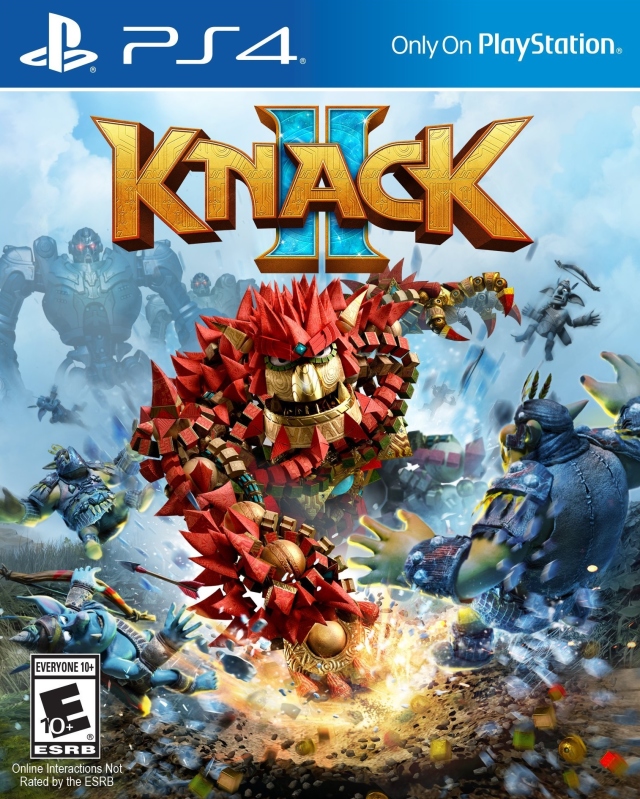
Knack 2 (PS4) Review

Though the game's over a year old now, I returned to Knack 2 after a long hiatus. I must say--I did not expect to like Knack 2 as much as I did. Dare I say, I loved it? Let's see what's so enjoyable about Knack 2 with my review.

Knack - Take 2


Oh, Knack. You whiffed your debut with a less than spectacular launch title for the PlayStation 4. Though you sold well (again, since you were a launch title and all), enough people got burned by you that they didn't bother checking out your much improved sequel. It's a darn shame, too, because Knack 2 improves on the original Knack in every way. And, just to make it clear since being better than the first Knack might not be a huge bar to clear for most PS4 owners out there, I can safely and unequivocally say that Knack 2 on its own is a terrific game worthy of playing.

Knack 2 begins in media res with a city being overrun and invaded by a nasty onslaught of robots. Who or what is behind it is uncertain, but just as things begin to look seriously bad for our hero, we get a flashback to show off the events leading up to the city's invasion. Knack 2 features the story of Lucas and his companion, the size-shifting hero of the first game, Knack. Surrounded by several supporting characters--many from the original game--the two tangle with a whole host of villains, high goblin mythology, robots, and much more. Knack 2's story interested me enough that I looked forward to see how each chapter would play out, but the humor didn't do much for me. I imagine it would be more welcomed by a younger audience than I, but I'd be lying if I said if I didn't chuckle or smile here and there.

Knack, Lucas, and friends will explore ancient ruins, snowy mountains, chaotic
city streets, and dense jungles alike throughout the enjoyable journey that is Knack 2.
Knack himself has the special ability to accumulate relic shards sprinkled throughout the game in order to grow to a larger size. Many levels in Knack 2 will require our protagonist to get to a certain weight or a specific height by nabbing enough of these shards in order to progress. The game features multiple puzzles where Knack must switch between his larger form and his small form voluntarily. Whether it's to fit inside a hole that only small Knack can fit through, walk along an incredibly narrow beam or ledge, or make his way through an otherwise claustrophobic crevasse, Knack needs his smaller self as well as his larger, much more brawny form to survive the perilous adventure.

For some reason, I don't think a 16-foot Knack would fit inside this passage here.
Additionally, some particularly clever platforming moments in Knack 2 require Knack to switch between sizes on the fly, and you'll be doing that a lot throughout the game's 10 hour time span. Such an example early in the game had me using Knack to leap on a moving platform and quickly needing to shrink down to small size to avoid getting Knack smashed to death by a spinning row of spikes as the platform passes below them. Not below enough for big Knack to pass by unscathed, but perfect for small Knack to get by.

Platforming is well integrated into levels, making for some truly fun and occasionally tricky challenges.
In Knack's journey he'll come across different materials to attach to his body at specific points during the game. For instance, coming in contact with ice shards will make our hero Ice Knack, able to freeze enemies with breath, as well as freeze gears and switches solid to hold open doors and platforms. Metal Knack can weigh down switches in addition to linking electric floor panels together to turn on machinery in levels. Finally, Stealth Knack can leisurely stroll through otherwise deadly lasers to reach otherwise impossible to visit areas.

"Ice is nice," says Ice Knack. "Oh, God..." groans Phil.
While these forms of Knack never show up in conjunction with one another, they do split up the standard platforming gameplay and combat (which I'll focus on soon), and make for some of the smartest puzzles within the game. A handful of times I sat confused at what to do with a particular puzzle, but once the solution presented itself to me (by my own intuition or the optional "hint" system included), I smiled at how clever the puzzle and level design I just saw was.

Would you say it's "time" to traverse up this clock tower?
"Oh, God..." groans all of you.
Meanwhile, Knack 2's combat serves its game well, allowing an "easy to pick up" fighting system that revolves around punches, kicks, guards, dodges, and parries in unison with one another against everything from solo encounters to group engagements--usually the latter. As you move forward during the game, you'll come across steadily more challenging enemies with different means to dispatch them, such as holding down the punch button to smash through an enemy's block, or chucking a boomerang to temporarily shut off electrified enemies for safe beat-downs.

For the most part, although what you'll be taking on in Knack 2 amounts to mainly two types of enemies: robots and goblins--there are such a multitude of varieties and fighting styles and tactics for each that combating these foes seldom gets tiring or repetitive. It also helps that just mashing buttons didn't do me much good even on the easiest difficulty. I had to learn when to attack, when to dodge, when to parry, and when all else failed, when to hightail it and retreat for a few moments while my damaged Knack eventually replenished his size.

And a third type of enemy revealed early enough in the game: living relics just like Knack.
You see, as Knack takes damage, the relic shards attached to him break apart. When Knack is at his smallest size, one hit from an enemy will result in death. When it came to the harder difficulty settings, I had to pick my shots, time my guards and evasions well, and sometimes just get a little lucky to survive. Ample amounts of checkpoints throughout Knack 2 made it, however, that I never had to redo sizable sections of the game at all.

Knack is about to teach this attacking foe that turnabout is fair play.
Knack earns experience for defeating foes as well from discovering treasure chests strewn about the Knack 2's levels that can be used on a skill tree of sorts. Each point on the skill tree filled unlocks new moves as well as a new combat bonuses, such as faster cooldown times per moves, higher attack or defense, and wider fields of attack for attacks. There are four sections of the skill tree total, and these unlock as previous trees are completed. It's really worthwhile to explore each level for treasure chests and to defeat enemies, as upgrading Knack with these aforementioned truly helpful moves and stat bonuses make Knack 2 much more manageable to beat. Plus, the treasures are hidden so cleverly and the level design is so well done that it's simply a joy to explore.

A well timed parry will launch this foe's laser right back at it.
When Knack 2 isn't have you take on some platforming, puzzle-solving, and fighting gameplay, the game mixes things up nicely with some alternate ways of play. One section has you aiming a turret at enemies (rest easy, forlorn Dead Space players--it's not as hard as that game), controlling a tank through an outdoor fortress, and even entering the cockpit of a gigantic robot. Furthermore, quick time events lend themselves nicely to game levels when they appear and readily telegraph themselves to not sneak up on unassuming players.

Knack 2 doesn't have to end after the initial campaign is beaten once. Almost every level in the game has well hidden treasures to find, and these special chests unlock beneficial gadgets for use in game. These range from a gadget that teleports Knack to safety if he falls into a pit, to new skins for Knack to wear (which also have bonus abilities).

Moreover, each level has three stars to earn for completing specific objectives. These can range from beating a level within a specific time limit, opening all treasure chests in a given level, defeating a set number of enemies as small Knack, and so forth. Levels can be selected from the world map at any time--even if you've not beaten the game yet.

Co-op is also a feature in Knack 2. Two players can team up together, and I do mean it quite literally. One player can charge up while the other player punches their back to let loose a barrage of spiky shards at enemies in front. Two Knacks are indeed better than one, and co-op is a perfect mode for those less experienced with Knack 2 or gaming in general to partner with a more skilled player. The latter player can take the lead while the second player is free to help. If they get too far behind, they will automatically warp close to the player who's up front.

These teeny, tiny goblins defeating Knack will definitely be a "tall" order.
Knack 2 is--without any semblance of irony--a very good game. It routinely introduces new enemy types, platforming challenges, and story scenarios to make for an engaging game from beginning to end. While the story and characters won't win over everyone--and definitely not folks in my bitter age bracket--Knack 2's tale kept me interested and continuing to play. And even if it didn't--certainly the well done level design, platforming, puzzles, and combat did the trick regardless. After a rough debut, Knack is back and he stars in one excellent action-platforming adventure.

[SPC Says: B+]