As of this past Sunday, the Nintendo Switch is now officially two years old. With it we've seen no shortage of great games for the system, and that doesn't seem to stop anytime soon. However, before we look towards the future of the Switch, let's turn to the past--more specifically the top ten exclusives for the system of its first two years. While you won't see The Legend of Zelda: Breath of the Wild on this list due to it also being available on the Wii U, you will see a tremendous amount of quality in these titles--and maybe more Mario than you'd expect, too!
10) Mario Tennis Aces
We start out with a game I was pretty harsh towards when it originally released. Now, since many patches and content updates (from where it was once unbalanced and missing essential features previous games had), Mario Tennis Aces is very much a game worthy of the Mario Tennis series name. Whether you're playing a standard round of tennis or special Mario Tennis rules with power shots and the stamina gauge, Mario Tennis Aces brings with it some high octane, high adrenaline, high value entertainment. Since launch, new modes, an abundance of new monthly characters, and balance changes have made appearances all for free, making was what once a lackluster Mario Tennis game a rather excellent one.
9) Super Mario Party
Party hearty, Mario and friends--and you're free to RSVP and join the celebration, too. While lacking the typical amount of boards seen in previous Mario Party games, the four boards within Super Mario Party are fantastic to themselves, offering a lot of action for their size. One could argue that it's their smaller sizes that allow more events and action to take place! Containing around 80 satisfying mini-games, Solo and Team boards, a fun and engaging four-player co-operative River Survival mode, and much more, Super Mario Party brings enough goodness to in its [party] favor to make it one of the best entries in the series yet.
8) Octopath Traveler
Shifting gears from parties to RPGs, Octopath Traveler is a gorgeous 2D sprite-based RPG from Square Enix that follows the story of eight travelers with their own unique vignettes and adventures. Octopath Traveler is obviously a looker with its unique visual style (your mileage may vary on how you like it--but I'm absolutely in love), but the role-playing systems within the game such as Boost Points allow a deep amount of strategy where you chain attacks to inflict the most amount of damage to enemies and assist your party members in the intense battles the game delivers. Throw in one amazing musical score, and Octopath Traveler strikes a fine balance between retro and modern that all RPGs fans need to experience for themselves.
7) Xenoblade Chronicles 2
Continuing with the RPG theme we have going here, Xenoblade Chronicles 2 features a colorful and charming cast of characters, a collectible Blade system that becomes incorporated into battle, and expansive lands and areas to explore. However, these lands are teeming with indigenous and hostile wildlife, so explore carefully and cautiously! Xenoblade Chronicles 2 is quite the meaty game, offering a robust lineup of Blades to acquire and enhance, side quests to take on, and a main campaign that will take dozens upon dozens of hours to complete. Though undocked performance on the Switch is a bit shaky, being able to hold a massive role-playing adventure like this in the palms of your hands is truly impressive, much like the overall adventure itself.
6) Mario + Rabbids: Kingdom Battle
Take command of three Mushroom Kingdom or Rabbid characters as you launch them into strategical battles X-COM style! Really, that's what Mario + Rabbids: Kingdom Battle essentially is--X-COM in colorful Mushroom Kingdom clothing. The odds are stacked against you in battle, but with a smart strategy, the odds will turn in your favor. Explore interactive environments filled with puzzles between said battles, discovering treasure and chests along the way. The addition of the Donkey Kong-themed DLC make an already enticing package even more irresistible, as does the completely Grant Kirkhope-composed soundtrack. The idea of Mario + Rabbids: Kingdom Battle was laughable for many, but after witnessing the astounding quality of the game, it's Nintendo and Ubisoft that are laughing now--and players of this hilarious and charming game as well!
5) Splatoon 2
Time to get wet and messy... with ink! What else did you think, you sickos? (...Or maybe it's I who is the sicko...) Nevertheless, Splatoon 2 features a full fledged campaign that puts Splatoon players in their paces with creative levels, rewarding scenarios and challenges, and some truly intense boss battles. The multiplayer is just as messy and fun as ever with four on four skirmishes in ranked and unranked play across a regular rotation of maps, some returning from the original Wii U Splatoon. An all-new co-operative mode encourages teamwork against hordes of enemies and bosses alike, and while this mode isn't always available, it is quite special of a gameplay experience when it is live. Whether you're splatting to see who can paint the most ground in their team's colored ink before time expires (the main multiplayer mode of the Splatoon series) or deeply engaged in customizing your Inkling to your liking, there's a lot on offer and a lot to love with Splatoon 2.
4) Pokemon: Let's Go, Pikachu! & Pokemon: Let's Go, Eevee!
The duo of games that got me back into being hyped for the Pokemon series, Pokemon: Let's Go, Pikachu! and Let's Go, Eevee! deliver a nostalgic trip through the Kanto region with some remarkable improvements. The lack of random battles makes searching for that rare, elusive Pokemon you wish to catch all the less tedious, and it also allows you to avoid battles when you desire nothing more than to evade that hundredth Zubat you faced in the original Pokemon Red, Blue, and Yellow games. For new players, the Let's Go pair offer plenty to be excited over--from the accessible and friendly Pokemon GO-style catching mechanics to the easier difficulty. While these might put off longtime Pokemon players, there are plenty of traditional features available to them, and even still, the newly announced Pokemon Sword and Pokemon Shield are the main course for these players regardless!
3) Mario Kart 8 Deluxe
Now, this one might be cheating a little--or at least bending the rules a bit--but Mario Kart 8 Deluxe is the definitive version of Mario Kart 8, featuring more characters than the Wii U game, a brand-new Battle Mode, and several unique gameplay features and mechanics like auto-acceleration, smart-steering, and a new item. I argue that Deluxe is different enough from the base Wii U version of Mario Kart 8 to be acceptable for this list. And, it's really difficult not to want to put Mario Kart 8 Deluxe on such a list like this because it's just so bloody good. (Oh, I'm talking like I'm across the pond all of a sudden! See how awesome you are, Mario Kart 8 Deluxe!) Containing all of the tracks both base and DLC from Mario Kart 8, the aforementioned bigger and better Battle Mode, and more characters than you can shake a stick shift at, and you have the definitive Mario Kart experience--and one of the best kart racing games of all time.
2) Super Smash Bros. Ultimate
We go from the definitive Mario Kart to the definitive Super Smash Bros. Super Smash Bros. Ultimate contains over 70 characters in its rosters--literally EVERYONE is here--and the majority of stages featured in past Super Smash Bros. games--that's over 100 stages to smash on. The brand new World of Light mode with over 1200 unique character and object spirits to collect to power up your fighters is my personal favorite single player campaign implementation in the series yet, and the other assortment of modes and features within Ultimate are nothing to whiff at either! This is definitely the ultimate Super Smash Bros. experience, and Masahiro Sakurai and his team aren't pleased to be finished there, as DLC soon drops this April featuring Joker from Persona 5.
1) Super Mario Odyssey
Since The Legend of Zelda: Breath of the Wild is also available on the Wii U, that leaves us with SuperPhillip Central's second favorite Nintendo Switch game as the number one exclusive on this list. Returning to the open sandbox worlds as seen in Super Mario 64 and Super Mario Sunshine, the massive platforming playgrounds available to Mario are some of the best levels ever seen in the 30+ year franchise. The exhaustive amount of mobile options allowed to Mario make the portly plumber the most nimble he's been in quite some time. The new capture ability allows for even more unique gameplay scenarios, as Mario inhabits the bodies of enemies and objects, using their abilities to progress in levels and solve puzzles.
The gargantuan amount of Power Moons featured in Super Mario Odyssey mean that any player can get the requisite amount necessary to proceed through the game, but for completionists and players who want a stiffer challenge, then they can go after all of the Moons--or at least the more difficult to acquire ones. Regardless of your skill level, it's hard not to be wowed by the magic that is Super Mario Odyssey, SuperPhillip Central's pick for best Nintendo Switch exclusive.
Honorable Mentions: ARMS, Kirby Star Allies, Monster Hunter Generations Ultimate
Wednesday, March 6, 2019
Friday, March 1, 2019
Review Round-Up - February 2019
![]() |
| "Boy, we both starred in SuperPhillip Central's Game of the Month AND Game of 2018." That you did, Kratos, with God of War's excellent rebirth on the PlayStation 4. |
We started off big with three games that made it on SuperPhillip Central's Best Games of 2018 list: Pokemon: Let's Go, Pikachu! & Pokemon: Let's Go, Eevee! (A-), the SPC's Game of the Year with the incredible God of War (A), and the remastered, remade goodness that was the Spyro Reignited Trilogy (A-).
Following that was a series of Nintendo Switch-reviewed indie games, starting with Instant Tennis, which took the court for some accessible but not necessarily deep tennis fun. It got a C- grade. Then, The Legend of Zelda-inspired Reverie: Sweet As Edition brought forth a unique New Zealand-like island to explore, getting a B- for its efforts. Following that was the puzzle and platforming combination that was Elli, earning a C+, and then the game that I can't seem to stop reviewing: Trine 2, this time around with Trine 2: Complete Story on the Switch (B).
We wrapped up the month together with two reviews: Starlink: Battle for Atlas' Switch version, soaring through the Atlas system with flying colors and a B grade; and a multiplatform review with NBA 2K Playgrounds 2, taking it to the court and slamming it down the basket's throat for a B+ grade.
Check out every review ever posted on SuperPhillip Central with the SPC Review Archive!
Pokemon: Let's Go, Pikachu! & Pokemon: Let's Go, Eevee! (NSW) - A-
God of War (PS4) - A
Spyro Reignited Trilogy (PS4, XB1) - A-
Instant Tennis (NSW) - C-
Reverie: Sweet As Edition (NSW) - B-
Elli (NSW) - C+
Trine 2: Complete Story (NSW) - B
Starlink: Battle for Atlas (NSW) - B
NBA 2K Playgrounds 2 (NSW, PS4, XB1, PC) - B+
![]() |
| The Pokemon: Let's Go games were a nostalgic trip through Kanto that rekindled my love of the Pokemon franchise. |
Thursday, February 28, 2019
NBA 2K Playgrounds 2 (NSW, PS4, XB1, PC) Review
For the past month or so, I've dribbled, dunked, shot, stole balls, pushed other players, and blocked shots like Michael Jordan in his glory years. Obviously I didn't do this in real life, but I did do so in NBA 2K Playgrounds 2. While the NBA season continues, why don't we take to the court together with this in-depth review of a surprisingly solid b-ball romp?
NBA 2K Playgrounds 2 brings with it high-octane, 2-on-2 b-ball with lots of engaging arcade action. Starting off, you get some Card Packs to open to unlock some random players to select from to play as. As you'll see as you begin playing, each player has their own stats based on how good, bad or ordinary they are at 2-pointers, 3-pointers, dunking, blocking, stealing, and running without blowing a lot of stamina.
There's an experience and leveling up mechanic for each player. To begin, it's as simple as playing continuously as a given player and playing well. If you want to advance a given player beyond the Gold rank, you need to complete a checklist of objectives for them, such simple tasks like performing two dunks in a game or doing five crossovers in a game to more challenging objectives like blocking two dunks or scoring five 3-pointers in one game.
As you level up players, they become more skillful in games. For instance, NBA 2K Playgrounds 2 uses a gauge system when a player attempts to take their shot. Stopping the gauge as close to the middle of the green area (as opposed to the red, orange, or yellow) results in a better likelihood of the ball going in the net. Bronze-level players will more likely have a low 2-pointer stat number. As they level up to silver, gold, and then possibly diamond (done by completing all of a player's objectives), their stat numbers improve, allowing them better chances to score 2-pointers.
This leveling up system can be a bit of a pain in the butt, though. For one, every player you get starts out with weak stats. Sure, they can be somewhat competent or even excel in one or two areas of the game, but they'll be lesser players all the same--even if they're Legends or Epic players like Kevin Durant or Allan Iverson, for example. This usually results in a lot of missed shots, frustratingly so, and a weak on-court experience. Furthermore, if you wish to play online with your favorite players and actually be competitive, you'll most likely need high leveled characters just to stand a chance. The player imbalances can result in some really lopsided games with one team's players shooting 3-pointers with ease while the other team struggles with simple layups and jump shots.
Still, when you get comfortable with the controls--which truthfully take some getting used to--and you level up your players enough, you'll find yourself easily laying up shots, performing finger roll baskets, killer dunks that have players leaping high into the air and jumping off the rim to slam the ball through the basket, blocking shots and even the occasional dunk attempt, pleasing the crowd with team and self-alley-oops, and much more. NBA 2K Playgrounds 2 succeeds in the most important area of all--it's just plain darn fun, and I say that as someone with a passing interesting in basketball and the NBA at best. Perhaps I'd be more interested if St. Louis had an NBA team to call its own... Just sayin'.
NBA 2K Playgrounds 2 contains plenty of content to it to make for an arcade basketball game that'll have you spending a lot of time on the dozen themed courts within the game. Whether you're having an Exhibition game on a steamboat in St. Louis (See? At least 2K and Saber Interactive didn't let me down) or having a 3-point contest in the middle of the Outback in the Australia court, you're going to be delighted with the incredible hustling and bustling environments and backgrounds on each court.
Meanwhile, Season Mode offers a a little over a dozen games to play as your favorite team, selecting a duo of players on the roster to take to the court and compete against other teams in your own conference. This leads to the NBA Playoffs, the Conference Finals, and then the NBA Finals themselves--all of which are a best 2 out of 3 set of series. Winning a championship as a team unlocks a special Legend to add to your collection of players. There can be a bit of a grind to play through 14 or 15 game seasons plus the playoffs to earn new Legends, but it's another optional goal to shoot for in NBA 2K Playgrounds 2.
Exhibition Games can use custom rules, such as choosing your court and basketball used, game time, how many seconds are on the shot clock, and whether lottery rules are used and which ones. Lottery rules include temporary things like two times the points for dunks and three-pointers, infinite stamina, a sped up shot clock for your opponents, and a ball that become caught in a blaze, allowing you to sink a shot from anywhere on the court--as long as your shot isn't blocked. All of these bonuses are temporary and randomly selected as rewards when the blue basketball meter on the bottom corner of the screen is fully filled. This is performed by successful shots and steals on the court by your team.
A big concern I had with NBA 2K Playgrounds 2 was how microtransactions would interfere with the game. There are two currency within NBA 2K Playgrounds 2--Baller Bucks, which are earned from normal play, and Golden Bucks, which can be earned from completing daily challenges, earned from opening Gold Card Packs, and yes, purchasing with real world money. Getting Card Packs is performed by spending Baller Bucks, which come naturally and more often than Golden Bucks. If you are wanting to earn every player right off the back, you'll have to spend some actual money to purchase enough Golden Bucks to unlock the entire roster.
Otherwise, if you're just like me, and were in no hurry to unlock everyone, you can just play through the game normally, hoping to unlock NBA players you're familiar with. No doubt NBA fans will want the best players in their roster, such as Lebron James or Michael Jordan--both players I lucked out on getting very early. Therefore, the RNG nature of opening Card Packs for the hopes of getting the NBA all-stars you want to play as can be maddening when you keep opening packs and get players you don't want rather than the ones you do. Still, if you have the patience to do so, by playing the game organically and completing daily challenges and opening Card Packs to earn Golden Bucks, you'll eventually get enough to unlock the entire roster by spending the 4,000 needed of the game's premium currency through ordinary play and perseverance.
NBA 2K Playgrounds 2 more than satisfies my desire for NBA Jam-like game that doesn't merely copy the formula, but instead adds to and iterates on it. The experience on the court is fast, fluid, fun, and exciting, having a bit of a learning curve at the beginning, but then easy to shoot and move like an NBA pro. While the level up, player unlocking, and microtransaction systems in place gave me some pause, overall, NBA 2K Playgrounds 2 sinks its shot from mid-court for an amazing three-pointer.
[SPC Says: B+]
The court is your playground, so let's play some ball, y'all.
NBA 2K Playgrounds 2 brings with it high-octane, 2-on-2 b-ball with lots of engaging arcade action. Starting off, you get some Card Packs to open to unlock some random players to select from to play as. As you'll see as you begin playing, each player has their own stats based on how good, bad or ordinary they are at 2-pointers, 3-pointers, dunking, blocking, stealing, and running without blowing a lot of stamina.
There's an experience and leveling up mechanic for each player. To begin, it's as simple as playing continuously as a given player and playing well. If you want to advance a given player beyond the Gold rank, you need to complete a checklist of objectives for them, such simple tasks like performing two dunks in a game or doing five crossovers in a game to more challenging objectives like blocking two dunks or scoring five 3-pointers in one game.
![]() |
| Watch out. There are legends on the court! |
![]() |
| Fly like an eagle into the future--the future being a slam dunk worth two points. |
Still, when you get comfortable with the controls--which truthfully take some getting used to--and you level up your players enough, you'll find yourself easily laying up shots, performing finger roll baskets, killer dunks that have players leaping high into the air and jumping off the rim to slam the ball through the basket, blocking shots and even the occasional dunk attempt, pleasing the crowd with team and self-alley-oops, and much more. NBA 2K Playgrounds 2 succeeds in the most important area of all--it's just plain darn fun, and I say that as someone with a passing interesting in basketball and the NBA at best. Perhaps I'd be more interested if St. Louis had an NBA team to call its own... Just sayin'.
NBA 2K Playgrounds 2 contains plenty of content to it to make for an arcade basketball game that'll have you spending a lot of time on the dozen themed courts within the game. Whether you're having an Exhibition game on a steamboat in St. Louis (See? At least 2K and Saber Interactive didn't let me down) or having a 3-point contest in the middle of the Outback in the Australia court, you're going to be delighted with the incredible hustling and bustling environments and backgrounds on each court.
![]() |
| Light up the already lit up Seoul court even more with some skillful shooting. |
![]() |
| This lottery pick froze the other team's net. They'll have to hit the net with three shots to unfreeze it. |
A big concern I had with NBA 2K Playgrounds 2 was how microtransactions would interfere with the game. There are two currency within NBA 2K Playgrounds 2--Baller Bucks, which are earned from normal play, and Golden Bucks, which can be earned from completing daily challenges, earned from opening Gold Card Packs, and yes, purchasing with real world money. Getting Card Packs is performed by spending Baller Bucks, which come naturally and more often than Golden Bucks. If you are wanting to earn every player right off the back, you'll have to spend some actual money to purchase enough Golden Bucks to unlock the entire roster.
![]() |
| He's on FIRE! Wait. Wrong NBA game series. |
NBA 2K Playgrounds 2 more than satisfies my desire for NBA Jam-like game that doesn't merely copy the formula, but instead adds to and iterates on it. The experience on the court is fast, fluid, fun, and exciting, having a bit of a learning curve at the beginning, but then easy to shoot and move like an NBA pro. While the level up, player unlocking, and microtransaction systems in place gave me some pause, overall, NBA 2K Playgrounds 2 sinks its shot from mid-court for an amazing three-pointer.
[SPC Says: B+]
Labels:
2k sports,
basketball,
nba,
nba 2k,
nba 2k playgrounds 2,
nintendo switch,
pc,
playstation 4,
review,
saber interactive,
steam,
xbox one
Wednesday, February 27, 2019
Pokémon Sword & Pokémon Shield (NSW) Announcement Trailer
A new generation of Pokemon heads to the Nintendo Switch late 2019 with the announcement of Pokemon Sword and Pokemon Shield. Taking place in the all-new and presumably UK-inspired Galar region (hope they aren't going through their own Brexit!), this pair of Pokemon games looks like a nice step forward for the franchise. What do you think about this new era of Pokemon so far?
Tuesday, February 26, 2019
Starlink: Battle for Atlas (NSW) Review
We now look towards the stars, as Starlink: Battle for Atlas is the next game SuperPhillip Central sets its eyes on for review. Ubisoft's toys-to-life game has hit bargain bin prices, and as the Nintendo Switch version has a big update coming in April, it seems like a perfect time to pick up Starlink and take to the skies (and stars), right? Let's discover that answer with the SPC review.
The industry has basically moved on from the toys-to-life approach and business model. Not even the harbinger of the genre, Activision's Skylanders, still... ahem... toys with the premise. That's not to say it's still not cool or anything like that--it's just a tough sell nowadays. However, instead of making characters that come to life, in Ubisoft's Starlink: Battle for Atlas, a variety of ships come to life, allowing players access to them to fight off the Legion menace plaguing the Atlas system. The ability to customize each ship toy with different weapons that can snap on and snap off make for an intriguing premise, but that all turns to space dust if the actual game isn't noteworthy. Fortunately, Starlink: Battle for Atlas manages to not only use the toys-to-life concept in an interesting way, but the overall game proves to be an enjoyable one.
Starlink opens with the titular team arriving in the Atlas system to investigate one of the crew member's past and to search for its home world. This arrival in Atlas is quickly turned to a dicey one, as an alien force known as the Legion, attacks the Equinox, the Starlink crew's ship, and abducts their captain for unknown reasons. Thus, the crew jets out to explore Atlas and track their missing mentor and friend down while putting a stop to whatever the Legion is up to.
After the opening mission, the galaxy of Atlas is completely open for you to explore. While the game has intended destinations for you to go to in order to advance the story, you can totally ignore those prompts. You won't even be constantly hounded to follow your objective either. The planets and various Outlaw bases and areas on space are yours to discover and embark in and around. The ability to be soaring through the skies of a planet like Haven, and then point your ship's nose upward to eventually seamlessly enter outer space with little obvious loading shown is pretty spectacular and never failed to amaze me. This is especially so as I was playing in undocked mode on the Switch most of the time. The additional ability to fast travel to previously explored placed like past planets and the home base of the Starlink team, the spaceship Equinox, also helped in making for a more pleasant experience.
Starlink's main focus is its toys-to-life approach, and while for much of the gaming industry, this is quite passe, Ubisoft opted to put it into Starlink regardless. In the Starter Pack you receive two ships (the Arwing of Star Fox fame is physically in the box, while the other is a digital-only addition), two pilots, and two weapons to attach to your ship. Merely linking these to your game once will allow you to equip and use these when you wish, without a need to keep having the toys read each time--like say, Activision's toys-to-life series Skylanders forced you to do. Still, if you're a child or kid at heart (the latter would be yours truly!), it is fun to swap weapons, ships, and pilots on the fly, and the figures themselves are made of a high quality.
With a game that spans multiple toys, multiple figures, and has multiple different ship, pilot, and weapon components to it, the big question to answer is whether or not one needs to obtain as many toys as possible to get the maximum enjoyment out of Battle for Atlas. Thankfully, that answer is no. You can beat Starlink with just the ships, pilots, and weapons provided to you. In fact, when you perish in battle in Starlink, your "lives" are actually the ships you use. Switch players get an extra "life" (or in this case, ship) from the get go with the Arwing that isn't included in the PlayStation 4 and Xbox One versions of the game. Even still, if one does have their ship destroyed in the dangerous Atlas galaxy, you're simply returned to a past checkpoint--in many cases, a safe base or area you've liberated from the Legion horde.
Yes, Starlink: Battle for Atlas has a liberation mechanic on each planet and in the overall Atlas star system itself. Throughout each planet is an array of outposts, cities, bases, and more that you can persuade the denizens of each to join your cause against the Legion. These boil down to slightly repetitive tasks like defeating all enemies within a specific area, analyzing wildlife, and retrieving items from one destination to another. Other points of interest on planets include Outlaw bases and crashed ships to discover and weed out Legion and/or Outlaw pests.
It's really rewarding to start out with a planet in total control of the Legion, and slowly whittle their influence away by acquiring outposts and liberating bases. That said (and as previously stated), a lot of the liberation efforts amount to a checklist of all too similar tasks and objectives that can make for some tedium for any extended period of time. Just seeing a planet's map and seeing all of the tried and true, infamous "Ubisoft open world design" map of icons to go to, boxes to check, and things to do make for a less exciting experience, especially due to how similar all of the tasks are.
There is a Legion hierarchy to the Atlas star system. Dreadnoughts are the gigantic space vessels that send Primes down to each planet. Meanwhile, each Prime is powered by Extractors. While it is indeed possible to go straight for the top of the chain and take down a Dreadnought in an epic outer space showdown, without taking out the Primes and Extractors will result in a much more difficult encounter. Of course, this is remedied by raising a given pilot's level to high numbers through gaining experience for using and mastering different weapons and ships.
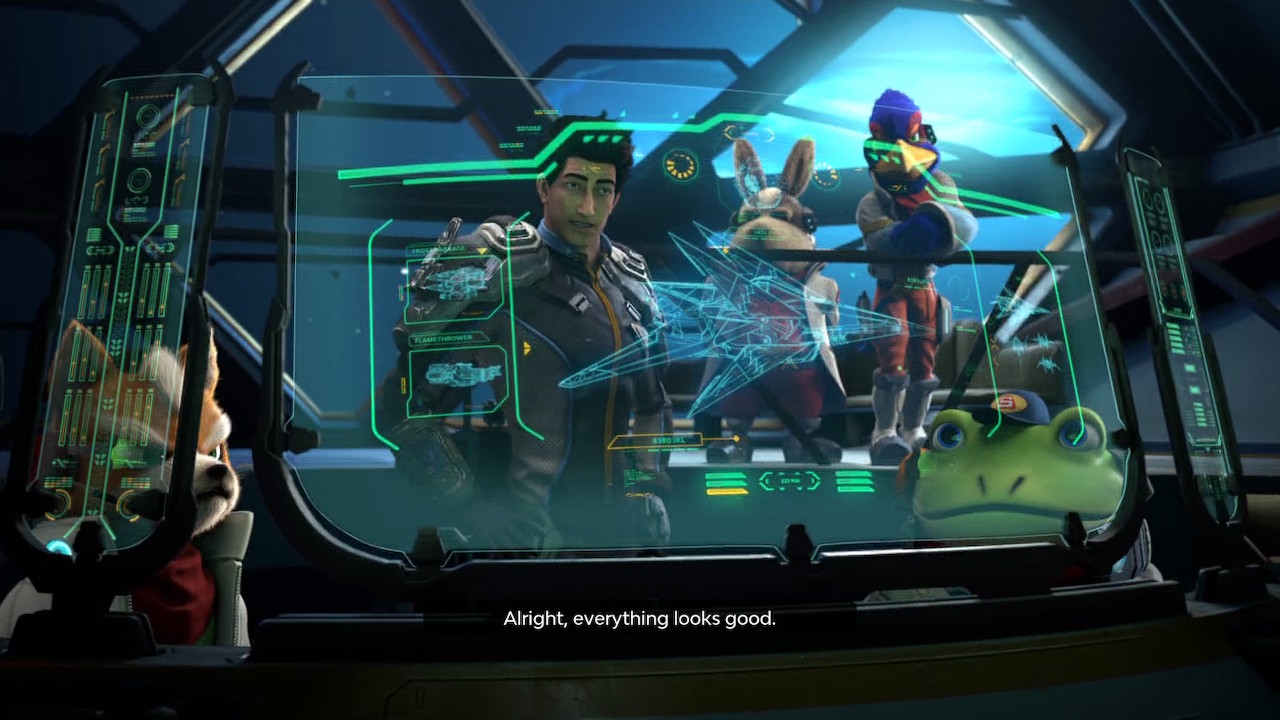
If "do I need these toys to see most of the content, much less beat the actual game?" is a primary question potential purchasers of Starlink: Battle for Atlas probably have, then the followup for Switch owners interested in buying the game would probably be, "How's the Star Fox content?" And I'd have to say, it's pretty good. For one, the interactions with the Star Fox and Starlink crews are very natural. Their dialog goes together well, though in most of the game's cutscenes, Team Star Fox takes a backseat, or don't appear at all. That said, in the totality of Starlink: Battle for Atlas, there were less than ten cutscenes total that broke up the story. Everything else played out in real time over-the-air chat with well executed character models being shown as each spoke. The missions pertaining to the Star Fox team are available to the player as the game progresses, and new missions appear as the plot advances.
Starlink feels great to play. Most planetary combat is limited to hovercraft-style controls with your ship floating a few yards above the ground. It's when you're in space that you can fly in all 360 degrees, U-turn, barrel roll, and much more. The left analog stick moves your vessel around, while the right stick controls the direction your ship faces. Weapons are mapped to the back shoulder buttons, while each pilot's special ability--in Fox McCloud's case, he calls upon one of his Star Fox wingmen to assist him in battle--can be used with a press of the L button when the gauge is full. The R button switches between ground and full flight settings, and the other buttons are used for boosts and interacting with things like other ships, treasure containers, and more.
Inside said treasure containers are a host of interesting items, such as Electrum, the primary currency of Atlas, and Mods, which can be equipped to your ship and both of the weapons on your wings. These can perform actions such as adding bonus elemental damage to your weaponry, increasing the experience you gain from completed objectives and defeated enemies, boosting your ship's defense, among other beneficial bonuses.
Starlink is one of the few third-party releases that shipped day and date with other platforms, so a question you might be pondering is... "How does Starlink run on the Switch?" It's my pleasure to respond that Battle for Atlas runs like a beaut on Nintendo's system. In docked, the clarity and crispness of the environments are a sight to behold, and even in undocked form, the Switch can handle the immense size of Atlas well. Only in particular heated and heavy encounters with many enemies on screen at once causes stuttering frame-rate issues, but overall, I was darned impressed with how Starlink performed on the Nintendo Switch.
All in all, Starlink: Battle for Atlas may not have set the galaxy on fire in sales--quite the opposite, actually--and that's a true shame. What Ubisoft has here is a game that boasts a creative take on the toys-to-life genre (even if it's a few years too late to cash-in on the toys-to-life fervor), superb gameplay (though not without some repetition), and Star Fox content that is organically interjected into the main story (and obviously the special missions meant specifically for Fox McCloud and his team). Starlink: Battle for Atlas reaches for the stars, and succeeds in deliver an engaging game, though not one I was totally over the moon with joy on 100% of the time.
[SPC Says: B]
"Starlink, Report In."
The industry has basically moved on from the toys-to-life approach and business model. Not even the harbinger of the genre, Activision's Skylanders, still... ahem... toys with the premise. That's not to say it's still not cool or anything like that--it's just a tough sell nowadays. However, instead of making characters that come to life, in Ubisoft's Starlink: Battle for Atlas, a variety of ships come to life, allowing players access to them to fight off the Legion menace plaguing the Atlas system. The ability to customize each ship toy with different weapons that can snap on and snap off make for an intriguing premise, but that all turns to space dust if the actual game isn't noteworthy. Fortunately, Starlink: Battle for Atlas manages to not only use the toys-to-life concept in an interesting way, but the overall game proves to be an enjoyable one.
Starlink opens with the titular team arriving in the Atlas system to investigate one of the crew member's past and to search for its home world. This arrival in Atlas is quickly turned to a dicey one, as an alien force known as the Legion, attacks the Equinox, the Starlink crew's ship, and abducts their captain for unknown reasons. Thus, the crew jets out to explore Atlas and track their missing mentor and friend down while putting a stop to whatever the Legion is up to.
![]() |
| The half-dozen or so planets within Atlas each have their own lovely visual identity. |
![]() |
| Space is the place for some hectic and heated action! |
With a game that spans multiple toys, multiple figures, and has multiple different ship, pilot, and weapon components to it, the big question to answer is whether or not one needs to obtain as many toys as possible to get the maximum enjoyment out of Battle for Atlas. Thankfully, that answer is no. You can beat Starlink with just the ships, pilots, and weapons provided to you. In fact, when you perish in battle in Starlink, your "lives" are actually the ships you use. Switch players get an extra "life" (or in this case, ship) from the get go with the Arwing that isn't included in the PlayStation 4 and Xbox One versions of the game. Even still, if one does have their ship destroyed in the dangerous Atlas galaxy, you're simply returned to a past checkpoint--in many cases, a safe base or area you've liberated from the Legion horde.
![]() |
| Starlink's fantastic Photo Mode was used to take all of the screenshots in this review. |
![]() |
| One of many tasks you'll be accomplishing ad nauseum: eliminating Imp Hives. |
![]() |
| Thwart these Legion forces to reclaim this town in the name of the Alliance. |
![]() |
| These Primes might look tough, but you know what they say about the bigger they are... |
![]() |
| With Team Star Fox aboard, you can say that again! |
Inside said treasure containers are a host of interesting items, such as Electrum, the primary currency of Atlas, and Mods, which can be equipped to your ship and both of the weapons on your wings. These can perform actions such as adding bonus elemental damage to your weaponry, increasing the experience you gain from completed objectives and defeated enemies, boosting your ship's defense, among other beneficial bonuses.
![]() |
| Another city, another batch of enemies to vanquish. Rinse and repeat. |
All in all, Starlink: Battle for Atlas may not have set the galaxy on fire in sales--quite the opposite, actually--and that's a true shame. What Ubisoft has here is a game that boasts a creative take on the toys-to-life genre (even if it's a few years too late to cash-in on the toys-to-life fervor), superb gameplay (though not without some repetition), and Star Fox content that is organically interjected into the main story (and obviously the special missions meant specifically for Fox McCloud and his team). Starlink: Battle for Atlas reaches for the stars, and succeeds in deliver an engaging game, though not one I was totally over the moon with joy on 100% of the time.
[SPC Says: B]
Labels:
nintendo switch,
review,
star fox,
starlink: battle for atlas,
switch,
ubisoft
Subscribe to:
Posts (Atom)