A blast from the past returns in a glorious way with the announcement of SaGa Frontier Remastered. Originally released in the West in 1998 for the PlayStation, SaGa Frontier arrives in remastered form for multiple platforms, including PlayStation 4, Nintendo Switch, Steam, and mobile devices. Alongside the familiar, this remastered edition of SaGa Frontier features new scenes and scenarios as well as an eighth playable protagonist to join the original seven party members. SaGa Frontier Remastered is planned to launch Summer 2021.

Showing posts with label android. Show all posts
Showing posts with label android. Show all posts
Saturday, November 28, 2020

Thursday, December 5, 2019
Mario Kart Tour (iOS, AND) Review
Mario Kart Tour revved up its engines and roared onto mobile devices several months ago. Now, that the exhaust has settled, it's time to take a deep dive into the game two months after the game's launch. Has it improved? Is it a worthy title to spend time with? Let's get behind the steering wheel and race for the finish line with SuperPhillip Central's review of Mario Kart Tour!

Nintendo's mobile offerings haven't exactly set the gaming world on fire. They're meant as more of a sampling--a tease, if you will--to get mobile players gaming on Nintendo systems by providing them with a taste of what will come from buying, say, a Switch or whatever. Between Miitomo, Super Mario Run, Animal Crossing: Pocket Camp, Fire Emblem Heroes, and on, Nintendo's found varying degrees of success, but mostly less than satisfactory results. Nintendo hopes to change that with one of its largest properties, and instead of bringing but a small tease of Mario Kart to mobile, Mario Kart Tour is pretty much a valid Mario Kart experience in phone and tablet form. However, as we'll see with my review, a valid Mario Kart experience on mobile has plenty, and I do mean plenty of bumps in its road.
The main draw of Mario Kart Tour is its seasons. Each season in Mario Kart Tour is comprised of multiple cups of three main races and a Mario Kart DS Mission Mode-like event. The latter can be things like time trials, passing through rings, defeating as many Goombas as possible, avoiding damage, and so forth. The actual racetracks featured in Mario Kart Tour are throwbacks from Mario Kart 7's selection of new tracks and retro track selection. Few of the returning tracks from past Mario Kart games come from anywhere but Mario Kart 7, such as Mario Kart Double Dash's Yoshi's Circuit.
 With regard to Mario Kart Tour's various seasons, it's not just about getting first place in a race (though that's somewhat important as is); it's about getting enough points to pass thresholds to acquire Grand Stars, which open up new cups in a given season. You earn points from doing all sorts of tasks--hitting opponents with items, performing tricks, collecting coins, and gaining hang time from flight sections of racetracks. Chaining actions together is paramount in achieving high scores on tracks. All of this adds up to a grand total, which determines how many Grand Stars you earn for that particular race.
However, Mario Kart Tour implements a system where even players who race more than adequately and cross the finish line in first place may and probably will still not have enough points to earn five Grand Stars in many races. Each track in a cup has a specific character, kart, and glider that gives different benefits for using them. The most egregious example of this comes from all tracks needing a specific racer to earn the ability to get three individual items upon driving through an item box. This can also result in a "Frenzy" when you get three of the same item, allowing you to enter invincibility and use as many of that item as you like until the effect wears off.
If you aren't fortunate to have the driver a specific track wants you to have (which you generally won't), you might be stuck with a racer who can only hold two items at once, or worse off, just one--which puts you at a severe disadvantage both race placement and point-wise. Using track recommended karts and gliders also helps in adding a bonus multiplier as well as increasing the amount of time your chain multiplier lasts. Seeing as the characters, karts, and gliders you unlock to use are mostly luck of the draw from pulls that require the use of expensive and hard-to-acquire Rubies, it can be darn difficult to stay competitive in the game.
 I say "competitive", but outside of weekly tournaments where you compete against your particular tier of twenty players to see who can earn the most points in a specific cup for prizes like gold and Rubies (good luck if you don't have the "right" racers for the chosen tracks), there is no multiplayer to speak of in Mario Kart Tour. Yes, the racing series synonymous with multiplayer fun with friends and family does not yet have this feature. That said, the feature is coming, but I worry how balanced it will be (or not be) if the same rules for single player play out in multiplayer.
Of course, it wouldn't be a freemium mobile game without microtransactions and a Gacha system. Nintendo has unfortunately satisfied both conditions to be a freemium mobile game with its repulsive pricing and downright scummy odds with driver, kart, and glider pulls. Rubies are handed out like candy at first in Mario Kart Tour, but soon they become like water to a Koopa in Dry Dry Desert--incredibly hard to come across. Considering every pull in Mario Kart Tour--that is, launching a reward out of the pipe for a chance at earning something new--whether that's a new racer, kart, or glider--costs five Rubies. The odds of getting one of the featured items of each season is disgustingly low, but the odds of pulling multiple copies of characters, karts, and gliders you already possess are frustratingly high. Yes, duplicates of already possessed goodies do eventually level up your drivers and such to make them earn more points in races, but it can be absolutely deflating to make ten pulls and have nothing but lame, low rarity items to show for it.
Then, there are the microtransactions. This is Nintendo kowtowing to investors who wanted the company to go all-in on MTXs because the prices on display here are hilarious in how bold and brazen they are. For example, Mario--the character that Mario Kart is named after--once was in a pack for $20. Yes, the main character of the game isn't even available at the very start of Mario Kart Tour. You either had to get lucky and get him from a pull like I did, earn enough coins to buy him from the shop, or just give in to the evil pricing strategies being conveyed here and straight up buy the pack.
 That's not even the worst of it. There's also a Gold Pass that unlocks more rewards for players for going through the various seasons. You earn more Rubies, more Gold, more goodies like drivers, karts, and gliders--but the catch here is that the Gold Pass costs $4.99. Oh, I'm sorry. I left out an important piece of information. That is $4.99 PER MONTH, a price that is insane. While you can try the Gold Pass out for a two-week trial (just be sure to cancel it before you're charged a day before the two-week trial ends), you better believe that this isn't really worth the asking price. Not by a long green shell shot.
And that's a shame that Nintendo seems to be doing everything with its pricing strategy to turn people like me off from the game, as Mario Kart Tour is rather fun. There is no real stamina system to worry about, which would otherwise limit how many times you can race per day. Instead, the amount of coins you can earn is capped at 300 per day, and the amount of experience you can earn per driver, kart, and glider is also capped at a limit per day as well.
 Pretty much all of Nintendo's mobile offerings have been poor man's versions of its popular franchises. With Mario Kart Tour, you pretty much get the full experience of Mario Kart on a mobile device. Obviously, unlike say, Mario Kart 8 Deluxe on the Nintendo Switch, with Mario Kart Tour you're able to play with just one hand, using your finger to slide from left to right on the screen in order to steer and drift. In order to launch an item, you swipe either forwards or backwards to fire off in the desired direction. That said, it's quite a bit of a challenge to properly aim an item in the direction you want all while negotiating a turn and especially a drift.
Mario Kart Tour constantly keeps you driving forward. There's some auto-steering involved and boundaries to make for a less frustrating experience. What I mean by the latter is that in Mario Kart games where it'd be easy to fall off the course, you automatically hug curves as if there's an invisible rail keeping you on the track. The only opportunity to plummet off a track is when you're hit by an item in midair while crossing a chasm, for instance.
It can be a bit frustrating to avoid items in Mario Kart Tour, especially because racers automatically hold whatever item they have on deck right behind them. This makes it all too easy to steer into it, making your character careen off course and lose precious podium and places and seconds of time. That said, it also makes it so you don't have to hold a button down to have an item trailing behind your character for safety purposes, so there's a pro and a con with this setup.
Mario Kart Tour's tracks forgo the typical three laps that the series has seen used since Mario Kart 64. Instead, Mario Kart Tour's races are two laps each. While the amount of total tracks isn't very high, and they do repeat a lot each season, the game cleverly alters how you race on them. There are four versions of each track--a normal version, a reversed version where you drive on it backwards, a trick version that has a multitude of ramps and other places to perform point-accumulating tricks off of, and a reversed trick version.
Additionally, the "Tour" in Mario Kart Tour refers to how many of the game's seasons sport a featured track that takes place in one real world location. So far, New York, Tokyo, Paris, and London have been featured as locales with unique tracks of their own, but these haven't been too exciting overall design-wise. They're certainly appealing to look at aesthetically, but they don't get the adrenaline driving as much as I would have hoped--particularly the Tokyo track, which was quite a letdown. Hopefully, Nintendo continues bringing new tours as well as new returning tracks into the roster of races to keep things fresh, in addition to new characters, karts, and gliders.
 Mario Kart Tour's tracks look absolutely delightful and brimming with color and personality. This is a mobile game that looks really good, even if it is a bit too taxing on my iPhone 5S (thus resulting in a lot of crashes--one every four or five races--before and after races). It's also quite a battery hog, quickly taking down my phone's battery, though this is somewhat remedied with the power-saving mode that helps lower the depletion on my phone's battery but downgrades the visuals severely. Sound-wise, Mario Kart Tour takes nearly all of its sound and music directly from past Mario Kart games with the only new compositions coming from menus and the new tour tracks.
Overall, it says more about how much I love Mario Kart that I can put up with the slimy Gacha and microtransaction practices than it does my delight for Mario Kart Tour. While the game is structurally sound on a gameplay note, the systems designed to inhale all of the contents from players' wallets are just horrid and completely disgusting to me, especially coming from family-friendly Nintendo. For most players, I feel Mario Kart Tour makes for a stopgap as they wait for Mario Kart 9 to come out (whenever it does--maybe even Nintendo's next system at this rate), and even then, it's a poor one. You'll most likely find yourself wishing to go back to Mario Kart 8 Deluxe. As for me, I see myself sticking with Mario Kart Tour for a little while longer, hoping I don't get to a point where I'll get truly repulsed and put off from playing the game for good--but deep inside knowing that I probably will.
[SPC Says: C-]
More of a Tour de Farce than a Tour de Force

Nintendo's mobile offerings haven't exactly set the gaming world on fire. They're meant as more of a sampling--a tease, if you will--to get mobile players gaming on Nintendo systems by providing them with a taste of what will come from buying, say, a Switch or whatever. Between Miitomo, Super Mario Run, Animal Crossing: Pocket Camp, Fire Emblem Heroes, and on, Nintendo's found varying degrees of success, but mostly less than satisfactory results. Nintendo hopes to change that with one of its largest properties, and instead of bringing but a small tease of Mario Kart to mobile, Mario Kart Tour is pretty much a valid Mario Kart experience in phone and tablet form. However, as we'll see with my review, a valid Mario Kart experience on mobile has plenty, and I do mean plenty of bumps in its road.
The main draw of Mario Kart Tour is its seasons. Each season in Mario Kart Tour is comprised of multiple cups of three main races and a Mario Kart DS Mission Mode-like event. The latter can be things like time trials, passing through rings, defeating as many Goombas as possible, avoiding damage, and so forth. The actual racetracks featured in Mario Kart Tour are throwbacks from Mario Kart 7's selection of new tracks and retro track selection. Few of the returning tracks from past Mario Kart games come from anywhere but Mario Kart 7, such as Mario Kart Double Dash's Yoshi's Circuit.

However, Mario Kart Tour implements a system where even players who race more than adequately and cross the finish line in first place may and probably will still not have enough points to earn five Grand Stars in many races. Each track in a cup has a specific character, kart, and glider that gives different benefits for using them. The most egregious example of this comes from all tracks needing a specific racer to earn the ability to get three individual items upon driving through an item box. This can also result in a "Frenzy" when you get three of the same item, allowing you to enter invincibility and use as many of that item as you like until the effect wears off.
If you aren't fortunate to have the driver a specific track wants you to have (which you generally won't), you might be stuck with a racer who can only hold two items at once, or worse off, just one--which puts you at a severe disadvantage both race placement and point-wise. Using track recommended karts and gliders also helps in adding a bonus multiplier as well as increasing the amount of time your chain multiplier lasts. Seeing as the characters, karts, and gliders you unlock to use are mostly luck of the draw from pulls that require the use of expensive and hard-to-acquire Rubies, it can be darn difficult to stay competitive in the game.

Of course, it wouldn't be a freemium mobile game without microtransactions and a Gacha system. Nintendo has unfortunately satisfied both conditions to be a freemium mobile game with its repulsive pricing and downright scummy odds with driver, kart, and glider pulls. Rubies are handed out like candy at first in Mario Kart Tour, but soon they become like water to a Koopa in Dry Dry Desert--incredibly hard to come across. Considering every pull in Mario Kart Tour--that is, launching a reward out of the pipe for a chance at earning something new--whether that's a new racer, kart, or glider--costs five Rubies. The odds of getting one of the featured items of each season is disgustingly low, but the odds of pulling multiple copies of characters, karts, and gliders you already possess are frustratingly high. Yes, duplicates of already possessed goodies do eventually level up your drivers and such to make them earn more points in races, but it can be absolutely deflating to make ten pulls and have nothing but lame, low rarity items to show for it.
Then, there are the microtransactions. This is Nintendo kowtowing to investors who wanted the company to go all-in on MTXs because the prices on display here are hilarious in how bold and brazen they are. For example, Mario--the character that Mario Kart is named after--once was in a pack for $20. Yes, the main character of the game isn't even available at the very start of Mario Kart Tour. You either had to get lucky and get him from a pull like I did, earn enough coins to buy him from the shop, or just give in to the evil pricing strategies being conveyed here and straight up buy the pack.

And that's a shame that Nintendo seems to be doing everything with its pricing strategy to turn people like me off from the game, as Mario Kart Tour is rather fun. There is no real stamina system to worry about, which would otherwise limit how many times you can race per day. Instead, the amount of coins you can earn is capped at 300 per day, and the amount of experience you can earn per driver, kart, and glider is also capped at a limit per day as well.

Mario Kart Tour constantly keeps you driving forward. There's some auto-steering involved and boundaries to make for a less frustrating experience. What I mean by the latter is that in Mario Kart games where it'd be easy to fall off the course, you automatically hug curves as if there's an invisible rail keeping you on the track. The only opportunity to plummet off a track is when you're hit by an item in midair while crossing a chasm, for instance.
It can be a bit frustrating to avoid items in Mario Kart Tour, especially because racers automatically hold whatever item they have on deck right behind them. This makes it all too easy to steer into it, making your character careen off course and lose precious podium and places and seconds of time. That said, it also makes it so you don't have to hold a button down to have an item trailing behind your character for safety purposes, so there's a pro and a con with this setup.
Mario Kart Tour's tracks forgo the typical three laps that the series has seen used since Mario Kart 64. Instead, Mario Kart Tour's races are two laps each. While the amount of total tracks isn't very high, and they do repeat a lot each season, the game cleverly alters how you race on them. There are four versions of each track--a normal version, a reversed version where you drive on it backwards, a trick version that has a multitude of ramps and other places to perform point-accumulating tricks off of, and a reversed trick version.
Additionally, the "Tour" in Mario Kart Tour refers to how many of the game's seasons sport a featured track that takes place in one real world location. So far, New York, Tokyo, Paris, and London have been featured as locales with unique tracks of their own, but these haven't been too exciting overall design-wise. They're certainly appealing to look at aesthetically, but they don't get the adrenaline driving as much as I would have hoped--particularly the Tokyo track, which was quite a letdown. Hopefully, Nintendo continues bringing new tours as well as new returning tracks into the roster of races to keep things fresh, in addition to new characters, karts, and gliders.
 Mario Kart Tour's tracks look absolutely delightful and brimming with color and personality. This is a mobile game that looks really good, even if it is a bit too taxing on my iPhone 5S (thus resulting in a lot of crashes--one every four or five races--before and after races). It's also quite a battery hog, quickly taking down my phone's battery, though this is somewhat remedied with the power-saving mode that helps lower the depletion on my phone's battery but downgrades the visuals severely. Sound-wise, Mario Kart Tour takes nearly all of its sound and music directly from past Mario Kart games with the only new compositions coming from menus and the new tour tracks.
Overall, it says more about how much I love Mario Kart that I can put up with the slimy Gacha and microtransaction practices than it does my delight for Mario Kart Tour. While the game is structurally sound on a gameplay note, the systems designed to inhale all of the contents from players' wallets are just horrid and completely disgusting to me, especially coming from family-friendly Nintendo. For most players, I feel Mario Kart Tour makes for a stopgap as they wait for Mario Kart 9 to come out (whenever it does--maybe even Nintendo's next system at this rate), and even then, it's a poor one. You'll most likely find yourself wishing to go back to Mario Kart 8 Deluxe. As for me, I see myself sticking with Mario Kart Tour for a little while longer, hoping I don't get to a point where I'll get truly repulsed and put off from playing the game for good--but deep inside knowing that I probably will.
[SPC Says: C-]
Tuesday, August 15, 2017
Pauli's Adventure Island (iOS, Android) Review
So many games, so little time. Isn't that always the way it is? Well, it definitely is when you review games like I do! Especially when you have deadlines! But enough about my struggles here, we're talking about a recent iOS and Android 2D platformer, Pauli's Adventure Island. Let's check it out and hopefully jump for joy!

With a ridiculous amount of mobile games launching on the App Store and the Google Play storefront each and every week, games get lost in the shuffle, and many are easy to ignore. There is just no time to play all of them, only to find out that you've wasted your time downloading it. I do have a soft spot, however, for a competent 2D platformer. The best in the genre are some of my favorite games of all time, and I just love the platformer, 2D or 3D, regardless. Upon reading about Pauli's Adventure Island, I wasn't too impressed by what I saw. However, when watching the gameplay trailer, the game seemed like a well made game worth looking into. It actually was, though several aspects stop Pauli's Adventure Island from being special.
One of the main reasons for this is that Pauli's Adventure Island certainly takes a lot of inspiration from the Super Mario Bros. series, most notably the recent New Super Mario Bros. titles. Everything from collecting three Star Coin-like clovers in each level to obstacles and ideas taken directly from the games. I'm talking platforms that you bounce off of while avoiding enemies who do the same (similar to mushroom platforms in New Super Mario Bros. 2) , square and rectangular platforms that rotate around one another with some posing the risk of crushing your cute, wittle wabbit, platforms that follow along a set track complete with Fuzzy-like enemies to avoid, familiar underground and castle-themed stages that occur around the same time in a world as they would in a Super Mario Bros. game, and more. That said, if you're going to take inspiration from a platforming series, why not take from the best?
What the developer behind Pauli's Adventure Island was also influenced by the Super Mario Bros. series, and this is a very good thing, is the tight and satisfying controls. In Mario games, Mario, Luigi, and whoever else joins his running and jumping cause, control well with no delay between the player's button inputs and the action the character does. This is most impressive in Pauli's Adventure Island because not only did the developer nail the feel of control of the stars of the game, but they managed to do it on a mobile device using a touch screen as the only source of input.
During many games, I'd worry about my thumbs covering up the screen over something important, or worse off, covering my view of what I was doing. This is not the case with Pauli's Adventure Island. The directional buttons one can press on the lower left hand corner of the screen and the A and B inputs on the lower right hand corner are easy to reach and do not get your thumbs in the way. The simple to learn inputs like running, jumping, rolling, and hovering in the air in certain wind tunnel sections in the game all control and play out smoothly. Incredibly commendable.
The level design won't blow anyone's mind or anything, but it's competent to say the least. Some of the clovers hidden in levels are smartly placed, and a bit of the platforming can be a bit tricky. There are four worlds of eight levels each, with the final level in each world consisting of a basic boss battle. For each level you can do the optional task of collecting all three clovers as well as beating the level under a specific target time. Most levels you can do this all in one run, but some later ones are challenging to do so. Regardless, you need not complete both tasks in one run anyway.
The 32 levels on offer, however, don't last long. In fact, the entirety of Pauli's Adventure Island is easily completed in under two hours at max. This stings less because the game is free, only offering a one-time purchase if you absolutely cannot stand occasional ads after every two levels, but something more substantial for replay value would be preferred. I'm talking about things like a harder mode with different and more challenging enemy placements, a requirement to beat the game as both of the two rabbit characters to earn an achievement, and things like that. As it stands, your mileage with Pauli will hardly last the duration of John Claude Van Daam's Sudden Death. Yes, it's a strange movie to choose, but it's a guilty pleasure!
Presentation-wise, Pauli's Adventure Island has a freemium appearance to it, perhaps even an internet browser game. The character animations are basic and while the backgrounds have a good amount of charm to them, they are also a bit modest in impact. The music features some hum-able tunes, but nothing that I can personally remember after playing the game. Nonetheless, while the presentation of Pauli's Adventure Island doesn't really have much "wow" factor, it's all pleasant overall.
Pauli's Adventure Island is a serviceable platformer which I wish would have received more time in the proverbial oven, perhaps to add more worlds and interesting obstacles. Everything presently is very safe and doesn't stray too far from 2D platformers like Super Mario Bros. The foundations for a great game are here, and if a sequel were to materialize from the developer, my interest would certainly be there to try it out. I just found myself enjoying my two hour play session with Pauli, and just saying, "that's it?" when my adventure was speedily over without much fanfare or buildup. Still, a fun game is a fun game, and Pauli's Adventure Island was just that. It's worth a play for 2D platformer maniacs like myself, but don't expect anything too amazing from it.
[SPC Says: C]
There's something about Pauli

With a ridiculous amount of mobile games launching on the App Store and the Google Play storefront each and every week, games get lost in the shuffle, and many are easy to ignore. There is just no time to play all of them, only to find out that you've wasted your time downloading it. I do have a soft spot, however, for a competent 2D platformer. The best in the genre are some of my favorite games of all time, and I just love the platformer, 2D or 3D, regardless. Upon reading about Pauli's Adventure Island, I wasn't too impressed by what I saw. However, when watching the gameplay trailer, the game seemed like a well made game worth looking into. It actually was, though several aspects stop Pauli's Adventure Island from being special.
 |
| Good luck will come to those players who gather all of the clovers in the game. (Well, at least in the form of an achievement!) |
 |
| During many levels, I would ask myself, "Haven't I seen this somewhere before?" |
During many games, I'd worry about my thumbs covering up the screen over something important, or worse off, covering my view of what I was doing. This is not the case with Pauli's Adventure Island. The directional buttons one can press on the lower left hand corner of the screen and the A and B inputs on the lower right hand corner are easy to reach and do not get your thumbs in the way. The simple to learn inputs like running, jumping, rolling, and hovering in the air in certain wind tunnel sections in the game all control and play out smoothly. Incredibly commendable.
The level design won't blow anyone's mind or anything, but it's competent to say the least. Some of the clovers hidden in levels are smartly placed, and a bit of the platforming can be a bit tricky. There are four worlds of eight levels each, with the final level in each world consisting of a basic boss battle. For each level you can do the optional task of collecting all three clovers as well as beating the level under a specific target time. Most levels you can do this all in one run, but some later ones are challenging to do so. Regardless, you need not complete both tasks in one run anyway.
 |
| Time to take you out, Not-Koopa-Troopa enemy! |
 |
| There is a nice crisp and clean look to Pauli's Adventure Island, but otherwise nothing too notable about the presentation. |
Pauli's Adventure Island is a serviceable platformer which I wish would have received more time in the proverbial oven, perhaps to add more worlds and interesting obstacles. Everything presently is very safe and doesn't stray too far from 2D platformers like Super Mario Bros. The foundations for a great game are here, and if a sequel were to materialize from the developer, my interest would certainly be there to try it out. I just found myself enjoying my two hour play session with Pauli, and just saying, "that's it?" when my adventure was speedily over without much fanfare or buildup. Still, a fun game is a fun game, and Pauli's Adventure Island was just that. It's worth a play for 2D platformer maniacs like myself, but don't expect anything too amazing from it.
[SPC Says: C]
Wednesday, April 26, 2017
Dan the Man (iOS, Android) Review
After today's earlier Kami 2 review, SuperPhillip Central continues to seek out interesting mobile releases with Halfbrick Studios' latest, Dan the Man. Is this game by the dev team behind Fruit Ninja and Jetpack Joyride worthy of standing next to those great games?

From the makers of Fruit Ninja and Jetpack Joyride, Halfbrick Studios, comes the team's latest title, a game based on a web series, Dan the Man. Without much context to the game, the story portrayed here is a bit confusing. Who the heck is this army of characters, what's up with the two dudes-- one bald and one with a hat, and just what in the world is going on? It says something then, that even without a cohesive story to its name that Dan the Man ends up being an enjoyable platformer/beat-em-up.
One thing I was worried about with a platformer with beat-em-up combat was the touch controls. Sometimes a game of this type can be let down by its touch-based inputs. Thankfully, this is not the case with Dan the Man. All it needs is its left and right movement inputs on the left side of the screen and its attacking, jumping, and special weapon buttons on the right side. However, if you want a more traditional experience, you can use an MFI controller for analog inputs, which was my preferred way of playing. Regardless, it's great that the standard touch controls work well, and that you have the option of playing with analog inputs if you so desire.

There are 16 levels in total in Dan the Man, and they are split up among four worlds, if you will. They are quite lengthy too, usually taking at least five minutes even when rushing through them, and up to ten minutes if you're playing more leisurely or exploring levels for secret areas. I would have enjoyed more bite-sized levels for convenience's sake, but there are ample checkpoints throughout. Still, many levels can feel long in the tooth, especially with all the "fight rooms" that impede your progress until you clear out the area of enemies. At the end of each level, your point total is accumulated based on how many enemies you defeated, secret areas found, damage you took, and how many objects you broke-- true to the style of the arcade games Dan the Man is inspired by.
The story mode won't take any more than a few hours to beat. The difficulty slowly increases as you play through the levels and worlds, introducing a steady amount of new, harder, more resilient enemy types, new obstacles and hazards to concern yourself with, and more challenging platforming bits to overcome. The game being but a few hours length-wise for a first play-through makes for an adventure that doesn't overstay its welcome. In fact, you might want even more after you've vanquished the impressive and enjoyable final boss.

That's where the two alternate modes of play come in for Dan the Man. One is an arena-style brawler that pits your character in a variety of battlegrounds, needing to take out all enemies in a set amount of time to get as high as score as possible. The other mode presents daily challenges to the player, where completing them nets some rather snazzy prizes in the form of coin bonuses.
Coins are a precious commodity in Dan the Man. They have a variety of uses to them, from upgrading each of the playable characters' fighting abilities in between levels to buying helpful inventory items from in-game shops that appear frequently throughout levels. These items include things like revitalizing potions that save your bacon when your health runs out or temporary weapons like shurikens, shotguns, and even explosive RPGs.
Outside of typical platforming in Dan the Man (which some can be a bit difficult as it can be hard to distinguish what you can and can't jump on occasionally), the combat reminds me a little of the Double Dragon series. There are kicks, punches (both from the ground and in midair) to unleash on foes, as well as holds and throws, performed by holding a direction while standing close to an enemy. It's a lot fun, frenetic action that is simple enough to be learned and perform with the controls, but mindless button mashing won't do you any favors. It's all about picking your shots and thinking ahead to avoid damage.
However, not all is perfect with Dan the Man, and there are two big issues I have gameplay-wise. For one, the knockback that Dan receives upon taking damage is insane. It has Dan rocketed backward, and this is only compounded by the second issue: there are no invincibility frames for Dan. That is to say that when you take damage, you can sort of be like a pinball, bouncing off hazardous objects and projectiles to quickly find yourself killed. It doesn't happen all the time, but when it does, it's maddening. Enemies also get knocked back from punches, so both the player and enemies are on even ground there, but at the same time, enemies don't have to go the entire level.

Still, death isn't a major blow to the player. Through watching a video or playing 200 in-game coins, you can revive yourself from the last checkpoint you came across. Most checkpoint signposts where progress is saved let you pass by freely, but sometimes a 30-second ad plays. These can be removed entirely by paying the premium price of $2.99. This also results in statues bestowing you with rewards when you pass by them instead of needing to break them and watch their videos to get the same reward. Other in-app purchases consist of new playable characters and bundles of coins. None of these IAPs are required to enjoy Dan the Man.
With Dan the Man, Halfbrick Studios has successfully created another winner. With a fair ad and pricing model, satisfying gameplay in both its brawling and its platforming, beautiful art, and respectable level design, Dan the Man delights in many ways. Yes, some of the gameplay issues do detract from the experience, and levels can be a bit too lengthy, but overall, Dan the Man is a short but sweet adventure from beginning to end.
[SPC Says: B]
Dan, Dan. Dan the Man. If he can't do it, no one can!

From the makers of Fruit Ninja and Jetpack Joyride, Halfbrick Studios, comes the team's latest title, a game based on a web series, Dan the Man. Without much context to the game, the story portrayed here is a bit confusing. Who the heck is this army of characters, what's up with the two dudes-- one bald and one with a hat, and just what in the world is going on? It says something then, that even without a cohesive story to its name that Dan the Man ends up being an enjoyable platformer/beat-em-up.
One thing I was worried about with a platformer with beat-em-up combat was the touch controls. Sometimes a game of this type can be let down by its touch-based inputs. Thankfully, this is not the case with Dan the Man. All it needs is its left and right movement inputs on the left side of the screen and its attacking, jumping, and special weapon buttons on the right side. However, if you want a more traditional experience, you can use an MFI controller for analog inputs, which was my preferred way of playing. Regardless, it's great that the standard touch controls work well, and that you have the option of playing with analog inputs if you so desire.

There are 16 levels in total in Dan the Man, and they are split up among four worlds, if you will. They are quite lengthy too, usually taking at least five minutes even when rushing through them, and up to ten minutes if you're playing more leisurely or exploring levels for secret areas. I would have enjoyed more bite-sized levels for convenience's sake, but there are ample checkpoints throughout. Still, many levels can feel long in the tooth, especially with all the "fight rooms" that impede your progress until you clear out the area of enemies. At the end of each level, your point total is accumulated based on how many enemies you defeated, secret areas found, damage you took, and how many objects you broke-- true to the style of the arcade games Dan the Man is inspired by.
The story mode won't take any more than a few hours to beat. The difficulty slowly increases as you play through the levels and worlds, introducing a steady amount of new, harder, more resilient enemy types, new obstacles and hazards to concern yourself with, and more challenging platforming bits to overcome. The game being but a few hours length-wise for a first play-through makes for an adventure that doesn't overstay its welcome. In fact, you might want even more after you've vanquished the impressive and enjoyable final boss.

That's where the two alternate modes of play come in for Dan the Man. One is an arena-style brawler that pits your character in a variety of battlegrounds, needing to take out all enemies in a set amount of time to get as high as score as possible. The other mode presents daily challenges to the player, where completing them nets some rather snazzy prizes in the form of coin bonuses.
Coins are a precious commodity in Dan the Man. They have a variety of uses to them, from upgrading each of the playable characters' fighting abilities in between levels to buying helpful inventory items from in-game shops that appear frequently throughout levels. These items include things like revitalizing potions that save your bacon when your health runs out or temporary weapons like shurikens, shotguns, and even explosive RPGs.
Outside of typical platforming in Dan the Man (which some can be a bit difficult as it can be hard to distinguish what you can and can't jump on occasionally), the combat reminds me a little of the Double Dragon series. There are kicks, punches (both from the ground and in midair) to unleash on foes, as well as holds and throws, performed by holding a direction while standing close to an enemy. It's a lot fun, frenetic action that is simple enough to be learned and perform with the controls, but mindless button mashing won't do you any favors. It's all about picking your shots and thinking ahead to avoid damage.
However, not all is perfect with Dan the Man, and there are two big issues I have gameplay-wise. For one, the knockback that Dan receives upon taking damage is insane. It has Dan rocketed backward, and this is only compounded by the second issue: there are no invincibility frames for Dan. That is to say that when you take damage, you can sort of be like a pinball, bouncing off hazardous objects and projectiles to quickly find yourself killed. It doesn't happen all the time, but when it does, it's maddening. Enemies also get knocked back from punches, so both the player and enemies are on even ground there, but at the same time, enemies don't have to go the entire level.

Still, death isn't a major blow to the player. Through watching a video or playing 200 in-game coins, you can revive yourself from the last checkpoint you came across. Most checkpoint signposts where progress is saved let you pass by freely, but sometimes a 30-second ad plays. These can be removed entirely by paying the premium price of $2.99. This also results in statues bestowing you with rewards when you pass by them instead of needing to break them and watch their videos to get the same reward. Other in-app purchases consist of new playable characters and bundles of coins. None of these IAPs are required to enjoy Dan the Man.
With Dan the Man, Halfbrick Studios has successfully created another winner. With a fair ad and pricing model, satisfying gameplay in both its brawling and its platforming, beautiful art, and respectable level design, Dan the Man delights in many ways. Yes, some of the gameplay issues do detract from the experience, and levels can be a bit too lengthy, but overall, Dan the Man is a short but sweet adventure from beginning to end.
[SPC Says: B]
Saturday, April 15, 2017
Run Sackboy! Run! (iOS, Android, Vita) Review
This weekend seems to be taking a mobile direction. I have no qualms with that! The next game to get the review treatment is Run Sackboy! Run!, a mobile spin-off of one of my favorite PlayStation franchises, LittleBigPlanet. As a fan, do I like this game? More importantly, if I wasn't a fan, would I like this game? Let's find out with the SuperPhillip Central review!

The gaming world loves Mario, and many publishers have tried to come up with a character that even becomes half as successful as Nintendo's biggest star. There have been many contenders in the past with SEGA's Sonic the Hedgehog and Sony's own Crash Bandicoot, but both have fallen to wayside in popularity. Since then, Sony's PlayStation brand hasn't really focused on making a rival to Mario, at least until Media Molecule's LittleBigPlanet came around starring the ever-customizable Sackboy. He's made big strides with his series built off of creation and curation, and he's even starred in his own kart racer. It seems he checks all the boxes of what a platforming mascot should be.
In 2014 on iOS and Android devices and then 2015 on the PlayStation Vita, Sackboy entered the mobile domain. Sackboy's adventure took the form of an endless runner, a genre that was in no shortage on mobile devices then and is in no shortage on mobile devices now. It takes a lot to distinguish oneself from the myriad other endless runners on the market, so does the LittleBigPlanet-themed Run Sackboy! Run! do enough to do so?
Well, not really. Sure, as I stated, Run Sackboy! Run! has the entire LittleBigPlanet dressing to it. It features the second game's antagonist the Negativatron chasing Sackboy as he runs along randomly pieced together sections of level, trying to avoid spikes, enemies, and other hazards. The levels themselves are generated in a way that makes every run different. Yes, you'll recognize beginnings and ends of level parts, but the way everything else is connected will vary. The game has multiple pathways, some leading to greater rewards but with higher risks, and environmental hints like arrows in the background and lines of bubbles reveal ways to smartly run and jump through the levels to survive.
The original LittleBigPlanet saw a multitude of unique areas, so it's a "little" disappointing that only three areas from that game appear in Run Sackboy! Run! You begin in the forested Gardens, then move to the science fiction haven of Avalonia, and then rush through the cactus-covered Canyons before starting the process over again only with altered visuals, closer together hazards, and a brisker running speed for Sackboy.
A run goes on until Sackboy takes damage from a spike or enemy (or other type of hazard) or gets caught in pink goo for too long and the Negativatron catches up to him and swallows him whole. If players have them, they can use a heart to revive Sackboy and continue the run from the point of death, but otherwise the run ends and the point total is tallied, added to a leaderboard. The goal is to reach the top of the leaderboard, devised up of character e close to the top of the leaderboard in the early going of the game.
When players begin Run Sackboy! Run!, they start off with no point multiplier at all, but as special goals are completed (like performing so many dashes in one section of the game or hitting a specific number of jump pads in one run), they gain Sackboy medals. When five are gained, a multiplier is added. Also, bubbles collected in various runs can be used to buy new costumes for Sackboy, also increasing the player's multiplier with each new costume purchased. These continued goals being laid out to the player is essentially the game's "carrot on a stick" that intends to keep them playing more and more.
And being able to play more and more isn't gated behind some lame stamina gauge or other gate that requires you to wait a specific amount of time before you can play again or have to pay money to do so. The only purchases available come in the form of bubbles, hearts used for continues, and permanent boosts like double bubbles. These are merely ways to get to the top of the leaderboards (either the in-game character one or Facebook-only one) more quickly. Purely inessential to the overall enjoyment of the game.
What Run Sackboy! Run! suffers from, however, is a twofold problem. For one, it doesn't take too terribly long for repetition to set in. Doing the same types of runs, grinding for bubbles, slowly getting enough to buy upgrades and new costumes, and so on and so forth-- it becomes stale after awhile. The second, and most disappointing, is how the developer of Run Sackboy! Run! merely made an endless runner with a LittleBigPlanet coating instead of a game that exudes and celebrates the many elements of the series. Whether it's being able to customize your Sackboy with different costume parts instead of just a handful of different costumes or even being able to create and share your own runner levels with friends and online-- I feel a ball has been dropped severely with how far the devs could have run with the LittleBigPlanet license.
That said, runs do offer some variety, as there are different power-ups that can be collected. These come in the form of bubble-attracting magnets, jetpacks that transform levels into pure flight sections where the goal is to hover along strings of bubbles, and a hang glider which is used to soar across distances. These power-ups offer temporary uses, but by spending bubbles, you can extend how long these last.
Another positive about Run Sackboy! Run! is the ease of the controls, regardless of if you're playing on a smartphone, tablet, or PlayStation Vita. Just tap to make Sackboy jump (a quick tap will do a short jump while a lengthier tap will do a higher jump), slide your finger to the right to have Sackboy perform a quick dash forward, and when enough bubbles have been collected and you desire to use it, tap the bottom left corner to initiate a protective shield around Sackboy which will block all damage from hazards and enemies (even allowing him to reach otherwise deadly alternate paths) for a short period of time.
As it stands, Run Sackboy! Run! is just a good endless runner that doesn't do enough to feel unique on platforms with so many better, more creative, and more distinctive endless runners on them. If you have no attachment to the LittleBigPlanet series, then you're probably not going to find too much to enjoy about this game. Fans of Sackboy and Media Molecule's franchise will have some fun here, much like I did, but it won't be too long before you feel like you're going through the motions and feeling strung along.
[SPC Says: C]
Is saying Run Sackboy! Run! is fun a pure fabric-cation?

The gaming world loves Mario, and many publishers have tried to come up with a character that even becomes half as successful as Nintendo's biggest star. There have been many contenders in the past with SEGA's Sonic the Hedgehog and Sony's own Crash Bandicoot, but both have fallen to wayside in popularity. Since then, Sony's PlayStation brand hasn't really focused on making a rival to Mario, at least until Media Molecule's LittleBigPlanet came around starring the ever-customizable Sackboy. He's made big strides with his series built off of creation and curation, and he's even starred in his own kart racer. It seems he checks all the boxes of what a platforming mascot should be.
In 2014 on iOS and Android devices and then 2015 on the PlayStation Vita, Sackboy entered the mobile domain. Sackboy's adventure took the form of an endless runner, a genre that was in no shortage on mobile devices then and is in no shortage on mobile devices now. It takes a lot to distinguish oneself from the myriad other endless runners on the market, so does the LittleBigPlanet-themed Run Sackboy! Run! do enough to do so?
Well, not really. Sure, as I stated, Run Sackboy! Run! has the entire LittleBigPlanet dressing to it. It features the second game's antagonist the Negativatron chasing Sackboy as he runs along randomly pieced together sections of level, trying to avoid spikes, enemies, and other hazards. The levels themselves are generated in a way that makes every run different. Yes, you'll recognize beginnings and ends of level parts, but the way everything else is connected will vary. The game has multiple pathways, some leading to greater rewards but with higher risks, and environmental hints like arrows in the background and lines of bubbles reveal ways to smartly run and jump through the levels to survive.
 |
| The way bubbles are positioned in runs helps in determining when to jump. |
A run goes on until Sackboy takes damage from a spike or enemy (or other type of hazard) or gets caught in pink goo for too long and the Negativatron catches up to him and swallows him whole. If players have them, they can use a heart to revive Sackboy and continue the run from the point of death, but otherwise the run ends and the point total is tallied, added to a leaderboard. The goal is to reach the top of the leaderboard, devised up of character e close to the top of the leaderboard in the early going of the game.
When players begin Run Sackboy! Run!, they start off with no point multiplier at all, but as special goals are completed (like performing so many dashes in one section of the game or hitting a specific number of jump pads in one run), they gain Sackboy medals. When five are gained, a multiplier is added. Also, bubbles collected in various runs can be used to buy new costumes for Sackboy, also increasing the player's multiplier with each new costume purchased. These continued goals being laid out to the player is essentially the game's "carrot on a stick" that intends to keep them playing more and more.
 |
| You get three goals to attempt at one time with the option of skipping particularly challenging goals by spending in-game currency. |
What Run Sackboy! Run! suffers from, however, is a twofold problem. For one, it doesn't take too terribly long for repetition to set in. Doing the same types of runs, grinding for bubbles, slowly getting enough to buy upgrades and new costumes, and so on and so forth-- it becomes stale after awhile. The second, and most disappointing, is how the developer of Run Sackboy! Run! merely made an endless runner with a LittleBigPlanet coating instead of a game that exudes and celebrates the many elements of the series. Whether it's being able to customize your Sackboy with different costume parts instead of just a handful of different costumes or even being able to create and share your own runner levels with friends and online-- I feel a ball has been dropped severely with how far the devs could have run with the LittleBigPlanet license.
 |
| As if the sharp barbs of the cacti weren't enough in the Canyons, there are these missiles to contend with! |
 |
| Propel Sackboy into these strings of bubbles for an excellent means to add to his wallet (and point total). |
As it stands, Run Sackboy! Run! is just a good endless runner that doesn't do enough to feel unique on platforms with so many better, more creative, and more distinctive endless runners on them. If you have no attachment to the LittleBigPlanet series, then you're probably not going to find too much to enjoy about this game. Fans of Sackboy and Media Molecule's franchise will have some fun here, much like I did, but it won't be too long before you feel like you're going through the motions and feeling strung along.
[SPC Says: C]
Friday, April 14, 2017
FZ9: Timeshift (iOS, Android) Review
FZ9: Timeshift launched late last month, and SuperPhillip Central has come around to not only trying it out but reviewing it. An FPS on a mobile device? That must be a recipe for disaster! See why it's not with this review.

Some genres really lend themselves well to mobile gaming: puzzle games, RPGs, card games, and so forth. However, some don't. One particular genre that I struggle to find enjoyment in on mobile devices is the first-person shooter. The often frantic gameplay that these games require is made difficult by touch controls. That made me a bit hesitant to try Hiker Games' new mobile game for iOS and Android, FZ9: Timeshift. However, its core mechanic turns what is usually a hard genre to make fun on mobile a lot of fun.
FZ9: Timeshift's core mechanic incorporates a Max Payne and Matrix-like bullet time slowdown effect when the player isn't moving. Here, bullets move incredibly slowly. When the player walks, time passes normally. This offers the player the ability to see the red trails from enemy bullets in the slowed down view and move accordingly to dodge them, as all it takes is one hit for players to die.
Here, Hiker Games takes what would ordinarily be a difficult genre to implement to mobile and makes it actually work. Because you can slow down the action at any time, you don't need to frantically move with quick speed like you would in a traditional FPS. That doesn't mean you can't get a bullet to the body in slow motion mode, however. If you stand still long enough when an enemy shoots at you, you will die.
Many FPS games especially nowadays have you equipped with two guns that can be cycled between, and if you want a new gun, you have to drop one of the two. Then, there's ammo dropped by foes to pick up. FZ9: Timeshift doesn't play like this. You begin with one gun with a very limited amount of shots, and when the gun runs out, you need to pick up a new one, usually either dropped by an enemy or found in a given level's environment. This constant need to pick up new guns when yours runs out adds some strategy to the game. It means you need to pick your shots well. Thankfully, the game has a button on it that automatically locks on to a nearby foe, one in your immediate view. It doesn't always mean you'll make the shot on them, especially moving targets, but it usually offers a good level of precision. Of course, you'll want to slightly adjust your aim if you wish to go for a headshot, something that offers more points.
The campaign of FZ9: Timeshift possesses about eight chapters with approximately 5-6 missions each. These are usually bite-sized in length, though some are quite lengthy in comparison. With the one-hit deaths, it can mean redoing a sizable portion of level in later chapters, but this burden is lessened with the ability to use gems to revive if desired. Levels themselves are linear and offer no rewards for exploration for the few occasions in the game where there is any semblance of exploration to be found. This also results in each run through a level giving players little variation in how they complete it.
Apart from the campaign, other modes unlock as the player completes chapters in the campaign. There is a cycle mode that randomly chooses a mission type for the player to try to overcome. Some of these include defending an area from enemies, jumping over a parade of oncoming reckless-driving cars, maneuvering and jumping through a laser grid, and picking up enemies with a sniper rifle on an opposite building rooftop. There is also a PvP mode where you compete against a player to get through a campaign level before they do. This mode incorporates a ranking system to keep players engaged.
FZ9: Timeshift offers controls that are mighty easy to follow. There's a virtual analog stick on the bottom left of the screen, and above that is a section of screen to press to automatically lock-on to a nearby enemy within your view. On the right side of the screen are the jump and weapon fire buttons. When you're near a gun you can pick up, you need to just tap in the center of the screen. Finally, looking around is performed by sliding your finger along and around the screen. As stated, this scheme works well considering the pace of the game, which is quite atypical of the other FPSes on mobile devices.
Now, all that sounds good, but here's where the rub is. FZ9: Timeshift is a free-to-play game with in-app purchases (IAPs). That's fine and all, but where it gets annoying is that you have a limited amount of energy that you can use. Doing story missions and other types of events in the game consumes a different number of energy. This results in playing until the game basically makes you wait to continue. Sure, your energy count returns to full after about two hours, but it's obnoxious regardless. Then, there's the need to grind battle points from completing missions of varying types in order to purchase all of the bonuses in the armory. FZ9 won't unlock the next chapter of missions in its campaign until you purchase all of a given tier's bonuses. This need to grind and the limit of how much you can play equals unnecessary delays in campaign progress. I'd rather just pay a $10 to $20 one-time purchase than to have to endure all of these inconveniences.
FZ9: Timeshift isn't the most impressive gaming app on either the Apple or Google Play storefronts. Its visuals hearken back to the PlayStation 2 era, and even then the performance isn't steady. Of course, if you watch gameplay of Timeshift, you'd think there was crazy amounts of stuttering when in actuality it's the player constantly being in and out of the bullet time mode. The music delivers a mix of level music and more intense battle music when enemy encounters get underway while the sound effects are rather rote at best. There is no voice acting to speak of in the game.
Through using a unique gameplay mechanic in the ability to slow down time upon standing still and turning, Hiker Games has come up with its own solution as to how to make a first-person shooter work on a mobile device without worrying about the frantic frenzy the genre usually offers. It's the type of frantic frenzy that makes FPS games on mobile devices not work. Here, with FZ9: Timeshift, we have an FPS that works and works well with its controls thanks to the innovative bullet time effect. The time and play restrictions are totally disappointing and get in the way of fully enjoying the game, but other than that, I enjoyed my time with Hiker Games' latest. Sure, I didn't feel like Neo from The Matrix, but I felt badass all the same.
[SPC Says: B-]
Bullet Time Any Time. Anywhere

Some genres really lend themselves well to mobile gaming: puzzle games, RPGs, card games, and so forth. However, some don't. One particular genre that I struggle to find enjoyment in on mobile devices is the first-person shooter. The often frantic gameplay that these games require is made difficult by touch controls. That made me a bit hesitant to try Hiker Games' new mobile game for iOS and Android, FZ9: Timeshift. However, its core mechanic turns what is usually a hard genre to make fun on mobile a lot of fun.
FZ9: Timeshift's core mechanic incorporates a Max Payne and Matrix-like bullet time slowdown effect when the player isn't moving. Here, bullets move incredibly slowly. When the player walks, time passes normally. This offers the player the ability to see the red trails from enemy bullets in the slowed down view and move accordingly to dodge them, as all it takes is one hit for players to die.
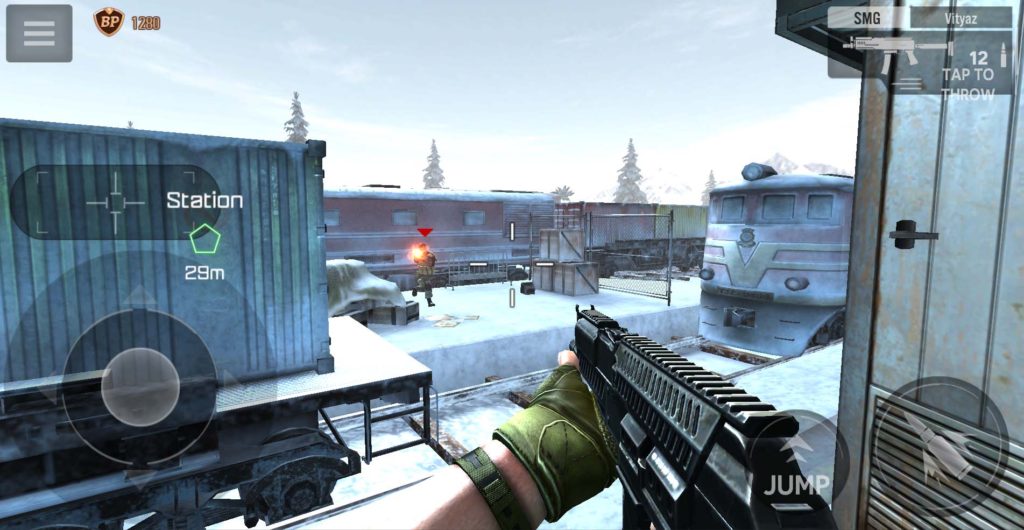 |
| The trains may move, but these targets are currently stationary. |
 |
| You can see the red trails of the bullets to determine when and where to evade. |
The campaign of FZ9: Timeshift possesses about eight chapters with approximately 5-6 missions each. These are usually bite-sized in length, though some are quite lengthy in comparison. With the one-hit deaths, it can mean redoing a sizable portion of level in later chapters, but this burden is lessened with the ability to use gems to revive if desired. Levels themselves are linear and offer no rewards for exploration for the few occasions in the game where there is any semblance of exploration to be found. This also results in each run through a level giving players little variation in how they complete it.
Apart from the campaign, other modes unlock as the player completes chapters in the campaign. There is a cycle mode that randomly chooses a mission type for the player to try to overcome. Some of these include defending an area from enemies, jumping over a parade of oncoming reckless-driving cars, maneuvering and jumping through a laser grid, and picking up enemies with a sniper rifle on an opposite building rooftop. There is also a PvP mode where you compete against a player to get through a campaign level before they do. This mode incorporates a ranking system to keep players engaged.
FZ9: Timeshift offers controls that are mighty easy to follow. There's a virtual analog stick on the bottom left of the screen, and above that is a section of screen to press to automatically lock-on to a nearby enemy within your view. On the right side of the screen are the jump and weapon fire buttons. When you're near a gun you can pick up, you need to just tap in the center of the screen. Finally, looking around is performed by sliding your finger along and around the screen. As stated, this scheme works well considering the pace of the game, which is quite atypical of the other FPSes on mobile devices.
 |
| Zombies. I've never seen these things appear in a game lately... |
FZ9: Timeshift isn't the most impressive gaming app on either the Apple or Google Play storefronts. Its visuals hearken back to the PlayStation 2 era, and even then the performance isn't steady. Of course, if you watch gameplay of Timeshift, you'd think there was crazy amounts of stuttering when in actuality it's the player constantly being in and out of the bullet time mode. The music delivers a mix of level music and more intense battle music when enemy encounters get underway while the sound effects are rather rote at best. There is no voice acting to speak of in the game.
 |
| This game definitely has a low budget feel to it. |
[SPC Says: B-]
Saturday, February 18, 2017
Red's Kingdom (iOS, Android, PC) Review
Before we close out this week's activity here at SuperPhillip Central, we have a review of a game that released last month on iOS and Android devices as well as PC. It's Red's Kingdom, a unique take on the sliding puzzle mechanic found in other games. Is it fun, or will it drive you nutty? Let's find out with the SuperPhillip Central review.

Sometimes developers need not come up with a wholly brand-new gameplay mechanic to create a novel experience. Sometimes it's just taking one mechanic and introducing it with some new dressing or with a completely different structure than the norm to create a fresh experience. That's what Cobra Mobile's Red's Kingdom does, and while it isn't totally successful with their approach, the overall game is worthy of checking out, especially for its low price.
The main gameplay mechanic of Red's Kingdom isn't that new of an idea. You control Red by swiping in one of four directions, and Red rolls continuously in that direction until he hits a solid object. As I said, the idea isn't really novel, but the structure of the game is. Instead of being a linear level-based affair, Red's Kingdom takes place in a wholly interconnected world. While this quite cool, it also becomes one of the main issues with the game, which I'll cover later.
Red's Kingdom has players moving from room to room, whether indoor or outdoor, by finding the correct path through them. This means to clear each room you'll have to do the correct combination of rolls to reach the exit. Sometimes there are multiple exits to take, which offers some exploration into the fold. Often, going off the beaten path can have you come across hidden goodies like a heart in a jar, where collecting three of these increases Red's health by one heart.
Starting off, you simply roll around rooms until you find the right means to reach its exit. As you go through the game, you'll find that the developers add multiple new hazards and obstacles into the game to keep things interesting and engaging. These range from buttons that open doors, levers that alternate between raising and lower red and blue blocks, puddles of sticky tar that stop Red right in his tracks no matter if there's a solid object nearby or not, and ramps that send Red flying over chasms.
There is a Metroid-style influence also found in Red's Kingdom. In the game, Red will come across certain items that allow him to access previously unreachable areas. For instance, early in the game Red will meet up with a fellow squirrel who will give him a medallion. With this medallion Red is able to deal damage to enemies that were once invincible to his rolls. Attacking enemies is as easy as rolling into them, but if you're only doing this, you also take damage. Thus, there is a cool technique the game teaches you, and that is to tap the screen right before Red rolls into a given enemy to deal a critical hit and take zero damage from rolling into the foe. Another item grants Red the power to roll into pink plants that spit him out to reach otherwise inaccessible locations.
For some of the secret goodies to be found in Red's Kingdom, you'll have to travel back to previous areas to use your new acquired item or ability to get them. Here comes a host of the game's problems. For one, backtracking in Red's Kingdom isn't as simple as say, The Legend of Zelda, where you can just run through a room. Instead, Red's Kingdom requires you to essentially solve a puzzle by navigating through each room by rolling from solid object to solid object until you finally reach the exit. The requirement to resolve rooms gets very tedious very quickly.
Another problem with Red's Kingdom is that many of the areas of the game look similar to one another, especially dungeon areas. It can mighty difficult recalling which dungeon or even outdoor section of the game's overworld contains the destination you wish to go to. "Now, where was that section of the world where that one spitting plant leading to that hidden chest I'm missing?" Questions like that will occur often, and since the world of Red's Kingdom is such a maze full of annoying backtracking, this becomes a serious problem.
All this would be fine if the save system was adequate. In its state, however, it's really not. Red's Kingdom automatically saves when you cross save icons in specific rooms. It also saves when you reach various transporters strewn throughout the world that allow you to travel to any other transporter you've already discovered. The problem with the former is that you find yourself in the wrong area of the game (again, easily done as a lot of areas are indistinguishable from one another), you can't just quit to a point from where you were transported because the game automatically saved when you rolled over a save icon-- usually one deep in an area. This means you have to backtrack all the way through an area just to reach the transporter to hopefully warp to the correct area.
Red's Kingdom sports an isometric view that generally works well. However, sometimes parts of the scenery can be obscured by other objects, making it hard to get a full grip on the room you're currently in. There were more than a couple of occasions where I aimlessly rolled around not knowing what to do until I finally saw a lever that could be barely be seen due to being obscured by another object.
An issue with the isometric view that I'm glad the developers got right is the ability to hold the touch screen to show dotted lines that represent all the paths Red can roll. This is crucial to use when there are multiple elevations to take in account as well as damaging hazards like enemies, pools of dangerous liquid, or spiked barrels. Having the dotted lines show what Red will be stopped by or will run into makes the isometric view much less of a bother than it could have been.
Red's Kingdom delivers a delightful visual package with 3D rendered graphics and detailed environments, whether outdoor with its lush vegetation or inside with its well done lighting effects, offering radiant auras that illuminate corners of the otherwise dank dungeons. The handful of animated scenes in Red's Kingdom are also pleasant to look at and cute to boot. What isn't so pleasant is the soundtrack. The song you'll hear the most in the game that features the bagpipe really grates on the ears after a few play-throughs. Now, imagine hearing it repeatedly as you frequent the area it plays in.
Overall, Red's Kingdom has its fair share of problems from the tedium of backtracking, the need to resolve rooms during said backtracking, areas that look too similar to one another, the maze that is the interconnected world, and an imperfect save system. However, even with all of those faults, Red's Kingdom offers an adorable adventure that will test your brain and sometimes even your reflexes. While the overworld structure of Red's Kingdom doesn't really work for a sliding puzzle game of this type, it's far from a bad game. It's just not a particularly great one.
[SPC Says: C+]
Backtracking again? Aw, nuts.

Sometimes developers need not come up with a wholly brand-new gameplay mechanic to create a novel experience. Sometimes it's just taking one mechanic and introducing it with some new dressing or with a completely different structure than the norm to create a fresh experience. That's what Cobra Mobile's Red's Kingdom does, and while it isn't totally successful with their approach, the overall game is worthy of checking out, especially for its low price.
The main gameplay mechanic of Red's Kingdom isn't that new of an idea. You control Red by swiping in one of four directions, and Red rolls continuously in that direction until he hits a solid object. As I said, the idea isn't really novel, but the structure of the game is. Instead of being a linear level-based affair, Red's Kingdom takes place in a wholly interconnected world. While this quite cool, it also becomes one of the main issues with the game, which I'll cover later.
Red's Kingdom has players moving from room to room, whether indoor or outdoor, by finding the correct path through them. This means to clear each room you'll have to do the correct combination of rolls to reach the exit. Sometimes there are multiple exits to take, which offers some exploration into the fold. Often, going off the beaten path can have you come across hidden goodies like a heart in a jar, where collecting three of these increases Red's health by one heart.
 |
| The beginning of Red's journey sees him rolling his way to this castle. |
There is a Metroid-style influence also found in Red's Kingdom. In the game, Red will come across certain items that allow him to access previously unreachable areas. For instance, early in the game Red will meet up with a fellow squirrel who will give him a medallion. With this medallion Red is able to deal damage to enemies that were once invincible to his rolls. Attacking enemies is as easy as rolling into them, but if you're only doing this, you also take damage. Thus, there is a cool technique the game teaches you, and that is to tap the screen right before Red rolls into a given enemy to deal a critical hit and take zero damage from rolling into the foe. Another item grants Red the power to roll into pink plants that spit him out to reach otherwise inaccessible locations.
 |
| Enemies can be rolled into, but if you don't tap the screen before barreling into them, Red will take damage. |
Another problem with Red's Kingdom is that many of the areas of the game look similar to one another, especially dungeon areas. It can mighty difficult recalling which dungeon or even outdoor section of the game's overworld contains the destination you wish to go to. "Now, where was that section of the world where that one spitting plant leading to that hidden chest I'm missing?" Questions like that will occur often, and since the world of Red's Kingdom is such a maze full of annoying backtracking, this becomes a serious problem.
 |
| What there is of the story is lighthearted fare that doesn't interrupt the gameplay too terribly much. |
Red's Kingdom sports an isometric view that generally works well. However, sometimes parts of the scenery can be obscured by other objects, making it hard to get a full grip on the room you're currently in. There were more than a couple of occasions where I aimlessly rolled around not knowing what to do until I finally saw a lever that could be barely be seen due to being obscured by another object.
An issue with the isometric view that I'm glad the developers got right is the ability to hold the touch screen to show dotted lines that represent all the paths Red can roll. This is crucial to use when there are multiple elevations to take in account as well as damaging hazards like enemies, pools of dangerous liquid, or spiked barrels. Having the dotted lines show what Red will be stopped by or will run into makes the isometric view much less of a bother than it could have been.
 |
| For rooms with different elevations, it's good to get a grip on where Red will roll. |
Overall, Red's Kingdom has its fair share of problems from the tedium of backtracking, the need to resolve rooms during said backtracking, areas that look too similar to one another, the maze that is the interconnected world, and an imperfect save system. However, even with all of those faults, Red's Kingdom offers an adorable adventure that will test your brain and sometimes even your reflexes. While the overworld structure of Red's Kingdom doesn't really work for a sliding puzzle game of this type, it's far from a bad game. It's just not a particularly great one.
[SPC Says: C+]
Tuesday, September 27, 2016
Mekorama (iOS, Android) Review
SuperPhillip Central continues its review frenzy with another iOS and Android game. This time it's an isometric puzzle game called Mekorama. It's definitely worth checking out, and this review pieces out why!

Isometric puzzle games are quite fun, and they're especially handy on mobile devices. You can turn on your phone or tablet, jump into a level, beat it, and then go about your day. There's something cool about having a miniature world in your hand where you can interact with it in ways that are highly enjoyable and engrossing. Of course, the poster child for this type of game on mobile is Monument Valley, but there are other games in the genre of puzzle titles on iOS and Android. One of these is Mekorama, a game primarily designed by one person that delivers some brain-twisting gameplay and pleasant charm.
The goal of Mekorama is to guide a little robot through isometric obstacle courses of sorts, leading him from the start of each level to the goal. This is performed through tapping the screen to guide the robot. Levels are made out of a grid format, so tapping the correct space usually isn't too trying. Though with a screen with little real estate like on my iPhone 5S, I did occasionally tap the wrong space. Zooming doesn't really help for the most part, as the zoom function (done by pinching the screen in and out) doesn't zoom in on your robot. It zooms in on the center of the level. As levels are sometimes spread out horizontally rather than vertically, this can be an annoyance.
 Regardless, if you're able to move the robot to the given space you tap on, a small white circle will briefly appear, showing that the robot will move to the space. If it cannot, due to an object or obstacle blocking the way, then a red X will show up on that space. Additionally, you can spin the level around in 360 degrees to get a full view of the obstacles in a level that await your robotic buddy.
Levels are devised up by one major move necessary to reach the goal in the beginning levels, and ramps up to eventually have a series of maneuvers required to reach the goal. In levels you can move and shift specific blocks around to transport the robot around when he stands on them to access new portions of the levels. Sometimes you'll even need to fall from higher elevations to reach lower platforms, or enter into building-like areas and come out from another side.
While the level design of Mekorama is generally good, there are some really poorly executed designs. Anything where you have to slowly push another moving character by tapping a space next to it to inch it along is annoying and quite tedious. Some levels require such precision timing that if you foul up, you essentially have to restart from the beginning. Since some levels can take minutes to complete, this can be quite the bother. There are also non-puzzle oriented levels like one where you have to guide a ball on a balance beam, carefully shifting the weight so the platform the ball rolls on doesn't topple over. For a supposed game to relax to, Mekorama doesn't always deliver a laid-back experience.
 The 50 levels included in Mekorama are just a primer for the main feast of content in the game, the level creator. While some kind of tutorial to use the actual creator would have been appreciated, what you're able to do with it is use the same tools that the developer used to create the already included levels. This is where Mekorama truly shines. Through tapping blocks on the bottom of the screen and placing them in the blank canvas available to you (though another bother I have is that there is no grid available for easier building), you can build your own crafty concoctions, and then save them to your game. Each level you create gets its own QR code that you can share online. Whole communities and websites are dedicated to the publishing and sharing of levels via these QR codes, so if the developer's initial 50 levels already included with Mekorama don't give you enough content, the created levels by the community surely will.

In this regard, Mekorama is a fantastic value. It's even a better value when you consider the price tag. Mekorama itself is free, but you can make a purchase between 99 cents and around $30 to support the developer as well as gain the ability to be provided in-game hints towards the 50 included levels. Though, the latter isn't much of a bonus as online walkthroughs are common in the digital age. Regardless, it's a wonderful way of being able to give money to the developer, and even if you don't, you have the full game available to you. The only thing that comes up are occasional "do you want to support the developer?" prompt between every three or four levels that takes you to the purchase page.
Mekorama leads you into some relaxing and rewarding experiences, allowing you to use that ol' noggin of yours, solve some puzzles, and gain some satisfaction in doing so. Some of the included levels are more annoying to play than others, but even if you don't even touch them, you have a theoretically infinite amount of levels available to you via the community. Building your own levels to share is fun, though it takes some learning to get the process down pat. Overall, Mekorama is a free download that serves as a reminder of why a lot of people love puzzle games like this, and why Google Play and the App Store are great avenues to find little hidden treasures like this game and others like it.
[SPC Says: B]
Robotic Valley

Isometric puzzle games are quite fun, and they're especially handy on mobile devices. You can turn on your phone or tablet, jump into a level, beat it, and then go about your day. There's something cool about having a miniature world in your hand where you can interact with it in ways that are highly enjoyable and engrossing. Of course, the poster child for this type of game on mobile is Monument Valley, but there are other games in the genre of puzzle titles on iOS and Android. One of these is Mekorama, a game primarily designed by one person that delivers some brain-twisting gameplay and pleasant charm.
The goal of Mekorama is to guide a little robot through isometric obstacle courses of sorts, leading him from the start of each level to the goal. This is performed through tapping the screen to guide the robot. Levels are made out of a grid format, so tapping the correct space usually isn't too trying. Though with a screen with little real estate like on my iPhone 5S, I did occasionally tap the wrong space. Zooming doesn't really help for the most part, as the zoom function (done by pinching the screen in and out) doesn't zoom in on your robot. It zooms in on the center of the level. As levels are sometimes spread out horizontally rather than vertically, this can be an annoyance.
 Regardless, if you're able to move the robot to the given space you tap on, a small white circle will briefly appear, showing that the robot will move to the space. If it cannot, due to an object or obstacle blocking the way, then a red X will show up on that space. Additionally, you can spin the level around in 360 degrees to get a full view of the obstacles in a level that await your robotic buddy.
Levels are devised up by one major move necessary to reach the goal in the beginning levels, and ramps up to eventually have a series of maneuvers required to reach the goal. In levels you can move and shift specific blocks around to transport the robot around when he stands on them to access new portions of the levels. Sometimes you'll even need to fall from higher elevations to reach lower platforms, or enter into building-like areas and come out from another side.
While the level design of Mekorama is generally good, there are some really poorly executed designs. Anything where you have to slowly push another moving character by tapping a space next to it to inch it along is annoying and quite tedious. Some levels require such precision timing that if you foul up, you essentially have to restart from the beginning. Since some levels can take minutes to complete, this can be quite the bother. There are also non-puzzle oriented levels like one where you have to guide a ball on a balance beam, carefully shifting the weight so the platform the ball rolls on doesn't topple over. For a supposed game to relax to, Mekorama doesn't always deliver a laid-back experience.


In this regard, Mekorama is a fantastic value. It's even a better value when you consider the price tag. Mekorama itself is free, but you can make a purchase between 99 cents and around $30 to support the developer as well as gain the ability to be provided in-game hints towards the 50 included levels. Though, the latter isn't much of a bonus as online walkthroughs are common in the digital age. Regardless, it's a wonderful way of being able to give money to the developer, and even if you don't, you have the full game available to you. The only thing that comes up are occasional "do you want to support the developer?" prompt between every three or four levels that takes you to the purchase page.
Mekorama leads you into some relaxing and rewarding experiences, allowing you to use that ol' noggin of yours, solve some puzzles, and gain some satisfaction in doing so. Some of the included levels are more annoying to play than others, but even if you don't even touch them, you have a theoretically infinite amount of levels available to you via the community. Building your own levels to share is fun, though it takes some learning to get the process down pat. Overall, Mekorama is a free download that serves as a reminder of why a lot of people love puzzle games like this, and why Google Play and the App Store are great avenues to find little hidden treasures like this game and others like it.
[SPC Says: B]
Monday, September 26, 2016
Riptide GP: Renegade (iOS, Android) Review
From one racer on Sunday to another this morning. It's time for a smart device game review, and it's been a little while for one of those. The subject here is Riptide GP: Renegade, which also saw a release on PlayStation 4, Xbox One, and PC. Is this cheaper version a lesser one? Let's find out with this review.

From the developer of Hydro Thunder, Vector Unit, comes a new aquatic racer with some extreme attitude and the ability to pull off some gnarly stunts. Oh, excuse me-- I'm falling back into the '90s here. Regardless, Riptide GP: Renegade is far from a relic of that era. It's modern, it's well designed, and most importantly, it's fun. Although the game is also on home consoles and PC, this version for smart devices ends up being a winner regardless, and a better deal!
Riptide GP: Renegade sports a story complete with a talkative cast of characters-- well, save for your own racer who stays silent. The campaign or career mode plays out in a linear format. You play each racing event in a row, requiring you to at least earn a star (i.e. getting third place in an event) to move on to the next event. The story follows your racer who gets hustled and tricked, thus having him/her end up in jail. Your racer then must slowly go up the ranks, having various characters join your team to teach the person who orchestrated your trip to prison a severe and serious lesson.
There are nine tracks total in Riptide GP: Renegade, and some feature a traditional circuit-based design with laps while others are races from the top of the track to the very bottom with no return to the beginning. Many races contain ample opportunities for shortcuts to get a leg (or waterbike) up on the competition, and many of these are pretty challenging to find. In addition to shortcuts, the developers have included literal Easter eggs in hidden portions of the races, so exploration of tracks is recommended and very much encouraged.
With nine tracks and a myriad of events to go through, you might think that there will be some tedium doing the same tracks over and over again. Said possible tedium is lessened due to there being different event types, but the campaign can still get a little long in the tooth.
Regardless, there are regular races as well as slalom races, where the goal is to move through the track, jetting through the track while weaving in and out of slalom markers designating which side to take them. Then, there is a mode where eight racers speed through a track, where every 15 seconds the racer in last place becomes eliminated until there's only one participant left. Additionally, there is a means to unleash your inner trickster, performing tricks off ramps to score points to attempt to get the high score. The campaign also occasionally has championships where you compete in a series of events and the overall point leader is deemed the winner. Finally, boss battles are included, mano e mano races where winning earns you the right to race as that character and their vehicle.
As you play through Riptide GP: Renegade, you earn experience and cash after each event, win or lose. Obviously winning nets you more of both. Experience adds up to gain your racer levels, which give you skill points and a cash bonus. The skill points can be used to buy new tricks and special bonuses such as extra boost energy upon successfully performing tricks and extra speed when drafting someone. Conversely, cash is used to purchase upgrades for your various vehicles in accuracy, top speed, handling, and boost.
Riptide GP: Renegade sports a multitude of control options for your smart device, including tilt controls that work well (tilt settings can be optimized for each player), touch controls, as well as MFi controller support. If you have a particular setup you prefer, Riptide GP: Renegade has it, which is fantastic. However, the standard control setup, and the one I used throughout my playtime with the game, was tilt controls with using the touch screen for tricks and to brake. When getting air, you can slide your fingers on the left and right sides of the smart device screen to initiate a trick. Depending on which directions each finger flicks determines the trick you use. Of course, you need to have enough time to pull off the trick, or you'll end up bailing, costing you precious seconds as you furiously tap to reset your vehicle on the track.
Unfortunately, I did find myself struggling to get the game to read my double and triple flick attempts, resulting in bigger trick attempts. This was highly frustrating in the Freestyle events. Regardless, as you perform tricks, you accumulate energy in your boost gauge. You can then tap the boost icon to get a massive burst of speed, great for either making up distance or putting distance between you and your opponent(s).
Since this is an aquatic racer, waves undulate, some more unsettled on some tracks than others, and this makes for plenty of stunt opportunities. The risk vs. reward system makes it so yes, successfully completing a trick gives you boost energy, but make the mistake of jumping off a wave or ramp that doesn't give you enough time to finish your stunt, and you'll find yourself submerged in water. ...Since you bailed. But you already knew the conclusion to that hypothetical scenario, right?
Outside of the single player experience, there is asynchronous multiplayer (compete against friends' times on the game's nine tracks) and traditional split-screen and online multiplayer. The latter was difficult to find other people to race, but eventually I did, and it was plenty of fun with minimal lag.
Riptide GP: Renegade looks the part of an aquatic racer. The water glistens and sparkles, undulating to great effect, and many times water will splash and drizzle on the screen before dripping away. The environments sport plenty of detail, and they make for a post-apocalyptic feel in some tracks while sporting a peaceful feel in others. There is a lot of movement going on outside of the boundaries of many tracks, but it's always pretty clear where you need to make a given turn, thanks to numerous guide arrows. Characters and vehicles have a lot of intricate designs to them, making for a game that is consistent in its visuals and a delight to view. Sound-wise, you won't get a lot from Riptide GP: Renegade, save for vehicle sounds and a rock/electronic soundtrack. It doesn't get grating at the very least.
Overall, the slightly repetitive nature of playing through the same nine tracks with slight event variations in the main campaign can invoke a sense of tedium, but ultimately it satisfies in both challenge and length. The tracks are well designed, and you can tell serious thought went into shortcuts, difficulty of turns, and environments. Riptide GP: Renegade feels like a much better deal on iOS and Android devices than it does on console, where it costs a mighty $14.99 USD compared to its $2.99 USD price on smart devices. If you're looking for an aquatic racer that is more than capable, Riptide GP: Renegade will get you wet with excitement.
[SPC Says: B-]
Water you waiting for-- this racer is worth it!

From the developer of Hydro Thunder, Vector Unit, comes a new aquatic racer with some extreme attitude and the ability to pull off some gnarly stunts. Oh, excuse me-- I'm falling back into the '90s here. Regardless, Riptide GP: Renegade is far from a relic of that era. It's modern, it's well designed, and most importantly, it's fun. Although the game is also on home consoles and PC, this version for smart devices ends up being a winner regardless, and a better deal!
Riptide GP: Renegade sports a story complete with a talkative cast of characters-- well, save for your own racer who stays silent. The campaign or career mode plays out in a linear format. You play each racing event in a row, requiring you to at least earn a star (i.e. getting third place in an event) to move on to the next event. The story follows your racer who gets hustled and tricked, thus having him/her end up in jail. Your racer then must slowly go up the ranks, having various characters join your team to teach the person who orchestrated your trip to prison a severe and serious lesson.
 |
| Sometimes you'll have to contend with the police. Can't have an easy go of it, now can you? |
With nine tracks and a myriad of events to go through, you might think that there will be some tedium doing the same tracks over and over again. Said possible tedium is lessened due to there being different event types, but the campaign can still get a little long in the tooth.
Regardless, there are regular races as well as slalom races, where the goal is to move through the track, jetting through the track while weaving in and out of slalom markers designating which side to take them. Then, there is a mode where eight racers speed through a track, where every 15 seconds the racer in last place becomes eliminated until there's only one participant left. Additionally, there is a means to unleash your inner trickster, performing tricks off ramps to score points to attempt to get the high score. The campaign also occasionally has championships where you compete in a series of events and the overall point leader is deemed the winner. Finally, boss battles are included, mano e mano races where winning earns you the right to race as that character and their vehicle.
 |
| The tracks feature plenty of eye candy, but don't get distracted-- there's a race to win. |
Riptide GP: Renegade sports a multitude of control options for your smart device, including tilt controls that work well (tilt settings can be optimized for each player), touch controls, as well as MFi controller support. If you have a particular setup you prefer, Riptide GP: Renegade has it, which is fantastic. However, the standard control setup, and the one I used throughout my playtime with the game, was tilt controls with using the touch screen for tricks and to brake. When getting air, you can slide your fingers on the left and right sides of the smart device screen to initiate a trick. Depending on which directions each finger flicks determines the trick you use. Of course, you need to have enough time to pull off the trick, or you'll end up bailing, costing you precious seconds as you furiously tap to reset your vehicle on the track.
 |
| Score mad air to perform crazy tricks. Just make sure you have enough room to land 'em! |
Since this is an aquatic racer, waves undulate, some more unsettled on some tracks than others, and this makes for plenty of stunt opportunities. The risk vs. reward system makes it so yes, successfully completing a trick gives you boost energy, but make the mistake of jumping off a wave or ramp that doesn't give you enough time to finish your stunt, and you'll find yourself submerged in water. ...Since you bailed. But you already knew the conclusion to that hypothetical scenario, right?
 |
| Weave through the revolving machinery here to stay on course (and on your machine)! |
Riptide GP: Renegade looks the part of an aquatic racer. The water glistens and sparkles, undulating to great effect, and many times water will splash and drizzle on the screen before dripping away. The environments sport plenty of detail, and they make for a post-apocalyptic feel in some tracks while sporting a peaceful feel in others. There is a lot of movement going on outside of the boundaries of many tracks, but it's always pretty clear where you need to make a given turn, thanks to numerous guide arrows. Characters and vehicles have a lot of intricate designs to them, making for a game that is consistent in its visuals and a delight to view. Sound-wise, you won't get a lot from Riptide GP: Renegade, save for vehicle sounds and a rock/electronic soundtrack. It doesn't get grating at the very least.
 |
| As you can see, everything down to the characters riding these aquatic machines is detailed. |
[SPC Says: B-]
Sunday, April 24, 2016
Disney Crossy Road (iOS, Android) Review
I started covering mobile games at SuperPhillip Central in February after a long time coming, and since then, I've been quite busy preparing new mobile games for review. The market is absolutely saturated, so it's hard to get an idea of the good, polished games from the rubbish. Disney Crossy Road is one of the good, polished games. Certainly not rubbish, as you'll be able to tell with my review.

I'm not a huge Disney aficionado, but I can't lie and say that Disney doesn't have some place in my heart, as corny and dramatic as that sounds. I love a good animated yarn, whether it's Hercules, Aladdin, or my personal favorite, The Hunchback of Notre Dame. Of course, Disney Crossy Road doesn't have any of those franchises in them, but the game is ever-expanding anyway, so maybe some day. Even still, the movies that it does contain are wide and varied, offering a robust roster of characters for each in wonderful voxel form.
Upon reading the title of this game (and assuming you know what Crossy Road in general is), you should know what to expect from it. You move diagonally through multiple lanes of traffic, hoping to avoid getting squashed or run over by an obstacle as one of many Disney characters in various Disney environments. It's simply Crossy Road with a Disney flavor, right?
Well, yes and no. The addictive quality of Disney Crossy Road comes from acquiring new characters with the Gacha machine, giving you one turn at it for every 100 coins you collect. This is done by waiting a specific amount of time until you're rewarded money and collecting coins strewn about the game's levels. With any Gacha machine, some characters are easier to get than others.
When you unlock a new character, you're not just getting a new figure to look at and admire. Depending on which series that character you earn is from, whether it be Mickey Mouse, Toy Story, Tangled, The Haunted Mansion, or Inside Out, to name a handful, the course you play is different. The Haunted Mansion houses dark corridors that need you to touch lights in order to brighten up the room, enabling you to get a better view of upcoming obstacles. Meanwhile, Tangled has a forest setting with rolling barrels that hurdle towards the player that much be evaded. Having different levels types based on the series your character is from makes you want to collect as many characters as possible from as many series as possible. It makes something already addicting even more so.
Those who know Crossy Road's gameplay will feel right at home, and those who don't will still find themselves welcomed thanks to the intuitive control system. You tap the screen to move your character forward and swipe left and right to move your character in that direction. It's a simple, easy, and accessible control method that most anyone can use.
There are two main goals in Disney Crossy Road, and they are to gain a high score-- each movie has a different personal best high score to keep improving on (or at least try to keep improving on)-- and to amass a collection of characters. The former's longevity comes from how much you enjoy setting high scores or not, while the latter is much more engaging, making you want to keep playing to build up your coin amount and character collection.
While Disney Crossy Road is free it does offer some in-app purchases to unlock characters more quickly. For instance, buying Hamm from Toy Story for $4.99 (USD) gives any character you play as a faster accumulation of coins. Additionally and occasionally the game will show a character you can purchase with real world money in-between plays.
Disney Crossy Road is fantastic for its free price, and can easily be played without investing a dime. However, if you want to unlock characters at a swifter speed and pace, then you have that option. Otherwise, beating your personal best high scores for each movies' obstacle course and building up your character collection are things that will keep you coming back for more.
[SPC Says: B+]
Why did the mouse cross the road? To get a high score!

I'm not a huge Disney aficionado, but I can't lie and say that Disney doesn't have some place in my heart, as corny and dramatic as that sounds. I love a good animated yarn, whether it's Hercules, Aladdin, or my personal favorite, The Hunchback of Notre Dame. Of course, Disney Crossy Road doesn't have any of those franchises in them, but the game is ever-expanding anyway, so maybe some day. Even still, the movies that it does contain are wide and varied, offering a robust roster of characters for each in wonderful voxel form.
Upon reading the title of this game (and assuming you know what Crossy Road in general is), you should know what to expect from it. You move diagonally through multiple lanes of traffic, hoping to avoid getting squashed or run over by an obstacle as one of many Disney characters in various Disney environments. It's simply Crossy Road with a Disney flavor, right?
Well, yes and no. The addictive quality of Disney Crossy Road comes from acquiring new characters with the Gacha machine, giving you one turn at it for every 100 coins you collect. This is done by waiting a specific amount of time until you're rewarded money and collecting coins strewn about the game's levels. With any Gacha machine, some characters are easier to get than others.
 |
| Because why should that blasted chicken get all the fun? |
 |
| A racetrack so sweet that it'll give you cavities. |
There are two main goals in Disney Crossy Road, and they are to gain a high score-- each movie has a different personal best high score to keep improving on (or at least try to keep improving on)-- and to amass a collection of characters. The former's longevity comes from how much you enjoy setting high scores or not, while the latter is much more engaging, making you want to keep playing to build up your coin amount and character collection.
 |
| Egad! A stampede! Find your bearings and cross when it's safe, or SPLAT! |
Disney Crossy Road is fantastic for its free price, and can easily be played without investing a dime. However, if you want to unlock characters at a swifter speed and pace, then you have that option. Otherwise, beating your personal best high scores for each movies' obstacle course and building up your character collection are things that will keep you coming back for more.
[SPC Says: B+]
Subscribe to:
Comments (Atom)