Easter Sunday was yesterday, so it only makes sense to follow that up with a Monday edition of SuperPhillip Central's Favorite VGMs that features classic RPG and action-adventure games. Why does it make sense? Okay, you got me. It really doesn't. I was just looking for any excuse to bring out some nostalgia to SuperPhillip Central's Favorite VGMs. This week's list of games starts big with Chrono Trigger, continues with Final Fantasy: Mystic Quest, moves on to Breath of Fire II, moves to the Sony side of the spectrum with Wild ARMs, and concludes with a heartfelt theme from Alundra. Let's get to the music!
v846. Chrono Trigger (SNES) - Frog's Theme
One of the more popular party members to join Chrono's cause in the Super Nintendo RPG classic Chrono Trigger is Frog. His theme has a majestic sound to it, as well as a Far Eastern flavor. It's the perfect song to get ready for an epic battle against enemies both small and large!
v847. Final Fantasy: Mystic Quest (SNES) - Town of Forest
Like you'll hear with the next VGM volume, Final Fantasy: Mystic Quest's Town of Forest gives a great sense of homeliness. It's a warm theme thanks to the warm synth that is played that invites you to stay in the safe boundaries of its town, chat with the locals, and upgrade your equipment.
v848. Breath of Fire II (SNES, GBA) - My Home Sweet Home
This theme is played in the majority of towns in Breath of Fire II. It says something to the longevity of My Home Sweet Home that you can hear it so much (and you will hear it so much in the game) and still never grow tired of it. It's a theme that brings a sense of home and comfort every time it is heard in the rough and dangerous world of Breath of Fire II.
v849. Wild ARMs (PS1) - Adlehyde Castle
Wild ARMs is one of my favorite RPG soundtracks of all time. It is in the same league as Final Fantasy VI, Final Fantasy Tactics, Star Ocean: The Second Story, and Xenogears to me. Part of that is the myriad of memorable themes and leitmotifs that come from the soundtrack, including this familiar theme from Adlehyde Castle. Michiko Naruke did a fantastic job with this soundtrack.
v850. Alundra (PS1) - The Shrine of the Lake
A heavily piano-centric piece from Alundra, essentially Sony's response to The Legend of Zelda series, The Shrine of the Lake is a beautiful, magical piece of music that evokes an emotional feeling with its motif and accompaniment. Almost makes you want to relive Alundra if you've already played it, doesn't it? Heck, I'm going to relive it now!
Showing posts with label breath of fire ii. Show all posts
Monday, April 6, 2015
Thursday, November 27, 2014
Bad Levels in Gaming History - Volume Six
Today is Thanksgiving for the United States. It's the day where we gorge ourselves on a massive-sized meal and partake in watching football. For this holiday, I'd like to talk turkeys. No, not the actual birds-- I'm talking about levels that are so bad that I consider them to be turkeys. Har-har!
These levels are frustrating, annoying, poorly conceived, have a certain segment in them that lead to nothing but tears, or are otherwise just plain bad. This sixth volume has games both recent and retro, such as Super Mario Sunshine, Sonic: Lost World, and Double Dragon II. If you are ready, let's dive in to some bad levels on this fine Turkey Day! Gobble-gobble!
Corona Mountain - Super Mario Sunshine (GCN)
Let's get this out of the way-- Super Mario Sunshine is my least favorite 3D Mario title. That said, it's not a bad game by any stretch of the imagination; it just features more annoyances (i.e. blue coins, annoying levels, a poor camera at times, etc.) than other 3D Mario games have let loose on me as the player.
Outside of picks like the Pachinko bonus level, the bonus level where you have to guide a leaf on a poison river to collect eight red coins (and getting to said level), that one Yoshi mission in Ricco Harbor, among others, one of the worst challenges in Super Mario Sunshine is the final level, a trek through the sultry and dangerous hot Corona Mountain, the volcano that sits right in the middle of Isle Defino.
From the very start, Corona Mountain is a genuine pain in Mario's tuchus. The first part of the level requires Mario to smartly use the hover function of the FLUDD to move from platform to platform. However, these platforms have intermittent spikes that protrude from each platform and flames, both of which will kill Mario in one hit if he even so much as touches them. This is an annoyance all to itself.
Nonetheless, the most taxing part of Corona Mountain is its second portion, navigating a boat along the channel of lava. This is performed by using the FLUDD to spray water to push the boat along. Spraying to the right will move the boat towards the left, for instance. Crashing into ANYTHING, and there's a lot of potential hazards to crash into, will result in the boat sinking, along with Mario. The boat handles so poorly, which nine times out of ten will be the reason for Mario's death in the level.
After the boat ride comes a section where Mario needs to propel himself into the air with the FLUDD's rocket nozzle, carefully rocketing himself onto the surfaces of clouds both stationary and moving. What is your reward for getting through this fairly ho-hum and frustrating final level? Why, an anti-climactic boss fight against Bowser, one of the worst in Super Mario history.
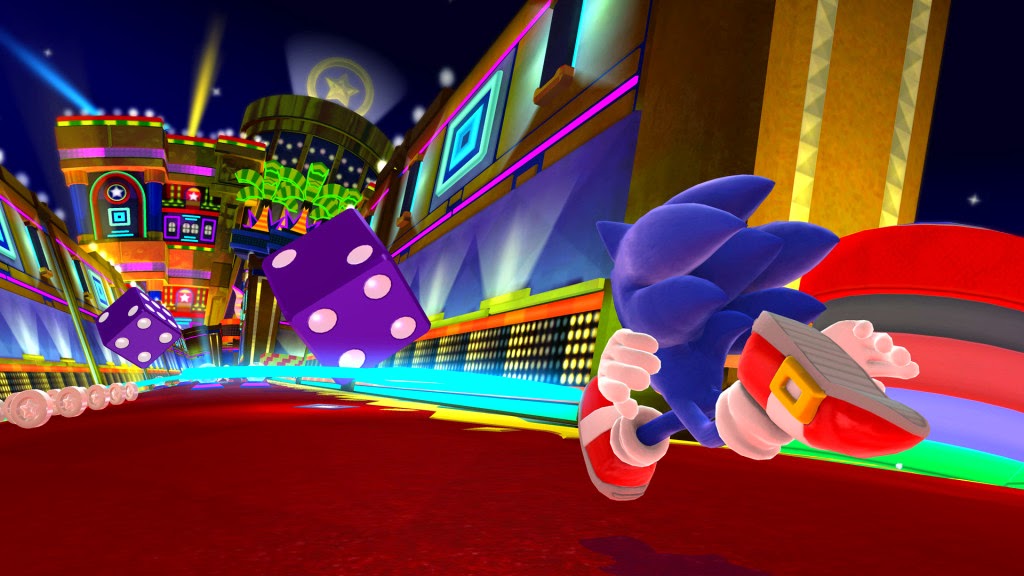
Frozen Factory Zone 3 - Sonic: Lost World (Wii U)
The first of two level picks from the Sonic the Hedgehog series, we deal with a level from Sonic: Lost World first. Sonic Team has a bad habit of working so much on the first level of its games to make a great first impression on players that it doesn't let later levels have enough time in the oven to be made wonderfully. This is the case with the third level in the Frozen Factory Zone, a casino level.
The level itself is essentially one long hall with multiple springs, split paths, and enemies to contend with. This by itself is just fine. There is nothing wrong at all with these segments of the level.
No, the major issue comes from the handful of segments where Sonic is transported into a pinball table. These sections are absolute hell. The ball physics are terrible, resulting in many cheap deaths, as falling off the table counts as a loss of life.
Unfortunately, one of the pinball tables is home to one of the game's many red rings, a collectible used to unlock extra content in Sonic: Lost World. It's at the very top of one of the three pinball tables. Not only is that problematic and infuriating to try to attempt to collect, but for every five or so times you lose a life, a little portal is created within the pinball table. Touching it makes you skip past the problem spot. The issue here is that the portal is so difficult to avoid that most players will hit it, thus unintentionally skipping the pinball table with the red ring. Talk about adding insult to injury! This means you need to kill Sonic just to get to a point before the portal, but heaven help you if you hit a checkpoint after that pinball table first!
Sky Canyon Zone - Sonic Advance 2 (GBA)
We move from one Sonic the Hedgehog game to another, though this time it's a 2D affair with Sonic Advance 2. Unlike its predecessor, Sonic Advance 2 started the whole "boost to win" level design of the handheld Sonic the Hedgehog games. While this essentially automatic gameplay where boost pads, springs, and grind rails directed players without much need for player control was not a problem in the more open zones of Sonic Advance 2, when the Blue Blur arrives at the Sky Canyon Zone, an issue rears its unfriendly head.
You see, Sky Canyon Zone, like its name implies, takes places in the sky. Therefore, there are plenty of points in the level where bottomless pits position themselves to gobble up the uninitiated. Needless to say, Sonic Advance 2's constant high speeds and bottomless pit placements do not mix well. You're constantly being forced to speed through the level thanks to boost pads and the like, and because of this you do not have a firm grasp on what lies ahead, making running into a row of spikes or worse yet, a bottomless pit, very easy to do.
Then there's the Dr. Eggman encounter at the end of the zone. If you're unaware of how most of Sonic Advance 2's boss fights go, you're always on the run in these battles, chasing after Eggman's latest machine. However, momentum plays a big part in each battle, making it so jumping or otherwise not running slows you down. With Sky Canyon's boss, made up of three unique parts moving in a circular pattern, not only do you have to dodge the boss' advances, but you are required to attack each part of the robot and destroy it. The latter is difficult, as you don't have a lot of real estate on the Game Boy Advance's screen to see which part of the boss is currently facing you're on top of it. Did I mention the boss has a one-hit kill move as well?
Mansion of Terror - Double Dragon II (NES)
Double Dragon II is one of those classic "NES hard" games that begs of its players to constantly get game overs while simultaneously improving and having its players get a little bit further in the game with each try. Soon, you become so skillful at the game that you know how to take down every grunt and boss that stands in your way.
However, even with the most skill, there is one sticking point in Double Dragon II that follows a no-no I have in game design. The Mansion of Terror turns a 95% beat-em-up into a 95% platformer near the end. This wouldn't be so bad if the mechanics of Double Dragon II lent themselves well to jumping with great precision. Double Dragon II's jumping mechanics absolutely, positively do not.
No, what you get is a game that was all about beating up foes for the most part and has it transform into a problematic platformer with plenty of cheap deaths that will result from falling into pits. Get used to having a full set of lives in your collection only to see them fall one by one as you miss jumps, get hit in midair, resulting in you falling to your death, and other incredibly cheap pit-related deaths.
Double Dragon II's Mansion of Terror is a level that requires the player to use a mechanic that the game was not based off of, adding up to an immense amount of frustration. It wouldn't be so bad if the penalty for messing up jumps wasn't so severe. However, seeing your tally of lives go from a high amount to zero because the game decided to throw in ill-conceived platforming for a gameplay system that doesn't handle it well is a game design sin from my position.
Infinity - Breath of Fire II (SNES, GBA)
RPG fans have it much easier nowadays than they did back in 8-bit and 16-bit eras. Breath of Fire II is a product of the 16-bit era, and it definitely possesses that old school, kick-you-in-the-butt type sensibilities. Its final dungeon, Infinity, puts players through the game's ultimate test.
Infinity is little more than an absurd endurance run through a labyrinth of many floors, many dead ends, and an abundant amount of random encounters. It really says something poorly about the random encounter rate when less than five steps results in a new battle and monsters to contend with.
It wouldn't be so obnoxious if the battles themselves didn't take so long, but even at the recommended level for your party, fights with enemies can take a(n) (un)fair while to complete. That isn't even considering many of the harder enemies are HP tanks and some can even cast a death spell that automatically kills one party member. This means that if you have a party member that has been fused with magical power to become stronger in battle and allowing said battles to be won more easily, this fusion is removed upon death.
Infinity is split up within two parts. The first part is actually the most difficult of the two, as it has zero save points. Don't be surprised to spend upwards of 45 minutes in a hellish dungeon with no opportunity to save your progress. This means one battle can undo 45 minutes of hard work.
Thankfully, there is a town that splits up the two halves of Infinity, and it contains a place to rest and a save point. However, upon entering the town, you're greeted with a very long conversation with one of the town's denizens, making that upwards of 45 minutes without saving stretch out even further. The impatient and weak-hearted need not apply to the absurd insanity that is playing through the incredibly exhausting Infinity dungeon in Breath of Fire II.
Monday, October 7, 2013
SuperPhillip Central's Favorite VGM - The World Ends When We Say So Edition
Welcome to the start of the work week here at SuperPhillip Central, and most likely, where you are, too. Today brings another installment of SuperPhillip Central's Favorite VGMs right to you. This week's edition contains music from The World Ends With You, Tales of Symphonia, as well as Pokemon Stadium. It's sure to be an enjoyable edition of VGM for everyone. Let's get started!
v476. The World Ends With You (DS) - Hybrid
The World Ends With You marked a time in Square Enix's history where they weren't as afraid to take risks. Present-day Square Enix is in panic mode currently, and things aren't looking too bright for the Japanese publisher. Regardless, we can look back at better times for the company with games like The World Ends With You for Nintendo DS.
v477. Tales of Symphonia (GCN) - Dance in the Sunshine
Nintendo's GameCube did not receive much in the way of RPGs. It's a fallacy to say that Tales of Symphonia is only thought of highly because it was one of the few RPGs on Nintendo's system. No, it's thought of highly because the game has a gorgeous art style, an engaging combat system, an intriguing story, and of course, great music.
v478. Banjo-Kazooie (N64) - Click Clock Wood (Spring)
Banjo-Kazooie was an evolution to the formula and foundation that the revolutionary Super Mario 64 laid down. It was a better game for it, though some might not have enjoyed how Banjo and Kazooie's full move set was not available immediately from the start of the game. Grant Kirkhope lent his composition genius to the soundtrack, creating a score that is still amazing to this day.
v479. Pokemon Stadium (N64) - Gym Leader Battle
Being able to hear the classic 8-bit melodies from Pokemon Red, Blue, and Yellow on the Nintendo 64 sound chip was a moment that made younger versions of the SuperPhillip Central staff squeal with delight. This particular theme is one of our absolute favorites, and made fighting the likes of Brock and Misty all the more intense.
v480. Breath of Fire II (SNES, GBA) - The Kingdom
The theme of Wyndia, a kingdom that has appeared in the majority of Breath of Fire games, The Kingdom is a majestic and regal theme. It seems like a great time to bring this game and its soundtrack up, as North Americans last month were able to download the game on the Wii U's Virtual Console service. Definitely check Breath of Fire II out if you haven't. Just be weary of the poor (but occasionally hilarious) translation.
Monday, June 11, 2012
SuperPhillip's Favorite VGMs - E3 Hangover Edition
I have overindulged on E3 and games, so it's time to wind down and return to normalcy with SuperPhillip's Favorite VGMs. This week we have music from titles like The Legend of Zelda: Ocarina of Time, Rabbids Go Home, and Resident Evil: Revelations.
v126. The Legend of Zelda: Ocarina of Time (N64) - Kokiri Forest (Hyrule Symphony Version)
Listed multiple times as my favorite game of all time, the 3DS version brought with it a higher and steady framerate, better visuals, and excellent and optional gyro aiming. Hyrule Symphony features compositions by Koji Kondo which have been arranged by Ryuichi Katsumata. There are thirteen tracks in all including Hyrule Field, Hyrule Castle, Lon Lon Ranch, Ganondorf, and this track, Kokiri Forest. It is a worthy CD to add to a video game music aficionado's collection.
v127. Rabbids Go Home (Wii) - Bubamara
For a while there the Rabbids took Rayman out of his own franchise and stole the spotlight entirely. When one thinks of Rabbids they usually think of mini-game collections. Well, Rabbids Go Home is nothing of the sort. It is a platforming/adventure game where the Rabbids must collect loads of trash and everyday items in order to build a giant pile to reach the moon, their home. Much of the music heavily showcases brass as performed by Fanfare Vagabontu.
v128. Professor Layton and the Diabolical Box (DS) - The History of the Village
Professor Layton is the type of a franchise that can appeal to a wide range of people and not just the stereotypical gamer. The series has sold millions of copies thanks to the efforts of Level 5 and Nintendo. The lack of localization news regarding The Mask of Miracle for the 3DS disappointed me. Apparently only games starring plumbers get E3 time. Regardless, The History of the Village is a tune appropriate for the man with the top hat and gentlemanly duty.
v129. Breath of Fire II (SNES, GBA) - Clean Hit
One of the many boss themes of Breath of Fire II, a classic Super Nintendo RPG developed and published exclusively by Capcom (if you recall, the original Breath of Fire was a joint effort between Capcom and Squaresoft), Clean Hit plays during some of the game's most chaotic battles. Although Breath of Fire II is a capable game, it does suffer from too many random enemy encounters, especially in later stages of the game. Despite this, the title still holds a fond place in my memory.
v130. Resident Evil: Revelations (3DS) - Revelations (Full Ver.)
The full theme of Resident Evil: Revelations plays during the credits. My favorite part happens around 1:02 and ends with 1:31. The actual game itself earned the number four spot on my Top Ten Retail 3DS Games of the System's First Year list, and for good reason. The series returned to its survival-horror roots while also giving players who enjoyed Resident Evil 4 and 5 their kind of preferred gameplay. The game is genuinely creepy and I did leap into the air at some rather unsettling parts. If you like action-oriented games or titles that make you squirm, Revelations is definitely a solid investment.
That concludes another installment of my favorite VGMs. Later in the week you can check out an all-new part of Killer Soundtracks - My Personal Favorites. Until then, if you missed a previous VGM, scope out my VGM Database.
v126. The Legend of Zelda: Ocarina of Time (N64) - Kokiri Forest (Hyrule Symphony Version)
Listed multiple times as my favorite game of all time, the 3DS version brought with it a higher and steady framerate, better visuals, and excellent and optional gyro aiming. Hyrule Symphony features compositions by Koji Kondo which have been arranged by Ryuichi Katsumata. There are thirteen tracks in all including Hyrule Field, Hyrule Castle, Lon Lon Ranch, Ganondorf, and this track, Kokiri Forest. It is a worthy CD to add to a video game music aficionado's collection.
v127. Rabbids Go Home (Wii) - Bubamara
For a while there the Rabbids took Rayman out of his own franchise and stole the spotlight entirely. When one thinks of Rabbids they usually think of mini-game collections. Well, Rabbids Go Home is nothing of the sort. It is a platforming/adventure game where the Rabbids must collect loads of trash and everyday items in order to build a giant pile to reach the moon, their home. Much of the music heavily showcases brass as performed by Fanfare Vagabontu.
v128. Professor Layton and the Diabolical Box (DS) - The History of the Village
Professor Layton is the type of a franchise that can appeal to a wide range of people and not just the stereotypical gamer. The series has sold millions of copies thanks to the efforts of Level 5 and Nintendo. The lack of localization news regarding The Mask of Miracle for the 3DS disappointed me. Apparently only games starring plumbers get E3 time. Regardless, The History of the Village is a tune appropriate for the man with the top hat and gentlemanly duty.
v129. Breath of Fire II (SNES, GBA) - Clean Hit
One of the many boss themes of Breath of Fire II, a classic Super Nintendo RPG developed and published exclusively by Capcom (if you recall, the original Breath of Fire was a joint effort between Capcom and Squaresoft), Clean Hit plays during some of the game's most chaotic battles. Although Breath of Fire II is a capable game, it does suffer from too many random enemy encounters, especially in later stages of the game. Despite this, the title still holds a fond place in my memory.
v130. Resident Evil: Revelations (3DS) - Revelations (Full Ver.)
The full theme of Resident Evil: Revelations plays during the credits. My favorite part happens around 1:02 and ends with 1:31. The actual game itself earned the number four spot on my Top Ten Retail 3DS Games of the System's First Year list, and for good reason. The series returned to its survival-horror roots while also giving players who enjoyed Resident Evil 4 and 5 their kind of preferred gameplay. The game is genuinely creepy and I did leap into the air at some rather unsettling parts. If you like action-oriented games or titles that make you squirm, Revelations is definitely a solid investment.
===
That concludes another installment of my favorite VGMs. Later in the week you can check out an all-new part of Killer Soundtracks - My Personal Favorites. Until then, if you missed a previous VGM, scope out my VGM Database.
Subscribe to:
Posts (Atom)