Showing posts with label super paper mario. Show all posts

Wednesday, August 12, 2020

Rank Up! - Ranking the Paper Mario Series

Yesterday, August 11th, saw the 20th anniversary of the original release of Mario Story in Japan. For most of us on this side of the world, however, we know it fondly as Paper Mario. After pouring through the contents of the latest Paper Mario game, The Origami King, and holding it in rather high esteem as my review shows, it seems like an ample time as any to give the Paper Mario franchise the Rank Up! treatment. Let's do just that!

As always with Rank Up!, I'll be counting down the list of every game in the Paper Mario series, starting with my least favorite of the bunch and slowly working my way down to the very best. After you've checked out my list and rationale for this order, why not share your thoughts and possibly your own ranking!

6) Paper Mario: Sticker Star (3DS)


My least favorite in the Paper Mario series greatly changed the formula of the franchise, and to start off, it was not for the better. While far from an awful game, Paper Mario: Sticker Star failed to live up to previous installments. After being teased with early screenshots featuring partners and the traditional turn-based battles of the series--all typical elements of the series--the final game saw a removal of nearly all of the things that fans of the franchise adored. The turn-based battles were still present, but now one-time use stickers were used for attacks and no experience was gained from battles. Both really undermined the need for players to engage with encounters altogether. Then, there were the dreaded Things, one-time use objects that needed to be used to turn the tide in specific areas of the game. The problem here was that in battles, most of the time the right Thing to use was so unclear that it made boss battles aggravatingly obtuse. Fortunately, Nintendo would use this decidedly shaky foundation to fine tune the concept for future, better installments.

5) Super Paper Mario (Wii)


The start of the shift in Paper Mario's gameplay concepts, Super Paper Mario on the Wii was quite the sizable shift to say the least. Really, one could call the game more of a spin-off due to the complete lack of turn-based battles altogether. Instead, everything was done in real-time via jumping and hammering in this platformer/RPG hybrid. The story of the game went in some truly bizarre and dark (at least for the series) places, offering new foes to face and numerous original characters to encounter. The main gimmick to exploration and world traversal was the ability to shift the camera to a new axis to reveal paths and hidden objects in a 3D perspective that were obscured when viewed from the traditional 2D perspective of the games. It was a novel idea but did lose its luster over the duration of the game. Super Paper Mario was an interesting and mostly successful experiment for the Paper Mario series, but it would lead to a future for the franchise that is quite different from its origin, and one that plenty of fans have and continue to adamantly oppose.

4) Paper Mario: Color Splash (Wii U)


Released in the final years of the Wii U, it's no surprise that many did not get to experience Paper Mario: Color Splash, either due to not owning the dismally selling Wii U or looking ahead to Nintendo's next console. Those that did would discover a mostly improved sequel to Paper Mario: Sticker Star. While Things were still a part of the game, their implementation was much less of a frustration and cause for headaches. The paint mechanic of coloring in the world brought an abundance of entertainment with regard to exploration, and the personality and humor of Color Splash when compared to its predecessor were much more apparent. This was a hilarious at best and humorous at worst game. It wasn't without its caveats, though, as battles still didn't feel worthwhile to engage with, as attack cards had limited uses. Worse, you had to use the Wii U GamePad in a needlessly convoluted manner to "paint" the cards into more usable forms. Still, I quite enjoyed my time with Paper Mario: Color Splash, and between the sensational presentation (both beautiful graphics and catchy music), exploration, and humor, it's a game that I do recommend... as long as you're not searching for a traditional Paper Mario experience.

3) Paper Mario: The Thousand-Year Door (GCN)


Often noted as many a Paper Mario fan's favorite game in the series, I don't have as much of a fondness for the sophomore entry in the Paper Mario franchise. By no means is it a terrible game--well, that much is obvious due to the game being number three on this countdown--but Paper Mario: The Thousand-Year Door has just enough elements that detract from the overall game that it somewhat sours me on it over the other two titles in the series. For one, there is a massive amount of backtracking in multiple chapters, which makes revisits to the game a chore... or at least more of a figurative headache than I would like. Secondly, there are some leaps in difficulty that could have used some more ironing out--particularly the super-challenging final boss. That said, everything else about The Thousand-Year Door is a delight. The humor, writing, and story are on point; the battle system is as engaging and enjoyable as ever; and the worlds are a ton of fun to explore and discover items and badges in. If you have yet to play this classic and have access to both the game and a functioning GameCube, (prepare for an awful pun...) do X-"naut" skip this game!

2) Paper Mario: The Origami King (NSW)


With the direction and approach of the modern Paper Mario games, I certainly did not expect one of the games to give me such a sensation of excitement and pleasure from playing--much less be number two on my list of favorite Paper Mario games. But, lo and behold, Paper Mario: The Origami King, the latest in the Paper Mario series, has achieved that feat. Well met, Origami King. The battles still don't reward experience for completing them, but not only are the puzzles fun to solve by turning and sliding rings to assemble enemies in nice groups to attack, they're also worthwhile this time around. Why? Because coins are more important than ever in The Origami King. They're used for purchasing new attack cards (which don't break after just one use), items, and all-important accessories. Exploration has never been more fun and engaging in a Paper Mario game due to how mesmerizing each location is, how lovely it is to uncover the myriad secrets in the world, and how delightful it is to discover hidden Toads, item boxes, and collectibles. Really, some lackluster moments in the game aside, Paper Mario: The Origami King made me a true believer of this new direction for the Paper Mario series, after just "liking" its two predecessors.

1) Paper Mario (N64)


Sometimes the first things are the best things. ...Is that a saying? I hope not, because it doesn't really roll off the tongue as well I'd like. Regardless, the game that continued the tradition of Squaresoft's Super Mario RPG arrived late on the Nintendo 64 with the original Paper Mario. (Heck, even the tentative title for the game was Super Mario RPG 2!) Paper Mario wasn't overly reliant on the foundation set by Squaresoft's classic SNES Mario game, but it did have several concepts in common, such as turn-based battles that feature context-sensitive button inputs as the main one. The game brought several new ideas to the table as well, and I don't just mean the paper/storybook aesthetic--though that was a big one. The addition of partners with both in-battle and out-of-battle skills that could be switched between to both attack foes and solve environmental puzzles added a fun element to the game. Another new addition was that of badges, which could give Mario and his partners various helpful bonuses in and out of battle. What puts the original Paper Mario over the top when compared to the other entries in the series, most notably The Thousand-Year Door, is that it has great pacing, worthwhile battles, and less aggravating points in it than any other game on this list. Plus, it's just overall the best game for me.

Thursday, June 20, 2013

The History of the Paper Mario Series

Nintendo of Europe has provided SuperPhillip Central with this infographic detailing all of the games in the popular Paper Mario line of games. From the original Nintendo 64 title to the latest Nintendo 3DS installment, this infographic will give you everything you wanted to know about the Paper Mario series in as brief a way as possible.


This Infographic comes courtesy of Nintendo UK. Paper Mario: Sticker Star is available on Nintendo 3DS and Nintendo 3DS XL

Friday, October 19, 2012

The 50 Best Nintendo Wii Games - Part Five

Here we are, ladies and gentlemen. If you have been following this series of five parts, then you have read about forty excellent Nintendo Wii titles that are worthy of being in one's library (at least in this writer's opinion). We have arrived at the final part where the final ten Wii games will be listed. If for some reason you missed out on a previous part, look at the end of this article for links to all four individual parts. On this final installment of The 50 Best Nintendo Wii Games, we examine the sequel to one of the most revolutionary games of the generation, we take a look at a *gasp* good 3D Sonic game, and we cheer on Kirby's 20th anniversary with a superb collection. Are you ready for the final ten Wii games?

Once again, I remind people that only North American releases will be listed here. Sorry, Fatal Frame, Disaster, and Pandora's Tower fans. 

Wii Sports Resort


After the stellar sales and appeal of the original Wii Sports, it only made sense for Nintendo to follow that success up with a new title. Rather than go the easy way, Nintendo opted to introduce a brand-new peripheral, Wii MotionPlus, to offer increased accuracy and immersion for players of Wii Sports Resort, a title made up of twelve activities. Such sports included Wii Sports favorites like bowling and golf were made more fun thanks to MotionPlus. Other sports featured were swordplay, archery, wakeboarding, power cruising, canoeing, basketball, table tennis, and cycling. Each sport featured multiple challenge levels for players to get acquainted to each activity as well as different spins on a given sport (e.g. Bowling's 10 pin and 100 pin forms). Outside of the Wii MotionPlus attachment (now included within new Wii remotes), Wii Sports Resort introduced a locale that would be featured in many future Nintendo titles: Wuhu Island. It can be seen in multiple games such as Pilotwings Resort and Mario Kart 7. Many imitators have tried to best Nintendo's efforts with Wii Sports and Wii Sports Resort, and very few have come close to rivaling the experience and success of both titles. Wii Sports Resort might be mocked for being a "mini-game collection", but give the game some time, especially with family and friends, and you will be delighted with a fantastic virtual vacation.

Sonic Colors


After the frowned upon Shadow the Hedgehog, the abhorrent 2006 Sonic the Hedgehog, and a less than spectacular Sonic Unleashed, Sonic fans felt that the franchise was better off dead. Then a game that was honest to goodness excellent came out and exclusively on Wii, no doubt. It was none other than Sonic Colors. The game was set on an interstellar theme parked made by Dr. Eggman. The gameplay featured a mix of traditional side-scrolling, over-the-shoulder gameplay, and both fast and more meticulous sections of levels. The new addition that shook things up for the game was Wisps. The Wii version possessed eight different types that could be used to reach otherwise inaccessible areas. Some would act like a drill, allowing Sonic to tunnel through soft patches of dirt to make it to secret areas; some would launch Sonic high into the air like a rocket; some would turn Sonic into a laser and bounce off walls -- the point was that each served a purpose. Some levels were short and used one or two Wisps exclusively. Also contained in each level were five Red Rings. Collecting these would unlock simulation levels where Sonic could earn a fabled Chaos Emerald. Alongside the brilliant gameplay and improved controls, Sonic Colors offered an outstanding presentation through graphics as well as a stellar soundtrack. The formula and foundation of Sonic Colors would be used in the PlayStation 3 and Xbox 360 Sonic Generations. If Sonic Team can keep utilizing this winning formula, Sonic's fortunes might turn out better than expected.

Fortune Street


Fortune Street was the first game in the long-running Square Enix Itadaki Street franchise. The game was published by Nintendo in North America. For those unfamiliar with how the games work, Fortune Street follows the same structure. It is sort of like Monopoly in some aspects, not so much in others. You roll a die to move around a board floating over a familiar Dragon Quest or Mushroom Kingdom locale. As you move around you buy properties that you land on. When another player lands on your space, you earn money from them. One of the differences from Monopoly was the concept of buying and selling stocks. Additionally, players are forced to gather a set of four suits (spade, club, diamond, and heart) to level up and gain a slew of gold once they reach the start of the board (the bank). The goal of the game was to reach the starting position with the necessary amount of money (possessed goal, value of stocks, and value of properties). It all sounds more confusing than it is, but it does take some learning to grasp. Fortune Street is by no means a Mario Party-like game, so get rid of such a notion right away. It, however, requires a lot more planning and skill than the more luck-heavy party franchise. Containing online play and a host of fan service for Dragon Quest and Mario franchise fans, Fortune Street has a lot of value in the Wii market.

Super Paper Mario


As the back of the North American box of Super Paper Mario says, Mario does indeed flip out in Super Paper Mario. The game was quite unlike previous installments in the Paper Mario series as this game focused more on platforming than usual, forgoing the traditional turn-based battles the series was known for. Rest assured, however, there were still role-playing game elements involved in Super Paper Mario such as HP, experience (earned through gaining points), and levels. There were 32 individual levels within the game, branched out over eight chapters. Each chapter took place in a different dimension with the goal of gathering all eight Pure Hearts to right the wrongs of the big bad. The main gameplay element of Super Paper Mario was the ability for Mario (and only Mario) to flip between 2D and 3D. In 2D, it was your typical Mario platformer. In 3D, the perspective switched and revealed much more depth for Mario to explore. If a batch of blocks in 2D was blocking Mario's progress, he could switch to 3D to walk around them, and so forth. Including Mario, there were four characters players could eventually assume the role of. Super Paper Mario was a nice change from the original formula and an enjoyable experiment. It is a game that is paper thin but thick with fun.

Battalion Wars 2


Leave it to Nintendo to make war colorful. Kuju Entertainment (now Headstrong Games) developed this Wii sequel to the GameCube original. Battalion Wars 2 takes the art of war across twenty missions of increasing difficulty and stakes. Unlike the series it is based off of, Advance Wars, the Battalion Wars series brings with it real time combat instead of turn-based affairs. In addition to the land and air combat of the original, new naval units were added into the mix such as battleships, submarines, and landing craft. To increase the odds in battle, players could capture headquarters, factories, air bases, docks, and other buildings to build more units in a faster amount of time. Alongside the five returning factions from Battalion Wars, the sequel introduces a sixth nation known as the Anglo Isles. Outside of the stellar solo campaign comes multiplayer (an oversight of the original Battalion Wars) which is online for two friends or two total strangers to tackle, consisting of three different modes: skirmish, assault, and cooperative. Whether you wish to team up or battle in tense conflict against one another, Battalion Wars 2's online has you covered. Perhaps my only gripe with the game outside of the occasional odd control problem is the lack of splitscreen multiplayer. Still, Battalion Wars 2 offers a splendid amount of whimsical military action and a high dose of color.

Kirby's Dream Collection: Special Edition


We celebrated Kirby's 20th anniversary in style with an in-depth review of this next game on the list: Kirby's Dream Collection: Special Edition. Unfortunately for my PAL pals, the game is not yet coming to your sunny shores, so I apologize for my upcoming gushing over this game. The collection featured six of Kirby's greatest adventures: Kirby's Dream Land (Game Boy), Kirby's Adventure (NES), Kirby's Dream Land 2 (Game Boy), Kirby Super Star (Super Nintendo), Kirby's Dream Land 3 (Super Nintendo), and Kirby 64: The Crystal Shards (Nintendo 64). The games ran exactly as they did on their home systems, for better or worse. Regardless, each game remained fun to this day. In addition to the six games on the collection, there was bonus content included such as an interactive timeline which detailed every game Kirby has ever been in, several challenge stages a la Kirby's Return to Dream Land, and several episodes of the Kirby: Right Back at Ya' anime. A bonus CD was also in the package, offering numerous musical tracks from past Kirby games, and even a few original arrangements. Kirby's Dream Collection: Special Edition brought with it a massive celebration of all things Kirby, making Mario's 25th ROM compendium look like a student film in comparison.

Mario Strikers Charged


We have already had a Next Level Games title on this list. It was Punch-Out!! Now we have Mario Strikers Charged, the exponentially better game than its GameCube predecessor, Super Mario Strikers. Mario Strikers Charged was very much a nontraditional soccer title (sorry, I'm American, so I will refer to it as soccer). Mario and friends told the refs that they could take their red and yellow cards and put them where the sun don't shine as there are few rules in the Mushroom Kingdom's version of the world's most loved game. Items like red shells and bananas could be utilized, opponents could be knocked to and fro, special moves could be unleashed on foes, and the ultimate in offense, the Mega Strike, could give a team upwards of multiple goals in one play. While the single player content was on the meager side, the multiplayer options were phenomenal. North America's first online Wii title was Pokemon Battle Revolution. Suffice to say, Mario Strikers: Charged took the crown as best Wi-Fi Wii game for the time quite easily. Online matches and tournaments offers plenty of online entertainment for the Mushroom Kingdom soccer elite. Whether you prefer to call it soccer or its more popular name football, Mario Strikers Charged offers a fast and frenetic bit of arcade sports action for Wii owners.

Blast Works: Build, Trade, Destroy


Based off of Japanese independent developer Kenta Cho's Tumiki Fighters, Blast Works: Build, Trade, Destroy was a massively overlooked but definitely worth it Nintendo Wii title. The basic gameplay was a shoot-em-up on the x and y axes. As enemies were eliminated, their wreckage could be able to be collected by the player's ship. For instance, if a player caught a fallen cannon from an adversary's ship, they would have a cannon connected to their aircraft, pending where it landed on it. By the end of a level, a player could have a massive arsenal of firepower attached to his or her craft, great for offense and defense. But that was just one part of Blast Works. The other was the ability to build and trade (hence the subtitle) created ships, enemies, pieces, and levels via the Nintendo Wi-Fi Connection and share them with the world. Majesco even created an online sharing hub for players to showcase their creations for all the world to see (seen here). Alongside the new content was four of Kenta Cho's past games for players to try out and enjoy. For a then twenty dollar game, Blast Works was one of the greatest deals on the Nintendo Wii, and the more people that know about this excellent title, the better.

The Legend of Zelda: Twilight Princess


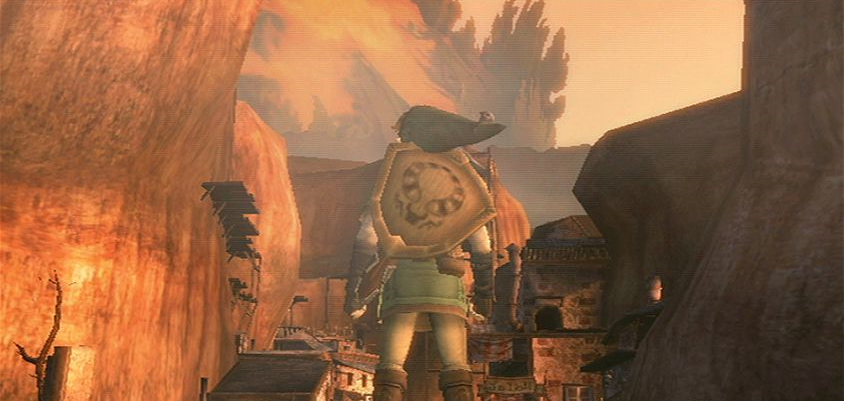
One thing that annoys me about the Zelda fan base is something that they like to condemn as untrue: the Zelda cycle. Well, it never fails to show up. When Twilight Princess came out, The Wind Waker was better. Now that Skyward Sword is out, Twilight Princess is now looked at more fondly. I'm of the camp that nearly every Legend of Zelda game is something special and worthy of most people's time. Twilight Princess is definitely one of those titles, featuring some of the best designed dungeons in Zelda history. The Wii version of the game offered motion control combat, albeit simple, and other touches such as sounds coming from the speaker of the Wii remote (sword slashes, the infamous chime when a puzzle is solved, Midna's laughter, etc.) and the ability to use certain items with much greater ease and precision than with an analog stick. It really does not matter which version of The Legend of Zelda: Twilight Princess you choose. You either get advanced camera control (GameCube) or better controls in general (Wii). Which ever version you choose, you are bound to be blown away by a masterful game. Some say the series is antiquated and in need of a massive shakeup; I say the series has never been better. 

Final Fantasy Crystal Chronicles: The Crystal Bearers


A Final Fantasy adventure exclusive to the Wii (and better than XIII, if I do say so myself), Final Fantasy Crystal Chronicles: The Crystal Bearers (take a deep breath after you say that long title) was an action-adventure game that starred a young male named Layle with telekinetic powers. Unlike typical Final Fantasy games, the action in The Crystal Bearers took place in real time. Through using his telekinetic powers, Layle could grab foes, throw them into others, as well as grab onto environmental objects. These different maneuvers could cause interesting interactions with enemies. Also, Layle did not gain experience or levels. He earned more health through eliminating all of the enemies in a given area of the world, and he gained strength through equipment such as monster drops. Regardless, battling was just one part of the experience. The story took players through mini-game like events such as performing a getaway on Chocobos while using Layle's powers to get rid of his pursuers, helping a friend out in winning a beach volleyball-esque game, finding children in a game of hide-and-seek, carefully avoiding detection aboard a locomotive, and piloting an airship through a tight canyon. The Crystal Bearers had its true longevity through challenges and achievements -- hundreds of them -- that players could try to complete. Dozens upon dozens of hours could be spent doing as many tasks as possible. Some critics argued that the game should have been more of an RPG than an action-adventure romp. If you can look past that a Final Fantasy game is more action-adventure than traditional Final Fantasy, then The Crystal Bearers is a fantastic addition to your library with a stunning presentation and soundtrack to match.

===

And there you go -- Fifty of the greatest Nintendo Wii titles! Did I leave off one of your favorites? Most likely I did. If you're not sure, check out one of the previous four parts of this special series of articles:

The 50 Best Nintendo Wii Games - Part One
The 50 Best Nintendo Wii Games - Part Two
The 50 Best Nintendo Wii Games - Part Three
The 50 Best Nintendo Wii Games - Part Four

Stay tuned in the coming weeks as I may have another "50 Best" five part article in store. It pertains to a certain portable on the market. Find out what it is soon!

Wednesday, December 7, 2011

QA Quandaries: How Nintendo Dropped the Ball This Gen

If you own a copy of the latest Legend of Zelda release, Skyward Sword, you are probably familiar with the game-breaking glitch that the title possesses late in the game. This is yet another glitch that stops dead the progress of players from Nintendo. What happened? When did the quality of Nintendo's QA drop so suddenly between generations?

The first glitch takes place in the infamous cannon room in The Legend of Zelda: Twilight Princess. The glitch occurs when players save their data in the room and then quit or reset the game. When Link wakes up, the cannon room attendant who was there before disappears. When players try to warp out of the room, Midna stops them stating that the room attendant is watching when he actually isn't. If Links attempts to walk out of the room, an invisible (see: glitched out) room attendant stops him, not letting Link out. If players come across this glitch and do not have an alternate save from an earlier point in the game, they have no choice but to restart the game from the beginning. This glitch only affects older copies of Twilight Princess as newer ones have the glitch fixed. Has this happened to you? I somehow avoided this as I felt no need to save my progress and quit inside the room.

Link might be a silent protagonist, but even he'd curse
if he had to start his journey all over again because of a glitch.

The next glitch, although not game-breaking, just game-crashing, happens in some PAL versins of Super Paper Mario. The glitch involves Mimi in Chapter 2-2 while the player is searching for Merlee inside her mansion. If one speaks to Mimi before retrieving the needed key and after entering the room with the falling spiked ceiling, the game will crash. The owner of their Wii will be forced to hold the power button on the console down for approximately five seconds to get things back to normal. Future editions of Super Paper Mario do not apparently have this glitch in it.

Returning from games crashing to games impeding one's progress permanently, Metroid: Other M has a game-breaking bug which halts the player's ability to advance. This occurs if players obtain the Ice Beam weapon, backtrack to the save room after destroying the "two-legged spiked enemy" in lieu of going to the next door and opening it. If players simply move forward after the fight, the glitch should not happen. Nintendo copped up to the bug, and gave players the option to send the SD cards to a Nintendo facility to have the problem fixed. It was an inconvenient solution to a botheration that should not have been there in the first place.

Forget the baby. The bug, the bug, the bug, the bug, etc.

The next game-breaking bug takes place within the realm of Skyloft in The Legend of Zelda: Skyward Sword. When players reach a plot-relevant three-way quest (the quest will be obvious to those who make it to this point of the game), if players talk to Golo the Goron twice without finishing the three parts of the quest, proceeding in the game will be impossible. Players will have to start the entire game from the beginning. There is no word on a fix to this obstacle such as sending one's SD card to Nintendo to have them remedy the situation. Nintendo themselves have owned up to this issue, but as said there is no solution other than restarting the game.

Just don't talk to Golo the Goron again, and you'll be fine.

The final and most recent glitch happens online in Mario Kart 7 on the Maka Wuhu track (the sunset-soaked Wuhu Island race). It happens if a player falls off the course in a certain section. The racer will then be dropped off by Lakitu way further ahead on the track. This exploit is something that is common with players who care more about winning than actually having fun and racing fair (see: people who snake). Hopefully, you have a decent community where players who pick Maka Wuhu won't exploit this unfortunate glitch.


The main problem with Nintendo's glitches is that they are not able to be patched like the HD platforms. As stated with Metroid: Other M, players who ran into the save room glitch either had to restart their data or send their SD card into Nintendo for them to fix. This makes QA exponentially important for Nintendo as they cannot just skimp out on testing and hope for the best. Even with hundreds of hours invested in QA, these aforementioned problems persist and exist. Some glitches can be fun to use, but the ones listed are completely hazardous.

Have you encountered any of the above glitches or glitches not mentioned in various Nintendo games? If so, let everyone know your horror stories via the comments section.

Sunday, September 13, 2009

Super Paper Mario (Wii) Review

This is another one of my earliest reviews as you can probably surmise by reading it. Super Paper Mario was one of the only games in the Best of the Best Wii story that did not have a review tied to it. Not anymore with this review of Super Paper Mario.

Paper-thin but thick with fun.


user posted image

What was once scheduled to be a Gamecube game during its development time is now what I consider to be the second killer app for the Wii, Super Paper Mario. Just because the game started in development on the Wii's predecessor does not make this game a Cube port as you'll discover through playing in this platformer with RPG elements.

user posted image
I now pronounce you Koopa and wife.

Super Paper Mario begins with the unlikeliest of scenarios-- Princess Peach and Bowser's wedding. Arranged by the crafty antagonist, Count Bleck, this union is said to cause worlds to be destroyed as foretold by the Dark Prognosticus, a book of undisclosed power. Without revealing too much, an unlikely hero comes to break up the marriage in the opening scene. Regardless, Mario treks off into a side-scrolling journey reminiscent of the old NES games.

user posted image
Sometimes all you need in life is a little perspective.

You hold the Wii remote sideways. The 2 button functions as your jump button, and the 1 button calls upon the help of your secondary Pixl. Pixls are fairy-like beings each granting Mario and company a power such as ground pounding, turning small, throwing enemies, dropping explosive bombs, and more. Finally, the coolest feature is accomplished by pressing the A button to shift the world from 2-D to 3-D. Can't get past a tall pipe? Flip the world to 3-D so you can walk around it easily. The largest enemy in 2-D can be unveiled to be paper-thin in 3-D. As you can guess this tactic of flipping dimensions is used a lot for puzzle-solving, progressing in the game, and obtaining hidden items. Pixls are also used to help out via bombing switches, ground pounding pillars, throwing a stone into a switch, and so on. Additionally to the Pixls to assist you, new characters will as well including the hovering parasol-packing Princess Peach and her "husband", the King of the Koopas, Bowser.

The game's flow is by chapter. There are usually four sub-chapters (1-1, 1-2, 1-3, 1-4) in each chapter culminating in a final boss battle for one of the legendary Pure Hearts. These aforementioned hearts are said to open new worlds as said by the Light Prognosticus, the hero's book of yore. The first chapter boss for instance, can only be defeated by flipping into 3-D, catching a ride on its back, and tossing enemies into its antennae. Each sub-chapter has Mario and friends going from various locales hopping, bopping, collecting coins, battling mini-bosses, and doing all of Mario's patented gameplay of 2-D faith ultimately towards heading to the goal block ending a sub-chapter.

user posted image
From 2-D to the 3-D.

I called this game a platformer with RPG elements because you'll be doing RPG-like actions such as managing your inventory, gaining experience, leveling up to increase hit points and your attack strength, wading through lots of text (some humorous and insightful and others just boring and pointless). You can collect cards of enemies to do double or triple damage to the enemy whose card you have acquired. These cards can be purchased in the hub town, found in various hidden areas in the sub-chapters, or taken directly from enemies using catch cards-- Pokeball-esque capture devices.

I very much prefer playing a platformer in the vein of an RPG instead of an RPG in the vein of a platformer as the previous Paper Mario games have been. The gameplay is refreshing and fun, there's sidequests to be had, various locales to (re)visit, and a vast majority of baddies to defeat. Few sub-chapters were tedious which involved the player to back-track, write down a bunch of numbers or directions for an asinine code, type the word "please" five different times to advance, and long text-driven sessions. The soundtrack is as generic and uninspired as Paper Mario: The Thousand-Year Door. There were few tunes I could hum too or enjoyed the melodies of (most of the music doesn't even have an identifiable melody).

user posted image
Hm... Yeah, that might be a problem.

Anyone though looking for a great platformer with very cool and clever 2-D to 3-D gameplay should definitely check out Super Paper Mario. It's what I consider to be the second killer app for the Wii, and the first killer app if you want something exclusive to the Wii.

[SuperPhillip Says]

Story: Guided by the Dark Prognosticus, Count Bleck wants to cause trouble by destroying various worlds. Mario and company to the rescue.

Graphics: Bright, colorful, and crisp. Sprites are excellent. 3-D worlds are a little bland though.

Gameplay: What you would expect from a Mario platformer. Simply brilliant.

Sound: The sound effects and occasional voices are nice. However, the music is quite generic and not easy to love.

Replay Value: From collecting all the cards to beating the Pit of 100 Trials, to finding all of the recipes and Pixls, there's a lot to do in this game.

[Overall: 8.5/10]