Showing posts with label platinum games. Show all posts

Monday, August 31, 2020

The Wonderful 101 Remastered (NSW, PS4, PC) Review

Concluding the month with a new review, The Wonderful Ones arrive once more on SuperPhillip Central as part of The Wonderful 101 Remastered, available on Nintendo Switch, PlayStation 4, and PC. Check out SPC's review of the original Wii U version right here, and then get ready to see how this remaster holds up by comparison.

Diplomacy has failed, but fortunately, this remaster has not.


The original Wonderful 101 came and went on the Wii U with small fanfare and even smaller commercial success. Now, a console generation later, and thanks to Nintendo relinquishing the publishing rights and the original developer Platinum Games taking on the self-publishing duties themselves thanks to a successful Kickstarter campaign, The Wonderful 101 arrives on new platforms. These platforms include Nintendo's current Switch, but also the PlayStation 4 and PC this time around. With new features and the same old gameplay that the 100 people who played and enjoyed the original Wii U version loved, The Wonderful 101 returns with a vengeance.

When times are at their toughest and Earth is on the brink from some kind of crisis, 100 fabled warriors will unite to take it on together. They are the Wonderful 100, and the story begins with an alien army named GEATHJERK starting to lay siege to Blossom City, home to Mr. Wedgewood--nay, Wonder Red, protector of justice and leader of the Wonderful 100! Amidst the chaos of the alien invasion, Mr. Wedgewood transforms into Wonder Red, and thus the stage is set for Earth's mighty stand against GEATHJERK.

The Won-stoppable Wonderful 100 are here to save the day.
The Wonderful 101 takes players on a high octane thrill ride from beginning to end, with some turbulence along the way when it comes to certain sections. The stakes keep growing and get bigger and bigger with each of the operations, or missions, in the game. Considering that the end of the first or second operation would make for a fantastic final foray and fight for any other game, the fact that Platinum Games kept outdoing itself with these amazing to play and astounding to behold scenarios is something else. But, I'm getting ahead of myself in my excitement, as I am wont to do. While The Wonderful 101 is successful at raising the stakes, raising the action, and making for an impressive sight each and every time, the game doesn't always hit the mark from moment to moment gameplay.

The majority of The Wonderful 101's gameplay takes place with an isometric view of the action with a camera that follows along automatically, separate from the player's control. The only control that you can assume over the camera is zooming in and out, performed by holding down the shoulder buttons. Sometimes it's difficult to see threats this way, which can result and has resulted in cheap hits from faraway enemies in the larger battle areas of the game.

In the game you're controlling the leader with the rest of The Wonderful 100 following closely behind. Using the right analog stick allows you to utilize a mechanic called the Wonder Liner, used not just to interact with the environment, but also to draw symbols that transform your team into one of many forms. Wonder Red's Unite Hand can not only grab handles and other objects in order to interact with them, but inside battle, he can punch foes into oblivion. Meanwhile, Wonder Blue's Unite Sword brings out his trusty Valientum Blade, which can slice and dice foes of all shapes and sizes, as well as serve as a key to unlock specific doors and crates. Each of the main cast members of The Wonderful 100 are able to perform their own Unite Form, allowing players to solve puzzles and take out enemies, many of whom have different weaknesses to different forms. Not all Wonderful Ones arrive on time to the alien invasion (SO unprofessional, by the way), so new Unite Forms unlock as you progress through the game. Thus, you're not overwhelmed with an immense number of Unite Forms to remember all at once that are thrown at you.

The Wonderful Ones unite up to form many weapons, such as this Unite Punch under Wonder Red's leadership.
Though, this leads to my first issue that is specific to this remaster of the game. Drawing shapes with the right analog stick isn't anywhere near as precise as the Wii U version's ability to use that system's touch screen to draw them. There are certain points that occur quite often in missions where you need to draw a shape quickly to become a specific Unite Form in time or risk taking damage and having to retry the short sequence. For things like Unite Hand, which is just drawing a circle, or Unite Sword, which is just a straight line, it's easy enough, but when you get to more complicated shapes like the club-like Unite Hammer and Unite Bomb, it can be mighty frustrating. This is especially so if you're aiming to get the best rank in missions.

Speaking of which, playing like a typical Platinum Games title, players are thrust between missions in levels that are graded based on their performance. In The Wonderful 101, it's based on three criteria: time--how quickly you complete the mission, combo--how high your combo meter gets in a given mission, and damage--how much or (preferably) how little damage you take in a mission. The highest rank is a Pure Platinum, and no doubt you can imagine that going for all Pure Platinums in a level is an imposing challenge. Try doing that on all levels on all five difficulties, and you'll definitely see a lot of longevity and replay value, but you'll also see the cracks in The Wonderful 101's superhero armor.

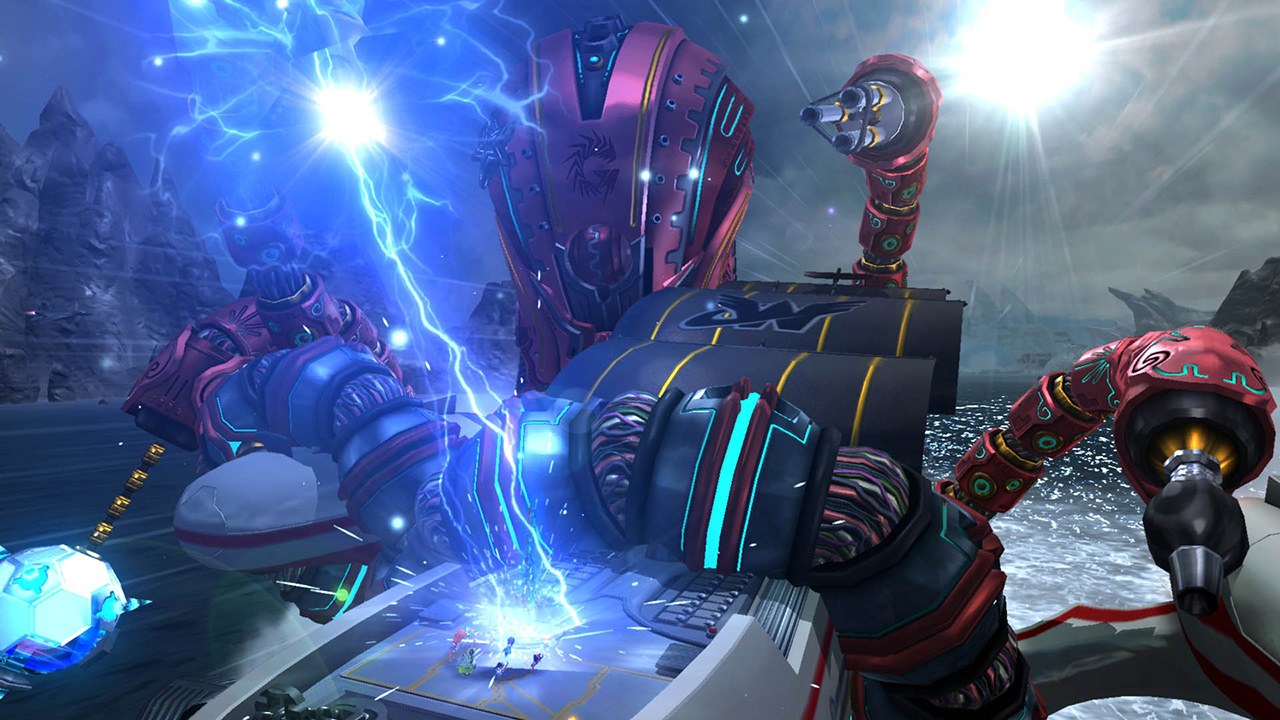
Each operation ends with a super-climactic boss battle,
and somehow the showdowns and stakes only get crazier and crazier.
Generally, The Wonderful 101 plays well as an action game. Battles are intense, require quick thinking and reflexes, and you can't just button mash your way to victory--at least without feeling a lot of pain. However, when the game tries to do too much and overextend itself outside of the tried and true signature style gameplay it creates, things get messy. Genre shifts are no stranger to Hideki Kamiya-directed games, but in The Wonderful 101, they're just obnoxious. Between on-rails shoot-em-ups, isometric shooters, Punch Out!!-inspired boss battles, among other sequences that don't adhere to what the game is good at doing, it's a shock to the system, and an unwelcome one at that. I get the need to add some variety to the game, but these moments are so out of place and some just outwear any welcome they might have had, that I can't help but hate most of them. A certain underwater shooting section really tested my patience, and if I was one to go for Pure Platinums, it would have made me call an end to that idea right away.

Variety may be the spice of life, but it is more the spice of frustration in The Wonderful 101 Remastered.
When you're in between missions in The Wonderful 101, you're doing a lot of puzzle solving as well as exploration. For the latter, there's plenty to discover, such as extra Wonderful Ones to lasso up with a Wonder Liner to have them join your team, hidden collectibles like figurines, and Wonderful 100 and GEATHJERK files respectively. The puzzles in The Wonderful 101 also add some variety to the game, and these are more welcome than the countless shoot-em-ups and whatnot that would drive prospective Pure Platinum run-goers mad.

The Wii U version of The Wonderful 101 had sections in the game which demanded the use of both the TV screen and the controller screen of the Wii U GamePad. It was one of the more novel uses of the Wii U GamePad, a device that even Nintendo had trouble finding a worthwhile reason for it to exist. Regardless, in The Wonderful 101 Remastered, since there's obviously no way to play on two separate tangible screens at the same time, the developers opted to put both screens on the TV at once. Pressing the Minus button the Nintendo Switch version brings up the second screen (or the old Wii U GamePad version of the screen) at any time in the game, and it places it on the bottom right quadrant of the screen. There, puzzles and sections of the game which required both to be used can be done without too much issue. For instance, there is a poison-filled maze in one mission where you must use the second screen to get a grounds-view of the maze while the TV screen shows it in a less-than-helpful isometric overhead view.

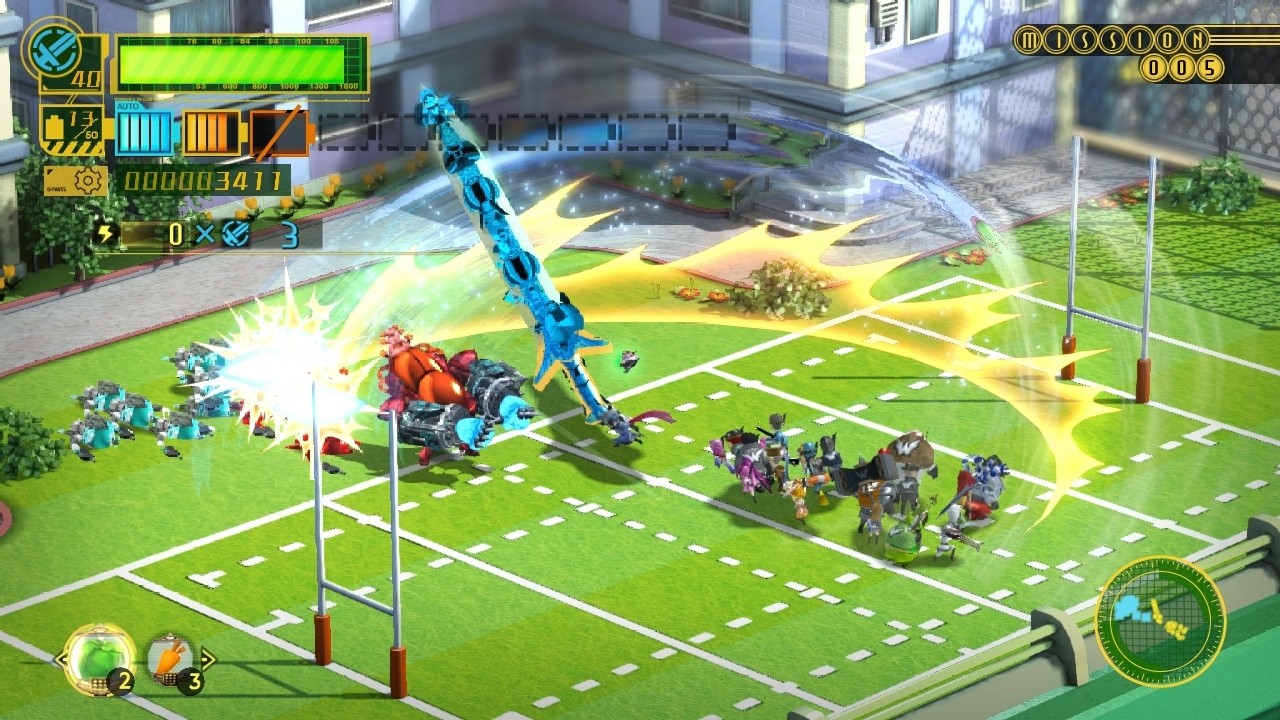
I'm pretty sure bringing out a giant sword is against rugby rules,
but it's 2020 so who the **** knows what's legal anymore.
This time around through The Wonderful 101 with this remastered version, I more carefully inched through levels, looking for hidden goodies throughout levels, and I found myself coming to two conclusions: 1) A lot of the secrets in the game are hidden really well, and 2) This makes the already lengthy levels even longer and more agonizing to play through, especially with no ability to save when you're already in a level. No, once you start a level, you better commit yourself fully to it, no matter how long it takes--and sometimes, it can take quite a while!

The Wonderful 101 Remastered hardly seems like an upgrade from the original Wii U version, at least on the Nintendo Switch version of the game. Then again, I guess calling the game "The Wonderful 101 Ported" wouldn't have the same level of gravitas to it, despite being more accurate. Still, the game looks and run as well as it did on the Wii U, popping with color, impressive effects, maintaining a mostly steady frame-rate despite all of the characters and action on screen at once, and other dazzling displays that take place throughout the 15-hour campaign.

Battles have all the spectacle you've come to expect from the action game masters at Platinum Games.
More than anything else, The Wonderful 101 Remastered is a second chance for Platinum Games' oft overlooked "mass hero" action game to gain an audience. Whether it deserves one is in the eye of the beholder, but for me, even with all of the obnoxious and borderline rage quit-inducing moments that the game supplied me with, a replay on my Nintendo Switch version saw me happy to revisit The Wonderful 100 and save the universe from GEATHJERK once more. It's certainly nowhere near the most accessible and beginner-friendly game out there, but give the game a chance (and a FAQ a look) and you might discover a game that surpasses your expectations. Just don't be surprised if your frustration becomes as big as many of the spectacles, scenarios and showdowns The Wonderful 101 Remastered has to offer!

[SPC Says: B-]

Tuesday, June 28, 2016

Teenage Mutant Ninja Turtles: Mutants in Manhattan (PS4, XB1, PS3, 360) Review

Welcome to the last week of June here at SuperPhillip Central. What's planned is a variety of reviews to send this month off in style. This next review is for a game in one of my favorite comic book properties. It's Teenage Mutant Ninja Turtles: Mutants in Manhattan. The Teenage Mutant Ninja Turtles and Platinum Games-- what could go wrong?

A shell of a time or a shell of a headache? 


The Teenage Mutant Ninja Turtles as a video game series was at its highest point in the early '90s where Konami developed a slew of well received and well regarded games. Since then, however, good Turtles games have been few and far in-between. Now, it seems that the Turtles are in good hands with a good developer, Platinum Games, masters of character action combat games. Nonetheless, with the developer's known quality, it makes it even harder to have to say that the latest game starring the heroes in a half shell, Teenage Mutant Ninja Turtles: Mutants in Manhattan, is more of a dud than what fans would expect of Platinum Games.

Right away, however, Mutants in Manhattan gave me what I wanted story-wise. It had the Ninja Turtles interacting with one another with funny quips and humorous one-liners. It had them investigating why Shredder's Foot Clan and Krang have teamed up to commit crimes all across the city, and it all culminates in an epic showdown. It feels like an adventure from the comics, and the scenes that bookend each level are well done and enjoyable to watch.

The cel-shaded art style of Mutants in Manhattan shows great detail, making it feel like you're playing an interactive comic book. Environments look nice enough as well. However, one part of the presentation package that doesn't work so well is the frame-rate, which can dip to low numbers in especially-packed-with-enemies-and-objects areas. Meanwhile, the music plays well with the game, though I couldn't hum you any song from it. It's mostly generic rock noise.

Brothers in arms and in half shells, ready to stop Shredder and Krang.
While the overall presentation of Mutants in Manhattan is serviceable, other parts of the game don't work out so well. Combat is usually one of Platinum's strong suits. In Mutants in Manhattan, however, it's a mixed bag. For one, you have usually four Turtles at once participating in battle against Foot Soldiers, Stone Soldiers, and Krang UFOs, and this can be very messy to look at. It can be hard to follow what's going on the screen at once, especially when all of four Turtles are engaging in kicking some enemy butt. The flashy visuals distract, and it can sometimes make it where seeing an enemy's prompt before they're about to attack somewhat difficult.

Battling with foes, you have a strong attack and weak attack to use. You also have four Ninjitsu abilities that are more powerful moves, but they require a cool-down period to use once again after they've already been used. Ninjitsu abilities can be mixed and matched between Turtles through the loadout screen from the menu in between levels. You'll want to have good Ninjitsu skills equipped, as even with these moves unleashed on foes, many enemies take WAY too long to defeat.

Just a typical Tuesday night in Manhattan, four bipedal Turtles taking on sword-wielding ninjas.
In addition to offensive abilities, the Turtles have ample defensive maneuvers to dodge and evade enemy advances. The back right shoulder button is used to guard. If timed correctly, your turtle can slip around the back of a foe and hop on their back, leaving the foe defensive while you pummel away at its head. The timing here is a bit tricky, and again, the craziness of battle with everything going on makes the timing hard to ascertain exactly. Using the guard button is a great way to avoid attacks, but using it too much causes a gauge to empty. As a turtle guards, it spins in his shell. Spin too much in too little of a time span, and your turtle ends up being vulnerable as it enters a dazed funk.

They may not be horses, but Michelangelo and Leonardo can still ride these enemies like cowboys-- er, cow-turtles!
When a turtle loses all of his health, they wind up hiding in their shells, requiring another turtle to revive them, or else they get sent to a pizza room where they must gobble up pizza to restore enough health to be sent back to battle. If all four Turtles end up in the pizza room, it's either time to use a continue or it's game over. The game difficulty selected means that on harder difficulties the time to revive a turtle before they return to the lair is shortened severely. Easy mode gives you ten seconds to revive a turtle while very hard only gives you three seconds.

These Stone Soldier enemy types are annoying due to how much health they have, a common problem in this game.
Items are found in Mutants in Manhattan all over the levels. You usually earn them from green orbs sprinkled around levels, as well as occasionally from fallen foes. Entering a manhole in a given level takes you to Splinter, where he offers various items for a price, specifically battle points earned from fighting enemies and completing missions. Most offensive items are completely throwaway in comparison to just normally attacking an enemy, and it's disappointing to see that. Meanwhile, you can stock up on pizzas that refill health when necessary.

Mutants in Manhattan also falters in its length. The game has but a small nine levels, and at least two of them are too long for their own good, as if Platinum Games realized its game was too short and needed to pad its length, and tediously so. These occur in the sewers. Sadly, even Platinum Games can't make trekking through the same similarly designed corridors without much level variance fun. Fancy that.

Most levels' structure have you getting calls from April O'Neil to check out various disturbances in the general area. By using a Batman: Arkham-like T-Vision to scan the area of enemies and objectives, you can easily find where these disturbances are. When you arrive at the location, you initiate a mission. These can vary from level to level, and they're random which ones you get (which for trophies that require you to do a certain mission a specific number of times, this results in TONS of grinding for the hopes of the RNG being kind to you). Missions can require you to protect three ATMs from being assaulted and robbed by Foot Soldiers, to team up with a second turtle to bring a Krang bomb to a designated location, or to deactivate several time bombs in the general vicinity.

After completing a set number of randomly assigned missions, the area where the boss of the level is hanging out at is unlocked. Boss battles are some of the most fun combat scenarios in Mutants in Manhattan, having the Turtles take on familiar foes like Bebop, Rocksteady, Slash, Karai, Krang, and yes, the nefarious rival of the Turtles, The Shredder. The harder the difficulty selected, the more life bars a boss has. Additionally and occasionally, a second boss can join a fight midway, making it so you have two targets to take down instead of just one.

Even with four Turtles fighting against one, that still might not be enough to take down Rocksteady.
As stated already, Mutants in Manhattan isn't a long game with its nine relatively short levels. However, if you frequent online, you can enjoy multiplayer with up to three other people, either in your own lobby or joining another's game. This makes for a more fun experience if you can get players to mesh well with one another, as the Turtle AI in single player isn't the brightest. It's just a shame that offline you can't play cooperatively with a local player in split-screen, something that past Turtles games are almost synonymous with.

Teenage Mutant Ninja Turtles: Mutants in Manhattan is an okay entry in a video game series that once was always a sure thing regarding its quality. However, with a developer known for its excellent work behind many of its games, just "okay" doesn't seem good enough here. In fact, it's quite disappointing. With combat that can be hard to follow, repetitive gameplay, a short campaign, and little to do outside of grinding for trophies, Mutants in Manhattan isn't the shell of a time I was hoping for.

Bummer, dudes.

[SPC Says: C-]

Saturday, April 30, 2016

Star Fox Zero (Wii U) Review

Time for the final review of April before we say goodbye to the month that was. Star Fox Zero is the subject of tonight's review, and it has gotten quite the differing of opinions. Let's see where I stand with the game with this special, in-depth review!

I was feeling it had been a while since someone told me to do a barrel roll...


One of my favorite lesser celebrated Nintendo franchises in the company's exhaustive lineup of IP is Star Fox. While it took me, like many, to fall in love with the series with Star Fox 64, I have since grown a fond appreciation of Fox McCloud and his furry friends. Whether performing barrel rolls to deflect enemy shots or tailing Star Wolf in an intense dogfight, Star Fox has given me many memorable moments of exhilarating gameplay.

Now, after many entries that have been passed off to outside developers, Star Fox is home with Nintendo, though not without the help of Platinum Games. It's no secret that the reception of the newest entry on Wii U, Star Fox Zero, is mixed at best with the greatest point of contention being the controls. Now, after spending over a dozen hours in Arwings, Walkers, Landmasters, and Gyrowings, how does Fox McCloud and crew soar the Lylat System's dimensions in my point of view?

Star Fox Zero is essentially a reboot of the Star Fox franchise. It's a retelling of Star Fox 64's story with some different story beats here and there, such as the use of teleporters and portals as a main theme with the game. Some of the lines of dialogue are the exact same or slightly edited versions from what was said in Star Fox 64. The ending of the game is basically a rehash of the Nintendo 64 classic as well with some mild variations. Still, overall, the story and especially the content of Star Fox Zero is new enough to not feel like you're having a strong case of déjà vu.

Oh, Slippy. Even 19 years later you're still getting yourself in to trouble.
The dialogue itself isn't nearly as corny as Star Fox 64 with much more impressive performances. That doesn't mean it isn't as memorable, though that's probably the case, as we've all had nearly 20 years of play-throughs of Star Fox 64 to memorize every line uttered. The only big issue I have with Star Fox Zero's dialogue is how much it can be repeated even in the span of one level. Some variety would have sufficed for me.

The main draws of Star Fox Zero after beating the 3-4 hour initial campaign have you returning to past levels to find alternate paths to new missions, gunning for high scores on each mission, and acquiring all of the game's 70 medals. What was then a 3 or 4 hour experience can easily triple and quadruple your overall time with the game. Thus, if you're just in to beat the game and then shelve it, Star Fox Zero is hard to recommend at its full price, but then I would imagine that most people who buy games pretty much want to get their money's worth. Thus, it makes sense to me that most players of Star Fox Zero would want to try to see everything the game has to offer.

Interested? You didn't even have to ask!
When you first start Star Fox Zero and play through the campaign, you are just going through a linear series of planets and areas for the most part, save for an opportunity to either go to planet Fortuna or the desert plant of Titania based on whether you can shoot down a certain enemy within a certain amount of time. Star Fox Zero doesn't have the same structure as Star Fox 64. You don't go through seven planets or areas with chances for multiple branching paths depending on what you do. Instead, each completed mission sends you back to the Lylat System map, allowing you to either play the next stage or return to a previously beaten level to go for a high score, find an alternate path, or collect medals, five of which are in each main stage with side levels having but one or two.

The alternate paths usually come in the form of portals that are found through different means. For instance, Corneria, the first planet and level of Star Fox Zero, has you running through it normally the first go around. Once your Arwing is given the ability to transform at will into the bipedal Walker form, you can hit a ground switch during the on-rails section of Corneria, opening a locked gate that leads to a portal, which, in turn, leads to an alternate level. This portal takes you to, and the alternate levels itself is an encounter with a sea-bearing mothership known as Aquarosa, which is a steeper challenge than just going the ordinary path in Corneria. Each alternate path that you can find usually requires you to replay a level, using a method that wasn't available to you the first go around, such as locking onto an attacking Star Wolf member ship to be transported to a level where all you do is duel them one-on-one, or in one case, one-on-two.

Aquarosa is one example of a boss that uses the two screen setup to brilliant effect.
There are 70 medals total to collect in Star Fox Zero, and this is the main way of extending the longevity of the game by the developers. You're rewarded new unlockables for reaching certain medal milestones, such as new training mode challenges or the ability to play as amiibo-unlockables without the use of amiibos.

For the standard stages with five medals, medals can be hidden in precarious locations, they can appear by performing a certain task like collecting three specially marked gold rings, they can be earned by completing a level with a "Mission Accomplished" message as opposed to a "Mission Complete" message, or you can claim one by beating a level's high score. A "Mission Accomplished" message is earned by completing a mission by performing a hard task that you wouldn't otherwise need to do to complete said mission. For example, Sector Gamma generally requires you to shoot down all three missiles in the level while keeping the Great Fox healthy. To get the "Mission Accomplished" message, you need to make sure no enemy drones attach themselves to the Great Fox. Not an easy task when you have to worry about impending missiles encroaching into unwanted territory.

I know you're blowing up and all, but inside voices, please!
The levels themselves usually have multiple phases to them, each containing their own high score tallies. The totals of each phase are added up, a bonus is included based on each Star Fox member wingman's health, and that final tally is what you score for that level. Corneria starts off as a traditional on-rails affair, but as you reach the second phase, the level turns into an all-range mode, a 360 degree arena-style mission. Here, you are tasked with destroying any 10 enemies to make the enemy run away. Once that has been completed, mechanical enemy spiders start exiting from containers on the ground, lurching closer and closer to a tower where an important NPC stands. Destroying all of the spiders in time will open up the final phase, a boss battle with the enemy mothership.

There is a great variety of mission types and scenarios in Star Fox Zero. They'll have you piloting the Arwing in both on-rails and all-range mode sequences, as well as transforming into the Walker variant form of the Arwing, moving through narrow chambers and passageways, while occasionally being able to hover. Then there's the Landmaster from Star Fox 64, which this time can transform into a flying variant for a limited amount of time (i.e. as long as the boost bar has juice in it). Also, this time, the Landmaster is used in all-range mode in two instances. Finally, the Gyrowing, which is a much slower vehicle, used for more methodical levels, can move up and down with ease, and can even extend a helper robot out from its bottom that can hack specific terminals.

The generally fast pace of Star Fox Zero slows down with these more methodical Gyrowing segments.
Now, let's get to the most pressing matter of Star Fox Zero, a sort of important thing to consider in a game, the controls. There are a lot of vehicles to learn how to control in recent Star Fox games, and Star Fox Zero complicates things by throwing in support for two screens, the TV screen and that of the Wii U GamePad. This can really put off some players who find it hard to concentrate on two screens at once. However, for the most part, focusing on both screens at once isn't necessary except for dog-fights, and in these sections of the game, I find it hard to want to go back to Star Fox 64 after using this new dual screen setup.

However, I'm doing what I usually do, getting ahead myself. Let me focus on these different vehicles one at a time. For the most part, with my experience with motion controls and gyro aiming with various Wii U, Wii, 3DS, and even some PlayStation Vita games, I took to the control scheme of Star Fox Zero like a fox to an Arwing. The on-rails sections in Star Fox Zero take care of an issue I've had with prior Star Fox games. In those games, the targeting recticle is dependent on where your Arwing's nose is pointing. Thus, if you have to dodge an enemy or enemy attack by moving to the right side of the screen while a batch of enemies were on the left, you pretty much forfeited those points because you couldn't aim at them. You were on the wrong side of the screen to take them out. This problem is remedied in Star Fox Zero, allowing you to be on one side of the screen while using the GamePad to aim the recticle at the other side of the screen. You're not stuck aiming at where you're looking, which is a tremendous upgrade in my opinion.

Some gameplay sections lock you onto a target, and you must use both screens to properly maneuver yourself.
When all-range mode comes into play, it's absolutely fantastic to be able to be flying one way, and be able to turn the GamePad to look to the left or right. So, when you're flying one way and say, a member of Star Wolf passes by you, you can be aiming and shooting in a completely different direction than where you're looking. This is paramount for flying beside an enemy to dodge their attacks while using the GamePad to look to the side to shoot their weak point. I understand that this kind of control setup isn't for everyone, and it's difficult to learn, especially if you've been using dual analog all your life, but it really works and works well once you get accustomed to the controls. Some will find it easier than others (such as myself), and some might not ever get them down. It's here I wish Nintendo would have provided a demo for those on the fence to test out the controls without investing several dozens of dollars to get that chance.

The Walker gave me some problems initially, but that was until I realized I could hold the ZL button to lock onto a direction and strafe with the left analog stick. This made dodging attacks while unleashing my own form of offense incredibly easy. It's also excellent to use the GamePad screen to aim better (thanks to the zoomed in view and bigger targeting recticle) to take out foes more quickly.

The Walker was probably the vehicle form that took me the longest to learn, but oh, boy, once I learned how!
The other vehicles pretty much follow the same control scheme and strategies for mastering them. I will say that the ability to recenter and recalibrate the target recticle is a godsend. When I felt my aiming was off, or I was holding the GamePad like a contortionist just to center the recticle, I could press the Y button in a comfortable position to restore the recticle to much more manageable location. However, this needed to be done a lot in levels, so please keep that in mind if you're experiencing trouble.

There's snow way out for this enemy bioweapon. Time to put it on ice. (Are my jokes leaving you out in the cold?)
Star Fox Zero doesn't pretend that you will take to the controls easily, so the first thing you get when you boot up the game for the very first time is a tutorial of how to fly your Arwing. Things like barrel rolls (Peppy's favorite, especially in one super special secret mission), somersaults, and U-turns are taught. However, it's rather confusing why the game instructs you to use both analog sticks to do the last two when X and B do the same thing and are much simpler to use. You also get a taste of all-range mode at the end as well. The training mode also houses control explanations and trials for the Walker, Landmaster, and Gyrowing as well, so it's a good idea to tackle those before you try your hand at the main campaign.

Star Fox Zero isn't the most visually stunning game on the Wii U. This is mostly to do with the fact that the game has two screens running at 60 FPS at the same time, the TV screen and the GamePad screen. That said, there is a highly clean look to Star Fox Zero's visuals, offering pleasant environments, detailed models of ships both friendly and enemy, and usually a lot of enemy aircraft on screen at once. The frame-rate rarely dips, but it does on occasion.

Missile destroyed. Now there are just two more to take down.
Meanwhile, the dialogue is well acted, while the music presents to players numerous remixes of classic Star Fox themes, including an incredible Latin choir popping up in Star Wolf's theme, and a wide variety of all-new tunes as well. It's a combination of symphonic and synthesized music, but pretty much all of it is a pleasure to listen to.

If the idea of motion controls or using two screens to play a Star Fox game doesn't sound appealing to you, you probably have already written off Star Fox Zero, whether justly or not. For everyone else, you will find a control scheme and setup that will take some getting accustomed to, but when you finally master it, you'll most likely enjoy yourself. For me, I struggled greatly with the final boss at first, but now I can beat him without breaking a sweat. I have found it somewhat difficult to return to Star Fox 64 and other entries because I keep wanting to aim independent of where my ship is looking. Not to say it's impossible; it's just different, though one might argue inferior.

Though you might complete the campaign in but a few hours, the replay value from getting high scores, finding all alternate paths in the game, and acquiring all medals makes for a tripled or quadrupled play time. Those who just desire an experience from the beginning to the roll of the credits will not find Star Fox Zero worth purchasing. Heck, just one run might not give you enough time to fully digest the controls depending your skill level with alternative control styles. Regardless, after many years of sequels that didn't quite live up to Star Fox 64, I feel Star Fox Zero really does live up to that game's legacy. It's not better, but it's not far from it, either.

[SPC Says: B+]

Thursday, January 28, 2016

Transformers: Devastation (PS4, XONE, PS3, 360) Review

Transformers: robots in disguise. It's one of Hasbro's most prominent franchises, and it has seen multiple iterations, including the recent Michael Bay helmed blockbusters. But now, Transformers goes back to its roots with this partnership between Activision and Platinum Games. It's Transformers: Devastation, and here's the SuperPhillip Central review.

Holy Cybertron, this game is good!


I've never been a huge follower of the Transformers franchise (seriously, my only fandom of the franchise growing up was the CG Beast Wars cartoon and its collection of figures), and it over the years went in a direction I didn't care for in the mainstream, a Michael Bay, grim, dark, edgy spectacle starring Shia Lebeouf. Really, the only word in that description that appeals to me is "spectacle". However, now, Activision and Platinum Games are once again working together to not only make another licensed action game (the first was The Legend of Korra), but they're using the version of the Transformers that is much more appealing to me, the cartoon version.

Platinum Games has one heck of an impressive resume under its collective belt. They've made creative character action games like Bayonetta and Metal Gear Rising: Revengeance. They've also went for a different route with The Wonderful 101, Vanquish, MadWorld, and Anarchy Reigns. In total, it's an amazing collection of titles developed by the studio. Platinum Games' latest is Transformers: Devastation, and as an outsider to the Transformer franchise, I am impressed, so I can only imagine how exciting this game should be for longtime fans.

Time to deconstruct this giant!
Transformers: Devastation fits right in with Platinum Games' development philosophy and general structure of its games. For one, each of the seven chapters of the game is split up between multiple missions. Doing well in these missions (i.e. earning enough points through dispatching enemies in a speedy enough amount of time) gives you a certain ranking, with SS being the best.

There's a great level of skill involved generally in Platinum Games' titles, and this is a continued trend in Transformers: Devastation. You can't just button mash your way through the game's battles and expect positive results. No, between your onslaughts of weak attacks and strong attacks on enemies, you'll need to do a lot of dodging and evading when a foe winds up its own brand of attack. Here, Bayonetta's Witch Time mechanic fits in well with the Transformers universe. A well timed evasion will slow time down to a crawl for everything except your Autobot of choice. It's at this point that you can get in some nice attacks to knock down an enemy's health bar.

Optimus Prime merely wants to axe these enemies a question.
Transformers: Devastation has other mechanics, too, to make for an exciting action game. As in the series, your Autobot can transform into a vehicle at will, quickly transitioning between Autobot and vehicle immediately. Attacking a foe enough with allow you to perform a vehicle attack, turning from your Autobot form into its vehicle form and then slamming into your enemy. You can also speed towards an enemy while in vehicle form and pop up into your Autobot form to perform a rush attack, great for taking out foes with shields or just to take down more health from an enemy than usual. The combat of Devastation has enough variety and challenge that all of the battling you'll be doing against the hordes of Decepticons never feels tedious or tiring.

Insecticon? Kill it with fire!
Outside of melee attacks, each Autobot comes equipped with ranged weapon possibilities. Whether it's a twin blaster or a sniper rifle for faraway targets, you're never without some formidable weaponry. This is because throughout Devastation, you can gain nice loot in the form of beneficial items and weapons from fallen foes, completing in-game challenges initialized by walking into specific portals, and from treasure chests strewn about the game's levels. The harder the difficulty you're playing, the better the rarity and rank of the weapons you earn.

While most of the action in Transformers: Devastation takes place in traditional combat form, there are parts of the game that completely change the rules of how the game is played. This is something that Platinum Games likes to do, such as Bayonetta's flying or bike sections or The Wonderful 101's Punch-Out!! inspired robot battles. It's the same with Transformers, and like those two aforementioned games, these sections do offer gameplay variety, they aren't to the quality of the other gameplay experiences found in the game. I'm talking about things like a side-scrolling chase on a bridge as well as an overhead section where you need to transport explosive Energon to specific part of a level.

Choose from one of five Autobots to play as in Devastation's relatively short campaign.
Transformers: Devastation isn't a long game by any stretch of the imagination. To complete its seven chapters will take most players upwards of six hours. As stated, there are multiple difficulties to choose from, where enemies will attack for more damage on higher difficulties. You also have a choice of playing through the game as each of the five Autobots, with each completed playthrough unlocking an achievement or trophy. There is also a host of collectibles to be found in the form of Decepticon flags and spy drones, logs, and little red jumping gnat-like creatures to collect. If that's not enough, there are fifty challenges outside of the story mode to complete; various battle scenarios that pit you against a selection of enemies. Despite its appearance of being a short game, you can see that there is plenty to accomplish in Transformers: Devastation.

Depending on your skill level, your score can give you anywhere between a D and an SS rank.
Staying true to its cartoon roots, Transformers: Devastation looks immaculate with its beautiful cel-shaded characters and colorful world. Staying true to its developer roots, Platinum Games has managed to create a game with a frame-rate that is as smooth as fine glass. Devastation successfully emulates the essence of the cartoon, making the whole experience feel like an episode from the show itself. High praise indeed. Meanwhile, the voice actors of the series have come back to reprise their roles, making for an even more authentic Transformers experience. And if you like rock, you'll also like the soundtrack of the game, particularly the ultra cheese (and in a good way) of the ending credits theme.

What you get with all of this is something that will truly excite Transformers fans, especially those who have felt jilted by the grittier direction the Hollywood movies went. This is pure Transformers goodness in all of its lighter-hearted cartoon glory. The gameplay is up to the usual excellent standard of Platinum Games, and the amount of time you can spend with the game makes it worth a look for either fans of Transformers, fans of Platinum Games, fans of action games, or fans of robots, vehicles, and/or robots that transform into vehicles.

[SPC Says: B]

Saturday, July 25, 2015

Bayonetta (Wii U) Review

As I stated on my Twitter, I have a second review for this fine Saturday. Quite out of the ordinary to have one review on a Saturday, much more two! Regardless, this second review is for a game I finally got the chance to play through on the Wii U after getting it late last year. It's Bayonetta. Is the Wii U version definitely definitive?

Fun in almost every witch way.


Reviewing a game that didn't release that long ago is always a bit challenging, as the experience is somewhat fresh in your mind so you somewhat know what to expect. However, the Wii U version of Bayonetta takes what players know of the original game and adds some stuff in both presentation and content to make for a game that is truly worthy of replaying.

An Umbran witch, Bayonetta awakens from a 500-year rest inside a coffin. Her memory is a bit fuzzy as to the events leading up to being placed inside her home of 500 years, and she's understandably wanting to make some sense of what happened. Along the way she heads to the European town of Vigrid, where her role in the future of the world will take shape.

Bayonetta isn't the clearest story out there. There are many times where I scratched my head at what discussions taking place were even about, and what a particular scene's relevance even was, other than identifying Bayonetta as someone who appears to be along for the ride. However, while the plot isn't crystal clear, the general idea of what was going on was in the back of mind as I played through the game. Even then, the story is just an excuse to pull off kickass battle maneuvers in some intense combat scenarios.

Our fair witch Bayonetta has a wide repertoire of killer moves to take down the angelic horde that is after her. The combat system is simple enough to learn, owing a lot to the already accessible Devil May Cry, another of director Hideki Kamiya's projects, but tough to master. Pardon that cliche there. With a combination of timed presses of the X and A buttons Bayonetta can cycle through punches and kicks. To maintain combos and attack foes from far away, she can let loose with her various guns, and with every attack, she's stylish as can be.

"Don't mind me, boys. I'm just getting some exercise in."
Loving to dish out pain, Bayonetta has some finishing moves that take the form of torture-style attacks. From putting a foe inside a giant guillotine to a massive vice, Bayonetta seems to have taken some pointers from the Saw series of movies. While those are always hard to watch in their cruel brutality, the finishing moves in Bayonetta take the shape of almost comical violence instead, easier on the eyes. Your mind, body, and soul will most definitely not need a shower after playing Bayonetta.

Ooh. This one is definitely going to hurt!
Of course, a witch's offense is only as good as her defense. This is where the mechanic of Witch Time comes in, initiated upon a last-second dodge from an enemy attack. When done correctly, the action will slow to a crawl, save for Bayonetta, who can unleash a flurry of attacks to deal massive amounts of damage to enemies during this time.

Bayonetta likes to fight for kicks.
Bayonetta is divided between chapters, and these are divided up more so between verses. Each verse grades your performance a la Viewtiful Joe (surprise, surprise, another Kamiya work) on how much of a combo you obtained, whether or not you took damage, and how much time the verse took you to complete. You are judged with a medal based on your efforts and ability, with a dull metal being the worst you can do, and a pure platinum being the absolute best.

This panther transformation allows Bayonetta
to dart fast through levels.
Going for pure platinum on every verse in the game, some are hidden from the normal path, by the way, is one of the most challenging things a gamer can try to accomplish. It may even be a fool's errand, but it no doubt makes the already lengthy game of about 10-12 hours (playing on Normal, of course) all the more replay-able. There are also five difficulties in all with the first two, Very Easy and Easy, basically putting training wheels on the action. You can also utilize the Wii U Gamepad's touch screen more, swiping on the screen to unleash attacks and dodges if you so choose. The higher difficulties introduce different, usually harder enemy combinations earlier in the game than you'd otherwise see on easier difficulties, and obviously our favorite whimsical witch takes more damage from enemy attacks.

While the combat feels fast and fluid, making you feel like a total bad-ass ripping and roaring through the angelic and demonic masses, there can be some kinks in how Bayonetta presents itself as a game. There are multiple times where a pure platinum run can be lost because of a stray quick time event that comes out of nowhere. These are definitely unwelcome as they're rather rare, but they happen enough that you basically always have to keep on your guard when the huge spectacle of battle and of the cutscenes take place.

You can also pick up weapons like this to temporarily use during combat.
Furthermore, there are occasions in Bayonetta where the game takes you of the pure character action-driven gameplay into completely different scenarios that take a bit of learning to play well. I'm referring to sections like the motorcycle riding chapter of Highway 666, as well as a late-game ode to games like Space Harrier. These are also moments that can mess up a good ranking run due to not being overly familiar with the brand-new gameplay style implemented and then never used again.

Between chapters and at particular moments in levels, Bayonetta can enter into a bar known simply as The Gates of Hell. Here, with the halos, the currency of the game, dropped from enemies and earned through getting high ranks in battle, you can purchase everything from helpful items (though using them in battle will lower your overall grade) to new moves, to special costumes and weaponry. It makes playing through Bayonetta more than once a must (it's already a fun idea to begin with) to purchase everything the shopkeeper offers.

Alongside the pretty much throwaway optional touch controls to perform attacks and movement, Bayonetta on Wii U features a lovely exclusive to it in the form of Nintendo-themed outfits. In addition to unlockable costumes like dressing up like a nun or cheerleader, Bayonetta can cosplay as Princess Peach, Daisy, Metroid's Samus Aran or The Legend of Zelda's Link, each offering a special set of moves and visual variety to said moves. You get these Nintendo costumes right from get-go, making it so even if you've played Bayonetta to death on the PlayStation 3 (so sorry for your suffering) or the Xbox 360, there is something new to make your latest play-through well worth it.

There's no worries of any babies marring the
 experience with the Samus Aran costume.
Bayonetta runs on Wii U rather well. It's no surprise that it beats out the abomination that was the PlayStation 3 version, but it also beats out the Xbox 360 in some aspects and others not. The frame-rate can vary oftentimes, but it never truly harmed my experience with the game. Textures also aren't the greatest, offering plenty of fuzzy-looking environments. Overall though, Bayonetta shines in its presentation, delivering well crafted visuals with absolutely stunning animation. Sound-wise, Bayonetta has terrific music, such as a pop-like version of "Fly Me to the Moon" as well as jazz, classical, choir music, and much more. The voice acting is suitably well acted, especially Bayonetta's voice actress who I believe steals the show... er... game.

Is Bayonetta on Wii U the definitive version of Platinum Games' classic character action game? I argue that yes, it is. Very much so. It offers a host of control and controller options, off-TV play is a godsend, and the extras included more than make the game worth playing, even if you've exhausted yourself on the original release five years ago. Bayonetta is an engaging thrill ride that once it sinks its teeth into you, it doesn't let go until long after the credits have ended.

[SPC Says: B]

Tuesday, June 16, 2015

Star Fox Zero (Wii U) E3 2015 Trailer

Nintendo's Digital Event for E3 2015 kicked off with the newest entry in the Star Fox franchise, Star Fox Zero. Why Nintendo failed to mention that Platinum Games was working on the campaign during the event itself can be answered with "because it's Nintendo." The company doesn't always have a pulse on what would make its most dedicated fans enthused. That said, this footage for the game looks absolutely action=packed and exciting. I'm eager to get my hands on the game when it releases this holiday season.

Tuesday, October 14, 2014

Bayonetta 2 (Wii U) North American TV Commercial

Bayonetta 2 is fast approaching. The game is receiving a plethora of great reviews leading up to its October 24 release date. In preparation for the launch is this commercial from Nintendo of America, already airing on TV.


Wednesday, September 17, 2014

Bayonetta 2 (Wii U) Nintendo Cosplay Trailer

By now, you should know that Bayonetta 2 would not exist without Nintendo. Nintendo's reach doesn't just go as far as funding the game, the development team at Platinum Games opted to include various Nintendo-themed costumes for the femme fatale as an ode to the big N and for some fan-service. Check out this trailer to see costumes based off of Link, Samus Aran, and Princess Peach, for starters.

Thursday, September 4, 2014

Bayonetta 2 (Wii U) "The Time Has Come" Trailer

A Bayonetta 2-centric Nintendo Direct just wrapped up, and at the tale end of it was a brand-new trailer, clocking in at just over four minutes. Does this trailer bring the hype? Oh, yes. Yes, it does.


Tuesday, June 10, 2014

Bayonetta 2 (Wii U) E3 2014 Trailer

Fans of Platinum Games or fast and frenetic action forays are no doubt quite interested in Bayonetta 2. It was announced this morning that the original Bayonetta would be included, so Wii U owners will get to experience the entire Bayonetta story from beginning of the original to the end of part two. Bayonetta 2 is set to release this October.

Thursday, February 13, 2014

Bayonetta 2 (Wii U) February 2014 Trailer

Let's be honest here. The starting games of this afternoon's Nintendo Direct were great. The middle of the presentation for North Americans received a grinning idiot boring of us and wasting our time with games we either knew about or didn't care about. However, the ending made it all worth it. That's because we received a new trailer for the 2014 release Bayonetta 2, exclusive to Wii U. Check out this trailer if you missed it. It's pure Platinum Games.

Tuesday, October 15, 2013

The Wonderful 101 (Wii U) Review

We started the week with the usual, SuperPhillip Central's Favorite VGM. Now, on the same day, we let loose a brand-new review for your reading pleasure. The Wonderful 101 has been receiving a slathering of reviews on both sides of the spectrum. Where does SuperPhillip Central fall in its judgment? Find out with our review.

Some Kind of Wonderful


Platinum Games has a solid reputation of coming up with action-packed, manic, usually brutally challenging, gaming experiences. When it was announced that Nintendo and Platinum Games were joining forces for two games, many grew excited for the possibilities. While the second game of the partnership won't be released until next year, the Wii U and its owners have gotten a first taste of what Platinum Games is made of with the delightfully wacky The Wonderful 101, without a doubt inspired by Japanese superhero shows such as Super Sentai. Should Wii U owners unite up and purchase this game?

It's been twenty years since the Earth invasion by the forces of GEATHJERK. A group of heroes fought them from the face of the planet. Now it is the present day and an alien invasion has once again hammered Earth. Riding in a school bus with his students, Mr. Wedgewood gets caught right in the middle of the action in Blossom City. Making sure his students stay away from the action, Wedgewood pulls out a necklace with a special insignia hanging from it and transforms into Wonder Red! It's time for the Earth's greatest defense, The Wonderful 100 to team up and take it to the GEATHJERK alien army.

"Wonderful 100, unite up!"
Right from the get-go, The Wonderful 101 is an absolute adrenaline rush. You're constantly thrust into insane moment after insane moment, and each time you ask yourself, "there's no way Platinum can top this moment, is there?" Then they do, and then you just stare in awe at what unfolds in front of you. In my play time with The Wonderful 101, I fought on the arms of a massive robotic menace, I played a Punch-Out!! inspired boxing match with a machine of even more colossal size, I piloted the Virgin Victory, ship of the Wonderful Ones, through a climactic scene of firing lasers and falling buildings, and I flew through an expansive fleet of enemy ships in an ultra-powerful robot. Each moment far outdid the last. Each moment put a stupid smile on my face.

They may be superheroes, but even
The Wonderful 100 can feel the burn.
The Wonderful 101 is designated as a mass hero game. As long as there is battery power to work with, you can draw a symbol either on the GamePad touch screen itself or use the right analog stick to unite up with your other heroic brethren to take the form of a myriad of objects. Wonder Red summons a mighty red fist to smash through foes' defenses, while Wonder Blue calls on the power of his Valientium Blade, able to slice and dice through enemies like butter. Each of the main cast of Wonderful Ones has their own special power, and these need to be cycled through to solve puzzles, find enemy weaknesses, and uncover hidden areas. I find myself going back and forth between using the GamePad to draw symbols and using the right stick of the controller. It simply depended on what was easier to do for a given shape. For instance, I can easily do Wonder Pink's whip as it is as simple as an "S" shape, while Wonder Yellow's hammer is more complicated to draw, better saved for the touch screen.

Fire foes from afar with
Wonder Green's gun.
The basic flow of The Wonderful 101 is to move from battle area to battle area, where missions primarily take place, while doing some exploration of each level, participating in platforming, and solving environmental puzzles in between these segments. You'll come across places where a circle of citizens cry for help. Drawing a loop around them brings the group to your side as temporary superheroes. Hey, the Wonderful 100 don't discriminate! Alongside hiring new heroes, there are plenty of hidden goodies to collect throughout each level. You can find platinum coins, hidden figurines, data files on Wonderful Ones and enemies, as well as special heroes to join your brigade of bravery.

Smashing, lovely!
Additionally, there's segments of the game where you'll enter into special indoor areas and be forced to rely on the GamePad screen to see the action. These segments are an interesting experiment, but the game would decidedly be a bit better off without them.

Outside of exploration, there comes the fights-- most of which occur in confined areas, cordoned off by red walls. Battles are vintage Platinum Games. The Wonderful 101 is no button masher. You're free to try that approach, but you'll soon find yourself on the receiving end of a pain sandwich rather quickly. No, The Wonderful 101 is a test of skill first and foremost. Through utilizing Unite Morphs (i.e. Wonderful One's special moves), you can lay the hurt on enemies. You can even assign part of your group of heroes to unleash one or several Unite Morphs while you attack directly with your own, a great approach to a swarm of enemies, or a baddie with a massive amount of health.

I hear the band Devo is a fan of
this Unite Morph, the whip.
Additional abilities can be purchased with in-game currency, such as turning into a mound of gelatin at the last possible moment to deflect a foe's attack. However, that move, Unite Guts, won't work on every attack. For those other kinds of attacks, it's better to simply evade with a press of the R button.

Right back at ya'!
You are graded upon how fast you completed a given mission, how high of a combo you acquired, and how much damage you took. Depending on how well or how poorly you do, you can get anywhere from the best rank, the pure platinum, to the worst rank, the embarrassing consolation prize. As there are five difficulties, each with separate ranks for each level, it is a true test of skill and endurance to get all pure platinum ranks in every mission of every level on every difficulty.

Some of the difficulty of The Wonderful 101 doesn't come from skill-required areas. No, the game can be a little hard due to the sometimes poor camera. While you can zoom in and out with the ZL and ZR buttons most of the time, on some occasions you just can't get close enough or far away enough from the action to either legitimately see what is going on (a problem compounded by all of the flash that goes on during battles), or legitimately have a full view of what dangers lurk around you. There's nothing more frustrating than taking out an enemy close by when suddenly a laser takes you out from clear across the battlefield-- one that the camera was too close in to see.

Forget these turtles--sometimes the
camera can be your worst enemy.
The Wonderful 101 also suffers from sometimes being too obtuse. This isn't a problem with the small amount of tutorials. In fact, that is a welcomed feature. Instead, it's more that there are situations where I simply didn't know what to do. One such segment had me at a boss fight. What the game wants you to do is to fill the eye of a behemoth robot with your Wonderful Ones. However, after multiple times attempting this and getting nowhere, I had to turn to Miiverse, which is what it's for, for the most part. Turns out I needed 100 heroes to completely fill the eye, and I needed to attack the boss's head to have more heroes get called in. Without the help of some kind folks from Miiverse, I probably would have never figured it out. What's even more annoying is when I didn't know what to do, and I was at a part of the game where I had to do an action quickly or die. I can think of few things worse than having little time to work with and having to figure out what to do just to survive.

Helpful prompts like this are always welcome.
Lastly, my other beef with The Wonderful 101 is the length of levels. Now, there's are nine operations, most of which have three levels to them. The third level is always a boss encounter. Some levels are just way too long. To my knowledge, there is no option to save your progress mid-mission. This means the game is hardly one you can pick up and play in relatively short bursts. This also makes Pure Platinum runs highly obnoxious, as one mess up usually means you have to restart the entire level. Most players probably won't care about the last one, as they might just play through the game once and call it a day.

Beating The Wonderful 101 will take anywhere between 15-20 hours. There are five difficulties, allowing every skill level to have a good time with the game. In addition to all of the hidden goodies placed in levels to collect, there are also a bevy of achievements to obtain. These unlock the most secret of characters in the game to play as. If you're worried about a shortage of content, don't be. There's much to do and much fun to be had.

Have friends who want in on the action?
Multiplayer events are always an option.
The Wonderful 101 is a sensational game to look at most of the time. Areas are colorful, detailed, and have a lot going for them. It's impressive to see a whole host of heroes, enemies, and effects on screen at the same time without much in the way of slowdown. Sometimes, however, this can be too a detriment. It can be hard to see your attacker, and you can get blindsided. Things can get a little too busy. Close up, the Wonderful Ones and civilians are rather low poly compared to other objects and enemies within the game. It's only noticeable when zoomed in, and even then, it's serviceable.

The voice work of The Wonderful 101 is deliciously cheesy, without being obnoxiously so. It's the right level of ham, if that makes any sense. On the music side, the blare of heroic brass plays in numerous levels, tense strings play in boss fights, and an awesome Wonderful 100 theme song plays during epic moments of the game. Platinum Games pulled zero punches on the presentation.

The Wonderful 101 isn't a game for everyone. It has a lot of old school sensibilities under that interesting superhero coat of paint. It's a marvelously funny game with a deep and complex fighting system, pending you put the time and effort to learn it. Yes, it's still a challenging game even then, but those Wonderful 100 certainly put a smile on my face far longer than they gave me any sense of frustration. No doubt a title that is going to be an overlooked gem in the Wii U's steadily more impressive library, The Wonderful 101 is another superb jewel in the crown that Platinum Games wears.

[SPC Says: 8.0/10]