Showing posts with label snes. Show all posts

Thursday, March 3, 2016

The Highs and Lows of Today's (March 3rd, 2016's) Nintendo Direct

After three months of waiting, a new Nintendo Direct wrapped up earlier this afternoon. With it came new announcements, updates on upcoming titles, and much more. Now I could just regurgitate all of the information shared during the Nintendo Direct, but that would be fairly boring, and you could find all of that information on any of the other (seemingly) millions of gaming sites out there.

Instead, I'd like to focus on the announcements and tidbits that personally excited and disappointed me most from today's 41 minute North American presentation. After you've read my thoughts, chime in with what you liked and disliked from today's Nintendo Direct.

+ New Star Fox Zero footage and trailer

Star Fox is one my favorite under-appreciated Nintendo franchises. I was quite worried to hear Liam Robertson of Unseen 64 suggest that the latest installment, Star Fox Zero, might get delayed due to quality control reasons. Whether Mr. Robertson has a pulse on the innards of Nintendo or not is debatable, but I'm just glad that the game is still coming at the end of next month.

With new announcements of cooperative play with one player guiding a vehicle while the other aims and shoots, branched pathways a la Star Fox 64, and more impressive footage, Star Fox Zero is indeed a game I'm quite looking forward to, hoping it makes fans like me super satisfied.

+ New Kirby announced

When Kirby's voice actress retweeted the news of today's Nintendo Direct, it gave way to rumors that something Kirby-related was going to be featured. Little did most of us know that it'd be a brand-new Kirby game for the Nintendo 3DS, Kirby: Planet Robobot, a traditional 2.5D Kirby game whose main new mechanic is the addition of a giant mech that Kirby can control. I am a huge lover of Kirby, and seeing the pink puffball's latest taking a similar formula to the great Kirby: Triple Deluxe makes me very excited. Kirby is basically comfort food gaming to me, so there's always room in my gaming stomach for second, third, fourth, etc. helpings.

+ Metroid Prime: Federation Force looks much improved

The anger, hostility, and quite frankly, entitled nature of Metroid fans when Metroid Prime: Federation Force was announced last E3 was pretty ugly and embarrassing. Still, Nintendo and Next Level Games (who have done a lot more good than bad, so they should at least get SOME benefit of the doubt) saunter on with development of this multiplayer Metroid.

Is Metroid Prime: Federation Force the ideal Metroid game after years of silence? Heck no, but does it deserve to be cancelled because it doesn't satisfy the personal desires of select fans? Heck no to that, too.

I, for one, am interested in seeing how Federation Force ends up being. I understand it's not to everyone's forte of what they want Metroid to be, but again, Nintendo and Next Level Games' relationship has been extremely fruitful thus far. The team deserves the benefit of the doubt here, I believe, even if the game is Metroid only in name.

+ A new Paper Mario was announced!
- It looks to be more like Sticker Star!

There were rumors from the 'net that a new Wii U Paper Mario game was in the works. Today, that rumor turned out to be true. However, while Paper Mario: Color Splash looks absolutely gorgeous visual-wise, its roots towards Paper Mario: Sticker Star seem very concerning to fans. I personally liked Sticker Star, but I'd be lying if I said I want more of that and not in the direction of the Nintendo 64 original and the GameCube hit, The Thousand-Year Door. That said, I don't want to jump the gun and also jump to a conclusion on what Color Splash will play like when all we've seen is about thirty or so seconds of footage.

- Dragon Quest VII release period possibly changed?

When Dragon Quest VII and Dragon Quest VIII were announced for localization to the West during the last major Nintendo Direct, Dragon Quest VII had a Summer 2016 planned release period. Today, the period was altered to late 2016, so we may have to wait some extra time for Dragon Quest VII to be released. One can then assume that Dragon Quest VIII will have a delay as well, well into 2017, unless Nintendo plans to publish both during the same launch period. Still, we've waited many years for the games to be localized, especially Dragon Quest VII, so a few more months isn't too much of a bother.

- No localization announcements for Picross 3D 2, Style Savvy 3, or Disney's Magical World 2... yet.

If you recall, an apparent leaker with sources to Nintendo posted a list of Nintendo 3DS games expected for 2016. A lot of the information on that list has come true, making it seem like the entire list might actually be worthwhile. Today, we saw the announcements of a new Kirby game (perhaps the Torte City mentioned in the leaked list), Disney Art Academy, and the localization announcement for the new best of collection of Rhythm Heaven for the 3DS.

However, something that disappointed me personally was a lack of information regarding the games mentioned above. There was no Picross 3D 2 (which is a game I desperately want to see localized, as the first Picross 3D on the Nintendo DS was fantastic), no Style Savvy 3 (the Americas are the last major market to not have the game), though that game might be the code name "Cadillac" in the list, and no word of Disney's Magical World 2.

It's important to note that Nintendo might not be ready to announce these titles, so while I am disappointed at the lack of them in the Direct, I am feeling everything but hopeless that these three games will be localized.

- Super Nintendo Virtual Console games for New Nintendo 3DS

Now, the announcement in itself wasn't bad by any stretch of the imagination. In fact, it's pretty awesome that New Nintendo 3DS owners will get to expand their collection of digital games from yesteryear. However, what isn't awesome is the fact that Nintendo once again expects its user base to pay for these games all over again with zero cross-buy features. Do you want Super Mario World to take with you on your New Nintendo 3DS, own the game already on Wii or Wii U Virtual Console, and don't want to pay for it again? Tough. Too bad. This is why millions of Nintendo fans eagerly await the NX to see some semblance of an account system in the near future.

Friday, June 19, 2015

Mega Man 7 (SNES, Wii U VC) Retro Review

E3 2015 is in the books. What books, you ask? Don't press me on these things, please. Instead of worrying about which books E3 2015 is in, why not check out this all-new retro review featuring one of my favorite video game series, Mega Man! It's time to dive into the seventh installment of the series, the Super Nintendo's Mega Man 7. Let's see if it has the power of a charge shot or a weak little pea shooter instead.

A new era of Mega Man doubles the bits and the action


For a long time it seemed like a Mega Man game releasing was a common occurrence. Heck, Capcom could have four Mega Man games releasing in one year-- and that's on the low end. Nowadays, we don't know what we've got until it's gone. Mega Man is seldom seen outside of rare cameo appearances. Still, we have a profusion of classic titles featuring the Blue Bomber to enjoy, and one such title is the Super Nintendo's Mega Man 7, also available on the Wii U Virtual Console. The latter, to me, is the better option considering most of us don't want have to justify spending over $100 to legally own a copy of the game.

Mega Man 7's structure is a little different from what you've seen from past Mega Man games. Yes, you still enter one of eight Robot Master stages and beat the boss at the end to absorb their special weapon, but this time around, Mega Man 7 begins with an opening stage that brings some narrative during gameplay. It's this dilapidated city street opening stage that has Mega Man meeting up with Bass and his canine companion (hmm, that seems a bit familiar) Treble. Is he friend, or is he foe?

Mega Man's about to send this polar bear into hibernation... for good!
After finishing the opening level, instead of all eight Robot Master stages being available to choose from, only four are available from the start: Freeze Man, Cloud Man, Junk Man, and Burst Man. Upon defeating all four Robot Masters, an interlude stage at the robot museum takes place, and then after that, the other four Robot Master stages of Slash Man, Spring Man, Shade Man, and Turbo Man are available along with the ability to replay the other four Robot Master stages if you like.

Junk Man's stage is in great need of an exterminator. 
This is different from past classic Mega Man games because in the NES series of six games, you couldn't return to a previously beaten Robot Master stage. With Mega Man 7, it's recommended to do so, as Mega Man 7 again adds more to the classic formula by having a heaping of collectible items that are optional but very helpful to gather.

For instance, in the first four Robot Master stages there are one of four R-U-S-H circuit pieces hidden in each that when all have been gathered, allows Mega Man to fuse with Rush, Mega's canine companion, to thrust into the air as well as power up his charge shot to unleash a homing arm attack. That's not all there is to find in Mega Man 7 either to add to the longevity of the game. There's Mega Man's bird buddy Beat to free from its cage in one of the eight Robot Master stages, items that are buried underground that only Rush can dig up (but you also need to find the Rush Search upgrade to do this). Perhaps there's even a gift from Mega Man's brother Proto Man to be found for those who search well enough for it...

On the Robot Master selection menu, you can press the Select button to enter Auto's shop, where bolts that are found sprinkled in levels and dropped by defeated foes can be spent on various goods. These are goodies like extra Energy Tanks that heal Mega Man in the middle of battle, Weapon Tanks that refill Mega Man's weapon energy, and extra lives for those especially hazardous levels to Mega Man's health.

Use bolts found in stages to purchase helpful
boosts for Mega Man's cause.
As the Blue Bomber in Mega Man 7 is a much larger sprite than what was seen in the NES games, levels feel much more compact. This is especially apparent in vertical areas, where it's not very easy to see what's up ahead of you.

As for levels themselves, Mega Man 7 features a robust collection of Robot Master stages that contain numerous obstacles, level hazards, and for lack of a better term, gimmicks, that will keep you on your toes and your palms sweating profusely. For example, Turbo Man's stage is one part tire factory, where you have to make careful jumps while avoiding getting bounced by the never-ending supply of tires being transported on the ceiling. The other part is a mad dash downward, evading deadly heat beams a la Quick Man's stage. Then there's Cloud Man's stage which is all about perilous leaps over bottomless pits from suspended in the sky platform to platform.

There's not much room to maneuver on these platforms,
so don't let those enemies push you off, Mega Man!
Each Robot Master stage coincidentally enough ends with a Robot Master battle. Each has their own attack patterns, some easier to dodge than others. It's to your benefit to figure out and use the weapon that that Robot Master is weak against (unless you're a total showoff, of course). Each time you defeat a Robot Master, you gain their special weapon. That weapon can be used on another Robot Master who it is weak against to make battles much easier than they would be otherwise. Obviously you can also use special weapons outside of boss battles, but you do have to worry about running out of weapon energy. This can be recharged by dropped items from enemies or through the aforementioned Weapon Tanks.

Mega Man-- practice your base-stealing moves
at another time. You've got a Robot Master to beat!
After the initial eight Robot Masters are taken down, Dr. Wily's lair opens up, It's a series of four stages that get progressively more difficult and offer the greatest platforming challenges within Mega Man 7. It also just so happens to feature what I consider the hardest final boss in the classic Mega Man franchise!

Mega Man 7 is a short game, possibly spanning anywhere between 3-6 hours based on skill level. Since the game does not have a save battery, you need to record the sixteen digit password that displays each time you complete or exit a level. Then, when you return to the game, you have to input that password to pick off where you left off with all of your items and weapons intact. It's a pain of a process, especially when games with save batteries on the Super Nintendo were so common even at the time of Mega Man 7's release, but at least it's not an NES Metroid-length password!

Perfect timing to be in this stage considering
Jurassic World just released in theaters.
Mega Man himself controls extremely tightly, offering great precision control. It's incredibly important for a precision-based run and gun platformer, so it's a godsend that Mega Man 7's controls feel so well done.

The visual style of Mega Man 7 truly uses the Super Nintendo's 16-bit processor to its full potential, offering vibrant levels, detailed and expressive character and enemy sprites, and impressive environments. There is slowdown to watch out for in particularly heated moments, which did mess me up once or twice while playing, so that's something to keep in mind. The music is suitably catchy, and is just as memorable as the NES stuff to me. That is to say that the music is still as awesome as ever.

Sure, it's all fun and games bouncing around
until you get skewered by some spikes.
Mega Man 7 is seen as sort of a black sheep in the Mega Man line due to its larger sprites, which I didn't mind too much, and it being the only 16-bit game in the classic mainline Mega Man series. What it doesn't offer much in screen space, it does offer smart level design, challenging boss battles, and plenty of extras, against the norm of past Mega Man games. It's imperfect and pales in comparison to the greats of the franchise, but Mega Man 7 is a solid Blue Bombing experience all the same.

[SPC Says: B]

Friday, September 12, 2014

Mega Man X3 (SNES, Wii U VC) Retro Review

Our second review of the month is another Super Nintendo classic. This time we're taking a look at Mega Man X3. A PlayStation version later came out, and it was the version used in the Mega Man X Collection compilation from the sixth generation of game consoles. Regardless, if you're looking for a cool Mega Man-related review, X(3) marks the spot.

Mech-a no mistake-- Mega Man X3 is one awesome ride!


For the first time ever, Nintendo's classic digital games library known as the Virtual Console has Mega Man X3 available on it. It's of importance to note that this is solely the Wii U Virtual Console being referred to. Regardless, if you've been waiting to finally play the Super Nintendo version of Mega Man X3 and do so in a legal manner that didn't require paying at minimum $100 for a used copy, then this Virtual Console release is the right one for you. It doesn't hurt that Mega Man X3 is a damn good 2D action game.

It is a futuristic age intelligent robots known as Reploids coexist with humans. At least, that is the wish of their creator, Dr. Cain. When a Reploid's free will causes it to become chaotic and unfriendly, it is known as becoming a "Maverick." Dr. Doppler is famous for coming up with the technology to neutralize Mavericks and turn them back to their calm selves. The reformed Reploids created a utopia of sorts known as Doppler Town. However, they returned to their Maverick state, growing violent, and even attacking the Hunter base where X, Zero, and Dr. Cain reside. The blame is put on Dr. Doppler, so X and Zero head out to hold Doppler accountable.

There's no roll, but there's plenty of
rock going on here in Tunnel Rhino's stage.
If you've played at least one classic Mega Man game or the any Mega Man X title out there, you're familiar with how the structure of the game works. You're eventually let loose to choose from one of eight levels. These can be played in any order. Each level ends with a battle against a boss. A defeated boss will grant X with their special weapon. This special weapon can be used on a certain other Maverick boss to make the battle much easier. Finding out which boss is weak to which special weapon is a challenge on its own. There's trial and error involved with this route, but that is the way of these old school Mega Man games.

Three against one? Such unfair
odds... for these enemies!
For the first time in series history, players can switch to Zero. However, this is incredibly limited, specifically as if Zero loses all of his health or absentmindedly falls into a pit or row of spikes, he can no longer be utilized. This lasts for the entire play-through, too. It wouldn't be until subsequent sequels that Zero would be a full-time character to play as.

Mega Man X3 has plenty of replay value, moreso than the two games that preceded it. Of course, there's still eight heart tanks that extend X's life gauge and four sub-tanks which act as a reserve of health if X's life gets too low. Nonetheless, Mega Man X3 brings even more optional content to partake in.

Take to Mavericks in all sorts of places.
It's a jungle out there, after all!
For instance, X can go about collecting four different robot armors within the game. At specific call-in points in various levels, X can pilot one of the four mechs. One is your typical offensive armor with nothing really else that makes it special, while the Frog armor is terrific in water, not so much on land.

Mechwarrior has nothing on Mega Man X.
Fans of the Mega Man X series know that X can get armor upgrades through finding Dr. Light's hidden capsules that were stowed away in secret locations, just waiting for X to find them. This piece of Mega Man X tradition continues, offering upgrades to X's helmet, arms, legs, and body. However, there's also for the first and only time in the series, red capsules, of which there are four in the game. Unlike the traditional blue capsules, players must decide with of the four upgraded abilities they want. Once they get one of these special abilities, all of the other red capsules are rendered useless and put offline. If you ever wanted to dash twice in midair, there's an app-- er-- capsule for that.

As you upgrade X's armor,
X's appearance changes as well.
Mega Man X3 also changes up the final stages on players depending on whether new antagonists Bit and Byte were defeated or not when X came across them in two of the eight Robot Master levels. If they were, then their boss fight where they combine into one mechanical creation is replaced by another boss. The same goes with Vile. He won't be the final challenge of the second Dr. Doppler stage if players enter his lair, defeat him with a particular special weapon, and successfully flee from the area before it explodes. Instead, a new boss will take his place.

Despite the added replay value of Mega Man X3, you are still going to deal with a rather short yet sweet game. A first run through the game might last no more than three hours. Now, that would definitely be a bum deal if it weren't for how fun it is to replay X3. It just isn't X3 that is engaging to go through time and again; it's generally how the Mega Man series works in general.

Like a shotgun blast to the face!
Mega Man X3 sports incredibly clean and detailed spritework and backgrounds. It can be way too easy to speed through levels, missing the details, so sometimes just stopping to proverbially smell the roses is awesome to do. That way the backgrounds and their many pieces of eye candy can be better appreciated. The music of Mega Man X3 is indeed catchy, focusing more on rock than anything else. It is, however, decidedly weaker than its two predecessors.

I said "Dam."
Overall, Mega Man X3 delivers plenty of excellent twitch-based action-platforming and intense battles. Sure, way too many of the bosses rely on running into walls, but it doesn't adversely affect the Maverick encounters too badly. The amount of replay value exceeds that of Mega Man X and X2, allowing multiple runs through the game to be as different as the player prefers. The addition of a playable Zero is nice, but his inclusion is far too limited to be 100% excited about. Regardless, Mega Man X3 is a successful 2D action game, and it's a wonderful ending to the Super Nintendo trilogy of X games.

[SPC Says: 9.0/10]

Tuesday, October 8, 2013

The Inane Idiocy of Saying "I've Outgrown Nintendo"

One of the most overused and obnoxious sayings I see against Nintendo from their critics is that gamers have "outgrown Nintendo." This is pure lunacy, in my opinion. That's like me saying I've outgrown Disney, despite that company producing and manufacturing content for all ages. What gets me further agitated is some of these same people say they've outgrown Nintendo go on to play what I would consider to be totally immature, albeit very fun and well designed game series like Grand Theft Auto and Call of Duty.

I think the most important distinction to be made is that "Nintendo games" is not a genre. By saying this, you're painting with a broad brush, thinking all Nintendo makes is one kind of product, which is completely untrue. It's not like saying "I've outgrown military shooters that are popular online with nine-year-old racists screeching profanities and telling me to have sexual things done to myself." There's a big, not-so-subtle difference here. Nintendo creates games for everyone. Just because some have more color than others does not mean that the game is simply for kids. That's a fallacy that only middle school children should make, and not grown adults.

Even still, Nintendo doesn't just make Mario and Zelda, though that is clearly their bread and butter, without question. No, they produce action games like Metroid and Kid Icarus, arcade shoot-em-ups like Sin & Punishment: Star Successor, eccentric sports games like ExciteBots: Trick Racing and Punch-Out!!, strategy RPGs like Fire Emblem, and traditional RPGs like Xenoblade Chronicles. When someone paints with a broad brush and states that they have outgrown Nintendo, that means to me that they've totally ignored everything Nintendo has put out. Nintendo doesn't do one thing and one thing alone. They make a wide assortment of games for a wide assortment of people. If a given person can't find anything that Nintendo produces, then I can't help but think they have an extremely limited taste in gaming.

Kid Icarus: Uprising
(i.e. Not a Mario or Zelda game.)
Some argue that the industry has grown up while Nintendo has not. This assumption annoys me, as all I see in the retail space are games that would rather be Hollywood blockbusters than-- you know-- actual games, titles with budgets that are insanely high and have a lopsided risk vs. reward ratio, and a profusion of games with guns. That is not growing up. That is simply a different direction than what Nintendo is doing. To me it's a worse direction, but to others it is what they want out of gaming. Perhaps they think that if gaming gets closer in scope to Hollywood and film the mainstream will take the industry more seriously. However, I'm sure all of the studios that closed this past generation due to only one of their games failing to sell one million copies just to break even wouldn't have minded trying Nintendo's direction if it meant staying alive.

While not a bad game by any means,
MGS4 felt more like a movie with gameplay
parts than a game with cutscenes.

I grew up in the 8-bit and 16-bit eras-- the true golden age of gaming. There was great variety in genres. You can't really say that today, where the most anticipated and/or best selling titles are either shooters or sports games. Developers didn't try to mimic Hollywood, making interactive movies under the guise of games-- they knew they were a separate medium than film and treated video games as such.

Sure, it's a type of shooter,
but not the type we see so much of today.
Another reason as to why some folks say they've outgrown Nintendo has nothing to do with their games and more to do with company's policies. In a generation where $400 and $500 systems will be the norm with their beastly power, the Wii U, in comparison, has all the power of a kitty cat. These critics who have "aged out of Nintendo" have possibly grown weary of the company utilizing underpowered consoles when compared to the competition. In this regard, they've outgrown Nintendo due to their weak hardware, which is one position I can actually understand.

Perhaps I'm simply being a stick in the mud, or showing my age. That's entirely in the realm of possibility. Nonetheless, I've been playing Nintendo's games ever since Super Mario Bros. on the original Nintendo Entertainment System. In an incredibly unstable gaming industry, one constant that I have the pleasure in knowing is that Nintendo will deliver competent, capable, and nearly always enjoyable games. They may take less risks and may be more conservative now than ever before, but the titles they churn out with care and polish still make me smile. In a world where guns and gore, or big blockbuster budget movie-like games seem to be what the industry deems "mature", I'm happy there is still a niche for creative and charming titles in the gaming industry. No, Nintendo isn't the only developer/publisher producing such titles. Far from it. However, they've always been a constant in this regard in their illustrious history in the gaming industry.

Thursday, June 20, 2013

F-Zero (SNES, Wii U VC) Retro Review

We conclude this Thursday with a retro review. F-Zero is a popular, but severely overlooked by Nintendo series that always brings with it intense speeds and careful precision racing. With our review of the original F-Zero (available now on the Wii U Virtual Console), we take a look at the franchise's humble beginning.

Life in the Fast Lane


Back at the Super Nintendo's launch, a new IP named F-Zero debuted, and it took racing to new speeds and to a futuristic setting. The F-Zero franchise is now one of the most wanted series that fans want Nintendo to return to, and for good reason. Its fast, futuristic racing on tracks that loop, spin, twist, twirl, and rise to the heavens has made many gamers' hearts race. However, all things must start with a beginning, and before the fully 3D versions of F-Zero X and F-Zero GX came to be, the F-Zero series started out with flat track design. That notwithstanding, the original F-Zero was still a technological marvel, being one of the first Super Nintendo games to use Mode 7 graphics to create the illusion of 3D. See why the beginning of the F-Zero franchise on the SNES is still worth a look with this review.

F-Zero is a racing game that takes place on futuristic courses suspended in the air. Of course, the technical limits of the Super Nintendo made it impossible for the tracks to actually look like they were high above the ground, but you work with what you've got. The aim of F-Zero is to compete in several cups, each containing five races each. Unlike Super Mario Kart, you don't earn points for winning races that tally up to make you the overall winner after all five races have been completed. Instead, the goal of F-Zero is to stay qualified and not retire.

Captain Falcon shows us his moves.
As each of the five laps of a given race are completed, the minimum place that you can get before being forced to retire gets stricter and stricter. While the first lap of a race only requires you to be in at least the fifteenth position, the last lap requires you to at least be in third place to continue onto the next track.

Then there's the worry about your vehicle. Of the four playable vehicles in the game (yes, a small number compared to what would be available in F-Zero X and F-Zero GX), each handles differently and comes with its own stats. For instance, the Blue Falcon serves as the well rounded type while the Fire Stingray is a brute that has the highest max speed but the worst acceleration.

This section of track brings a whole new
meaning to the term "snaking."
You need to be wary of your machine's health during a race. The tracks are lined with hazards-- even the walls are dangerous! If your vehicle's health is empty, you will retire from the race. If your vehicle leaps off of the track, you will retire from the race. Losing a machine means losing a life. Run out of lives, and it is game over. Thankfully, each track has a pit stop area that you can quickly speed through to recover a slab of health.

There are three leagues in F-Zero, sporting five races each, adding up to fifteen tracks total. The leagues range from easy like the Knight League to the King League which is the hardest of the three. Tracks are oftentimes windy, offering some brutal curves that will put your racing prowess (or lack thereof) to the test. Some tracks contain jumps, some contain mines, and some have patches of track that are harmful to run over. The track design is quite good in F-Zero, and it provides a nice challenge to the player.

Whether dawn, day or dusk, the F-Zero
racing league speeds on.
Speaking of challenge, F-Zero will put you through the ringer. It's not difficult because of poor controls or unfair AI. No, it is legitimately a hard game, so if you're not in the mood to try, try again on that race you just can't seem to beat on that difficulty level you just can't seem to pass, you should look elsewhere for your retro racing fix.

The controls in F-Zero feel quite nice. Of course, I have no reference as to what cars that hover above a track handle like, but I imagine F-Zero's machines handle just fine. You can tap the accelerator to more gently careen around corners, you can use the super jet to get a burst of speed (once per lap), and you can use the shoulder buttons to shift your vehicles weight for better handling.

White Land is one of the more 
impressive tracks in F-Zero.
One of the two things that glare out at me the most concerning F-Zero's faults is the total lack of multiplayer. It seems like such a shocking omission for this type of game. Secondly, the practice mode only allows you to race on seven of the fifteen tracks. This means you cannot practice on the more challenging races or participate in time trials for them in a single race affair. I would have thought I could have unlocked more races for practice mode, but no matter what league on what difficulty I beat, I never earned more tracks to try out. Disheartening, and makes for frustration when your first try on a track goes horribly because you couldn't practice it. And you WILL need to practice for some of these tracks (e.g. Fire Field).

F-Zero is a magnificent showcase of the Super Nintendo's power. The Mode 7 visuals allow for 3D-like tracks that still impress to this day. The frame-rate is super smooth, only further contributing to the awesome sense of speed F-Zero provides. The soundtrack features some very catchy tunes like Mute City and Silence, which continue to amaze my ears.

The speed of F-Zero is helped by
the absolutely fluid frame-rate.
Despite lacking any form of multiplayer and being a truly tough game, F-Zero is a worthwhile addition to anyone's gaming library-- especially fans of futuristic racing or a racing game outside the norm. This 1991 classic is still a very capable racing title that dazzles as well as entertains. F-Zero is the type of game that allowed the Super Nintendo to show its moves, and now you can show F-Zero your moves too.

[SPC Says: 8.0/10]

Thursday, June 6, 2013

Top Ten SNES Soundtracks

The Super Nintendo is one of our favorite systems of all time. We don't say that out of pure nostalgia either. A lot of the games available for the system that we enjoy are classics that remain as good now as they did then. Rather than talk about our favorite games for the system (we can do that at a later date), we want to talk about the music of the software for the system. Picking and choosing ten out of the immense library of great games with great soundtracks is no easy task. We know we left out favorites of people. That's what's so great about the Super Nintendo-- there's so much good music and so many excellent games to select from. We hope that at least you will understand our reasons for picking the ten titles that we have. Let's get to the sensational sounds, shall we?

10) Super Mario World 2: Yoshi's Island 


The first game our list is a game that starred Yoshi as the hero, with Mario in the backseat, so to speak, in baby form. It's Super Mario World 2: Yoshi's Island, a classic in every sense of the word, from its gameplay to its level design and of course, music. You have such catchy tunes like Flower Garden and Athletic, but then you also have dramatic tunes like Castle & Fortress, Boss, and Final Boss. It's a grand soundtrack, for sure, and one that evokes memories of tossing eggs and screaming babies.

9) Super Mario RPG: Legend of the Seven Stars


A soundtrack fitting for a game set in the mystical Mushroom Kingdom, Super Mario RPG: Legend of the Seven Stars is a marvelous masterpiece of magnificent music. The soundtrack was composed by Yoko Shimomura, whose works you might recall from the Kingdom Hearts series. No doubt fans of this game are really familiar with the themes heard in the game such as Beware the Forest Mushrooms, Fight Against an Armed Boss, Rose Town, Let's Do the Fooka Fooka (Nimbus Land), and Goodbye Geno.

8) Donkey Kong Country


David Wise needs employment at some big studio. He's deserved that, hasn't he? Is he still out of work? Someone answer us!! Anyway, we exclaim all these things because Mr. Wise's work on the Donkey Kong Country trilogy is absolutely phenomenal. Don't believe us? Foolish mortal! Take a listen to these atmospheric tracks that are not only catchy but full of delightful ambiance. There's Jungle Groove, Mine Cart Madness, Treetop Rock, Ice Cave Chant, and Fear Factory. Glorious, glorious music! The Donkey Kong Country soundtrack is a work of art, but it's not Wise's best work on the system. Stay tuned for that game coming up on this list!

7) Mega Man X


Right when you press start and enter the opening Central Highway level, you're greeted with this rocking song, letting you know you're in the thick of some seriously awesome action. Then, after the initial level has been completed and Zero has saved X's hide, you get a great stage select theme. Don't miss out on the excellent level themes, such as Flame Mammoth, Storm Eagle, and Sigma 1st. Choosing which Mega Man X game from the original SNES trilogy was a tremendous challenge, and it was a toss-up between X1 and X2. We figured we might as well go with old true blue.

6) Super Mario World


We put Super Mario World's soundtrack at the sixth position for a variety of reasons. Well, actually two. 1) We have a good bit of nostalgia that comes out when we hear this soundtrack, and 2) It's just a well done soundtrack. Koji Kondo provided the simple yet virtuoso-like tunes for Super Mario World. The classics are so classic that we don't even need to describe them to most people. Just listen and be taken back to your childhood, or if you were born in the year 1995 onward, we're so sorry for your misfortune. There's Overworld, Athletic, Underwater, Castle and Ending.

5) Breath of Fire


The original Breath of Fire is one of our favorite RPGs of the 16-bit era. Even though it has been outclassed by other games of the same genre, we still hold a special place for Ryu and the gang in our gamer hearts. Breath of Fire's soundtrack was composed by Alph Lyla, what was then Capcom's in-house composition team, featuring Mari Yamaguchi, Minae Fuji, Yasuaki Fujita, and Yoko Shimomura. Like any great RPG soundtrack, you have a wide range of feelings that you get from listening to the music. From sadness with Fate to a warm feeling of nostalgia with Day and Night. Then there's memorable themes like A Road, Battling, and Dawn.

4) The Legend of Zelda: A Link to the Past


The Legend of Zelda: A Link to the Past is one of most well regarded games in the history of this fine hobby of ours. Not even Zelda's creators could create a 2D Zelda that topped it. You're free to disagree, however. Regardless, the soundtrack is also something that made A Link to the Past so special, composed by Nintendo veteran Koji Kondo. There's, of course, the Overworld Theme, which plays in virtually every Zelda game, but this one is one of the more majestic versions. Then there's Hyrule Castle, The Dark World, Forest of Mystery, and the introduction of a legacy theme for the series, Zelda's Lullaby. Bah! Now we want to replay A Link to the Past for, like, the fiftieth time!

3) Chrono Trigger


The third best SNES soundtrack comes from the marvelous mind of Yasunori Mitsuda. Well, actually that isn't entirely true. You see, Mr. Mitsuda was so stressed out with the undertaking of composing the music for Chrono Trigger that he needed the assistance of Final Fantasy series composer Nobuo Uematsu to contribute some tracks. Regardless, this team effort stands as one of the greatest SNES soundtracks. How could you not enjoy this time traveling epic with songs like Zeal Palace, To Far Away Times, Battle With Magus, Brink of Time, and Battle 2?  

2) Donkey Kong Country 2: Diddy's Kong Quest


David/Dave Wise had a little support composing the soundtrack to our next game, but most of the music comes from him and him alone. Donkey Kong Country 2: Diddy's Kong Quest features a wide array of musical styles that are as atmospheric as the levels they are played in. Plunder the deep with Lockjaw's Saga, party like it's 1975 with Disco Train, get mellow with Hot-Head Bop and Stickerbrush Symphony, and hear the melody of DKC's Gangplank Galleon with Snakey Chantey. David Wise's music accentuates each level splendidly, and the masterful compositions are ones that sound great to this day.

1) Final Fantasy III


Not just our favorite Super Nintendo soundtrack, but also one of our favorite soundtracks of all time, Nobuo  Uematsu's Final Fantasy III (or as it's now known in the West by its true name, Final Fantasy VI) provides a wide range of musical styles and emotions. The forlorn and beautiful Celes brings tears to our eyes, the sound of Terra makes us ready for adventure, and the town theme of Kids Run Through the City Corner gives us such a warm feeling with its instrumentation and melody. Final Fantasy VI also possesses several of the greatest boss battles themes from a game, such as The Decisive Battle, The Fierce Battle, and Dancing Mad. Final Fantasy III is a music composition triumph, regardless of what medium it is in.

===

We've named our favorite Super Nintendo soundtracks, and there's many we wanted to add but had no room, like Super Metroid, Final Fantasy II, Secret of Mana, Mega Man X2, and Kirby Super Star! However, even though we've listed our favorites, there's just the matter of answering this one question: What are your favorites? Let us know in the comments section.

Thursday, May 30, 2013

Super Metroid (SNES, Wii U VC) Retro Review

We cap off this Thursday night with a retro review. It's a big one, as this game is on many folks' list as one of the best games ever made. Give up on which one it is? Well, you should already know because the title of this entry sort of gave it away... It's Super Metroid for the Super Nintendo and now Wii U Virtual Console.

A Return to One of Samus Aran's 
Most Memorable Missions


Almost twenty years ago, Super Metroid released on the Super Nintendo, and it was greeted with great sales and even better reviews. To this day, the game is seen as one of the Super Nintendo's best titles, and one of the best games of all time. Why is this, though? That is what SuperPhillip Central wants to investigate with this very review.

Super Metroid takes place directly after all the fun stuff that occurred in Metroid II: Return of Samus. After defeating the Metroid Queen and coming across a Metroid larva which hatched from an egg, the Metroid larva seemed to think that bounty hunter Samus Aran is its mother. Samus Aran took the larva to a group of scientists at the Ceres Space Colony, who performed a series of tests and researched the larva. Not more than mere minutes after leaving the colony, Samus gets a distress signal, which has her gunship flying straight back to the colony, only to find the scientists had died and the Metroid larva gone missing. Following who she believes to be the culprit, Samus Aran tails Ridley to the planet of Zebes to find the missing Metroid larva and to bring Ridley to justice. The story elements are incredibly small in Super Metroid. In fact, the only real cutscene occurs in the very beginning of the game. Everything else plays out in real-time, unlike Metroid Fusion, you are playing the game instead of being stopped constantly interrupted by exposition.


For those who have no clue what a Metroid game is like, where have you been for the past few decades? Regardless, Super Metroid has players venturing through a network of interconnected caverns and rooms in search of new power-ups and abilities. These new abilities grant Samus Aran access to previously inaccessible areas within planet Zebes. For instance, the Hi-Jump Boots give Samus the ability to leap higher than ever before, allowing her to reach high up platforms that she couldn't originally reach.

Welcome to planet Zebes, Samus.
Samus Aran has plenty of abilities that she can learn, such as her stand-in, the Morph Ball, allowing her to curl up into a small ball to slip through narrow passages. There's the helpful Grappling Hook, that allows Samus to swing from specially marked ceilings and walls. Then there's all the beam upgrades Samus can obtain, like the enemy-freezing Ice Beam; the Phaser, which allows Samus to shoot through walls, floors, and ceilings; and the Charge Beam, allowing Samus to charge her shots for maximum damage and efficiency. Follow all that with the helpful missiles, super missiles, and power bombs, that can clear out entire rooms of breakable blocks and enemies.

Looks like Samus is certainly getting the swing of things.
Not only do these abilities help Samus uncover new paths and the way to progress through the game, but they also allow her to come across upgrades to her missiles, super missiles, power bombs, and health. There are a multitude of upgrades hidden throughout the game, and a lot of them require certain abilities to obtain. The essential rule of Metroid games is to not believe anything. What I mean by this is that what looks like an ordinary wall can actually house a hidden upgrade or path to a secret room. This means missing upgrades is quite common when you first start out in Super Metroid. This can be annoying in the regard that if you forget about a certain upgrade and it is in a faraway place, you will have to do a lot of backtracking, a common element in Metroid-style games.

While blue doors can be opened with any weapon,
red doors must be opened with missiles.
That's one of the issues with Super Metroid and games of its style in general. There is a sometimes tedious amount of backtracking through familiar locales, rooms, and areas. So much so that it can really drain on the player, soil the experience, and ruin the pacing of the game. Let's face it, though, Metroid games aren't exactly the fastest in the pacing department anyway.

Double the trouble for Ms. Aran!
Another issue with Super Metroid comes from teaching yourself how to perform a certain technique. I'm, of course, referring to the wall jump. This move is needlessly complicated to pull off. It isn't as simple as say, New Super Mario Bros. or Mega Man X, so it takes some genuine skill to pull off. Normally in a game you'd just jump into a wall, hit the jump button, and voila! A wall jump is born. In Super Metroid, it is more complicated than that. You need to spin jump into a wall, hold the d-pad in the opposite direction of the wall you're leaping into, and then press the jump button. You can't press the d-pad and jump button simultaneously, or you won't wall jump. Given there's no indication of how to really pull of a wall jump in the game, trying to do so is a serious frustrating effort.

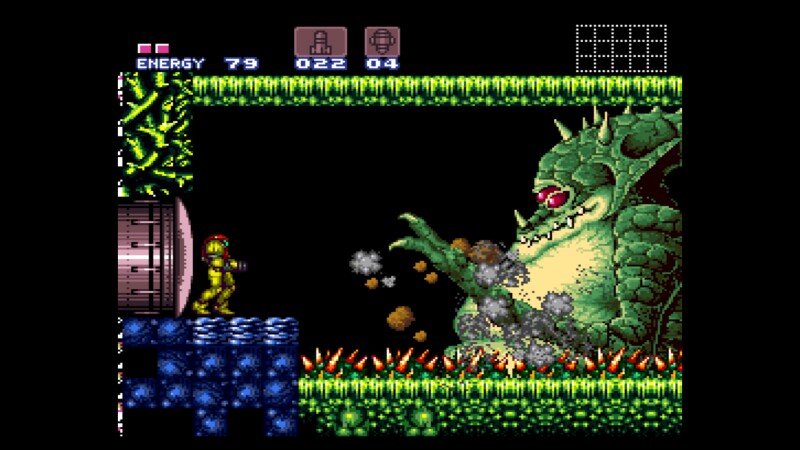
The main goal of Super Metroid is to explore a variety of themed areas like the fiery pits of Norfair or the submerged Miridia in search of new abilities and items to reach new areas. Generally the coolest and most helpful of power-ups are held by the game's powerful bosses, such as Kraid, Crocomire, and Ridley. These same bosses are the four generals of the Space Pirates, and must be beaten before Samus Aran can explore the deepest reaches of planet Zebes.

Why, hello there, Kraid!
Super Metroid is a much better game than its predecessor on the Nintendo Entertainment System/Famicom. The areas have a much more varied look to them that sets them apart from one another, and the inclusion of a map allows the player to not get as lost so easily. The level design is superb, with hidden doodads located in some seriously clever places. The entirety of planet Zebes feels like one cohesive world, oozing with environmental ambiance and personality.

Nothing like a Screw Attack to the face
to give some bounty hunter-style justice!
This is helped by the detailed graphical style of the game. Enemy sprites are full of life, backgrounds have plenty of the aforementioned personality and give off a great amount of ambiance, and everything generally runs at a steady clip. The only times the frame-rate chugs is when there are a lot of enemies on screen at the same time. The music is full of atmospheric tracks, perfect for exploring the labyrinthine caverns and mazes of the game.

A planet so dangerous and deadly,
even the statues want Samus eliminated!
Super Metroid is indeed a classic, and one of the better entries in the legendary Metroid franchise. It's the type of game that's not for folks who are turned off by revisiting old locations time and time again. For everyone else, the creature-blasting, block-bombing, ability-getting gameplay is something that we at SuperPhillip Central can wholeheartedly recommend. Regardless of whether you track down the original SNES cartridge or buy the game on the Wii U's Virtual Console (hurry, as the game is only thirty cents for a little while longer), Super Metroid will provide you with one of Samus Aran's most heralded missions. Welcome back, Ms. Aran. It's a pleasure to see you again.

[SPC Says: 9.5/10]